
Why ChatGPT Ads Isn't Working for Performance Advertisers
ChatGPT Ads launched with high expectations but is failing performance advertisers. This article uses real data—including a 0.91% CTR, broken reporting, and a premium-user paradox—to explain why most teams should treat it as experimental budget only.
- Platform
- OpenAI
- Change category
- policy
- Effective date
- 0-07
- Change type
- policy shift
- Impact level
- High
As of July 2026, the practical answer to “chatgpt not working fix for advertisers” is not a clever campaign setting. For performance advertisers, ChatGPT Ads is not working because the platform does not yet give buyers enough audience control, reporting depth, or premium-user access to optimize toward ROI. The cleanest public warning sign is a 0.91% CTR reported from an Adthena-covered advertiser case, roughly seven times below a 6.4% Google search benchmark in the same vertical, but CTR is only the first problem.[1]
Low click performance can be tested through if the rest of the machine is accountable. Here, the machine is thin: advertisers have faced a reporting failure that blocked campaign data access, native reporting is capped at seven metrics, paid ChatGPT tiers are ad-free by design, targeting relies on context hints instead of demographic or behavioral controls, and CPMs have been reported in a $18 to $65 range depending on placement and competitive topic.[2][3][4][5]

The Dashboard Problem Comes Before the Media Plan
A performance buyer can live with an ugly first test if the data tells her what to change next. Cut the bad audience. Shift budget toward the query theme that converts. Exclude the placement that eats spend. Rewrite the offer. Defend the learning on the Monday call. ChatGPT Ads makes that basic loop difficult.
The reporting issue was not just a mild inconvenience. Coverage of OpenAI’s Ad Manager described a major glitch that kept advertisers from viewing their own campaign data, with Adthena CMO Ashley Fletcher saying ROI calculation became “all but impossible.” OpenAd CEO Manny Puentes said his team saw “no reports” for more than a week.[2]
That matters because a new channel is supposed to earn trust fastest through transparency. If a Google Ads test misses target CPA, the buyer can usually show search terms, auction movement, conversion lag, device splits, geography, or creative rotation. If a Meta test struggles, she can still read delivery, creative fatigue, audience overlap, pixel events, and breakdowns. With ChatGPT Ads, the complaint is more basic: even when advertisers want to diagnose waste, the native surface gives them too little to work with.
Digital Applied’s 2026 measurement playbook describes the native reporting ceiling as seven metrics and says advertisers do not get query-level, demographic, or placement-level reporting by design.[3] That is not a small missing column. It removes the pieces performance teams normally use to separate a weak offer from a weak audience, a bad placement from a bad bid, or poor fit from poor volume.
This is also where generic “test and learn” advice becomes too easy. A test only creates learning if the platform exposes enough signal to change the next test. Otherwise, the buyer is left with blended spend, a few surface metrics, and a client asking whether the new AI channel produced pipeline, purchases, or qualified demand.
Seven Metrics Is Not a Performance Measurement Layer
A seven-metric dashboard can be enough for a sponsorship recap. It is not enough for serious performance optimization. Performance teams are not only asking whether an ad was seen or clicked; they are asking which intent path, audience segment, creative promise, and landing-page experience produced profitable action.
| What a performance buyer needs to know | Why the missing detail matters |
|---|---|
| Which query or prompt context triggered the ad | Without this, intent quality is mostly inferred rather than verified. |
| Who saw the ad by demographic or firmographic pattern | Without this, budget can drift toward users who are curious but unlikely to buy. |
| Where the ad appeared in the response experience | Without this, placement-level waste cannot be isolated. |
| Which segment converted after the click | Without this, optimization falls back to blended averages. |
| Which campaign touched CRM-qualified outcomes | Without this, pipeline teams cannot separate awareness from revenue contribution. |
The distinction matters because the 0.91% CTR figure is not, by itself, proof that the whole channel is unusable. It comes from a single advertiser case covered through Adthena-related reporting, not a disclosed cross-industry aggregate.[1] A buyer should treat it as a warning light, not a universal law.
The harder problem is that a weak CTR becomes much more expensive when the platform cannot show enough of the “why.” If volume is thin, the team needs to know whether inventory is scarce. If clicks are weak, it needs to know whether the prompt context is wrong. If leads are poor, it needs to know whether the ad is reaching students, researchers, junior employees, procurement teams, or actual buyers. A seven-metric ceiling keeps too many of those questions outside the room.
There are agency-side claims that external attribution can uncover more value than the native interface shows. Adventure Media has reported client findings suggesting ChatGPT Ads may be undervalued without stronger attribution and has shared creative and landing-page benchmarks from its own accounts.[6] That is useful as a caveat, not a rescue. One agency’s client data can show what is possible under its setup; it does not replace platform-level reporting that every advertiser can use.
For teams already running incrementality tests, CRM matching, and multi-touch attribution, ChatGPT Ads can be wrapped in an external measurement plan. Smaller advertisers and agencies with lean analytics stacks will have a harder time. They are being asked to buy premium inventory, then rebuild the accountability layer around it.
The Premium-User Paradox
The strangest part of the product is that the users many advertisers would most want are the ones they cannot reach. OpenAI’s ad principles make Plus, Pro, Business, Enterprise, and Edu experiences ad-free by design.[4] That means a user paying $20 per month for Plus, $200 per month for Pro, or using ChatGPT through a workplace or school plan is outside the ad-supported inventory.[4]
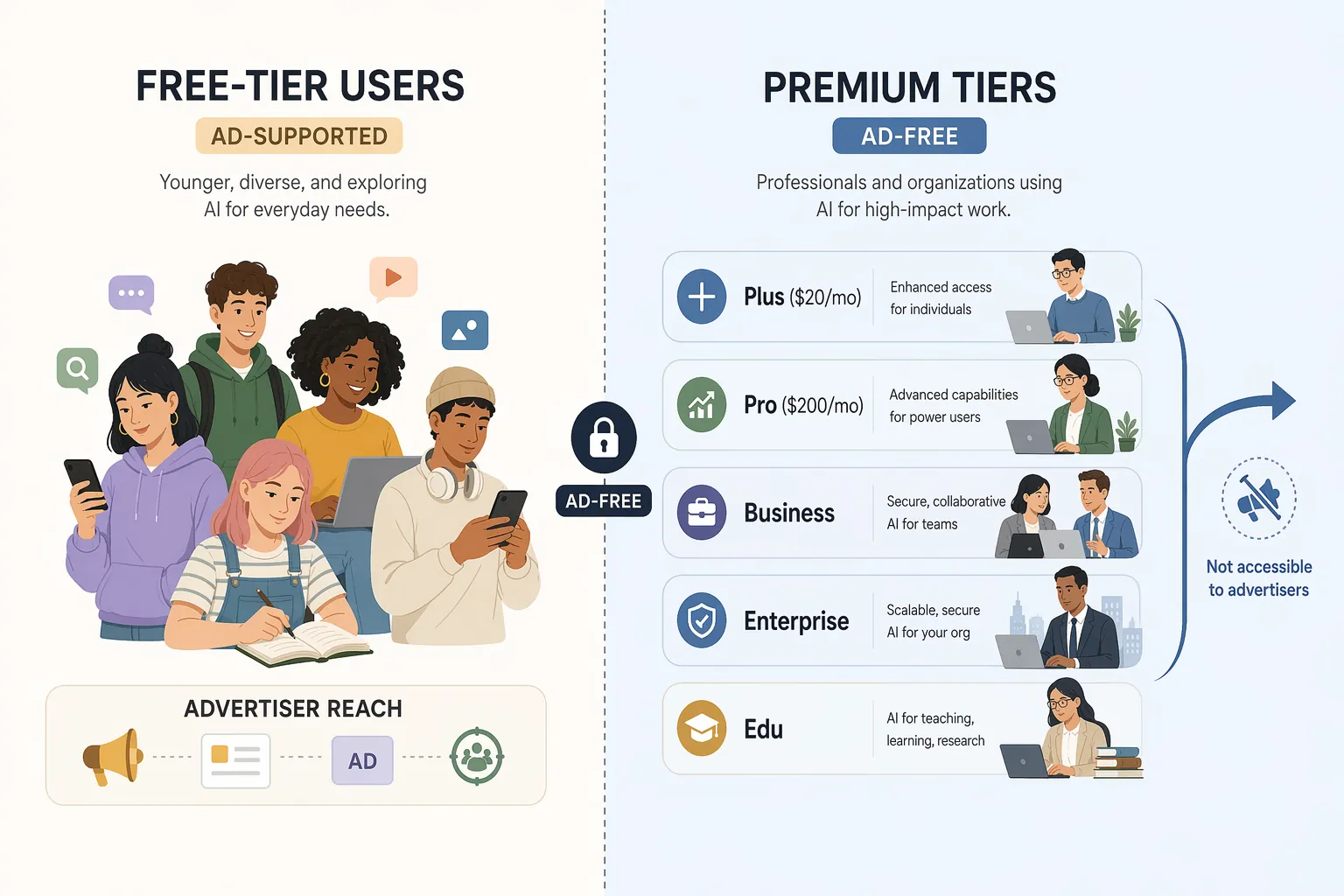
That design may be good for subscriber trust. It is a real media-buying constraint. The professional who has made ChatGPT part of a paid workflow, the enterprise user asking business-critical questions, the buyer with a company account, and the power user willing to pay for higher access are precisely the segments many B2B and high-consideration advertisers would prefer to see. They are also the segments removed from ad reach.
OpenAI’s own user research adds another wrinkle: 58% of adults under 30 use ChatGPT, nearly half of messages come from users under 26, and adoption drops to 10% among adults over 65.[7] Those numbers do not make the audience bad. They do suggest the ad-accessible population can skew toward younger, earlier-career, and more price-sensitive users than the premium narrative around ChatGPT might imply.
That is where some B2B tests can get awkward. A software brand may want finance directors, operations leaders, IT decision-makers, or founders in buying mode. The available impression pool may contain plenty of research behavior, but less of the paid, senior, high-intent usage the brand had in mind. Monks has flagged this demographic mismatch risk for B2B advertisers evaluating the channel.[8]
This is not a moral criticism of ad-free subscriptions. Users who pay for an ad-free product should get one. The issue is that advertisers should price the channel based on the audience they can actually buy, not the halo of the full ChatGPT user base.
Context Hints Are Not the Same as Buyer Targeting
ChatGPT’s natural advantage is intent language. A user does not type a chopped-up keyword; she asks for help, compares options, describes a problem, or plans a purchase. That should be attractive to advertisers. The trouble is that the current buying controls do not match the precision that performance teams are used to elsewhere.
The targeting model described in the research available to advertisers is built around context hints and topic clusters rather than demographic or behavioral targeting.[3] That may protect privacy and reduce creepy ad experiences. It also means the buyer cannot easily say: show this offer to mid-market operations leaders, exclude students, suppress existing customers, raise bids for high-income households, or split budget by seniority.
Adthena’s one-million-query dataset also shows deliberate category restrictions. Legal, Pharma, Banking, and Nonprofit returned zero ads in the analysis, while the strongest ad frequencies appeared in Logistics at 12.4%, Home & Garden at 12%, and Beauty at 10%.[1] Those category results should not be stretched into a complete market map, but they do show that availability is uneven and shaped by policy choices.
For some brands, contextual matching may be enough. A home improvement retailer, beauty brand, or logistics vendor may find useful moments inside planning and recommendation prompts. For others, especially regulated categories and B2B advertisers with narrow buying committees, the absence of deeper audience controls changes the test from “Can we beat our search CPA?” to “Can we learn anything useful without reaching the buyers we normally optimize toward?”
That is also why Google and Meta comparisons only go so far. Google search is imperfect and expensive, but the buyer can see enough intent structure to prune and bid. Meta has signal loss and black-box automation, but still gives advertisers audience, creative, event, and delivery levers. ChatGPT Ads asks buyers to trust a new intent surface while withholding several of the controls they use to make existing platforms accountable.
The CPMs Need Better Proof Than This
High CPMs are not automatically a deal-breaker. Performance buyers pay up when the audience is right, the intent is strong, and downstream revenue proves out. The problem is paying premium rates while the audience is partially hidden, the best subscribers are excluded, and the dashboard cannot explain enough of the result.
Reported ChatGPT Ads CPMs range from $18 for lower-cost placements to $65 for sponsored answer cards in competitive topics such as B2B SaaS and financial services.[5] Comparative reporting cited Meta CPMs around $10 to $20 and Google Search CPCs around $2.25 to $3.96.[5] Those are not perfect apples-to-apples comparisons because CPM and CPC price different actions. They are still enough to show the budget pressure.
An enterprise advertiser case covered in the same Adthena reporting makes the volume issue concrete: the advertiser reportedly used only 3% of a $250,000 allocation because “the volume isn’t there.”[1] That is a single anecdote, not a market-wide utilization rate. It is still the kind of story that makes a growth lead pause before moving money out of proven campaigns.
A channel can be expensive and worth it. A channel can be immature and worth testing. Expensive, immature, underreported, and unable to reach its highest-value paid users is a much harder buy.
Why This Still Matters
The negative verdict does not mean ChatGPT Ads can be ignored forever. Adthena’s index counted 7,378 distinct advertisers by July 2026, and placements reportedly grew 97 times from April to June.[1] The base behind that 97x growth was not disclosed, so it should not be read as mature scale. It does show that advertiser interest is moving fast.
OpenAI also appears to want advertising to become a major business line. Reported projections put ad revenue at $1 billion in 2026 and $25 billion by 2029, alongside heavy business pressure from large infrastructure costs.[9] Those projections are not proof that advertisers will get performance outcomes. They are proof that the platform has a strong reason to keep changing.
That matters for budget timing. Minimum spend reportedly dropped from more than $200,000 to $0 between February and May 2026, which is a reminder that access rules and pricing can change within weeks.[1] Any recommendation here has to be dated. For Q3 2026 planning, the operating facts are unfavorable for core performance budget. For Q4 or 2027, the answer depends on whether OpenAI materially changes reporting, targeting, and paid-tier inventory rules.
A Budget Rule for Q3 2026
The clean budget rule is to treat ChatGPT Ads as experimental awareness spend, not as a core ROI channel. If a team tests it, the money should come from a learning budget, not from campaigns already carrying pipeline, revenue, or acquisition targets. A defensible testing range is 5% to 15% maximum of total ad spend for teams that choose to experiment.
- Do test if the brand can tolerate unclear attribution, wants early presence in answer moments, and has external measurement strong enough to supplement native reporting.
- Do not test with money needed to hit monthly CPA, ROAS, SQL, or pipeline commitments.
- Do not judge success only on ChatGPT’s native dashboard if business outcomes live in a CRM or commerce backend.
- Revisit the channel when OpenAI expands reporting beyond the seven-metric ceiling, adds more useful targeting controls, or changes whether paid-tier users remain fully ad-free.
There is a related privacy trade-off behind some of these constraints; the site’s analysis of ChatGPT’s data privacy design and ad measurement is the better place to go deeper on why OpenAI may be limiting the exact signals advertisers want. For the media plan, the consequence is simpler: privacy-preserving design does not remove the need to prove spend.
So the fix is not a new headline formula or a broader topic cluster. The fix advertisers need is structural: reliable reporting, more diagnostic campaign data, clearer audience controls, and a product decision about whether the most valuable ChatGPT users will ever be reachable. Until then, ChatGPT Ads belongs in the experimental line of the budget, outside the forecast a performance team has to defend.
References
- Adthena coverage via Search Engine Land, WinBuzzer, MM+M, and MarTech Daily
- ChatGPT's First Advertisers Can't Prove Ads Work — WinBuzzer
- Measurement Playbook 2026 — Digital Applied
- OpenAI ad principles and advertising approach documentation — OpenAI
- ChatGPT Ads CPM comparison reporting — Adthena, Optimum7, Aurelius Media
- Adventure Media ChatGPT Ads creative and attribution benchmarks — Adventure Media
- OpenAI user research on ChatGPT demographics — OpenAI
- ChatGPT Ads demographic mismatch analysis — Monks
- OpenAI advertising revenue projections and business-pressure reporting — research brief sources
Primary source: https://openai.com/advertising