
How Visa's AI layoffs change ad payment approval for media buyers
Visa's July 2026 layoff of 2,600 tech workers shifts ad payment approvals from human-engineered systems to AI. Media buyers should expect higher approval rates for standard transactions but degraded escalation options for declines, based on Visa-claimed benchmarks and Gartner data.
- Platform
- Google Ads
- Campaign type
- Performance Max
- Spend range
- Medium
- Timeframe
- July 0
- approval rate
- 0%
- Verdict
- mixed
- Last reviewed
- 0-07-29
The impact of Visa's AI restructuring on ad payment processing starts at a very ordinary moment: a card-funded ad account asks for approval, the campaign budget is ready, and the platform is waiting for the charge to clear. After Visa's July 28, 2026 restructuring announcement, more of that approval path now sits behind AI-driven network systems and fewer technology and product employees are behind the repair layer when something does not clear cleanly.
Visa is cutting 2,600 technology and product roles, equal to 7% of its workforce, as part of an efficiency push tied to AI acceleration, according to CNBC's coverage of the CEO memo and announcement.[1] TechTimes' same-day coverage connected the cuts to AI automation in payments network engineering and named Intelligent Authorization among the systems taking on more of the work.[2] For a media buyer, that is not a labor-market abstraction. It changes the operating assumption behind every late-night card decline: the standard flow may get cleaner, while the odd decline may become harder to get reviewed before spend delivery is damaged.

What changed inside the payment path
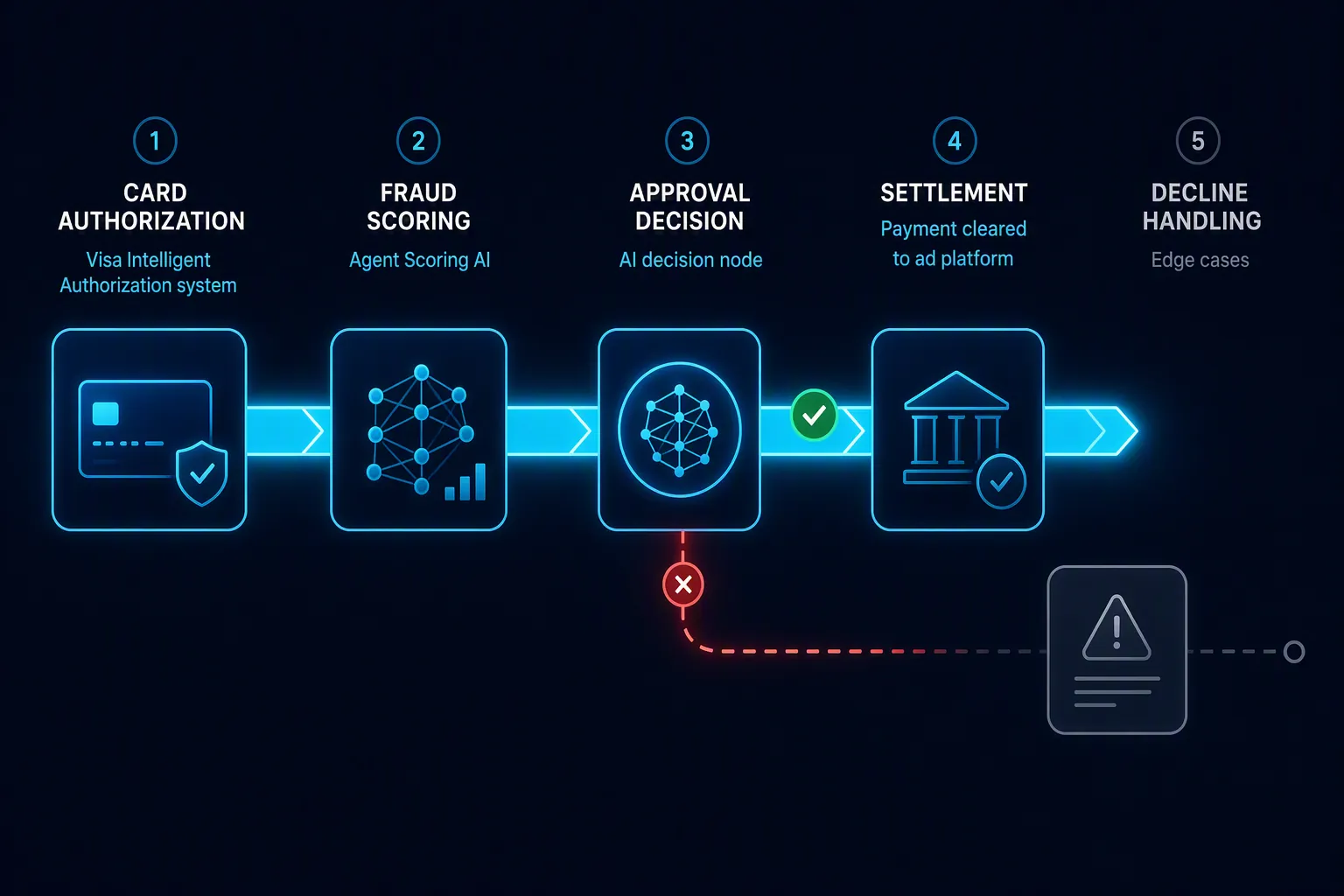
Ad platforms do not need a philosophical answer about AI. They need a yes or no on a charge, usually fast enough that delivery does not pause. A Visa-branded card charge for ads typically has to move through authorization, fraud scoring, approval or decline, settlement, and then whatever decline handling exists if the first decision fails. The available sources do not provide a dedicated study of ad payment processing, so the ad-payment angle here is an operational synthesis from Visa's network-processing changes rather than a Visa-published ad-tech finding.
The named systems matter because they sit close to the points where media buyers actually feel pain. Visa describes Intelligent Authorization as a system used to assess transaction risk and says it has achieved a 96.3% global approval rate; it also describes its Large Transaction Model as trained on billions of transactions for real-time fraud decisions.[3] PYMNTS reported in 2026 that Visa was scaling Intelligent Authorization to Europe and cited Visa's 99.999% uptime claim.[4] Those are Visa-claimed benchmarks, not independent audits, but they are still the right numbers to watch because they describe the infrastructure now carrying more of the decisioning burden.
| Payment stage | What the media buyer experiences | Why the AI restructuring matters |
|---|---|---|
| Card authorization | The ad platform attempts to charge the card before or during delivery. | Intelligent Authorization can approve ordinary, recognizable transactions faster if the risk signal is clean. |
| Fraud and risk scoring | A charge may look routine, risky, unusually large, cross-border, or out of pattern. | Systems such as Agent Scoring and the Large Transaction Model make more of the real-time judgment. |
| Approval or decline | Campaigns keep spending, slow down, or stop depending on the decision returned. | Average approvals may improve while rare false declines remain operationally expensive. |
| Settlement | The ad platform receives confirmation that payment cleared. | A cleaner approval flow helps only if the transaction reaches settlement without later friction. |
| Decline handling | The buyer retries, switches cards, contacts the issuer, or opens a support path. | Reduced human engineering capacity raises the risk that edge cases take longer to diagnose. |
Why ordinary ad charges may improve
A predictable ad billing pattern is exactly the kind of transaction that can benefit from better automated authorization. If a buyer funds the same ad account, from the same business card, with similar billing cadence and no suspicious jump in behavior, a modern risk model has more room to approve without waiting for a conservative rule to block the charge. Visa's own 96.3% approval-rate claim for Intelligent Authorization points in that direction, provided the buyer's transactions resemble the mainstream patterns the system handles well.[3]
That matters for card-funded advertising because many payment failures are not dramatic fraud events. They are ordinary charges caught in stale rules, unusual billing windows, retry loops, issuer sensitivity, or platform-side timing. If AI systems reduce false declines across the broad network, some media buyers may see fewer avoidable interruptions. The important distinction is that this would be an improvement in average authorization performance, not proof that every ad billing failure becomes easier to resolve.
The uptime claim also deserves a practical reading. Visa-claimed 99.999% uptime, as reported by PYMNTS, is a strong infrastructure benchmark if it holds in production.[4] But uptime means the system is available. It does not mean the system made the right call on a specific charge, or that a buyer can get a bad decline reversed before a campaign misses a launch window.
Where the risk moves: edge-case declines
The uncomfortable part is not that AI approves transactions. Visa has been building AI-enabled payment infrastructure for years; a 2025 Forbes interview with Visa's chief data officer described how data and AI were already being used to transform digital payments before this restructuring.[5] The new issue is the timing and scale of the human reduction around those systems.
Edge cases are where media buyers lose sleep. A new market launch creates a spend spike. A platform batches charges differently than usual. A card that normally pays Meta also starts paying TikTok. A cross-border campaign changes the merchant pattern. A large prepay attempt looks unlike the account's historical behavior. None of those examples proves a Visa decline will happen, but they are the kinds of pattern breaks that automated risk systems may treat differently from routine billing.
A cleaner automated model can raise average approvals and still make rare failures harder. The model may be right most of the time, the network may stay up, and the buyer may still have no useful answer when one charge fails with a generic decline reason. The practical damage is not only the decline. It is the time spent guessing whether to retry, lower the charge amount, switch cards, call the issuer, contact the ad platform, or pause the launch.
The missing repair path is the real operating concern
When a campaign goes dark, the buyer rarely knows whether Visa, the issuer, the ad platform, the acquiring side, or an internal billing rule caused the failure. Human engineering teams were never a magical help desk, and nobody should pretend every old escalation path worked. But fewer humans maintaining and interpreting a high-volume automated network can make ambiguous failures stay ambiguous longer.
TechTimes cited a May 2026 Gartner survey finding that 80% of companies deploying AI had reduced headcount without seeing superior financial returns; the coverage described the survey as involving 350 executives at companies with more than $1 billion in revenue.[2] That is a warning light, not a Visa-specific audit. It does not prove Visa's systems will perform worse. It does, however, support caution about assuming that headcount reduction plus AI deployment automatically equals better operational reliability during the first 12 to 18 months.
What to monitor in Q3 2026 payment logs
The useful response is not to abandon Visa cards or assume every decline is now AI-related. The useful response is to make payment logs more specific while the restructuring is fresh and before future Visa benchmarks or post-earnings details clarify whether reliability is improving.
- Track approval rate by card, ad platform, country, and billing pattern rather than only total failed payments.
- Separate first-attempt declines from successful retries, because retry recovery hides authorization friction.
- Record decline reason codes exactly as returned, even when they look generic or unhelpful.
- Flag spend spikes, new platforms, new geographies, and large prepay attempts before treating a decline as random.
- Measure time to resolution, not just whether the payment eventually cleared.
- Keep a backup payment method ready for launch windows where a delayed escalation would cost more than card fragmentation.
The most revealing metric will be the gap between routine billing and abnormal billing. If recurring platform charges keep clearing but unusual funding events become slower to recover, the restructuring is not showing up as a broad payment outage. It is showing up as an edge-case operations problem.
A restrained read on the next 12 to 18 months
Visa's AI systems may approve more clean, ordinary ad charges than older processes did. The company's own approval and uptime claims are strong enough that media buyers should not treat the restructuring as automatically negative.[3][4] For stable accounts with predictable billing, the visible effect may be fewer routine interruptions.
The risk sits in the decline that does not fit the model and does not come with a usable explanation. With 2,600 technology and product roles cut, the question for campaign operations is whether the human layer behind exception handling thins out faster than the AI layer improves.[1] Until Visa provides more post-restructuring detail, media buyers should watch approval rates, decline reasons, retry outcomes, and escalation time as separate signals.
References
- Visa is cutting 7% of employees in efficiency push as AI reshapes work, CNBC, July 28, 2026.
- Visa Cuts 2,600 Tech Jobs as AI Automates Payments Network Engineering, TechTimes, July 28, 2026.
- Modern payment infrastructure for the AI economy, Visa.
- Visa Scales Intelligent Authorization Tech to Europe, PYMNTS, 2026.
- How Visa Is Using Data And AI To Transform The Digital Payments Industry, Forbes, June 2025.
Built on this evidence
No Bidding tactic or Creative record currently cites this case file. Compare it against other results in Benchmarks.
Related benchmark reading
Report a corroborating or contradicting result
Seeing something different in your own account? Feed the data-integrity loop instead of leaving an open comment.