
CoreWeave's AI Cloud Backlog and the Debt Risk Ad Platforms Face
This article examines CoreWeave's $99.4 billion backlog against its $24.9 billion debt to understand whether the AI infrastructure company's financial structure poses a risk to ad platform reliability and media buyer costs. It identifies the key signals media buyers should watch to anticipate possible GPU scarcity, inference cost increases, and CPA degradation.
- Platform
- Google Ads
- Campaign type
- Performance Max
- Spend range
- Enterprise
- Timeframe
- July 0
- CPA
- Degradation expected
- Verdict
- mixed result
- Last reviewed
- 0-07-29
The useful question is not whether CoreWeave’s share price is cheap or expensive today. It is whether CoreWeave can finance the GPU capacity it has already promised fast enough that downstream AI systems, including ad-platform automation, do not feel the constraint as higher inference costs or less stable campaign delivery.
The mismatch is clean enough to put at the top of the tracker: CoreWeave reported $99.4 billion in contracted revenue backlog and $24.9 billion in total debt, while the business also faces annual capital-spending needs above $30 billion to keep building the infrastructure behind those commitments.[1] Backlog sounds comforting when it is read like demand. For a media buyer, it should also read like a delivery schedule that has to be funded, supplied with chips, staffed, powered, cooled, and brought online before it becomes usable compute.

Why a Cloud Balance Sheet Can Become a Media Buying Problem
Performance Max, Advantage+, AI Max, Symphony, and the next layer of automated creative and bidding products all depend on large pools of compute. A media buyer does not need to know which exact cluster handled a single auction decision. The operating risk is broader: if AI infrastructure capacity tightens, the marginal cost of serving AI-heavy prediction, generation, ranking, or optimization systems can rise.
That cost pressure does not need to show up as a line item called “GPU surcharge.” It can arrive as weaker model-refresh cadence, stricter product eligibility, higher platform take rates, less generous automation, or simple performance volatility. The person explaining the CPA swing will rarely be given a data-center postmortem.
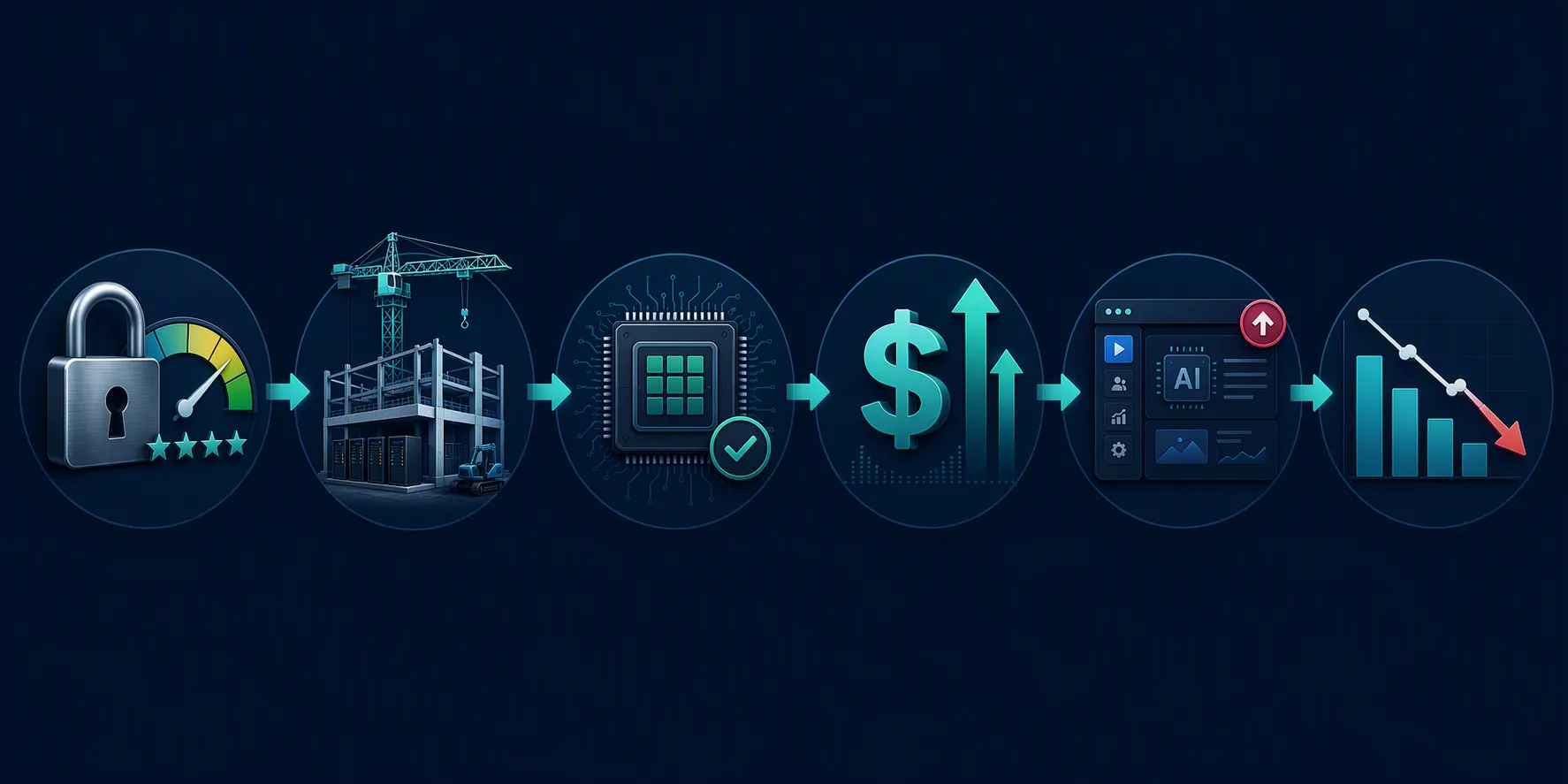
The transmission chain is straightforward enough to monitor without pretending it is deterministic: a financed buildout slows, GPU availability tightens, inference costs rise, ad platforms absorb or pass through more cost, and campaign efficiency becomes harder to forecast. None of that proves a near-term disruption. It does explain why CoreWeave’s credit access belongs in an AI-ad infrastructure watchlist rather than only in an equity analyst note.
Backlog Is Demand, but It Is Not a Cushion
A $99.4 billion backlog says customers have contracted for a lot of future capacity.[1] It does not say that the capacity already exists. In a capital-intensive AI cloud business, backlog can become a funding obligation: CoreWeave has to turn financing into data centers, chips, networking, power, and service delivery before the contracted demand becomes realized revenue.
That distinction matters because the customers named around CoreWeave’s growth are exactly the kind of companies media buyers already depend on indirectly: major AI labs and platform operators building or leasing enormous compute estates. If a large customer receives capacity later than expected, or if a provider has to ration expansion toward the most strategic contracts, the market for available GPU compute can become less forgiving.
This is also why the debt number is not just an investor-risk input. CoreWeave’s $24.9 billion of total debt sits beside a buildout model that needs continuous access to capital.[1] If that access gets more expensive or narrower, the practical question is not “what multiple should the stock trade at?” It is “which promised capacity gets delivered on time, and what does scarcity do to AI-service pricing?”
The Bullish Counterweight Is Real
The bearish version of this story is too easy if it skips the operating growth. CoreWeave reported $2.08 billion in Q1 2026 revenue, up 268% year over year, and a 56% Adjusted EBITDA margin.[1] Those are not the numbers of a company with no demand signal. They are the numbers of a company trying to scale into demand that is arriving faster than traditional cloud planning cycles were built to handle.
The pressure is in the gap between operating momentum and financing burden. In the same Q1 2026 materials, CoreWeave reported a GAAP operating loss of $144 million, interest expense of $536 million, and an accumulated deficit of $3.38 billion.[1] A 56% Adjusted EBITDA margin can coexist with a debt-service profile that makes timing and credit-market access central to the capacity story.
That is the uncomfortable part for ad buyers: the company can be commercially right and still operationally sensitive. Strong demand does not remove the risk that financing costs, chip prices, or construction bottlenecks change how much capacity reaches customers on schedule.
The Memory-Hedging Signal Is Worth Watching Carefully
The most concrete recent tell is not an analyst target. It is Reuters’ July 14, 2026 report that CoreWeave has been exploring put options on memory-chip stocks as a way to hedge exposure to memory-price swings.[2] The report described the discussions as early stage and said no hedges had been executed, so it should not be treated as an active risk-control program already protecting margins.[2]
Even with that caveat, the discussion matters. Memory is not a side cost in AI infrastructure. If management is studying equity-market hedges tied to memory-chip producers, it suggests chip-price cyclicality is large enough to deserve boardroom-level attention, not just procurement-team negotiation.
For media buyers, this is the same cost channel that can later show up inside AI ad products as tighter availability, higher platform economics, or more cautious rollout of compute-heavy features. The hedge discussion does not prove those outcomes. It gives a dated signal to put beside memory pricing, GPU delivery timelines, and platform comments about AI infrastructure cost.
Floating-Rate Debt Makes Capacity More Sensitive to Credit Conditions
CoreWeave’s financing stack includes an $8.5 billion delayed-draw term loan facility known as DDTL 4.0 priced at SOFR plus 2.25%, along with $3.5 billion of convertible notes and a $2 billion Nvidia equity stake at $87.20 per share.[3] SOFR is a short-term benchmark rate; “SOFR plus 2.25%” means the borrowing cost moves with that benchmark, with an added spread. For an infrastructure provider still building aggressively, that structure ties capacity expansion more closely to credit-market conditions.
Morningstar’s view lines up with that concern without turning it into a collapse call. It assigned CoreWeave a “Very High” uncertainty rating, a no-moat view, and a $106 fair value estimate when the stock was referenced around $67, with analyst Luke Yang warning that rising interest rates could break CoreWeave’s business model.[4] That is not an ad-tech conclusion by itself. It is useful because it identifies the same pressure point a media buyer should care about: the cost and availability of the money that turns backlog into working GPU capacity.
If capital becomes more expensive, the first effects may be boring: altered buildout pacing, more selective contract prioritization, tougher procurement terms, or less room to absorb chip-price changes. Boring is exactly how infrastructure risk usually looks before it reaches the dashboard.
Do Not Overread the Stock Price
Late-July stock-price volatility is evidence that the market has not agreed on the risk, not a clean operating forecast. CoreWeave closed at $67.30 on July 28, 2026, while published analyst targets ranged from $32 to $303, with consensus around $138.[5] That spread is too wide to use as a media-buying signal.
The same caution applies to stories about large customers changing their capacity strategies. Reports that Meta may lease its AI capacity were part of the market conversation around a July 2026 selloff, but those accounts were not official confirmations from Meta or CoreWeave. They are worth logging as possible diversification chatter, not treating as settled procurement strategy.
GPU hourly-price comparisons also help only at the margin. Third-party aggregator Spheron has shown indicative pricing such as $2.39 per hour for CoreWeave versus $3.40 for Azure and $6.88 for AWS, but these figures vary by region, reservation term, cluster configuration, and source methodology.[6] Directionally, lower-cost GPU supply can matter for AI-service economics. Operationally, buyers should not build a campaign-risk model on a single posted hourly comparison.
What Media Buyers Should Track Before CPA Moves
The next hard checkpoint is CoreWeave’s Q2 2026 earnings call on August 11, 2026.[1] The stock reaction will be noisy. The more useful readout is whether management changes language around capacity delivery, customer concentration, capex timing, financing access, or component costs.
| Signal | Why It Matters to Ad Buyers | How to Read It |
|---|---|---|
| Capacity-delivery guidance | Delayed data-center or GPU delivery can tighten available AI compute before platforms mention campaign effects. | Watch for changed timing, softer buildout language, or more emphasis on prioritizing specific customers. |
| Interest-cost commentary | Higher financing costs can make aggressive capacity expansion harder to sustain. | Look for comments on borrowing cost, liquidity, refinancing, delayed-draw facilities, and capital-market access. |
| Memory and GPU price trends | Component inflation can raise the marginal cost of inference-heavy AI systems. | Track whether memory hedging remains only exploratory or becomes an executed risk-management program. |
| Customer diversification signs | If major customers spread capacity across providers, CoreWeave’s backlog quality and bargaining position may change. | Separate confirmed customer disclosures from market speculation. |
| Ad-platform product behavior | Platforms may reveal cost pressure through feature gating, pacing changes, automation limits, or pricing changes before naming infrastructure. | Compare unexplained CPA swings with platform AI-product announcements and infrastructure news. |
This is not a reason to abandon AI campaign tools. Most media teams are already too dependent on automated bidding, generation, targeting, and ranking systems to pretend the answer is manual purity. The practical move is to add infrastructure signals to the same incident log that already holds attribution outages, platform-side learning resets, unexplained CPA jumps, and vendor “AI improvement” announcements.
A Simple Operating Rule
Treat CoreWeave stock as a noisy sentiment gauge. Treat capacity guidance, financing terms, chip-price movement, and customer concentration as the operating indicators. If those start pointing in the same direction, the risk is no longer just a shareholder debate; it becomes part of the cost environment around AI-driven media buying.
The early warning will probably not be a platform telling advertisers that neocloud credit risk is pressuring inference economics. It will be smaller and more familiar: a feature rollout that slows, a bidding system that behaves differently, a fee structure that changes, or a CPA line that stops matching the budget plan before anyone has a satisfying explanation.
References
- CoreWeave Q1 2026 earnings release and filing, CoreWeave
- Reuters exclusive on CoreWeave exploring put options on memory-chip stocks, Reuters, July 14, 2026
- CoreWeave financing disclosures and analysis, Motley Fool / CoreWeave filings
- Morningstar analyst report on CoreWeave fair value, uncertainty rating, and moat view, Morningstar
- CoreWeave analyst target range and July 28, 2026 price reference, StockAnalysis / Barchart, late July 2026
- GPU hourly pricing comparison, Spheron
Built on this evidence
No Bidding tactic or Creative record currently cites this case file. Compare it against other results in Benchmarks.
Related benchmark reading
Report a corroborating or contradicting result
Seeing something different in your own account? Feed the data-integrity loop instead of leaving an open comment.