
The $489B AI Debt Funding Trend That's Changing Ad Platforms
Media buyers facing unexplained platform changes can trace the pressure to Big Tech's $489B AI debt binge. This analysis explains how that debt shapes on-by-default ad product changes and what metrics to monitor.
- Platform
- Google Ads
- Campaign type
- Search
- Spend range
- $0
- Timeframe
- July 0
- CTR
- 0%
- Verdict
- mixed
- Last reviewed
- 0-07-25
The weirdest ad account problems in 2026 rarely announce themselves as finance problems. They show up as a traffic mix that moved without a clean creative test, a paid-search curve that suddenly has to replace missing organic clicks, an automation layer that starts distributing budget differently, or a default setting that quietly makes a platform more involved in the auction than it was last month.
That is the practical reason the AI debt funding trend for ad tech companies matters. The number attached to it is no longer small enough to treat as background noise: Goldman Sachs estimated that AI-related bond issuance reached $489 billion in 2026, as reported by Yahoo Finance.[1] North Ridge Partners put the broader spending pressure in the same frame, estimating combined 2026 Big Tech capex at about $725 billion and arguing that the buildout cannot be comfortably funded from cash flow alone.[2]

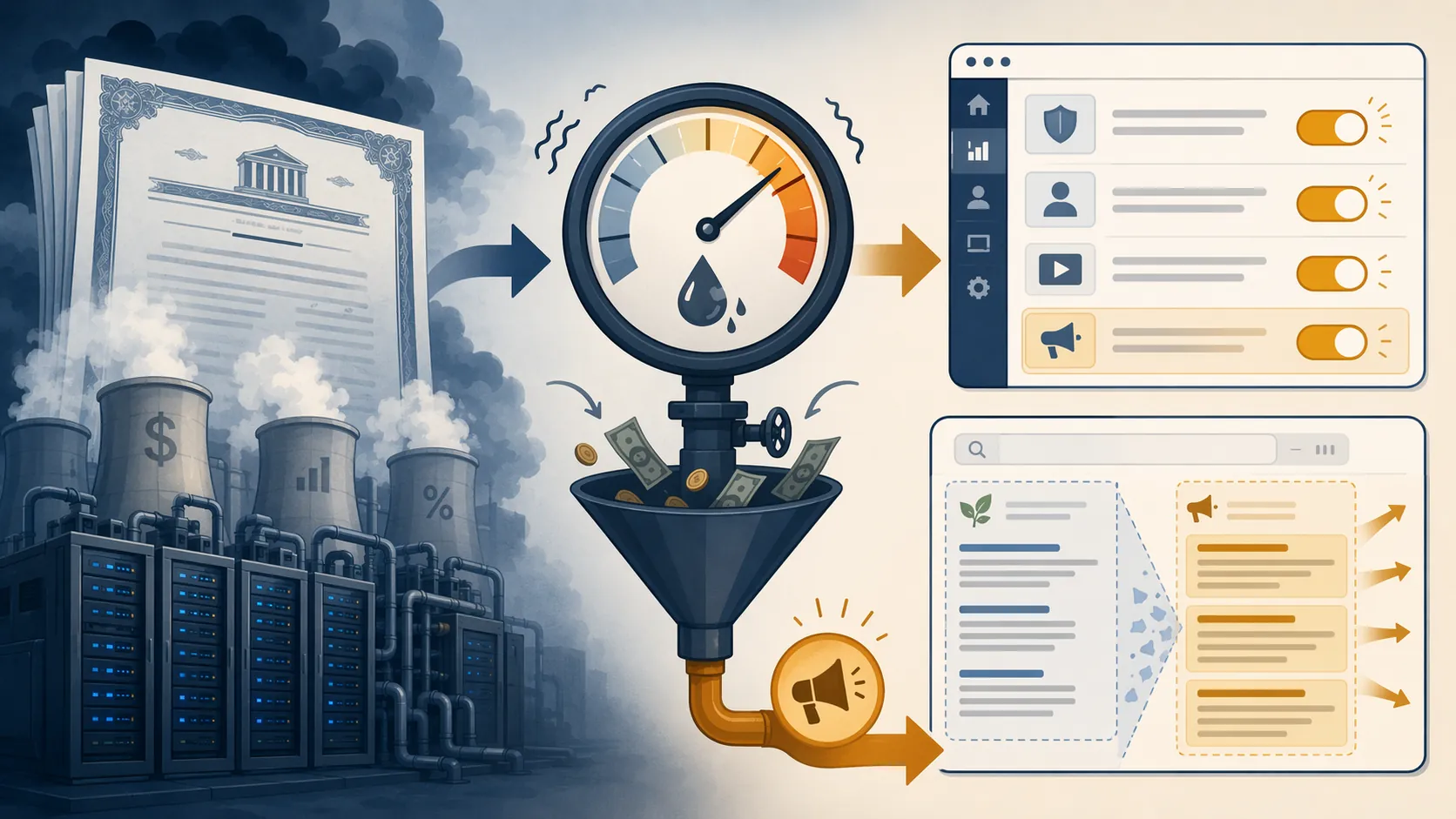
That does not mean a product manager at Google, Meta, or Amazon receives a memo saying a specific ad toggle must ship because a specific bond deal closed. That is not the claim. The cleaner read is an incentive chain: AI infrastructure spending increases capital pressure; debt service makes durable revenue streams more valuable; the ad businesses are among the few places large enough to absorb that pressure; and product defaults tend to move in ways that increase platform control, paid dependency, or spend capture.
The debt story lands inside campaign reports
A buyer does not need a bond-market dashboard to feel the change. The symptoms are account-level: more spend flowing through Performance Max, Advantage+, AI Max, Amazon DSP automation, or creative systems that the platform increasingly wants turned on by default. Some of those systems work. Plenty of buyers use them because they beat manual builds on real CPA, ROAS, incrementality, or scale tests.
The problem is not automation itself. The problem is asymmetry. Platforms can change defaults, reporting surfaces, inventory access, and traffic distribution faster than advertisers can isolate the cause. When a buyer has to explain why branded paid search rose after organic click volume softened, or why creative variation distribution changed without an obvious test design, the official product language usually arrives cleaner than the data in the account.
That is where the financing data becomes useful. It gives a disciplined way to interpret platform behavior without pretending to have leaked strategy documents. If AI infrastructure is consuming hundreds of billions of dollars, then ad products should be read not only as advertiser tools but also as revenue systems sitting under capital pressure.
The pressure map: capex, cash flow, and bonds
The 2026 financing picture has several moving parts, and they should not be flattened into a panic story. The companies involved are not tiny software firms running out of cash. They still own enormous revenue machines. The issue is that the AI buildout has become large enough that even enormous revenue machines have to be managed differently.
| Pressure signal | What it measures | Why media buyers should care |
|---|---|---|
| $489B in AI-related bonds in 2026 | Goldman Sachs estimate of AI-related bond issuance reported by Yahoo Finance | Shows that AI infrastructure is being financed at a scale large enough to affect revenue expectations |
| ~$725B in 2026 Big Tech capex | North Ridge Partners estimate of combined AI-era capital spending | Makes ad revenue more important as a stabilizing cash-flow engine |
| $244B in 2026 bonds from the six largest AI spenders | Goldman Sachs estimate cited in the research brief as 14x 2024 levels | Indicates that borrowing has moved from occasional financing to a major funding channel |
| Alphabet free cash flow possibly below $10B in 2026 | North Ridge Partners analysis, not Alphabet guidance | Raises the importance of protecting and expanding monetization from search and ads |
| Additional borrowing projected at $1.5T | Morgan Stanley projection cited by North Ridge Partners | Suggests the pressure compounds over an 18- to 36-month planning window rather than disappearing after one funding cycle |
North Ridge Partners also described Alphabet as carrying about $85 billion in debt across six currencies and estimated that its free cash flow could fall below $10 billion in 2026; that estimate is third-party analysis, not Alphabet’s own guidance.[2] The distinction matters. A platform filing, a bank estimate, and an analyst model are not the same kind of evidence. But for buyers, all three can still point to the same operating reality: management teams have stronger incentives to make the ad business carry more of the AI bill.
There are also signs that bond-market patience is not unlimited. North Ridge Partners cited Oracle credit default swap widening and an S&P downgrade to BBB- as evidence that lenders are starting to price AI infrastructure risk more carefully.[2] Amazon’s $25 billion July 2026 bond sale was described in the research brief as the weakest hyperscaler launch since Meta’s October 2025 sale, based on Bank of America’s read of the market. Those are not ad product facts. They are discipline signals. They make it harder to assume that platforms can fund the AI buildout indefinitely without asking the ad stack to do more work.
Why the ad business becomes the buffer
AI infrastructure has an awkward cash-flow profile. The spending happens upfront: data centers, chips, power, cooling, networking, and long-term capacity commitments. The revenue arrives later, unevenly, and sometimes through products whose margins are still unclear. Advertising is different. It is already scaled, already priced through auctions, already connected to millions of businesses, and already adjustable through product design.
That makes advertising the obvious buffer. Not because every ad feature is a debt-service feature, but because ad systems are where platforms can most quickly change monetization density. They can alter how much free traffic remains free. They can increase the share of spend routed through automated buying. They can make creative and placement expansion easier to accept than to refuse. They can reduce the number of levers advertisers use to constrain spend, inventory, or targeting.
This is also why the changes often feel small in isolation. A default-on enhancement here, a reporting change there, a search-results layout shift somewhere else. The buyer sees fragments. The financing picture explains why the fragments deserve to be tracked together.
Google: AI Overviews turn a financing question into a traffic question
Google is the cleanest place to see the transmission mechanism because search has always mixed two very different advertiser realities: free organic discovery and paid demand capture. If AI Overviews reduce the number of people clicking out to organic results, the consequence does not stay inside SEO dashboards. It moves into paid search, retail media, affiliate economics, and blended CAC.
Pew Research Center’s 2025 study found that users clicked a traditional search result link in 8% of visits when an AI summary appeared, compared with 15% of visits when no AI summary appeared.[3] That is not proof that every publisher or advertiser loses half its organic traffic. It is a measured user-behavior gap in a specific study context. But it is the kind of gap that buyers should take seriously because it changes the baseline from which paid search is judged.
If organic listings receive fewer clicks, some demand does not disappear; it gets answered on the results page, delayed, or forced through other channels. For many brands, the channel that can be turned up fastest is paid search. That creates a convenient overlap between user-facing AI product strategy and Alphabet’s need to keep search monetization strong while AI capex and debt pressure rise.
This is the point where sloppy analysis usually overreaches. The careful claim is not that Alphabet issued debt and therefore designed AI Overviews to push every advertiser into paid search. The careful claim is that AI Overviews can reduce outbound organic click opportunities, and that such a shift is financially useful to a company whose ad business is being asked to support a much larger AI infrastructure base.
For a media buyer, the monitoring task is specific. Do not only ask whether AI Overviews exist for your keywords. Ask whether the presence of AI summaries coincides with lower organic CTR, higher branded paid-search dependency, rising CPC pressure on queries that used to get efficient organic capture, and a worse blended CAC after paid search backfills traffic that SEO no longer delivers.
Meta: default-on automation is the pattern to watch
Meta’s case is less visible to users than Google’s search-results page, but it is familiar to anyone who has opened Ads Manager and found another Advantage+ recommendation waiting. Meta completed a $30 billion bond offering in October 2025, and the research brief connects that financing period with more aggressive Advantage+ default rollouts. That correlation should be treated as a pattern to watch, not as direct evidence that one financing event caused one product default.
The buyer-facing issue is control drift. Advantage+ Creative Enhancements and related automation can expand or alter how creative is rendered, combined, or distributed. Sometimes that helps. Sometimes the winning account-level number hides weaker creative learnings, brand-review issues, or performance concentration that becomes visible only when the platform changes delivery again.
Under a debt-funded AI buildout, Meta has every reason to prefer systems that make more inventory, more creative permutations, and more automated delivery feel normal. The platform can argue, often sincerely, that these systems improve performance. The buyer still has to verify whether the improvement survives holdouts, incrementality checks, placement analysis, and post-update comparisons.
The useful tracker here is not a general opinion about Advantage+. It is a dated log of when default settings changed, which campaigns accepted them, how much spend shifted into automated structures, what happened to CPA or ROAS in the next learning window, and whether creative-level reporting became more or less explainable after adoption.
Amazon: the DSP story runs through AWS capacity
Amazon’s ad platform sits in a different structure because the company also sells the cloud infrastructure that AI demand consumes. That makes the Amazon DSP and AWS connection more conditional than the Google search example, but still worth watching. When AWS compute utilization matters more, AI-powered buying products have strategic value beyond the immediate media margin: they normalize more algorithmic demand, more data-intensive optimization, and more platform-managed decisioning inside Amazon’s commercial system.
The July 2026 bond-market signal matters here because it suggests even the strongest hyperscalers are not immune to funding scrutiny. A weaker bond launch does not mean Amazon Ads must squeeze buyers next quarter. It means the financing environment makes high-margin, scalable ad revenue more valuable as AWS and AI infrastructure require continued investment.
For buyers using Amazon DSP, the practical watchpoint is whether AI-powered buying becomes the default path for more inventory and whether manual constraints become more costly in reach, reporting, or setup friction. If automated buying earns its keep, use it. If it mainly captures more budget while making marginal return harder to audit, treat that as a platform tax wearing an optimization label.
What to monitor after platform updates
The right response is not to reject AI products on sight. That is how buyers miss real efficiency. The right response is to stop treating major AI defaults and organic-to-paid traffic shifts as isolated product news. They belong in the same tracker as budget changes, auction shifts, landing-page releases, and attribution updates.
- Organic CTR loss: track query groups where AI summaries appear, then compare organic CTR, organic sessions, branded search demand, and paid-search spend needed to recover volume.
- Paid search dependency: watch whether paid search is replacing traffic that previously arrived through organic listings, direct navigation, or unpaid shopping surfaces.
- Default-on feature adoption: log the date each account accepted or rejected Advantage+ Creative Enhancements, AI Max settings, PMax expansion features, or DSP automation prompts.
- Automation spend share: measure the percentage of spend routed through platform-managed campaign types before and after product updates.
- Unexplained CPA or ROAS movement: separate performance changes caused by known budget, promo, feed, or creative events from changes that begin after a platform release.
- Reporting visibility: note whether the update improves diagnosis or makes placement, creative, query, or audience-level performance harder to audit.
The date stamp matters. A platform update that looks harmless in the first week can become expensive after the learning period, after a seasonal demand shift, or after a second related default rolls out. Buyers need a record that can survive the next client call: what changed, when it changed, which campaigns were exposed, and which metrics moved afterward.
The interpretive rule
The $489 billion AI debt figure does not prove a conspiracy inside ad platforms. It does prove that AI infrastructure is being financed at a scale that makes ad monetization more important to Google, Meta, Amazon, and the broader ad tech economy. Over the next 18 to 36 months, major AI ad defaults, reduced free click opportunities, and expanding automated buying should be read as financially incentivized platform changes first, then tested on account performance second.
References
- Tech’s AI debt boom in one chart, Yahoo Finance
- Big Tech’s AI ambitions come with a mounting debt bill — eventually, somebody has to pay, North Ridge Partners
- Google users are less likely to click on links when an AI summary appears in the results, Pew Research Center, July 22, 2025
Built on this evidence
No Bidding tactic or Creative record currently cites this case file. Compare it against other results in Benchmarks.
Related benchmark reading
Report a corroborating or contradicting result
Seeing something different in your own account? Feed the data-integrity loop instead of leaving an open comment.