
What Rumble Q2 earnings signal for RAC advertisers
Rumble's Q2 2026 headline revenue is an AI-infrastructure story, not an ad story: the Rumble Video segment behind Rumble Advertising Center (RAC) grew 21% YoY, with roughly $4.8M tied to a single Tether commitment disclosed on the earnings call. This dated record gives advertisers the segment-level check to run before scaling RAC budget.
- Platform
- Rumble Ads
- Campaign type
- Earnings report
- Spend range
- $0M Tether commitment
- Timeframe
- Q0 2026
- Rumble Video segment revenue growth
- 0% YoY
- Verdict
- mixed
- Last reviewed
- 0-08-26
Rumble reported Q2 2026 results on August 10, 2026, for the quarter ended June 30, and the first read looks like a growth print: total revenue of $40.37 million, up 61% year over year and 58% quarter over quarter. For advertisers weighing Rumble’s Q2 earnings and AI strategy, that headline is too broad. The buyable ad-channel question starts with the Rumble Video segment, which produced $30.3 million of revenue, up 21% year over year and 19% quarter over quarter; Northern Data added $10.1 million after its June 17 close, which means a meaningful part of the consolidated step-up belongs to AI infrastructure consolidation, not to Rumble Advertising Center demand. [1]
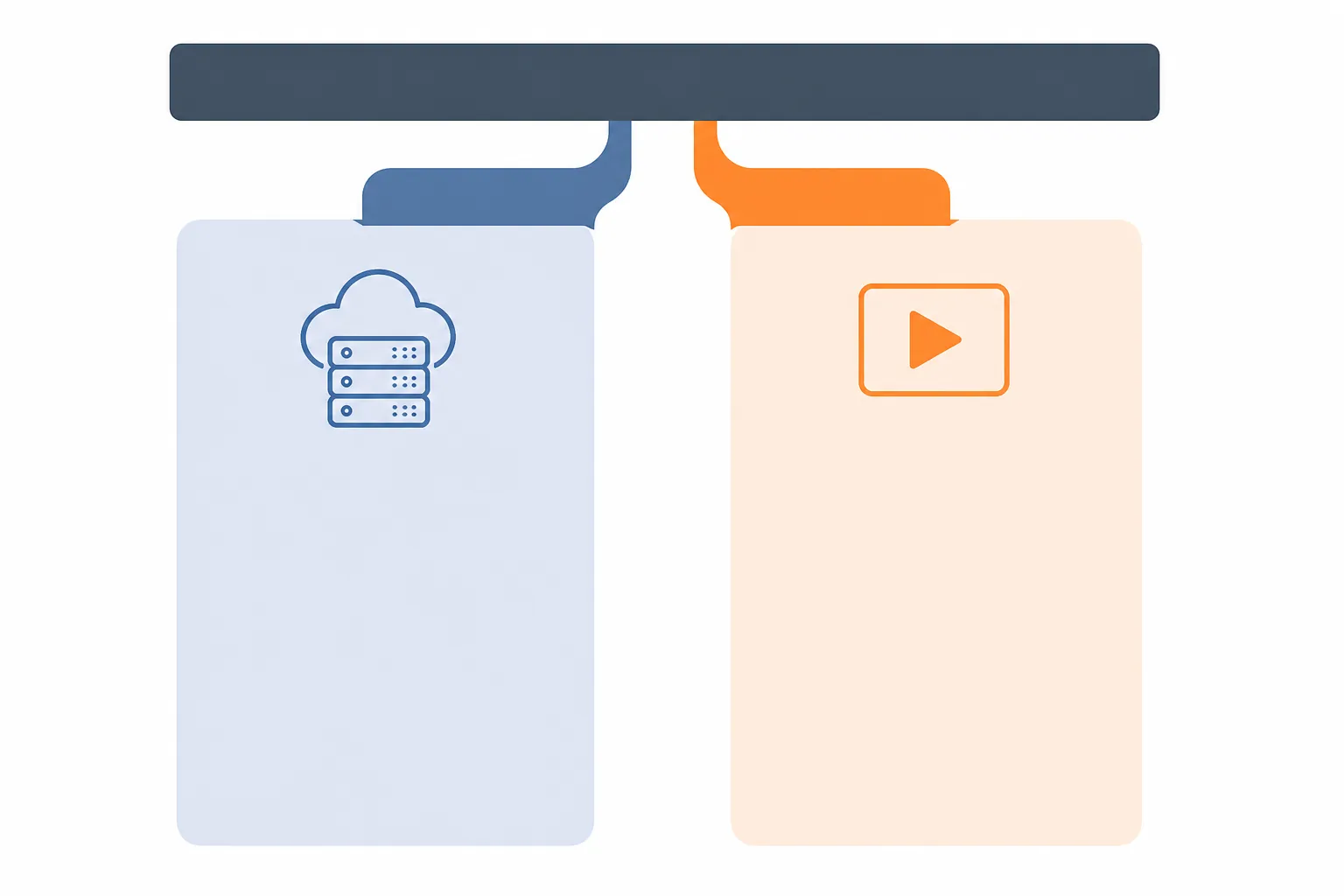
That split is the whole file for a media buyer. RAC spend should eventually show up through the video and audience monetization side of the company. Quake AI may become a large business for Rumble, but a server-capacity story does not prove that more advertisers are clearing auctions, that inventory quality is improving, or that campaigns are scaling beyond isolated commitments.
Read the revenue bridge before the revenue headline
| Q2 2026 line | What Rumble reported or disclosed | How an RAC buyer should read it |
|---|---|---|
| Consolidated revenue | $40.37M, +61% YoY and +58% QoQ. [1] | Useful for company scale, but mixed with AI infrastructure consolidation. |
| Northern Data contribution | $10.1M from the June 17 close. [1] | This is the main correction to make before treating the quarter as an ad-market signal. |
| Rumble Video segment | $30.3M, +21% YoY and +19% QoQ. [1] | This is the public segment closest to the channel advertisers can actually buy through RAC. |
| Tether commitment | CFO-disclosed $4.8M contribution, corrected on the call from an initial approximately $6M statement. [2] | Real revenue, but not the same as diversified, repeatable advertiser demand. |
| Audience Monetization | Increased $5.6M YoY, driven by a $5.9M advertising revenue increase and offset by a $0.5M subscription decline. [1] | The cleanest reported evidence that advertising revenue improved inside the relevant business. |
| Other Initiatives excluding Northern Data | Down $0.4M, with reduced publisher-network advertising inventory and cloud decline cited. [1] | A warning against assuming all RAC-adjacent inventory pools were expanding. |
The Tether math is simple and important: $4.8 million divided by the $30.3 million Rumble Video segment equals about 15.8%, or roughly 16% of the segment for the quarter. That percentage is computed from the segment revenue and the call-disclosed Tether amount; it is not a separately filed segment line. [1][2]
This is why the consolidated $40.37 million print can be directionally true and still unhelpful for a budget decision. If a buyer is deciding whether RAC deserves more than test money, the better question is not whether Rumble revenue beat a screen. It is whether the video business is growing in a way that would still be visible after separating out Quake AI consolidation and a large single commitment.
The Tether commitment helps the quarter, but it does not diversify the channel
The Tether revenue should not be hand-waved away. A paid commitment from a large partner is better evidence than a platform deck, and it belongs in the channel-health record. The problem is what it cannot prove. One large commitment can lift a quarter without proving that smaller advertisers are joining, staying, and increasing spend across enough categories to make RAC a dependable scaling lane.
That distinction matters more because Rumble also reported that Audience Monetization improved by $5.6 million year over year, with advertising revenue up $5.9 million and subscriptions down $0.5 million. The improvement is real, but the Tether amount is large enough relative to the segment that concentration belongs in the first screen, not in the footnotes. [1][2]
The other useful clue is the part of the business that did not improve. Excluding Northern Data, Other Initiatives revenue declined by $0.4 million, and Rumble cited reduced publisher-network advertising inventory and cloud decline. For RAC buyers, that narrows the claim: Q2 supports growth in the core Rumble Video segment, not a broad conclusion that every ad inventory source connected to Rumble was expanding. [1]
Rumble’s AI strategy changes the reporting lens
Rumble’s realignment around two core businesses, Rumble Video and Quake AI, is useful context because it explains why future consolidated revenue can move for reasons that have little to do with RAC. The AI strategy may be economically important to the company, but it makes lineage more important for advertisers: a dollar spent through RAC should be judged against the video and monetization lines, not against an aggregate that includes newly consolidated compute revenue. [3]
Management’s larger AI-compute language, including a $3 billion-plus ARR opportunity and approximately $11 million per megawatt per year economics, belongs in the investor-risk file. It may affect valuation, capital allocation, and balance-sheet expectations. It does not establish that RAC has more repeatable ad demand, better auction liquidity, or cleaner inventory. [2]
There is a practical reason to be strict here. Media buyers already have too many vendor narratives that convert platform scale into implied performance. The cleaner method is to map spend to the public line that should move if the channel is healthy. That same discipline shows up in other earnings-as-channel-health reads, such as the way an Alphabet earnings print can be separated from in-account AI Max testing. Rumble now requires the same separation, only with Quake AI as the extra variable.
The last MAU and ARPU read is useful because it is disappearing
Rumble reported ARPU of $0.48, up 20% quarter over quarter, on 57 million average global MAUs. MAU and ARPU are not perfect advertising measures: MAU says little about reachable logged-in users, ad load, geography, frequency, or auction depth. Still, they gave buyers a dated monetization reference. Q2 is the last quarter where those headline metrics are visible before the reporting dashboard changes. [1][2]
The replacement check is segment reporting. On the earnings call, Rumble’s CFO said the company would begin reporting Rumble Video and Quake AI segments starting in Q3. That makes the next report more important than the Q2 consolidated beat for advertisers evaluating RAC. [2]
Q3 guidance also needs the same filter. Rumble guided to $87 million to $93 million of Q3 2026 revenue, but the guide is driven mainly by Quake AI consolidation rather than a disclosed acceleration in the ad business. MarketBeat’s earnings calendar estimated the next report around November 9, 2026, which makes that filing the next dated checkpoint for RAC rather than a generic catalyst date. [1][2][4]
RAC product claims belong in a verification box
Rumble’s own RAC walkthrough is operationally useful, but it is still vendor material. The June 2025 walkthrough describes 100% human creative review, CPM Flat Rate and Smart Bid options, demographics for logged-in users, and “billions of ad requests.” Those claims can help structure a test plan; they should not outweigh segment evidence from the earnings report. [5]
| RAC claim or feature | Why it can matter | What to verify before scaling |
|---|---|---|
| 100% human creative review. [5] | May reduce some brand-safety and policy-surprise risk compared with fully automated approval queues. | Approval times, rejection patterns, and whether review standards are stable across campaign types. |
| CPM Flat Rate and Smart Bid options. [5] | Gives buyers a way to separate controlled reach tests from optimization-led bidding. | Effective CPM, completed-view cost, click quality, and whether Smart Bid improves outcomes after enough delivery. |
| Logged-in user demographics. [5] | Can support basic audience planning if the reachable logged-in pool is large enough. | Match between reported demographics, delivered impressions, and post-click or post-view behavior. |
| Billions of ad requests. [5] | Suggests inventory availability. | Fill quality, placement mix, frequency, viewability, fraud controls, and whether scale is available in the target geography. |
The phrase “billions of ad requests” is the easiest one to overread. Ad requests are not revenue, completed views, incremental customers, or stable advertiser demand. In a test, the useful translation is delivery quality: where impressions ran, how often the same users were hit, whether spend cleared without odd placement concentration, and whether the traffic behaved after the click or view.
Keep the financial-health noise dated and separate
Rumble’s GAAP EPS was -$0.28, with a $79.1 million net loss that included $28.3 million of acquisition-related transaction costs. Adjusted EBITDA loss improved to -$16.6 million. Those figures matter for company health and funding tolerance, but they do not answer whether RAC has enough repeatable ad demand to absorb larger budgets. [1]
Consensus screens were also noisy: MarketBeat showed an EPS estimate of -$0.10, while Investing.com showed -$0.09. The SEC-reported GAAP result is the better anchor for the dated record. Share-price snapshots are similarly limited: Investing.com cited a $6.21 close on August 10, while MarketBeat showed $10.13 at the August 26 crawl date. Those moves may matter to investors, but they do not change the RAC evidence hierarchy. [4][2][1]
The next check for RAC budget
Q2 gives RAC buyers enough to justify watching or testing the channel, not enough to treat the consolidated revenue beat as proof of scalable advertiser demand. The cleaner record is narrower: Rumble Video grew 21% year over year, Audience Monetization improved, and a large Tether commitment represented roughly 16% of the Rumble Video segment for the quarter. [1][2]
The next budget decision should wait on the Q3 separation. RAC can stay in test-budget territory unless the next report shows Rumble Video growth that is separable from Quake AI consolidation and less dependent on a single large commitment.
References
- RUM Group Inc. Reports Record Second Quarter 2026 Results, SEC, August 10, 2026.
- Earnings call transcript: RUM Group posts Q2 2026 revenue beat but wider loss, Investing.com.
- Rumble Announces Realignment into Two Core, Yahoo Finance.
- RUM Earnings Date and Information, MarketBeat.
- Rumble Advertising Center Platform Walkthrough & Tips, Rumble Ads, June 2025.
Built on this evidence
No Bidding tactic or Creative record currently cites this case file. Compare it against other results in Benchmarks.
Related benchmark reading
Report a corroborating or contradicting result
Seeing something different in your own account? Feed the data-integrity loop instead of leaving an open comment.