

The Four-Layer AI Governance Framework for Marketing Teams
Most AI governance frameworks designed for IT don't fit marketing's need for speed, brand consistency, and creative iteration. This article presents a four-layer governance framework tailored to marketing operations, with a 90-day phased rollout roadmap and metrics from teams that have cut approval cycles by more than half.
Marketing using AI has moved faster than the operating model around it. Content teams are drafting emails, ad variants, landing pages, sales enablement copy, and personalization rules with AI in the loop. The awkward part is no longer whether the tools can produce something. It is whether anyone knows, before the asset reaches a launch queue, which claims are allowed, which brand rules apply, who reviews what, and when legal needs to be involved.
That gap is showing up in the numbers. Averi reports that 82% of marketing teams use AI without formal governance frameworks, and cites an ACC survey finding that 71% of legal departments flag marketing AI as high-risk.[1] Jasper’s 2026 survey of 1,400 marketers found governance blockers increased 3.4x year over year.[2] IAB’s 2025 survey of 125 ad industry executives found that 70% had encountered an AI-related incident, while only 6% believed current safeguards were sufficient.[3]
The answer is not another policy deck that tells marketers to “use judgment.” Judgment is exactly what breaks down at scale when one campaign has 40 generated variants, three regional adaptations, two product claims, and a paid media deadline. The useful question is narrower: what kind of governance lets marketing move faster because the decision path is already designed?
A workable framework has to be built around what marketing actually ships: customer-facing claims, brand voice, visual identity, audience segments, offers, competitive positioning, and campaign workflows. Governance should sit inside the broader AI marketing strategy, not float above it as a separate compliance exercise.
The Four Layers Marketing Actually Needs
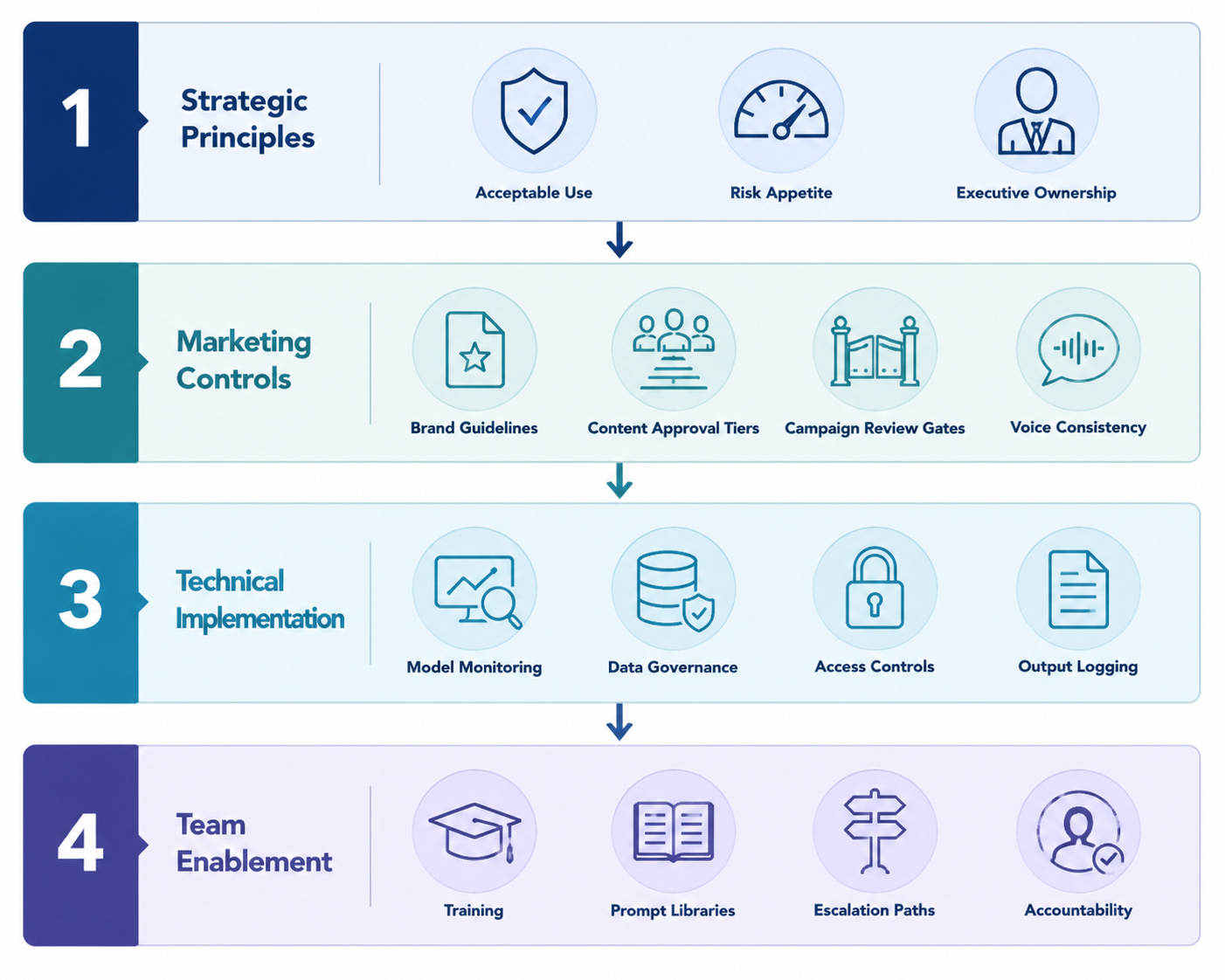
Averi’s enterprise model separates AI marketing governance into four layers: strategic principles, marketing controls, technical implementation, and team enablement.[1] That structure is useful because it does not pretend the CMO, marketing ops lead, brand director, legal reviewer, and content strategist all need the same governance artifact.
| Layer | Primary owner | What it decides |
|---|---|---|
| Strategic principles | Executive leadership | Acceptable use, risk appetite, investment criteria, executive accountability |
| Marketing controls | Marketing leadership, brand, legal, RevOps | Brand rules, approval tiers, campaign gates, claims review, visual and voice standards |
| Technical implementation | Marketing ops, RevOps, IT, data teams | Tool configuration, access controls, data governance, monitoring, output logs, automated checks |
| Team enablement | Marketing managers and functional leads | Training, prompt libraries, escalation paths, ownership, adoption habits |
The middle two layers carry most of the weight. Strategic principles matter because they give leaders a way to say yes and no consistently. Team enablement matters because people need to know how to use the system. But the daily friction usually lives in marketing controls and technical implementation: the routing rule that decides whether a landing page needs legal review, the brand schema that lets a model catch off-voice copy, the logged output that shows what changed between draft and approval.
Layer 1: Strategic Principles
The strategic layer should be short enough that people can remember it and specific enough that it changes decisions. It answers four questions: where AI is acceptable, which risks the company will not tolerate, which investments deserve budget, and which executive owns the tradeoff between speed and exposure.
Acceptable use is not a generic permission slip. A practical policy might allow AI-assisted brainstorming, first drafts, campaign variants, metadata, and internal summaries, while restricting unsupported performance claims, regulated product statements, customer data enrichment, or synthetic testimonials. The exact boundaries depend on the business, but the important part is that the policy names marketing objects rather than broad tool categories.
Risk appetite should also be operational. “Low risk” is not a mood. It might mean internal-only copy, non-claim-based social posts, or repurposed content derived from already-approved messaging. “High risk” might mean pricing, legal terms, health, finance, security, customer outcomes, competitor comparisons, or product capabilities not already documented. Once those boundaries exist, marketing ops can route work instead of convening a meeting every time someone opens a new AI tool.
Investment criteria belong here too. If a tool cannot support approval routing, output logging, permissioning, or brand controls, it may still be useful for a small experiment, but it should not quietly become infrastructure. That distinction matters for leaders trying to separate durable AI capability from a pile of disconnected subscriptions. It is the same leadership discipline behind the five decisions that separate AI marketing leaders from tool collectors.
Layer 2: Marketing Controls
Marketing controls are where generic AI governance usually loses the room. A corporate AI policy can say “protect the brand,” but that does not tell a content lead whether an AI-generated webinar abstract can ship without legal review, whether a paid search ad can use a competitor comparison, or whether a product image variation has changed the offer in a way that creates risk.
Highspot’s go-to-market content governance work is useful here because it treats brand governance as a distinct layer rather than a soft afterthought: voice consistency, messaging alignment, visual identity compliance, and competitive positioning all require their own controls.[4] Hightouch makes a similar marketing-specific point: AI governance for marketers has to account for how audience data, personalization, content, and activation tools interact, not just whether a model is approved by IT.[5]
The most common failure mode is trapping brand rules in documents people do not use while asking AI tools to produce “on-brand” work. A usable control system turns brand assets into inputs tools and reviewers can act on: approved claims, forbidden phrases, tone examples, product naming rules, audience-specific messaging, visual identity constraints, competitor language, disclaimer requirements, and examples of copy that should be rejected.
That does not mean every asset needs a long checklist. It means each asset type needs a route. An internal campaign brief, a top-of-funnel blog outline, a regulated product landing page, and an AI-generated product ad image should not move through the same approval path. The workflow patterns may differ by organization, but the governance question is consistent: what can be pre-approved, what needs human editing, what needs specialist review, and what should not be generated without source material?
For teams already experimenting with AI-assisted production, this is where workflow design matters. The governance layer should fit the actual AI content marketing workflow patterns teams use, rather than inventing a parallel compliance flow that no one follows under deadline pressure.
Approval Tiers Beat Asset-by-Asset Negotiation
Typeface’s approval-tier model gives this layer teeth. Instead of checking governance after content is created, it encodes governance into routing before deployment. Typeface describes low-risk content with 1–4 hour turnaround, medium-risk content with 24-hour turnaround, and high-risk content requiring custom review; it also reports governed teams reducing approval cycles from 7–10 days to 2–4 days and revision rounds from 5–7 to 2–3.[6]
| Tier | Typical marketing assets | Default route |
|---|---|---|
| Low risk | Internal drafts, approved-message variants, non-claim social copy, metadata, repurposed snippets | Brand or content owner review; fast turnaround |
| Medium risk | Campaign landing pages, nurture emails, paid ad copy, customer-facing claims based on approved proof points | Content, brand, and designated campaign approver review |
| High risk | Regulated claims, pricing or legal terms, product capability claims, competitor comparisons, sensitive audience targeting, synthetic product visuals | Custom review with legal, compliance, product, or executive owner as needed |
The exact turnaround times will not transfer to every company, and Typeface is a vendor source, not a neutral benchmark. Still, the mechanism is right. Teams move faster when the route is known before the draft exists. A content strategist should not have to guess whether an AI-generated case study intro is a brand review, legal review, customer approval issue, or all three.
The tiering system also gives human editors a cleaner role. They are not just polishing AI output; they are checking the asset against the right risk class. A low-risk email subject line may need tone and clarity. A medium-risk landing page may need evidence matching and claim discipline. A high-risk comparison page may need source validation and legal review before copy polish even matters. That sits naturally on top of a human-editing workflow for AI content, but it is not the same thing.
Visual and product advertising need their own controls. AI image tools can change packaging, product dimensions, use context, disclaimers, or implied results in ways that are easy to miss during a quick creative review. A useful governance framework names those risks and routes them before media spend is attached. That is the operational bridge between governance and concrete AI image generator risk mitigation.
Layer 3: Technical Implementation
Technical implementation is not where marketing hands the problem to IT and waits. It is where marketing rules become usable inside the systems where work happens: creative platforms, content operations tools, DAMs, CMSs, campaign management systems, personalization engines, and approval workflows.
Typeface and Smart Insights both point toward governance as infrastructure rather than governance as a shelf document: rules embedded into tools, workflows, templates, checks, and review systems.[6][7] In marketing operations terms, that means a claim library is connected to content creation, brand voice guidance is available during drafting, approval status travels with the asset, and outputs can be audited later.
A practical technical layer usually includes six capabilities:
- Data governance: define which customer, campaign, product, and performance data can be used by AI tools, and which data cannot leave approved environments.
- Access controls: limit who can generate, approve, publish, export, or connect AI-generated assets to activation channels.
- Output logging: preserve prompts, generated outputs, edits, approvers, and publication status so teams can investigate incidents and improve prompts.
- Automated checks: flag missing disclaimers, unsupported claims, off-brand terms, restricted words, competitor language, or visual identity violations before review.
- Model and tool monitoring: watch for drift, recurring quality failures, unusual usage, and outputs that require more manual correction than expected.
- Workflow configuration: map content types, risk tiers, approvers, service-level expectations, and escalation rules into the systems teams already use.
This layer is also where tool evaluation gets less theatrical. A copywriting platform, image generator, or campaign assistant should not be judged only by output quality in a demo. Marketing operations should ask whether it supports permissioning, reusable brand rules, review routing, logs, integrations, and export controls. Those criteria matter when deciding what you are actually paying for with AI copywriting tools.
Data governance deserves extra attention because marketing AI often sits on top of messy activation data. Improvado reports that 76% say governance cannot keep pace, and its guidance emphasizes data governance prerequisites for AI systems.[8] For marketers, the practical version is simple: do not let teams generate personalized campaigns from data sources whose consent status, freshness, field definitions, or ownership are unclear.
A technical layer can still become bureaucracy if it is built as a separate approval maze. The better test is whether the controls reduce manual checking. If the system already knows that a healthcare claim, competitor comparison, or unapproved product name triggers a different route, the reviewer spends less time detecting the category of risk and more time deciding whether the asset is acceptable.
Layer 4: Team Enablement
Team enablement is lighter than the control layers, but it is where adoption either becomes normal or quietly decays. A training session that says “be responsible with AI” will not change much. People need role-specific instructions: what a paid media manager can generate, what a content strategist must verify, what a designer should never alter, when a campaign owner escalates, and how to document exceptions.
Prompt libraries belong here, but only if they are maintained like operational assets. A prompt library should include approved context blocks, source requirements, brand voice examples, claims rules, channel-specific constraints, and examples of unacceptable output. If the content team rebuilds prompts every week because brand rules live in a PDF, the organization does not have enablement; it has folklore.
Escalation paths need the same clarity. A marketer should know whether to go to brand, legal, product marketing, RevOps, data governance, or the campaign owner. The point is not to escalate more. The point is to stop escalating everything because nobody knows the difference between a copy issue, a claims issue, a data issue, and a model behavior issue.
A 90-Day Rollout That Does Not Start With a Committee
Ninety days is enough time to build a usable governance spine, not enough time to perfect every edge case. That is fine. The goal is to create a system that can route common work, surface high-risk exceptions, and measure whether governance is improving speed and quality.
| Timing | Main work | Decision that prevents slowdown |
|---|---|---|
| Days 1–30 | Policy foundation, brand asset schema, approval tier definitions | Decide which assets are low, medium, and high risk before teams generate them |
| Days 31–60 | Tool configuration, automated controls, team training | Put the rules into workflows and systems instead of relying on memory |
| Days 61–90 | Dashboards, incident response, continuous improvement loop | Measure whether governance reduces cycle time, revisions, incidents, and confusion |
Days 1–30: Decide the Routes Before the Work Arrives
The first month should produce three artifacts that people can actually use: a short acceptable-use policy, a brand asset schema, and approval tier definitions. Smart Insights’ AI marketing policy structure is useful as a starting point, especially for clarifying purpose, scope, responsibilities, data use, content standards, and review requirements.[7] The mistake is stopping at the policy.
The brand asset schema is the more practical document. It should translate brand and messaging material into fields a workflow or tool can use: approved product descriptions, proof points, claims requiring citation, prohibited claims, preferred terminology, restricted terminology, disclaimers, audience tone rules, visual identity requirements, and example assets. This is not glamorous work, but it is often the difference between AI that accelerates production and AI that creates more review debt.
Approval tiers should be agreed during this phase, with legal and brand in the room early. If those teams only appear after the first batch of AI-generated assets is ready, the organization has already chosen rework. The tier definitions should include asset examples, default approvers, expected turnaround, documentation requirements, and escalation triggers.
Days 31–60: Configure the Controls Where Work Happens
The second month is where governance either becomes real or becomes a folder. Configure the tools. Map content types to approval routes. Add required fields for risk tier, source material, claim type, audience, region, and publication channel. Connect brand libraries where the systems allow it. Restrict publishing permissions where the risk is too high for self-serve activation.
Automated controls should start with the checks that catch frequent, expensive mistakes: unsupported superlatives, missing disclaimers, restricted claims, off-brand terminology, outdated product names, competitor references, and use of data fields that should not feed personalization. The first version does not need to catch everything. It needs to catch enough that reviewers stop acting as the only safety net.
This is also the moment to rationalize the stack. If five teams are using five AI tools with five different ways of storing prompts, outputs, and approvals, governance will be negotiated tool by tool. Consolidation is not always the answer, but uncontrolled tool sprawl makes every control harder. That is the same operating problem behind an oversized content automation stack.
Days 61–90: Measure the Operating System, Not the Slideware
By the third month, the governance dashboard should answer whether the system is improving how marketing works. It should not only report AI usage. Adoption without cleaner routing can increase volume and still make launch dates worse.
| KPI | What it measures | Why it matters |
|---|---|---|
| Deployment velocity | Time from brief or draft to approved campaign asset | Shows whether governance is helping teams ship |
| Compliance cycle time | Time spent in legal, compliance, or regulated review | Reveals whether risk routing is working |
| Revision rounds | Number of review loops before approval | Shows whether AI output is getting cleaner |
| Brand consistency score | Structured assessment of voice, messaging, and visual alignment | Connects governance to brand quality |
| Incident rate | Number and severity of AI-related issues | Tracks whether safeguards are reducing exposure |
| Team confidence | Whether marketers understand when they can act and when to escalate | Shows whether governance is usable |
Averi reports that companies with comprehensive governance see 47% faster deployment, 62% fewer compliance cycles, and 31% better brand consistency, while also citing Deloitte on a 78% failure rate for generic frameworks applied to marketing functions.[1] Those numbers should be treated as directional, not automatic. Governance does not create speed by existing. It creates speed when the route, risk tier, owner, and control are visible before the asset hits review.
Team confidence is the softer metric that deserves a place on the dashboard. Jasper found that high-maturity organizations reported 61% ROI confidence compared with 41% in the general population.[2] That does not prove governance alone causes confidence, but it does support what operators see on the ground: teams are more willing to use AI when they know where the boundaries are.
Where Generic Governance Slows Marketing Down
Generic AI governance usually starts from infrastructure risk: model approval, data security, vendor review, regulatory exposure, and enterprise architecture. Those issues matter. They are just not sufficient for marketing, where the output is public, iterative, brand-sensitive, and often tied to claims, offers, audience targeting, and revenue deadlines.
A generic policy might say that AI-generated content requires human review. A marketing-specific framework says which human, for which asset, against which rule, within which timeline, with which evidence, and where the decision is recorded. That extra specificity is not bureaucracy. It is what prevents every campaign from becoming a fresh interpretation of the AI policy.
This is also why broad regulatory context should not dominate the operating model. The EU AI Act and similar regimes may shape enterprise policy, especially for organizations operating across regulated markets. But a campaign team still needs Tuesday-morning controls: whether a claim can run, whether a generated image misrepresents a product, whether a personalization rule uses approved data, and whether the asset has reached the right reviewer.
Poorly designed governance absolutely can slow creativity. If every AI-assisted draft goes to the same committee, teams will either stop using AI or route around the process. The better design is selective friction: low-risk work moves quickly, medium-risk work gets structured review, and high-risk work gets expert attention before it becomes a launch blocker.
The Business Case Is Fewer Surprise Reviews
The executive case for marketing AI governance should not be “more control.” That may be true, but it is not the reason a CMO gets budget, legal cooperation, or team adoption. The stronger case is fewer surprise reviews, faster campaign deployment, fewer revision loops, more consistent brand output, and clearer accountability when something goes wrong.
For marketing operations, the test is practical falsifiability. Can the team see where the decision gets made? Can they identify the owner? Can they tell which risk tier applies? Can they prove cycle time, revision rounds, incident rate, or brand consistency is improving? If not, the framework is still mostly language.
Marketing-specific governance works when it is designed around the actual objects marketing ships and the speed at which those objects change. Generic governance asks marketing to wait for permission. A better system predefines the conditions for moving.
References
- The AI Marketing Governance Framework Enterprise Teams Actually Use — Averi
- New Research: The State of AI in Marketing 2026 — Jasper
- AI Adoption Is Surging in Advertising. But Is the Industry Prepared for Responsible AI? — IAB, 2025
- The AI Content Governance Framework for Go-To-Market — Highspot
- The 2026 Guide to AI Governance For Marketers — Hightouch
- Content Quality Control and Brand Governance with AI — Typeface
- Example — How to structure an AI for marketing governance policy — Smart Insights
- AI and Data Governance in 2026: The Complete Guide — Improvado

Comments
Join the discussion with an anonymous comment.