
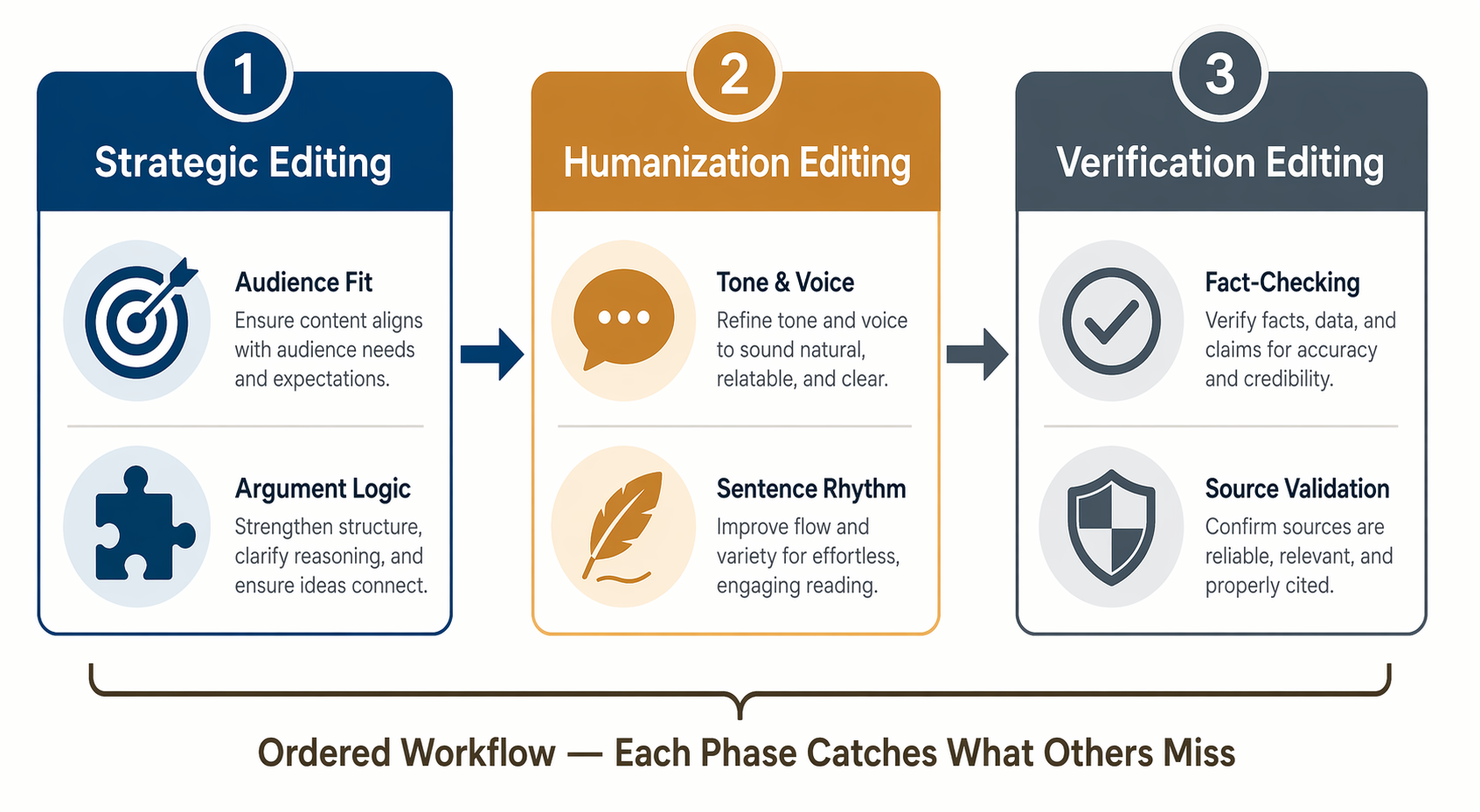
How to Human-Edit AI Content: A Three-Phase Workflow
This article provides a repeatable three-phase editing workflow — strategic, humanization, and verification — that helps content marketers turn AI-generated drafts into authentic, brand-aligned content that performs.
Most teams are already doing some version of human editing on AI drafts. The problem is that “some version” is doing a lot of damage. In 2026, 85% of marketers said they edit AI content before publishing, but only 38% said they have a structured editing process, up from 19% in 2025.[1] That gap explains why so many AI-assisted articles arrive on an editor’s desk looking clean enough to pass a quick skim while still being strategically flat, factually loose, or indistinguishable from ten other posts in the same search result.
If you are trying to learn how to human edit AI content, the answer is not “make it sound less robotic” and call it a day. That is a language pass. Useful human editing is a sequence: fix the strategy before the sentences, make the draft feel written by someone with judgment, then verify every claim that could create risk.
That order matters. A weak angle does not become useful because you added contractions. A hallucinated source does not become safer because the paragraph has better rhythm. A generic article does not become brand-aligned because someone inserted your product name twice.
If your team is still working out the upstream process that produces the draft in the first place, start with Beyond the First Draft: A Full Workflow Guide for AI Content Creation. If you do not yet have any repeatable AI production process, How to Build Your First AI Marketing Workflow is the better prerequisite. This article assumes the draft already exists and the question is what a human editor should do next.
The three editing jobs are not interchangeable
AI editing usually goes wrong when one person opens a draft and starts fixing whatever irritates them first. A headline here, a phrase there, maybe a source check if something looks suspicious. That feels efficient, but it mixes three different jobs that need different kinds of attention.
| Phase | Main question | What it catches |
|---|---|---|
| 1. Strategic editing | Is this the right article for the audience, intent, and business goal? | Wrong angle, thin argument, mismatched format, missing audience context, poor section order |
| 2. Humanization editing | Does this read like a competent person took responsibility for it? | Generic language, uniform rhythm, vague claims, synthetic transitions, weak examples, off-brand voice |
| 3. Verification editing | Can we publish this without factual, compliance, or trust problems? | Hallucinated citations, outdated claims, unsupported data, internal contradictions, brand or legal risk |
The workflow is not ceremonial. Each phase catches something the others are bad at catching. Strategic editing sees whether the draft deserves to exist in its current shape. Humanization editing makes the piece readable, specific, and recognizably yours. Verification editing protects the reader and the brand from confident nonsense.
This is also why the AI-content debate is now mostly an operations problem, not a novelty problem. Ahrefs reported that only 2.5% of AI-involved web pages were pure AI, while 71.7% were human-AI blends.[2] The common workflow is not “machine publishes article.” It is “machine drafts, human team decides whether the result is worth trusting.”
Phase 1: Strategic editing before touching the prose
The first pass should be uncomfortable because it asks whether the draft is structurally worth saving. This is where many AI articles fail quietly. They are fluent, organized, and useless.
Content Marketing Institute draws a useful line between big-picture editing and line-level editing: angle, audience fit, format, and message alignment need to be checked before language cleanup.[3] Kevin Indig’s editing workflow similarly starts with structure, clarity, and argument logic before moving into smaller revisions.[4] That is the right order. If the draft has the wrong job, better sentences only help it fail more politely.
Start by reading the draft against the brief, not against your irritation. The first pass should answer six questions:
- Audience: Is the draft written for the actual reader’s knowledge level, responsibility, and urgency?
- Intent: Does it satisfy the search or content intent behind the topic, or does it answer a safer, more generic question?
- Angle: Is there a clear editorial judgment, or is the article a neutral tour of obvious points?
- Argument: Does each section move the reader forward, or does the draft circle the same premise in different words?
- Format: Is the shape right for the task: workflow, comparison, checklist, explainer, case analysis, or decision guide?
- Message alignment: Does the draft support the brand’s actual point of view, or just borrow the vocabulary?
A practical strategic pass often produces more moving and cutting than rewriting. You may delete a polished opening because it delays the useful answer. You may move a buried section to the top because that is where the reader’s real question begins. You may replace a balanced “pros and cons” structure with a workflow because the audience does not need philosophy; they need to know what to do at 3 p.m. before publication.
What strategic editing looks like in practice
Suppose an AI draft about editing AI content opens with a broad explanation of what generative AI is, then lists benefits, then warns that content may need a “human touch.” That structure is technically coherent. It is also late. A working editor would move the process near the top, cut the generic AI background, and use the introduction to name the operational problem: most marketers edit, but most do not have a process.
The same applies to search intent. Someone searching “how to human edit AI content” is not asking whether AI tools exist. They want steps, order, examples, and quality controls. If the draft spends 600 words defending AI-assisted writing before it gives the workflow, the issue is not tone. The issue is editorial sequencing.
This phase is also where you decide what the article is allowed to claim. AI-assisted blog content has been reported to receive 12% more organic traffic than purely human content when properly optimized.[2] That does not mean AI drafts automatically perform better. It means the combination of AI assistance and proper optimization can correlate with stronger organic performance in that dataset. The editor’s job is to preserve that distinction before a sentence turns into a sales claim.
Strategic editing ends when the piece has the right promise, the right route, and the right evidence plan. Only then is it worth spending serious time on the sound of the sentences.
Phase 2: Humanization editing that does more than hide the machine
Humanization editing is the pass most people mean when they ask how to make AI content not feel AI-written. It is also the pass most likely to become theater. Replacing “utilize” with “use,” adding a few contractions, and deleting “delve” may improve a sentence. It will not make a draft feel owned.
Readers notice when no one has taken responsibility for the text. SmythOS reported in 2025 that 52% of consumers reduce engagement with content they identify as AI-generated.[5] That finding is about consumer response, not a universal measurement of content quality. Still, it matches what editors see every day: people disengage when the writing feels assembled rather than judged.
A good humanization pass works at four levels: diction, rhythm, specificity, and point of view.
Replace AI-default language with accountable language
AI drafts often lean on phrases that sound thoughtful without doing much work. GPTZero vocabulary data, cited by Coursera in May 2026, found that “provide a valuable insight” appeared 182 times more often in AI text, “left an indelible mark” 111 times more often, “a nuanced understanding” 77 times more often, and “underscore the importance” 53 times more often.[6] Treat those patterns as symptoms, not as a banned-phrase game.
The fix is not to maintain a giant blacklist. The fix is to ask what the sentence is dodging. “This provides a valuable insight into customer behavior” should become something like: “The survey shows that customers noticed the source of the content and changed their engagement accordingly.” That revision names the evidence and the action. It gives the reader something to evaluate.
| AI-default wording | Editorial problem | Stronger human edit |
|---|---|---|
| This underscores the importance of human oversight. | Vague conclusion with no operational detail. | An editor needs to check the claim before publication, not after the prose has been polished. |
| Brands must develop a nuanced understanding of their audience. | Abstract advice that could fit any article. | The editor should know whether the reader is a content strategist, SEO specialist, or legal reviewer because each one reads for a different failure. |
| AI has left an indelible mark on content marketing. | Grand claim that adds no decision value. | AI has moved the bottleneck from drafting to editing, review, and accountability. |
Break the uniform rhythm
The Content Technologist has pointed to one of the more teachable AI tells: uniform sentence structures.[7] Many drafts march in evenly balanced paragraphs, each one beginning with a general statement, adding a mild contrast, and ending with a tidy abstraction. Nothing is exactly wrong. That is the problem.
Human rhythm is not random. It follows emphasis. When a point is procedural, a short sentence can carry it. When a consequence needs context, the sentence can stretch. When the reader needs to compare options, a table may beat three polished paragraphs.
During this pass, look for paragraphs that all perform the same move. If every section opens by saying a concept is “essential,” “crucial,” or “in today’s landscape,” the draft is using structure as filler. Cut the throat-clearing and move the useful noun or verb closer to the front.
Add specificity where the draft is hiding
One practical humanization workflow recommends replacing generic language, adding specific examples, and injecting personal perspective.[8] Coursera’s guidance similarly emphasizes storytelling elements, active voice, data points, and named entities as ways to replace vague claims.[6] That is useful because specificity is hard to fake at scale.
Here is the difference:
| Before | After |
|---|---|
| AI content can improve efficiency for marketing teams. | AI can shorten the drafting stage, but the editor still has to check whether the argument fits the search intent, whether the examples prove expertise, and whether the cited sources exist. |
| Human editing helps content resonate with readers. | Human editing turns a generic claim like “brands should build trust” into a concrete sentence about who verifies the claim, what source supports it, and what the reader can safely do next. |
| Businesses should maintain a consistent brand voice. | If your brand voice favors direct operational guidance, do not let the draft drift into motivational language just because the model produced a smooth closing paragraph. |
Specificity does not require pretending every article needs a personal anecdote. For content marketing, the stronger move is often professional context: the approval step someone forgets, the metric that gets misread, the buyer who does not care about your internal terminology, the SEO section that answers the wrong intent.
Use brand voice as a constraint, not decoration
Brand voice editing is not sprinkling in favorite phrases. It is deciding what the brand would notice, what it would refuse to overclaim, how it handles uncertainty, and how much hand-holding the reader actually needs. If your team needs a governance system for that, use a framework like Brand Voice Governance for AI Content: A Practical Three-Layer Framework before editors are left enforcing taste from memory.
A usable brand-voice pass asks:
- Would we make this claim this strongly if a customer challenged it?
- Does this example sound like our actual customer’s workday?
- Are we using the reader’s language or our internal campaign language?
- Does the tone match the decision being made: exploratory, evaluative, urgent, or technical?
- Where should we be more direct because ambiguity would waste the reader’s time?
This is the pass where the article starts to feel less like output and more like editorial work. The prose becomes clearer, but more importantly, the piece starts making choices.

Phase 3: Verification editing before publication
Verification editing is where charm stops mattering. If a draft says a study found something, the editor needs to know whether the study exists, whether it says that, and whether the sentence preserves the right scope.
Jasper’s AI content guidance emphasizes fact-checking every claim, verifying sources cited by AI, checking timeliness, and cross-referencing internal consistency.[9] Rellify adds compliance checks, brand alignment review, and validation against internal knowledge.[10] That is the right shape for the final pass: claims, sources, dates, internal logic, and publishability.
Do not save verification for the final five minutes. It belongs after strategic and humanization editing because the wording should be stable enough to check, but before layout, approval, and distribution because factual changes can still alter the argument.
The verification checklist
- Trace every statistic to a source the team can open, read, and cite.
- Check whether the source supports the exact claim, not just the general topic.
- Confirm dates, sample boundaries, market scope, and whether the finding applies to B2B, B2C, agencies, consumers, or another group.
- Separate adoption data from effectiveness data, attitudes from behavior, and correlation from causation.
- Look for internal contradictions created during rewriting, especially when sections were moved or merged.
- Run compliance and brand checks for regulated claims, product promises, customer references, and unsupported competitive statements.
This pass is where an editor protects the article from attractive overreach. For example, unedited AI content has been associated with 23% higher bounce rates in reporting attributed to Ahrefs and Semrush.[2][11] That is useful context, but it should not become “AI content always increases bounce rate by 23%.” The first sentence describes a reported association. The second invents a universal rule.
The same caution applies to more dramatic improvement claims. Digital Applied cited a 2026 finding that proper human refinement can reduce bounce rates by up to 73%.[12] The “up to” matters, and so does the source chain. If your article uses that figure, frame it as a cited performance claim that needs source review, not as a guaranteed outcome any team can reproduce.
A usable editing sequence for real production
In an actual content operation, the workflow should be simple enough to repeat and strict enough to prevent skipped thinking. A practical version looks like this:
- Read the brief, target keyword, audience note, and intended conversion or trust goal before opening the draft.
- Do a strategic pass: fix angle, intent match, structure, section order, argument logic, and missing evidence.
- Do a humanization pass: replace vague language, vary rhythm, add specific examples, use active voice where it improves clarity, and align with brand voice.
- Do a verification pass: validate claims, sources, dates, internal consistency, compliance, and brand risk.
- Only then polish headlines, meta elements, formatting, links, and final readability.
Notice where polish sits. Last. Not because polish is unimportant, but because it is expensive to polish material you may still cut, move, narrow, or fact-check into a different claim.
For teams, the cleanest handoff is to label the pass being requested. “Can you humanize this?” is too vague. Better: “Strategic pass only: confirm the angle and structure before rewrite,” or “Verification pass: check stats, sources, dates, and compliance claims.” That small operational habit prevents the common failure where three people each improve the surface and no one owns the substance.
What publishable AI-assisted content should prove
A publishable AI-assisted article does not need to hide that a tool helped draft it. It needs to show that a competent human made the decisions a tool cannot be trusted to make alone: what the reader needs, what the article claims, what evidence supports it, what the brand is willing to stand behind, and what should be cut.
That is the practical standard. AI drafts can perform when treated as inputs to a disciplined editorial workflow. The value comes from doing the strategic, humanization, and verification passes in order, not from trying to “humanize” a flawed draft after the important decisions have already been skipped.
References
- Siege Media + Wynter AI content editing survey, Siege Media and Wynter, 2026, link
- AI content statistics, Ahrefs, 2025, link
- How Good Editing Takes AI Content From Mediocre to Memorable, Content Marketing Institute, link
- Growth Memo 3-round editing workflow, Growth Memo, link
- AI content consumer engagement research, SmythOS, 2025, link
- How to Humanize AI Content, Coursera, May 2026, link
- AI writing and sentence structure guidance, The Content Technologist, link
- Three-step workflow for humanizing AI content, Yıldırım Sertbaş, LinkedIn, link
- AI content best practices, Jasper, link
- Guide to editing AI-generated content, Rellify, link
- AI content bounce rate reporting, Semrush, link
- Human refinement and AI content performance study, Digital Applied, 2026, link

Comments
Join the discussion with an anonymous comment.