
5 Risks of AI Image Generators for Product Ads and How to Mitigate Them
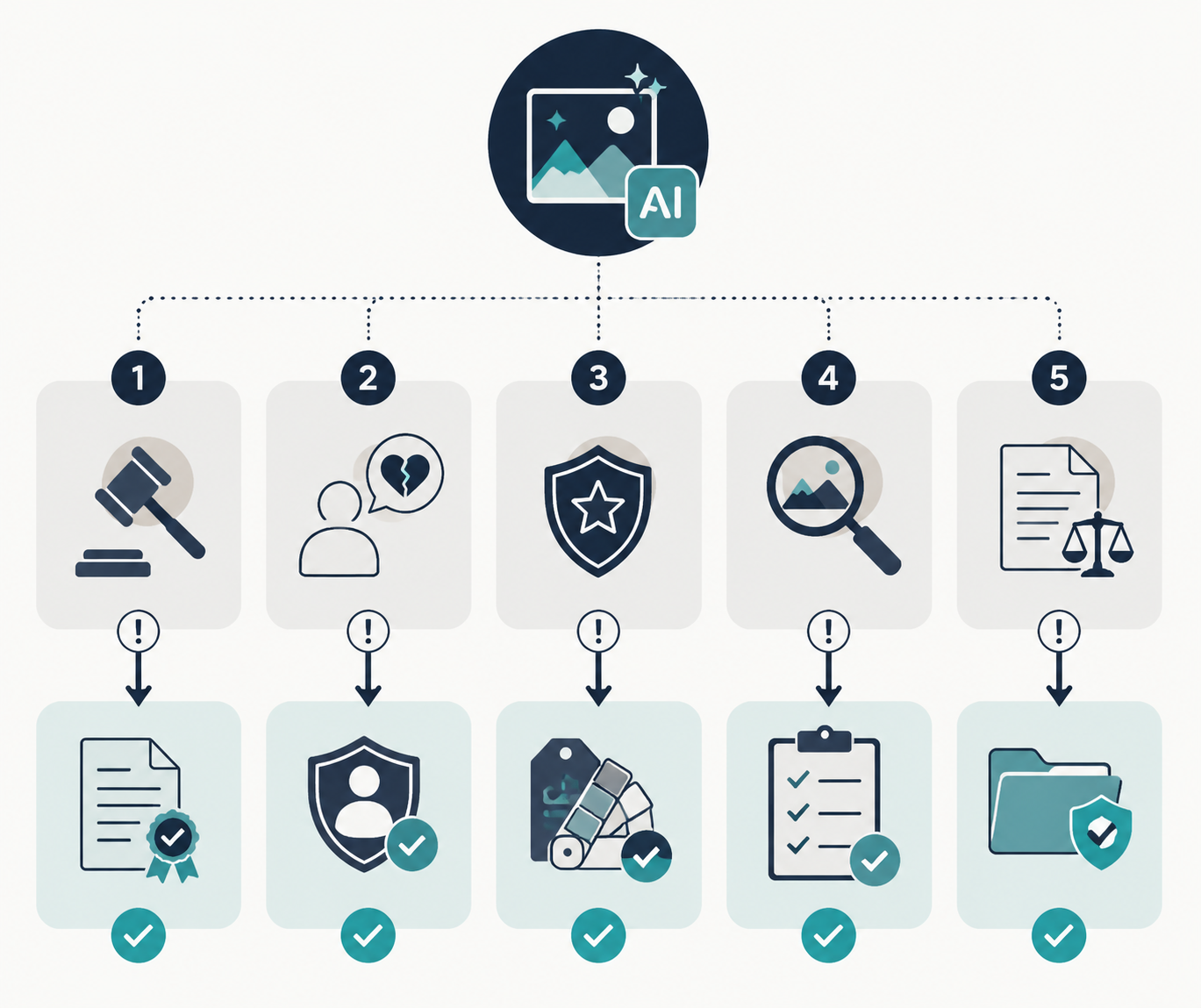
Using AI image generators for product ads carries legal, consumer trust, brand safety, quality, and regulatory risks. This article breaks down the five most significant risks with documented evidence and concrete mitigation steps to help paid media teams adopt the technology responsibly.
The risky moment is not when someone on the team opens an AI image generator. It is five minutes before launch, when a product ad has already cleared media planning, the budget is loaded, and someone notices that the generated image made the fabric look smoother than it is, placed the product beside a competitor-like logo, or left no record of who changed what. The useful question for Q3 2026 is direct: if we use an AI image generator for product ads this quarter, what can go wrong, and what control prevents that failure before it reaches customers?
Start With A Risk-To-Control Map
For paid media teams, the answer should not be a vague AI policy that sits in a folder. It should be a launch checklist that separates different kinds of risk. Copyright exposure, consumer trust, brand safety, visual accuracy, and disclosure compliance fail in different ways, so they need different controls.
| Risk | What failure looks like in a product ad workflow | Control before publishing |
|---|---|---|
| Legal and copyright exposure | The team treats a purely AI-generated product visual as protectable brand creative, or uses a tool without understanding training-data litigation risk. | Document meaningful human authorship, keep source and prompt records, and have legal review production tools before use. |
| Consumer trust damage | The image looks polished but shoppers feel misled because the product, person, or usage context appears synthetic or undisclosed. | Use real product photography for hero accuracy, reserve AI mainly for scenes and backgrounds, and disclose substantial AI generation. |
| Brand safety and consistency failure | A generated variant drifts from the brand system, adds an unsafe association, or creates a logo/style issue that reviewers catch too late. | Create a brand-specific AI style guide and require human approval before launch. |
| Visual hallucinations and quality errors | The ad shows a wrong texture, extra feature, distorted component, impossible shadow, or product detail that merchandising cannot defend. | Use reference images, negative prompts, and product-spec checks against the final asset. |
| Regulatory compliance gaps | The ad is materially AI-generated but has no clear disclosure trail, or the label does not meet applicable federal or state expectations. | Maintain an AI disclosure checklist covering FTC expectations and state-specific labeling rules. |
That map is intentionally operational. It does not ask whether AI belongs in the creative process. For many ecommerce teams, it is already there. The gap is between generation speed and review speed.
Risk 1: The Asset May Not Be Protectable, Even If You Paid To Make It
Legal risk starts with a deceptively simple assumption: the team generates a strong product ad image, pays for the tool, approves the creative, and then assumes the resulting visual is an owned asset in the same way a photographed campaign image would be. In the United States, that assumption is not safe for purely AI-generated images.
In Thaler v. Perlmutter, the Supreme Court denied certiorari in March 2026, leaving in place the position that works generated without human authorship are not copyrightable under US law. The practical consequence for product ads is uncomfortable: if an image is purely AI-generated and lacks sufficient human creative contribution, the brand may have limited ability to stop others from reusing that specific image as copyrightable creative work.[1]
That is a different problem from whether the brand is allowed to use the image in the first place. Copyrightability asks whether the finished asset can be protected. Tool risk asks whether the system used to generate it is entangled in disputes over training data, outputs, or rights. The current litigation environment is not theoretical. Norton Rose Fulbright's 2026 update discusses Disney's suit against Midjourney, while retail legal commentary has also pointed to the Bartz v. Anthropic $1.5 billion settlement as part of the broader uncertainty around AI-generated advertising assets.[1][2]
A paid media team does not need to become a copyright court. It does need to stop treating every generated image as a clean owned asset. The control is documentation: record the tool, date, prompt, reference inputs, edits, human selection decisions, retouching, compositing, and final approval. If designers materially arrange, select, edit, composite, or transform the image, that human contribution should be visible in the file history rather than reconstructed after a dispute.
- Do not rely on purely AI-generated hero visuals for assets the brand expects to defend as exclusive campaign creative.
- Ask legal to approve the image-generation tools used in paid production, not only the final ad copy.
- Store prompts, reference files, generated candidates, human edits, and approval notes with the asset.
- Use real product photography or human-directed compositing when the asset is strategically important enough to protect.
Risk 2: Shoppers May Read Synthetic Product Imagery As A Trust Problem
Consumer trust is where AI product imagery gets expensive without immediately looking broken. The ad can pass a quick internal review and still make a shopper hesitate because the product looks too smooth, the model looks synthetic, or the scene feels like a promise the product page cannot support.
The current retail trust baseline is low. In YouGov's December 2025 US consumer sentiment data, only 26% of Americans said they trust AI in retail settings, while 33% explicitly said they distrust it.[3] That does not prove every AI-assisted product ad will underperform. It does mean that retail marketers are not launching into a neutral trust environment.
Older Getty Images VisualGPS research, fielded from 2022 to 2024 with 7,500 respondents, found that nearly 90% of consumers wanted transparency around AI images and 98% said authentic visuals were pivotal to establishing trust.[4] The date range matters; consumer familiarity with AI imagery has continued to change. But the finding still points to a durable operational issue: when visuals are part of the product promise, authenticity is not decoration.
The strongest mitigation is not to ban AI backgrounds. It is to separate what the image is allowed to invent from what it must prove. A generated kitchen counter behind a water bottle is a different trust question from a generated bottle with a reshaped cap, invented texture, or altered label. The first can speed creative variation. The second can misrepresent the item being sold.
A July 2025 Virginia Commonwealth University study found that using AI for scenes, but not people, may help retain consumer trust in ads. The study tested service ads, such as doctors' offices and providers, so it should not be stretched into a universal rule for physical product advertising. Still, its direction is useful for ecommerce: consumers may tolerate synthetic context more readily than synthetic people or core offering representations.[5]
Disclosure also deserves more nuance than many teams give it. Basis, citing Yahoo and Publicis data, reported that AI disclosure can increase ad appeal by 47% when done correctly.[6] That is not a license to place a tiny label anywhere and call the job finished. It is a reminder that transparency does not automatically kill performance. In some contexts, it can make the ad feel more honest.
| Image element | Safer default | Reason |
|---|---|---|
| Hero product shape, texture, color, label, packaging, and functional details | Use real photography or tightly controlled human-edited composites | These details define what the customer believes they are buying. |
| Backgrounds, surfaces, seasonal scenes, and non-product environments | Use AI with review | These can expand testing variety without changing product truth. |
| People using or wearing the product | Use extra review or real imagery | Synthetic people can create trust, consent, representation, and realism concerns. |
| Lifestyle claims implied by the setting | Match the claim to what the product and landing page can support | A generated scene can overpromise even when the product itself is accurate. |
For product ads, the rule should be blunt: AI can help vary the stage, but it should not quietly rewrite the product. If the generated image changes what a shopper would reasonably expect to receive, it is not a creative variation. It is a product accuracy issue.
Risk 3: Brand Safety Breaks In Small, Fast Ways
Brand safety failures in AI-generated product ads are often less cinematic than the public conversation suggests. The common version is not an outrageous image that everyone instantly rejects. It is a layout that almost follows the brand system, a background that feels off-category, a logo-like mark in the corner, a model pose the brand would not normally approve, or a visual association that makes sense to the generator but not to the category.
The IAB's 2025 report found that more than 70% of marketers had experienced an AI-related incident and that 40% had to pause or pull ads. That statistic covers AI in advertising broadly, not specifically product image generation, so it should be read as a signal of operational readiness rather than proof of a product-image failure rate.[7]
The mitigation is not a general instruction to be careful. It is a brand-specific AI style guide that tells the tool and the reviewer what cannot drift. The normal brand book may not be enough because AI generation introduces failure modes that a designer would rarely create from scratch.
- Approved product angles, crops, lighting ranges, and background types
- Banned visual contexts, props, symbols, competitor-like marks, and category-sensitive associations
- Rules for logo visibility, spacing, color handling, and packaging integrity
- Examples of acceptable AI-assisted backgrounds beside rejected examples
- A named human approver for final paid media assets, not only a generator operator
This is where review ownership matters. If everyone assumes someone else checked the image, the ad will move at the speed of automation and fail at the speed of accountability. The person approving spend should know who approved the final visual.

Risk 4: Visual Hallucinations Turn Into Product Misrepresentation
Quality errors are easy to dismiss when they look like classic AI weirdness: a distorted hand, a warped reflection, a melted object edge. Product ads need a stricter standard. The more dangerous failures are plausible. A generated backpack gets an extra zipper. A skincare jar has a glossier finish than the real packaging. A shoe sole appears thicker. A countertop appliance gains a button that does not exist.
Those are not just aesthetic defects. They create a gap between the ad and the item delivered. Even if the change is accidental, the customer experiences it as a claim. Merchandising, support, and compliance inherit the problem after media has already captured the click.
Reference images reduce this risk, but they do not eliminate review. Negative prompts can help block known failure patterns: no extra buttons, no altered logo, no changed texture, no additional accessories, no modified packaging, no invented claims on labels. The final asset still needs to be checked against product specifications, not just against whether it looks good in the ad preview.
| Check | Reviewer should compare the AI-assisted asset against |
|---|---|
| Color and finish | Approved product photography, product detail page, and packaging specs |
| Shape and dimensions | Hero photo, SKU documentation, and merchandising notes |
| Labels and claims | Approved packaging, legal copy, and claim substantiation files |
| Accessories and included items | What is actually in the box or bundle |
| Use context | Landing page claims, safety constraints, and category rules |
A useful internal threshold is whether customer support could defend the image without explanation. If the answer requires saying, "that part was just AI," the asset should not run as a product ad.
Risk 5: Disclosure Rules Are Becoming A Launch Requirement, Not A Nice-To-Have
Regulatory risk is often collapsed into a single warning to disclose AI. That is too blunt to be useful. A paid media team has to answer narrower questions: Was the content substantially generated by AI? Is the disclosure clear and hard to miss? Does the ad make any product claim that depends on the synthetic image? Are there state-specific rules for the market where the ad is served? Can the team prove what it did if asked later?
Commercial compliance guidance on 2026 rules reports FTC penalties of $53,088 per violation, the creation of a dedicated FTC AI enforcement unit in January 2026, and New York's AI Disclosure Law taking effect in June 2026 with clear labeling requirements for ad content that is substantially generated by AI and penalties up to $5,000 for a first offense.[8] Because this source is compliance-market oriented rather than a neutral regulator page, teams should treat it as a trigger for counsel review, not as a substitute for legal advice.
The practical control is a disclosure decision tree that sits inside the creative workflow. It should be completed before trafficking, not after a platform reviewer, regulator, or customer asks the question.
- Classify the asset: no AI, AI-assisted editing, AI-generated background, or substantially AI-generated image.
- Identify whether the AI-generated portion affects the product, a person, a claim, or only the surrounding scene.
- Apply the required disclosure language for the channel and jurisdiction.
- Check that the disclosure is visible in the ad experience, not buried only in an internal note.
- Archive the asset classification, disclosure decision, approver, and launch date.
This is also where paid media and legal need a shared vocabulary. "AI-assisted" can mean anything from removing dust on a photographed product to generating the entire product scene from a prompt. The review burden should rise as the AI contribution gets closer to the product, the person, or the claim.
A Defensible Q3 2026 Workflow
A workable policy for AI image generators in product ads does not need to slow every test to a crawl. It needs to reserve the slowest review for the assets with the highest consequence. Background variation for a low-claim product retargeting ad should not go through the same review path as a hero image that changes packaging, shows a person using the product, or runs in a regulated category.
The lean version looks like this: keep real product photography as the source of truth; use AI to create controlled scenes, crops, and backgrounds; document human contribution and tool use; disclose substantially AI-generated content; check the final image against product specs; and require a named human approval before the asset goes live.
That still leaves plenty of room for speed. The team can generate more seasonal backgrounds, test more lifestyle contexts, and reduce dependence on full reshoots for every concept. What it cannot do is let generation speed outrun product truth, disclosure review, legal documentation, or brand QA. The checklist should exist before the first pulled ad, not after it.
References
- AI in litigation series: An update on AI copyright cases in 2026, Norton Rose Fulbright
- The Hidden Legal Risks of AI-Generated Advertising for Retailers, MyTotalRetail
- American trust in AI for retail: Consumer sentiment in 2025, YouGov
- Nearly 90% of Consumers Want Transparency on AI Images, Getty Images
- In creating an ad, using AI for scenes – but not people – may retain consumer trust, VCU, July 2025
- How Advertisers Can Harness AI While Navigating its Risks, Basis
- AI Adoption Is Surging in Advertising, But Is the Industry Prepared for Responsible AI?, IAB
- FTC AI-Generated Content Disclosure: 2026 Rules Explained, HumanAdsAI
Comments
Join the discussion with an anonymous comment.