

5 AI Content Marketing Workflow Patterns from Brands That Actually Get Results
Five workflow patterns separate brands achieving measurable AI content marketing results from those creating more drafts for humans to fix. These patterns are drawn from real brand case studies including Adore Me, Cushman & Wakefield, and BILL.
The frustrating part of artificial intelligence content marketing in 2026 is not that teams cannot make drafts faster. They can. The problem is that too many workflows move the hard work downstream, where editors, SEO leads, subject-matter reviewers, and legal teams inherit claims the system should never have produced.
That is why the most useful AI content benchmark is not a speed stat. Digital Applied reported a 73% bounce-rate reduction for AI-assisted content with human editing, while pure unedited AI content showed no improvement.[1] The difference is not “AI versus human.” It is whether the workflow has enough structure, constraint, and authority before a draft becomes someone else’s cleanup job.
The market has already moved past tentative adoption. theStacc reported 96% AI use among content marketers, with SEO at 93%, demand generation at 89%, and brand at 79%.[2] So the useful question is no longer whether content teams use AI. It is why one team gets publishable work from it while another gets a larger pile of drafts waiting for repair.
The wrong workflow can still look productive for a quarter. Search Engine Land and Digital Applied reported a pattern of 42% more content per month followed by 90-day traffic decay when AI production lacked editorial rigor.[3] That is the kind of result that makes a dashboard look healthy until the cleanup cost shows up somewhere else.
The Five Patterns in One View
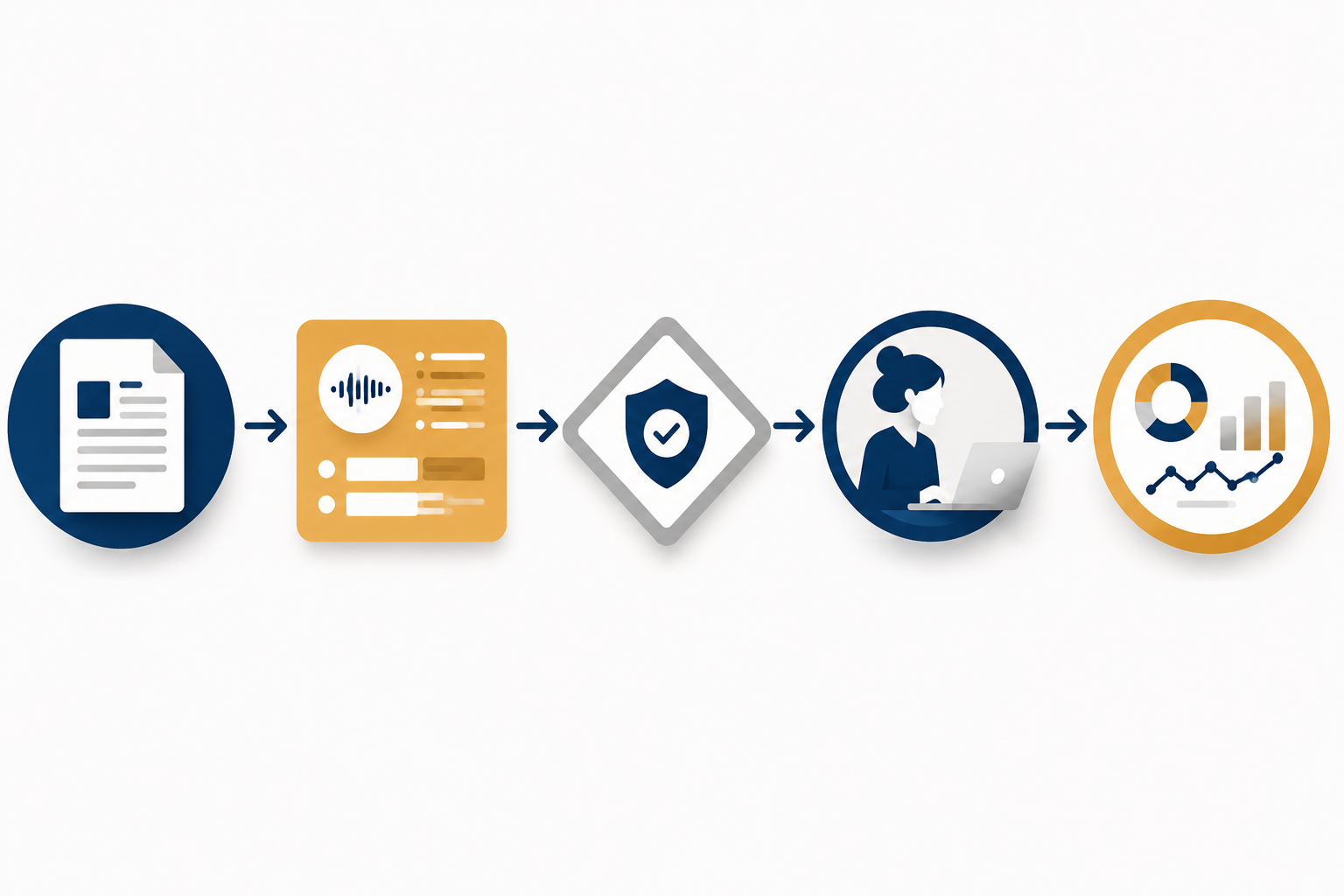
The brands getting better results are not treating AI as a magic drafting layer. They are building an operating system around it. The five patterns below are not a maturity model, and they do not need equal time in every organization. They are the handoff points where quality is either designed in or pushed onto reviewers later.
| Workflow pattern | What it prevents | What changes operationally |
|---|---|---|
| Structured source material | Invented context, unsupported claims, generic positioning | AI receives approved facts, product data, customer language, and source boundaries before generation |
| Codified brand voice guidance | Vague “make it sound like us” edits | Voice becomes rules for tone, vocabulary, claims, examples, and prohibited language |
| Defined review gates | Senior reviewers becoming the first quality filter | Drafts pass agreed checks before they reach executives, legal, or final editorial review |
| Human editorial authority | No one clearly owning judgment calls | People retain responsibility for research, outline decisions, factual claims, and approval |
| Outcome-first metrics | Counting output as success | AI work is measured against speed, cost, conversion, quality, or durable organic performance |
Start With Source Material, Not a Prompt
Most weak AI drafts do not fail because the prompt lacked flair. They fail because the model was asked to fill gaps it should not have been allowed to fill. If product positioning, customer objections, compliance boundaries, and offer details are missing, the draft will still sound complete. That is exactly the danger.
Adore Me’s AI marketing work is a useful case because the input discipline comes before generation. Pragmatic Digital describes the brand using approved product data and customer language as structured inputs, which changes the job of AI from inventing context to recombining vetted material.[4] That may sound less glamorous than a clever prompt library, but it is the part that keeps the first draft from creating new facts for an editor to disprove.
For content teams, “structured source material” does not have to mean a heavyweight knowledge base on day one. It can be a brief that separates approved inputs from background notes. The distinction matters. Approved inputs are facts the draft may use directly. Background notes are context the writer may interpret. Unverified claims are excluded until someone with authority clears them.
A workable AI source packet usually answers five questions before a draft starts:
- What facts, product details, customer quotes, or research points are approved for use?
- Which claims require review before publication?
- Which audience segment is the draft serving, and what does that audience already know?
- Which examples, comparisons, or proof points are off-limits?
- Who owns the source packet when product, legal, or positioning changes?
This is also where many teams quietly create their own traffic decay problem. They scale briefs that are too thin, then wonder why the published work reads interchangeable after a few months. If the source layer is generic, the output will be generic at a larger volume.
Turn Brand Voice Into Rules People Can Enforce
Brand voice is often where AI workflows become politely useless. A reviewer writes “more confident,” “less salesy,” or “make this sound more like us,” and the next draft changes adjectives without improving judgment.
Cushman & Wakefield’s case points to a better pattern. Pragmatic Digital describes the firm codifying tone, vocabulary, claims, and do-not-use language for AI-supported marketing work.[4] The important move is translation. “Professional” becomes vocabulary rules. “Trusted” becomes claim discipline. “Expert” becomes a standard for evidence. “Avoid hype” becomes a list of words, structures, and unsupported promises that do not pass review.
This matters because AI tends to produce confident linguistic averages. If the brand guidance only says “clear, authoritative, and helpful,” the system has been given almost nothing enforceable. Those words may be accurate as an aspiration, but they are not operational guidance.
A useful voice guide for AI-assisted content is less like a manifesto and more like a reviewable rule set:
| Vague voice instruction | Operational version |
|---|---|
| Sound expert | Use specific evidence, name the decision-maker affected, and avoid claims that imply guaranteed results |
| Be approachable | Prefer plain-language explanations over internal acronyms unless the audience already uses them |
| Avoid hype | Do not use phrases such as “game-changing,” “revolutionary,” or “unlock your potential” unless they appear in approved campaign language |
| Be concise | Remove setup paragraphs that repeat the search intent without adding a decision, example, or constraint |
This is not just a brand team preference. It reduces review drag. When voice guidance is specific, an editor can reject a sentence because it violates a rule, not because it “feels off.” That gives writers and AI operators something to fix without waiting for a senior brand reviewer to rewrite the paragraph by hand.
Define the Review Gate Before the Draft Reaches Senior People
The most expensive person in the workflow should not be the first person discovering what “good” means. That is the operational lesson in BILL’s case. Pragmatic Digital describes BILL defining quality before drafts reached senior reviewers.[4] The distinction is small on paper and large in practice.
Without a review gate, AI output travels upward too early. A director flags missing positioning. Legal catches a claim that should have been excluded at the brief stage. SEO rewrites the structure because the article answered the wrong intent. The content may still publish, but the workflow has converted speed into hidden senior labor.
A review gate is not the same thing as a final edit. It is a pass/fail moment that decides whether the draft deserves more expensive attention. For AI-assisted content, that gate should usually sit between generation and senior review, not at the very end.
The gate can be simple, but it has to be explicit:
- Source check: every factual claim traces back to an approved source, or it is marked for removal or verification.
- Intent check: the draft answers the actual search or campaign need before adding background explanation.
- Voice check: the draft follows the codified tone, vocabulary, and prohibited-language rules.
- Risk check: legal, regulatory, medical, financial, or performance claims are isolated before senior review.
- Usefulness check: the piece gives the reader a decision, action, comparison, or consequence they did not already have.
This is where the 73% bounce-rate reduction matters again. Human editing improved outcomes in the Digital Applied data, while unedited AI did not.[1] The lesson is not that every draft needs more subjective polishing. It is that the workflow needs a defined human checkpoint where accuracy, fit, and usefulness are evaluated before publication.
Teams that need a tactical implementation layer can pair this pattern with a pre-publish AI content quality checklist. The important thing is not the checklist format. It is that a draft cannot advance just because it exists.
Keep Human Authority Where Judgment Actually Happens
Human-in-the-loop is an easy phrase to say and a surprisingly easy one to hollow out. If the human only skims the final draft after the angle, evidence, and claims have already been set, the person is not really in the loop. They are at the end of the loop, holding the risk.
The stronger pattern is human ownership at the points where judgment compounds: research selection, outline structure, claim approval, message fit, and final publication. Digital Applied reported 34% more content at equivalent quality when humans owned research, outlining, and first-draft oversight.[1] That is a more useful productivity signal than raw draft volume because it protects the parts of the workflow that determine whether the draft deserves to exist.
Virgin Holidays and Farfetch are useful here because their AI-supported email optimization work, as described by Pragmatic Digital, kept clear human-in-the-loop ownership rather than leaving optimization decisions entirely to automation.[4] The point is not that email is special. It is that ownership was attached to the decision system, not just the final asset.
In a content operation, the ownership map should be visible enough that no one has to ask who is accountable for a bad claim after it publishes. AI can suggest angles, summarize research, create variants, and compress assembly time. A person still needs to decide which source is authoritative, which angle serves the reader, which claim is too strong, and whether the page should ship.
That does not mean every human task deserves equal protection. Some tasks can be automated, some should be edited, and some should be skipped entirely. A separate automate, edit, or skip framework can help teams make those calls. For this workflow, the rule is narrower: do not automate away the person who owns the consequence.
Measure the Result You Actually Needed
Output is the easiest AI metric to inflate. It is also the least helpful once the novelty wears off. If a team produces more articles but organic traffic decays after 90 days, the workflow did not become more effective; it became better at generating short-lived inventory.[3]
Unilever and Cadbury’s AI marketing cases, as collected by Pragmatic Digital, are useful because they connect AI work to business outcomes rather than treating generated assets as the finish line.[4] In a mature workflow, the metric is chosen before the work begins: faster cycle time, lower production cost, stronger conversion, higher content quality, better reuse of approved assets, or more durable search performance.
Quality also has to be measured as more than internal approval. Content Marketing Institute’s 2026 research on quality perception is relevant because it keeps the focus on how content is judged, not just how quickly it is produced.[5] A page that passes an internal AI detector anxiety test but fails the reader’s usefulness test has not solved the real problem.
That is why measurement should include at least one metric from the workflow and one from the market. Workflow metrics can include days from brief to publish, number of review cycles, percentage of drafts rejected at the gate, or senior-review hours per asset. Market metrics can include engaged sessions, conversions, assisted pipeline, rankings that hold beyond the first month, or content-driven retention behavior.
Speed still matters. Loopex Digital reported an 80% reduction in content production timelines, from five days to one day, in its 2026 analysis.[6] That is meaningful if the saved time is not simply transferred to reviewers. The useful version of speed is cycle compression with fewer avoidable defects, not a faster route to the same bottleneck.
There is also a caution in vendor-side abandonment data. Averi reported a 42% abandonment rate in 2026, but because Averi is an AI content tool vendor, the figure should be read with that source context in mind.[7] Still, it fits the broader pattern: teams do not abandon AI because it cannot produce text. They abandon workflows that make the organization absorb too much uncertainty after the text appears.
Where Tool Choice Fits
Tool selection matters, but it is rarely the first broken handoff. A stronger model can still generate weak work from vague inputs. A specialized writing platform can still create review debt if no one has defined voice rules, claim boundaries, or approval gates. A workflow with clear source packets and review authority will usually expose tool limitations faster than a tool trial will expose workflow gaps.
For teams still building the broader rollout model, a companion AI content marketing workflow can help sequence the operating system before these patterns are applied in detail. Teams that need more context on where AI saves time across marketing functions can also use broader AI marketing use cases to decide which workflows deserve priority.
The Pressure Is Rising, but the Standard Should Not Drop
McKinsey’s 2026 work on agentic AI estimates that two-thirds of current marketing activities could be affected and that campaign creation could accelerate by 10 to 15 times.[8] That is a forward-looking estimate, not a current benchmark every team should claim. Its value is as a pressure signal: marketing workflows are going to absorb more AI-generated planning, production, variation, and optimization, not less.
The brands getting results from AI content marketing are not the ones asking AI for more content. They are the ones building a workflow where AI has better inputs, tighter constraints, human authority, and outcome-based accountability from the start.
References
- Digital Applied 2026 content marketing statistics roundup, Digital Applied, 2026
- AI content marketing statistics, theStacc, 2026
- Search Engine Land / Digital Applied 2026 traffic decay pattern, Search Engine Land / Digital Applied, 2026
- AI marketing case studies, Pragmatic Digital, July 2026
- Content Marketing Institute 2026 quality perception data, Content Marketing Institute, 2026
- Loopex Digital 2026 timeline reductions, Loopex Digital, 2026
- Averi 2026 abandonment rate, Averi, 2026
- Agentic AI workflows, McKinsey, April 2026

Comments
Join the discussion with an anonymous comment.