
The Pre-Publish Audit: 22 Checks AI Content Routinely Misses (and How to Fix Each One)
AI-generated content often looks publishable but systematically fails on citation integrity, information gain, E-E-A-T signals, answer-first structure, and voice. This article provides a repeatable 22-point pre-publish audit based on testing and Google's 2026 update signals.
The dangerous AI draft is not the messy one. It is the almost-publishable one: clean introduction, sensible H2s, keywords in the right places, confident explanations, and just enough statistics to look researched. It moves through review quickly because nothing feels obviously broken.
Then someone checks the source link. Or compares the page against the top five ranking results. Or asks who, exactly, has reviewed the advice. That is where an AI content quality checklist for SEO has to do more than catch typos. It has to decide whether the draft can survive contact with search results, clients, readers, and future updates.
The scale of the problem is no longer theoretical. Ahrefs analyzed 900,000 new pages and found that 74.2% contained AI-generated content, while only 2.5% of pure AI output ranked in its sample.[1] Semrush’s April 2026 survey of 224 SEO professionals found the same workplace split many teams already feel: 70% cited speed as AI’s top benefit, but only 19% said AI improves content quality.[2]
That does not mean AI content is automatically bad, or that Google is simply punishing AI. It means the draft is not the quality gate. In Semrush’s April 2026 study of 42,000 blog posts, position-one results were 80.5% likely to be classified as human-written by GPTZero, compared with 10% classified as AI-generated; that finding is useful, but it should be read as detector-classified content, not a perfect measure of authorship.[2]
A small but revealing test from NextGrowth.ai shows where the failure usually lives. In a 12-post test across SaaS, DevOps, and marketing content using GPT-4o and Claude 3.5 Sonnet, AI drafts averaged 41/100 against a structured pre-publish checklist. After all 22 practices were applied, the same content scored 85 or higher. The weakest areas were not grammar or formatting: E-E-A-T signals averaged 3/15, and 11 of 12 drafts had zero verified sources for statistical claims.[3]
That test is small and should not be stretched into a universal benchmark for every industry, model, or content format. Its value is more practical: it names the gaps editors keep finding after the draft looks finished.
The five failures this audit is built to catch
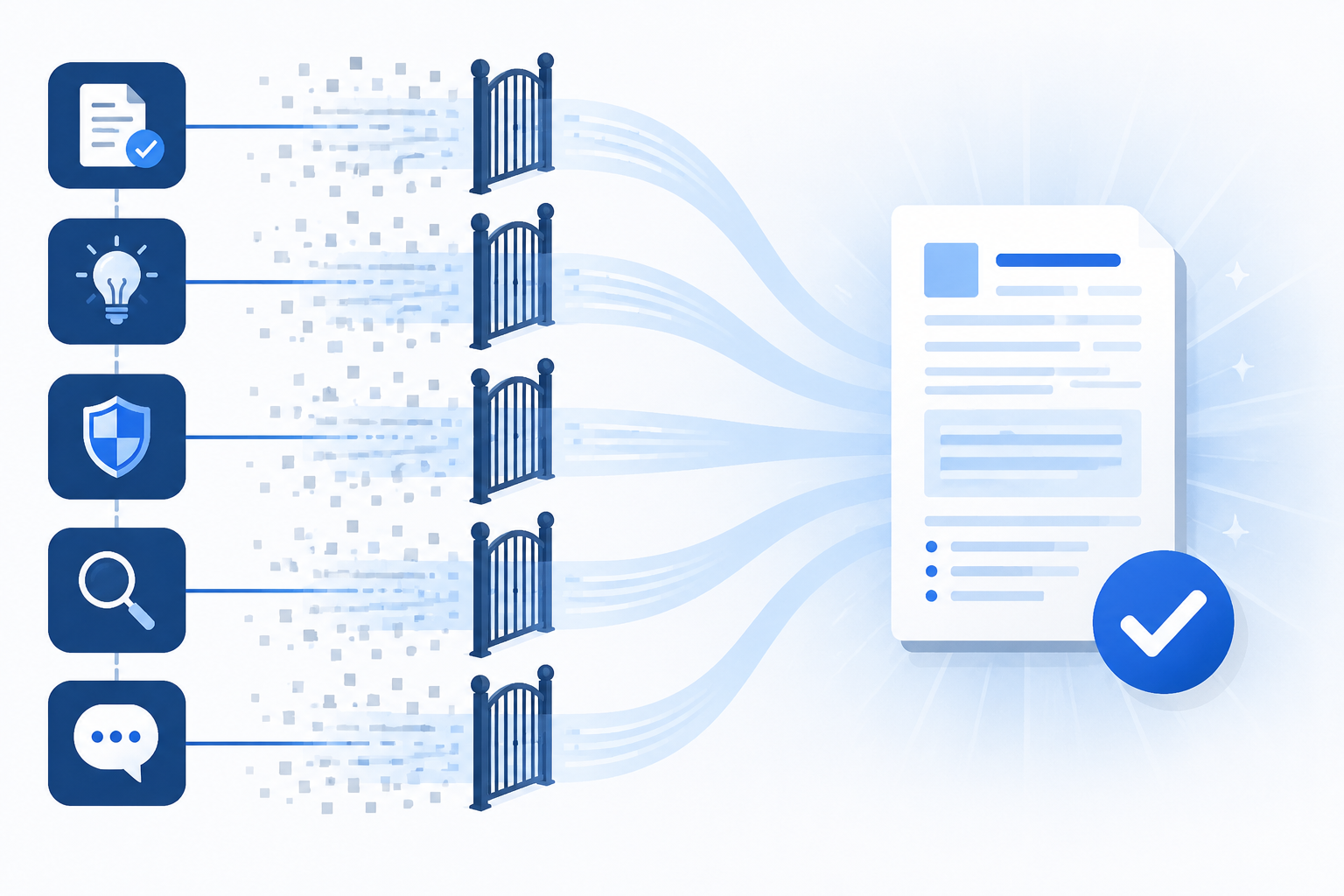
Most AI-assisted SEO drafts do not fail in 22 unrelated ways. They fail in a smaller set of repeatable patterns. The checklist is organized around five of them: citation integrity, information gain, E-E-A-T signals, answer-first structure for AI extractability, and voice.
| Failure category | What usually looks fine | What actually needs checking |
|---|---|---|
| Citation integrity | The draft includes numbers, links, and source names. | Every factual claim traces to a live, relevant, non-hallucinated source. |
| Information gain | The page covers the expected subtopics. | The page adds something readers cannot get by skimming the top competing results. |
| E-E-A-T signals | The advice sounds competent. | A real person or organization can be identified, evaluated, and trusted. |
| Answer-first structure | The headings are keyword-aware. | The page gives clear extractable answers before long explanation. |
| Voice | The prose is fluent. | The piece has rhythm, judgment, and a consistent editorial stance. |
Google’s own helpful-content guidance gives editors two useful pressure tests: whether the content is “mainly summarizing what others have to say without adding much value,” and whether it is “written or reviewed by an expert or enthusiast who demonstrably knows the topic well.”[4] Those are not decorative questions. They are the difference between a draft that merely fills a page and one that deserves to be published.
E-E-A-T should also be handled carefully. It is a quality-rater framework, not a direct scoring checklist editors can mechanically optimize. Still, it is useful because it forces a draft to show who knows the topic, how they know it, and why a reader should trust the page.[4]
The 22-point pre-publish audit
Use this as a pass/fail gate before publication. A draft does not need theatrical “humanizing.” It needs repairable checks. If a check fails, assign the fix to a person who can actually perform it: editor, subject-matter expert, SEO lead, analyst, or content manager.
Citation integrity
| Check | Pass/fail test | Concrete fix |
|---|---|---|
| 1. Every statistic has a live source | Pass only if each number, percentage, date, sample size, and benchmark links to a live source that actually contains the claim. | Open every citation. Replace dead, irrelevant, or circular links with primary research, official documentation, or a credible secondary source. |
| 2. The source supports the exact claim | Pass only if the wording matches what the source proves, without inflating scope or certainty. | Narrow the sentence. Change “proves,” “causes,” or “all companies” to language the evidence can support. |
| 3. No source exists only because the model named it | Pass only if the cited report, author, publication date, and URL can be independently verified. | Remove hallucinated citations. If the fact matters, research it manually; if it cannot be verified, cut it. |
| 4. Data methodology is visible | Pass only if important studies are described with sample size, time frame, method, or detection caveat when available. | Add a short methodology phrase near the claim, such as the sample size or classification method. |
| 5. Source quality matches claim weight | Pass only if major claims rely on credible Tier 1 or Tier 2 sources rather than anonymous roundups or unsupported vendor pages. | Upgrade weak citations to original studies, official documentation, government or academic sources, or named industry research. |
| 6. The article has enough evidence density | Pass only if roughly three or more credible sources support every 1,000 words when the topic includes data, trends, or advice with risk. | Add sources where the reader would reasonably ask, “How do you know?” Do not add filler citations to obvious statements. |
Citation integrity is where polished AI content most often over-earns trust. A model can produce a paragraph that sounds researched while blending real reports, outdated numbers, copied phrasing from competitor pages, and claims no source ever made. The fix is not to ask the model for “better sources” and move on. The fix is to audit each claim as if the person who published it may later need to defend it.
The difference between a usable citation and a decorative citation is exactness. If a source says a survey of 224 SEO professionals found that 70% cited speed as AI’s top benefit, the article should not turn that into “most marketers use AI because it improves results.”[2] One statement reports a surveyed attitude; the other implies broader behavior and performance. That small inflation is how a draft becomes unreliable without ever sounding reckless.
Detection-based claims need the same restraint. Semrush’s position-one finding is worth citing because it suggests the top of the SERP still rewards substantial editorial involvement. It should not be written as proof that Google knows exactly who typed every word. The study used GPTZero classifications, and AI detectors can produce false positives and false negatives.[2]
Information gain
| Check | Pass/fail test | Concrete fix |
|---|---|---|
| 7. The page adds something beyond the top results | Pass only if the draft contains insight, data, process detail, examples, or judgment not already obvious from the top five competing pages. | Run a SERP comparison and mark overlap. Add a proprietary observation, expert review, original example, or sharper decision framework. |
| 8. At least one original element is present | Pass only if the article includes at least one original data point, benchmark, teardown, first-hand observation, workflow, or field-tested recommendation. | Interview an internal expert, analyze internal data, document a real process, or add a clearly labeled editorial teardown. |
| 9. Competitor summaries are not the article’s backbone | Pass only if the structure is not merely a cleaned-up composite of ranking pages. | Rebuild the outline around the reader’s decision or workflow instead of the most common SERP headings. |
| 10. Generic advice has been replaced with operational detail | Pass only if recommendations tell the reader what to inspect, change, assign, or remove. | Convert vague advice into action: name the owner, artifact, decision point, and failure consequence. |
| 11. The article distinguishes adoption, attitudes, and outcomes | Pass only if survey findings, behavior data, and performance claims are not treated as interchangeable. | Rewrite each data sentence to state what was actually measured. |
Information gain is a plain editorial question wearing a technical name: why should this page exist if the reader can get the same answer elsewhere? Google has not published a detailed public specification of how information gain is measured or weighted, so it is better to avoid pretending the signal can be reduced to a formula. But the practical editorial test is still clear enough.
Evertune’s analysis of Google’s March 2026 core update described a re-weighting toward originality, author expertise, and topical coherence, while noting that AI-assisted content was not categorically penalized. Its conclusion is more useful than the usual update panic: AI-drafted content that is substantially edited by a named expert can still perform under those re-weighted signals.[5]
For an editor, “substantially edited” has to mean more than smoothing sentences. It means the article now contains decisions the model could not responsibly make alone: which sources are strong enough, which claims are overextended, which competitor talking points are stale, which examples reflect real work, and which advice would actually change a reader’s next step.
A simple SERP pass helps. Open the top competing pages and list what they all say. If your draft repeats the same points in the same order with slightly fresher phrasing, it has not earned its place. Add something that changes the reader’s understanding: a workflow from your own team, a mistake pattern from client reviews, a benchmark from your own data, a before-and-after teardown, or a more precise distinction the existing results blur.
E-E-A-T signals
| Check | Pass/fail test | Concrete fix |
|---|---|---|
| 12. A named author or reviewer is visible | Pass only if the page identifies who wrote, reviewed, or approved the content. | Add a byline, reviewer line, or editorial review note with a real person and role. |
| 13. Credentials match the topic | Pass only if the author or reviewer has experience relevant to the advice being given. | Add a short credential note, author bio link, or reviewer explanation that connects expertise to the topic. |
| 14. Experience markers are specific | Pass only if the article includes concrete signs of first-hand knowledge rather than generic claims of expertise. | Add details from actual workflows: tools used, review steps, decision criteria, failure cases, or constraints. |
| 15. Trust signals are easy to find | Pass only if readers can locate About, contact, editorial policy, or company credibility information from the page or site. | Link to relevant trust pages and make review ownership visible. |
| 16. Claims with real-world consequence get expert review | Pass only if legal, medical, financial, technical, or high-stakes operational advice is reviewed by someone qualified. | Route the draft to a subject-matter expert and record the review before publishing. |
The weakest E-E-A-T signal in AI-assisted content is often absence. Nobody is wrong on the page, exactly. Nobody is there at all. The article has advice, but no accountable reviewer. It has confident conclusions, but no visible path from experience to recommendation. It has a brand logo, but no human judgment.
This is why a named review step matters. A byline alone can be cosmetic if the person has not touched the piece. A useful review step leaves evidence: a corrected claim, a sharper example, a caveat added where the draft overgeneralized, or a note that a recommendation applies only under certain conditions.
Specific experience markers are usually easy to spot because they contain friction. A generic AI paragraph says teams should “monitor performance regularly.” A reviewed paragraph says the SEO lead checks rankings after publication, the editor checks source decay quarterly, and the content owner rewrites sections when a cited benchmark becomes outdated. The second version gives the reader an operating model, not just a principle.
Answer-first structure for AI extractability
| Check | Pass/fail test | Concrete fix |
|---|---|---|
| 17. Each major section answers first | Pass only if every H2 section gives a direct answer or clear takeaway before expanding. | Move the answer into the first paragraph, then add explanation, evidence, or examples. |
| 18. The first 300 words contain a useful quick answer | Pass only if the reader can understand the article’s practical answer early. | Add a short answer, brief framing paragraph, or compact table near the beginning. |
| 19. Tables use HTML, not images | Pass only if comparison data, checklists, and matrices are readable as text. | Convert visual-only tables into HTML tables with clear headers. |
| 20. FAQ-style answers match real reader questions | Pass only if question-led sections answer actual search or sales questions rather than invented filler. | Use People Also Ask, sales calls, support tickets, or editorial notes to select questions. |
Structure for extractability is not the same as writing for machines at the expense of humans. It is retrieval hygiene. If a section buries the answer after four throat-clearing paragraphs, both readers and answer engines have to work harder than they should.
The repair is usually mechanical. Put the answer first. Use descriptive headings. Keep comparison data in real tables. Avoid turning every subsection into a mini essay when a direct answer plus one supporting sentence would do the job.
Voice and editorial stance
| Check | Pass/fail test | Concrete fix |
|---|---|---|
| 21. The rhythm does not feel machine-smoothed | Pass only if paragraph length, list length, and sentence structure vary naturally. | Edit for cadence. Combine over-fragmented lines, cut padded transitions, and vary list formats only where it helps the reader. |
| 22. The article takes a defensible stance | Pass only if the piece makes judgments a qualified editor, expert, or brand would stand behind. | Add clear editorial decisions: what to prioritize, what to cut, what is overstated, and what requires expert review. |
Voice is not an anti-detection costume. Swapping in slang, adding jokes, or forcing choppy sentences can make the piece worse. The real question is whether the article sounds like it has been through a thinking person with standards.
A consistent brand voice shows up in what the article refuses to do. It does not overstate weak evidence. It does not flatten every recommendation into a best practice. It does not end each section with a slogan. It gives the reader a judgment they can use, then moves on.
Where editors should spend the most time
Not every failed check deserves the same response. Some failures are cosmetic. Some are ranking risks. Some mean the draft is not ready for publication at all.
| Failure type | Examples | Publish decision |
|---|---|---|
| Cosmetic | Repetitive transitions, overlong intro, same-length lists, bland phrasing. | Fix during copyedit if the article is otherwise sound. |
| Ranking-risk | No information gain, weak structure, poor source density, unclear topical angle. | Hold until the page adds value beyond existing results. |
| Trust-breaking | Fabricated citations, unsupported statistics, fake expertise, high-stakes advice without review. | Do not publish until a human verifies, rewrites, or removes the claim. |
Citation problems and information-gain problems deserve the slowest pass because they are the easiest to miss in a fluent draft. A sentence with a number feels more authoritative than a sentence without one, even when the number is unsupported. A page that covers every expected subtopic feels complete, even when it adds nothing to the search result.
The editor’s job is to make those hidden weaknesses visible before publication. If a source cannot be opened, the claim is not ready. If a paragraph could appear unchanged on five competing pages, it needs a stronger reason to exist. If no qualified person can stand behind the advice, the draft needs review, not another polish pass.
A practical workflow for the last human pass
The checklist works best when it is assigned, not admired. One person should not have to catch every issue at the end of a rushed production cycle. Split the audit by failure mode.
- SEO lead: checks SERP overlap, information gain, answer-first structure, and search intent alignment.
- Editor: checks citation integrity, claim wording, rhythm, voice, and whether the article has a defensible stance.
- Subject-matter expert: checks technical accuracy, missing caveats, real-world feasibility, and experience markers.
- Content manager: checks byline, reviewer visibility, trust links, ownership, and future maintenance.
A clean workflow can be simple: generate the draft, perform a source audit, compare against the SERP, route expert review, restructure for direct answers, then edit voice and publish. The order matters. There is little value in polishing a section that may be cut because its claim is unsupported or its advice is indistinguishable from existing pages.
The maintenance owner matters too. AI-assisted content can age badly when source links break, statistics become outdated, or a model-generated phrasing choice turns out to be too broad. If the article relies on research, benchmarks, or update-sensitive advice, assign a review cadence before it goes live.
The publish decision
AI can produce the scaffold. It can draft the first version before lunch, suggest headings, summarize source material, and give the team something easier to edit than a blank page. That is useful.
But the publish decision belongs to the audit. A draft that fails voice checks may need editing. A draft that fails structure checks may need reorganizing. A draft that fails citation integrity, information gain, or expert review needs human work before it earns a URL.
The best use of AI in SEO content is not pretending the draft is done because it looks done. It is using the model for speed, then applying a human quality gate strong enough to catch the parts a fluent draft can hide.
References
- What percentage of new content is AI-generated? — Ahrefs.
- Does AI content rank well in search? — Semrush.
- SEO Content Checklist: 22+ Practices AI Writers Skip — NextGrowth.
- Creating Helpful, Reliable, People-First Content — Google Search Central.
- Google's March 2026 Core Update: A Content Best Practices Guide — Evertune.

Comments
Join the discussion with an anonymous comment.