
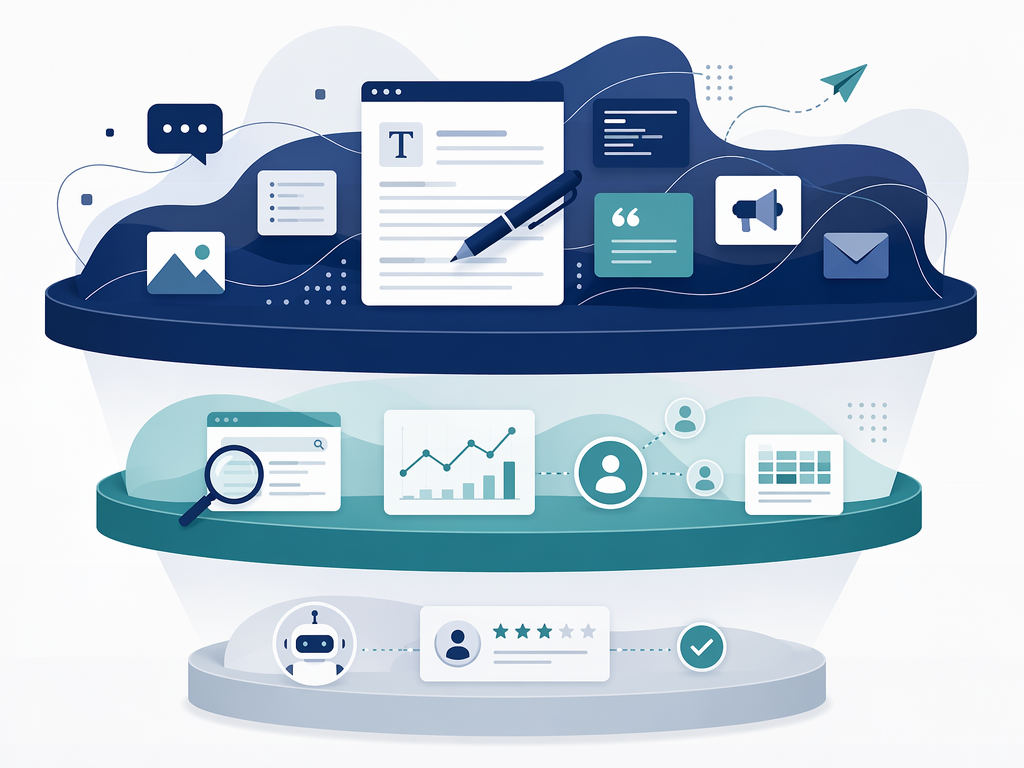
How Digital Marketing Teams Are Actually Using AI: Use Cases, Workflows, and Measured Time Savings
A data-backed breakdown of the specific AI use cases marketers use weekly, the time savings by function, and actionable workflow templates — based on the latest industry research and real brand examples.
Digital marketing using AI is usually described as a capability story. The weekly workflow data says something less dramatic and more useful: teams are mostly using it where the volume is high, the first draft is expensive, and the cleanup can still be owned by a human. That makes the real question not whether AI is present, but which tasks get repeated often enough to matter.
Weekly use looks like tiers, not one maturity ladder
In HubSpot's 2026 survey of 14,000 respondents, the clearest signal is frequency: some tasks are already part of the weekly operating rhythm, while others still sit below the fold [1].
| AI use case | Weekly usage | What it usually means in practice |
|---|---|---|
| Content drafting | 78% | First-pass blogs, landing copy, briefs, and rewrites |
| Ad copy | 71% | Variant generation for search, social, and display |
| Email subject lines | 69% | Rapid testing across tone, length, and angle |
| Image generation | 64% | Concepting, mockups, and social creative exploration |
| SEO briefs | 53% | Outlines, intent mapping, and page structure |
| Campaign analytics | 49% | Summaries, pattern spotting, and performance notes |
| Personalization | 47% | Segment-specific copy and modular messaging |
| Video work | 38% | Scripts, shot lists, and repurposing support |
| Agents | 34% | Production tasks that run with limited supervision |
| Lead scoring | 33% | Lower-frequency operational and data-driven workflows |
That tier map matters more than the headline adoption number. Content drafting, ad copy, and subject lines sit at the top because they recur every week and are easy to inspect before publication. SEO briefs, campaign analytics, and personalization are already significant, but they ask for more context and more cleanup. Agents and lead scoring are clearly real, yet they are still below the core content loop for most teams. The practical lesson is that AI adoption in marketing is not one ladder; it is a set of task clusters with different cadence, risk, and payback.
Where the hours actually go
The same survey reports an average savings of 6.1 hours per week across marketers using AI, but the useful detail is the function-level split: content marketers save 7.8 hours, SEO specialists save 6.9 hours, and demand gen teams save 5.7 hours [1]. Those are self-reported benchmarks, so they should be read as directional rather than audited time studies. Even so, the pattern is clear enough to benchmark against.
| Function | Average time saved per week | What that usually buys back |
|---|---|---|
| Content marketing | 7.8 hours | Draft generation, editing passes, and variant work |
| SEO | 6.9 hours | Brief creation, outline work, and page refinement |
| Demand gen | 5.7 hours | Offer copy, nurture assets, and campaign prep |
Content marketing gets the most attention here for a simple reason: it combines the strongest weekly usage with the clearest workflow shape. If a team is already using AI for drafting, the next question is not whether the tool is fast enough. It is whether the brief, the edit pass, and the publication standard are good enough to make the saved time matter. For readers who want a staged rollout rather than a loose collection of prompts, The AI Content Marketing Workflow: From Using AI to Using AI Well maps the sequence more explicitly.
What the workflows look like when they are actually useful
The most useful workflows are not elaborate. They move AI to the front of the process, where the work is expensive to start, and keep the human review where judgment is still the bottleneck.
- Content drafting: start with a short brief, ask for a rough outline plus two or three angle variants, then have a human rebuild the lead, examples, and claims before publication.
- SEO briefs: use AI for intent mapping, section ideas, and draft questions, then add the SERP reality, internal links, and source constraints yourself.
- Paid media: generate headline and primary-text variants, cut aggressively, and check policy, offer fit, and landing-page consistency before launch.
- Email: use AI for subject lines and preheaders, then test for clarity and offer alignment instead of letting the model optimize only for novelty.
That is the real shape of digital marketing using AI in 2026: not fully automated content production, but a faster first pass that reduces blank-page time and expands variant volume. The teams getting the best return are usually the ones that know exactly which step AI should own and which step still belongs to an editor, strategist, or media buyer.
The editing threshold is the quality gate
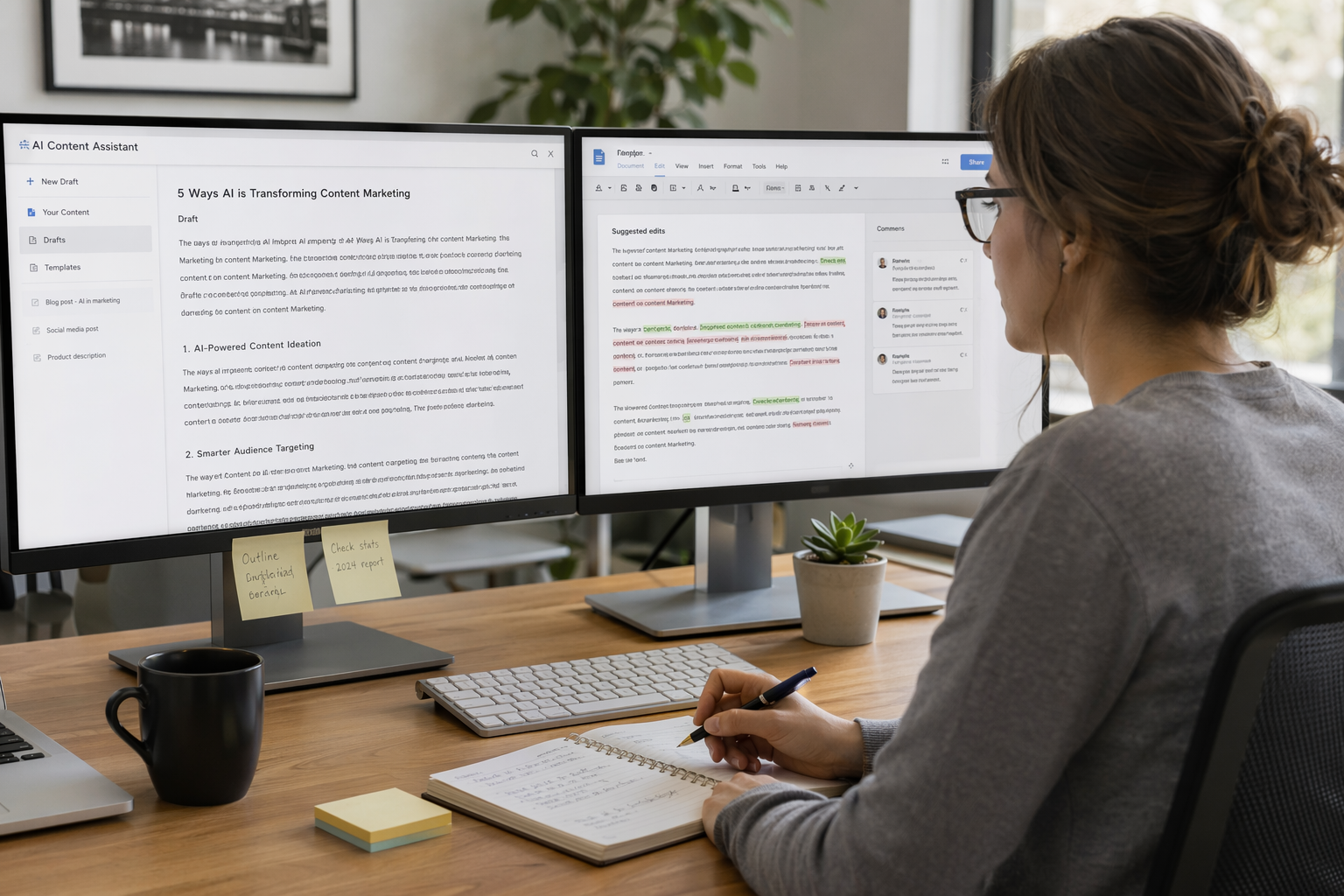
The benchmark that keeps showing up across the available studies is not how much AI a team uses, but how much human editing follows it. Teams that edit 20% or more of AI content by word count report 2.7x better organic traffic outcomes than teams that edit less than 5% [1]. That should not be treated as a law of nature, but it does match what editorial teams already know: the rough draft is where AI helps most, and the final version is where ownership lives.
That is why the best internal guidance is usually about selection and sequencing, not enthusiasm. What to Automate, Edit, and Skip When Using AI for Marketing in 2026 is useful precisely because it forces that decision. The related hybrid content playbook goes one step further by showing how AI and human edits can be structured so the final asset still sounds owned, not merely generated.
The practical consequence is simple. Faster drafting only helps if the edit pass is real enough to protect accuracy, brand voice, and search performance. Under-edited output may feel efficient in the moment, but it tends to shift the cleanup cost downstream into revisions, weaker engagement, or low-confidence publication decisions.
The next wave is bigger in analytics than in agents
The fastest-growing use cases in the survey are campaign analytics, up 26 points year over year, video work, up 24 points, and audience research, up 23 points [1]. That is a more revealing signal than another generic promise about automation. It suggests teams are pushing AI into places where volume and synthesis are high, but final judgment still needs a human.
Agents are also becoming more visible in production. As of early 2026, 34% of enterprise marketing teams reportedly run at least one autonomous agent, and among those users the most common production task is SEO content briefs and outlines, at 58% [2]. That is notable, but it still reads as an operational add-on rather than the center of the marketing stack. For a deeper strategic frame on that shift, Five Decisions That Separate AI Marketing Leaders From Tool Collectors is the better internal read.
A narrow optimization case shows why bounded AI still matters. Virgin Holidays and Phrasee reported a 2% open-rate lift from AI-powered subject line optimization, which the case study tied to millions in revenue [3]. That is useful evidence for email teams because the feedback loop is tight and the variable is isolated. It is not a universal proof that every channel will behave the same way.
The cleanest benchmark for 2026 is not whether a team says it uses AI, but whether it can name the weekly use cases, measure function-level time saved, and keep a real editing threshold in place. That is where the productivity gain stops being a tool story and starts becoming a workable process.
References
- HubSpot State of Marketing 2026 — HubSpot
- AI marketing statistics 2026 adoption data points — Digital Applied
- AI Marketing Case Studies — Visme

Comments
Join the discussion with an anonymous comment.