

What You're Actually Paying for with AI Copywriting Tools in 2026
This article breaks down whether premium AI copywriting tools like Jasper and Copy.ai deliver value beyond what you get by prompting Claude or GPT-5 directly. You'll learn when the wrapper premium makes sense and when direct prompting produces better output.
The most useful way to evaluate the best copywriting AI in 2026 is to stop asking which product has the smartest AI. In many cases, the premium tool is not selling you a fundamentally better writing brain. It is selling a layer around a foundation model: saved prompts, templates, brand voice rules, workflow routing, scoring, integrations, permissions, and a cleaner place for a team to work.
That distinction matters because Jasper, Copy.ai, Writesonic, Anyword, Claude, and GPT-class tools often get judged as if they are all the same kind of thing. They are not. A foundation model is the engine. A copywriting platform is the production system built around an engine. Sometimes that system saves the day. Sometimes it flattens a good brief into a template-shaped smear.
AdLibrary’s April 2026 comparison makes the mechanism unusually visible. Its review argues that many AI copywriting tools sit on top of the same or similar frontier-model capabilities that marketers can access directly, so the practical buying question becomes what the wrapper does to the brief before the model ever writes a sentence.[1]
That is the part most tool roundups blur. They compare outputs as if the wrapper generated them from nowhere. In real production, the wrapper has already made several decisions: which fields the marketer can fill in, how much context gets passed forward, which tone options are available, what the model is told to optimize for, and whether the brand’s actual constraints survive the trip.
The wrapper is a production layer, not magic writing judgment
A good copy brief is messy in useful ways. It contains the audience’s sophistication level, the offer’s tradeoffs, the thing the brand refuses to say, the sales objection nobody wants to mention, the competitor cliche to avoid, and the reason this campaign exists now. A template box usually wants cleaner inputs: product, audience, tone, goal.
That cleanup feels efficient until it amputates the material that made the brief worth writing. If a tool reduces a nuanced DTC positioning problem to a short product description and a tone dropdown, the model is not being asked to solve the same problem the marketer had. It is being asked to write from a smaller, safer version of the problem.
This is why direct prompting can look unfairly strong in the hands of an experienced operator. The operator is not just using Claude or GPT-5. They are feeding the model a richer assignment: positioning context, audience tension, examples of unacceptable phrasing, channel constraints, proof points, and a review standard. The model has more to work with, so the copy has more chances to sound like it came from a real commercial situation.
None of this makes wrappers useless. It means their value should be measured in the right category. A wrapper that standardizes intake for twelve writers is doing a different job from a blank Claude chat with a meticulous strategist behind it. The first is buying coordination. The second is buying flexibility.
Where the output gap actually appears
The clearest evidence in the current material is AdLibrary’s side-by-side test. In its April 2026 example, the same DTC brief was run through Copy.ai’s template workflow and through Claude Opus 4.7 with a six-part structured brief. The template route produced generic startup-style marketing copy; the structured direct prompt preserved more specificity, restraint, and practitioner-grade tone.[1]
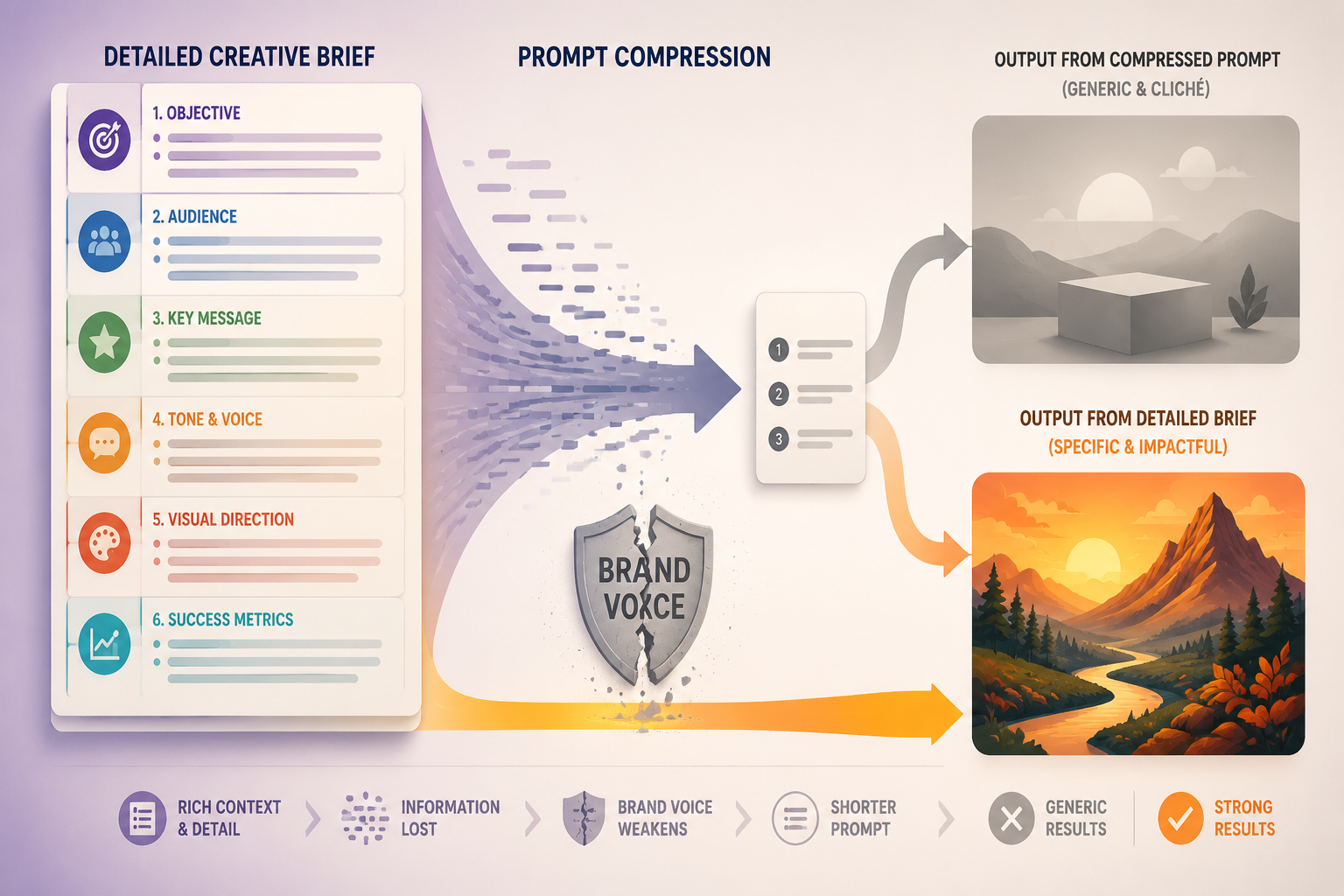
The important point is not that Copy.ai can never produce strong copy, or that Claude will always beat a wrapper. A single comparison cannot prove that. The useful lesson is narrower and more operational: when the wrapper compresses the brief, the model receives fewer signals about what good looks like. Blandness is often introduced before generation, not during generation.
A six-part direct brief gives the model more surface area to reason from. It can separate the audience from the buyer, the offer from the claim, the proof from the tone, and the channel from the conversion goal. A compressed template tends to merge those distinctions. Once they are merged, the safest next token is usually something fluent, broadly positive, and forgettable.
This is the part that trips up otherwise capable teams. They treat the template as a neutral convenience. It is not neutral. It is an editorial interface. It decides which context matters enough to ask for, which context can be hidden in a dropdown, and which context disappears entirely.
For a simple Google ad variation, that may be fine. For a positioning-sensitive landing page, a founder-led LinkedIn post, or an email sequence that has to navigate skepticism without sounding over-managed, the lost context shows up fast. The editor then spends the review pass trying to put back what the intake form removed.
What a strong direct brief includes
The direct-prompt advantage is not created by writing longer prompts for the sake of it. It comes from preserving the useful constraints that shape taste. A workable direct brief for copy usually includes:
- Commercial context: what is being sold, to whom, and why the audience would care now.
- Audience tension: what the reader already believes, doubts, wants, or resents.
- Offer mechanics: what the product does, what it does not do, and where the claim could be overstated.
- Voice boundaries: examples of phrasing to use, phrasing to avoid, and the level of polish that would feel wrong.
- Channel constraints: length, format, CTA, compliance limits, and what the copy must make easier for the next step.
- Evaluation criteria: how the draft will be judged before anyone starts rewriting it.
That kind of brief is not glamorous. It is also exactly where senior marketers already do their best work. The model is not replacing that judgment; it is responding to how much of that judgment gets encoded before the draft starts.
Claude and GPT-class models are already good enough for the writing layer
The case for direct prompting is stronger in 2026 because the base models are no longer the weak link for many marketing tasks. DataCamp’s comparison of Claude Opus 4.7 and GPT-5.5 frames both as highly capable frontier models, with differences that matter by task rather than a simple winner-takes-all hierarchy.[2]
For copywriting, that means a marketer who can brief well does not need to treat a wrapper as the only path to professional output. Claude may be preferred for certain long-form, tonal, or editorially sensitive work; GPT-class models may be preferred for other workflows, integrations, or structured task handling. The model choice matters, but it rarely matters as much as the quality of the assignment.
There is a practical ceiling here. A direct model session does not automatically remember your brand rules across a team, prevent a junior writer from skipping the positioning context, score ad variants against historical patterns, or push approved copy into a CMS. If you need those things, the writing layer is only one part of the purchase.
That is why a simple “Claude versus Jasper” argument goes stale so quickly. A solo consultant writing a sales page and a content lead managing ten contributors are not buying the same outcome. The first wants maximum fidelity to a brief. The second may need fewer off-brand drafts by Friday.
When the wrapper earns its premium
The wrapper starts to make sense when the bottleneck is not raw drafting. It is coordination. If every campaign requires a content lead to re-explain the brand voice, rebuild the same prompt, paste the same product facts, and clean up the same predictable mistakes, a paid platform can remove real friction.
| Wrapper feature | What it can actually buy |
|---|---|
| Brand voice storage | Fewer repeated explanations and a more consistent starting point for multiple writers |
| Templates | Faster intake for repeatable assets, especially ads, product descriptions, and short-form variants |
| Approval workflows | Clearer review paths when drafts pass between writers, editors, legal, and marketing leads |
| Predictive scoring | A prioritization signal for ad or landing-page variants, not a guarantee of performance |
| CMS and collaboration integrations | Less copy-paste work and fewer places for version control to break |
Jasper’s value, for example, is easier to defend when it is treated as a marketing workflow hub rather than as a mystical prose machine. Brand voice governance, reusable campaign structures, and collaboration features can matter for a team with several writers producing similar assets under deadline. The question is whether those controls reduce enough review time to justify the subscription.
Anyword belongs in a slightly different bucket. Its predictive ad scoring is not the same thing as better writing taste. It is a performance-oriented layer meant to help teams compare variants before launch. That can be useful when paid media volume is high enough for prioritization to matter, but it should not be confused with proof that the highest-scoring line will always win in market.
Copy.ai and Writesonic can also be useful when the team’s problem is repeatable throughput: generate product descriptions, refresh ad angles, produce first-pass landing-page sections, or give non-writers a safer starting point. In those cases, the template is not necessarily the enemy. It is a guardrail. The trouble starts when the same guardrail is used for work that needs judgment, asymmetry, and voice.
For teams comparing paid platforms, a use-case-first evaluation is more useful than a feature checklist. A tool that is mediocre for founder voice may still be valuable for paid social variants. A tool that feels restrictive to a senior strategist may be exactly what keeps a distributed freelance bench from drifting. For a deeper use-case framework, see Not "Best Tool" but Best Tool for the Job.
When direct prompting is the better buy
Direct prompting usually wins when the person using the model can supply the missing system themselves. That means they can write a real brief, maintain a swipe file or voice guide, judge the output without being dazzled by fluency, and run a disciplined revision pass.
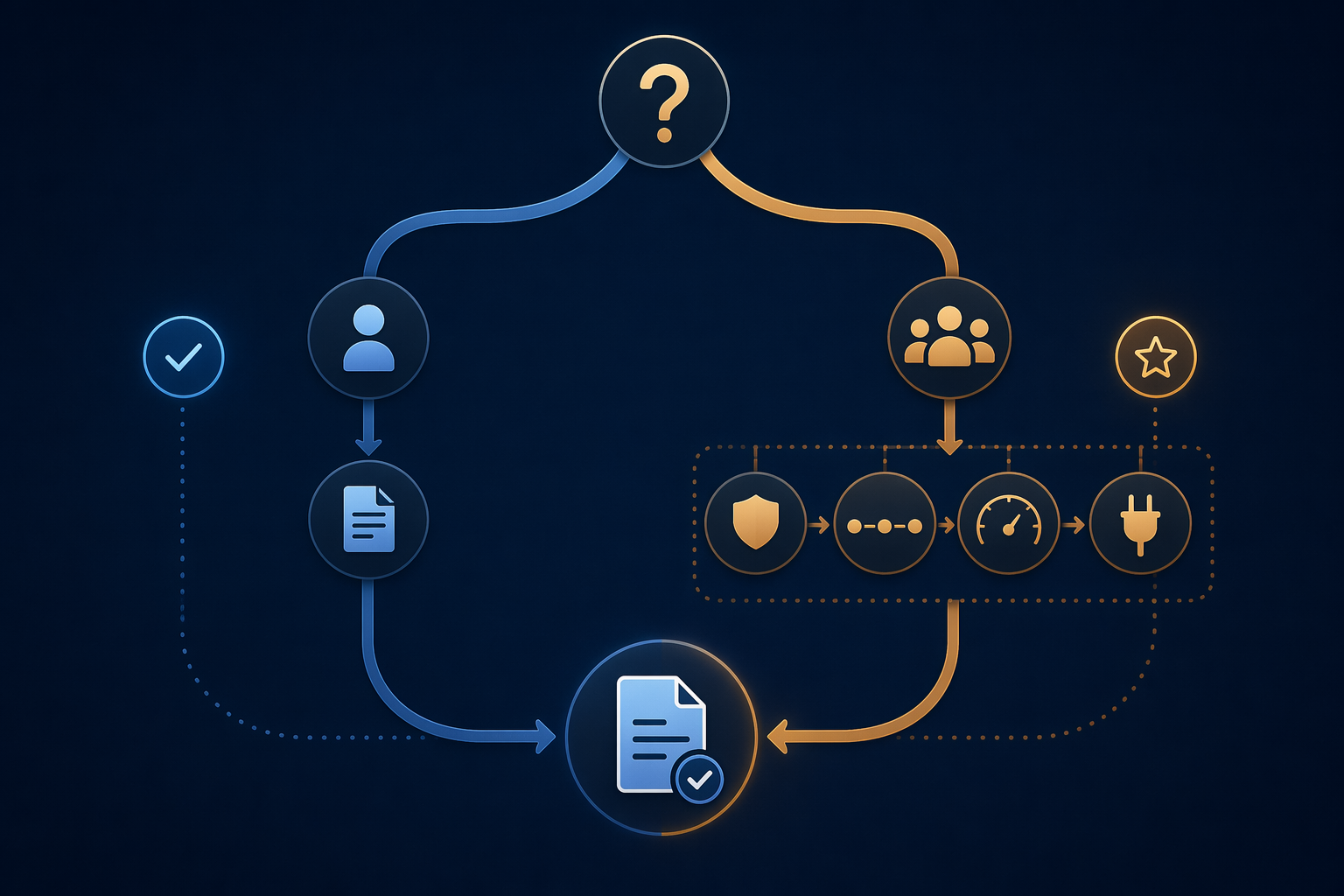
This is why experienced solo marketers often get frustrated with copywriting platforms. They are not failing to understand the tool. They are feeling the cost of an interface that was designed to make the work repeatable for a broader user base. The very thing that helps a less experienced team member move quickly can slow down someone who already knows what context the model needs.
A solo operator also has a cleaner cost equation. If the work lives mostly in one person’s head, there is less value in shared brand memory, approvals, permissions, and team dashboards. The money is better spent on access to a strong foundation model, a well-maintained prompt library, and enough human editing time to make the draft commercially sharp.
Small teams sit in the middle. If two or three people share the same standards and can use structured briefs consistently, direct prompting may still be enough. Once the team adds freelancers, channel owners, legal review, or multiple business units, the wrapper’s boring features become less boring. Version control and brand drift are not theoretical problems when everyone is pasting from different chat windows.
The dividing line is not company size by itself. It is whether the process depends on tacit judgment or shared enforcement. If the best person on the team has to personally rescue every draft, the team does not have an AI writing system. It has a faster way to generate editing debt.
The productivity data supports spending, but not blindly
There is a real reason marketers keep buying these tools. DataForest reports that AI copywriting tools can cut content costs by 30% to 50% and speed production by 80%.[3] Those numbers explain the appetite for AI-assisted production, but they do not settle the wrapper-versus-direct-prompt decision.
Speed is only valuable when the downstream review burden does not eat the gain. A tool that produces five drafts quickly but requires a senior editor to rebuild the argument from scratch has not necessarily saved time. It has moved the work from drafting to repair.
Budget pressure cuts both ways. Digital Applied’s 2026 marketing AI statistics roundup reports that 81% of CMOs expect AI tool spend to grow 47% over the next 12 months, and that the median mid-market team spends $3,400 per month on AI marketing tools.[4] That kind of spend makes the wrapper premium easier to hide inside a stack, but it also makes tool sprawl more expensive to tolerate.
The responsible read is not “AI tools pay for themselves.” It is more specific: AI-assisted copy production can be economically attractive when the organization has a review process, clear standards, and a tool choice matched to the actual bottleneck. For more on the cost side of that decision, see Is an AI Copywriting Tool Worth It in 2026?.
How to evaluate a copywriting AI without getting distracted
The fastest way to test a tool is to bring your own brief. Do not start with the vendor’s sample prompt, demo product, or most flattering use case. Use an asset your team actually produces and a brief that includes the uncomfortable constraints: the skeptical audience, the banned phrases, the required proof, the approval friction, and the reason previous copy missed.
Then compare three outputs: the wrapper’s normal workflow, a direct foundation-model prompt using the full brief, and a direct prompt that uses the same compressed information the wrapper collected. That third version matters. It shows whether the wrapper is adding value or whether the direct model only won because it received a better assignment.
- Quality: Does the draft preserve the specific commercial tension, or does it default to category language?
- Controllability: Can you steer structure, tone, claims, and exclusions without fighting the interface?
- Review burden: How much senior editing is needed before the copy can be shown internally?
- Repeatability: Can another person on the team produce a comparable first draft next week?
- Governance: Are brand rules, permissions, approvals, and source materials easier to manage?
- Cost clarity: Does the subscription replace real labor, or does it add another place to manage drafts?
Do not over-index on the first draft’s polish. Fluency is cheap now. Look for whether the model understood the business situation. The best output usually contains fewer generic adjectives, fewer inflated claims, and more evidence that the draft knows what the reader is likely to resist.
Also check what happens after the first draft. Can the platform preserve the reasoning behind edits? Can it remember why a phrase was rejected? Can it route the draft to the right reviewer? A direct model chat can be excellent for one skilled person and still be a poor shared operating system.
A practical decision rule
Pay for the wrapper when the workflow layer saves more than it costs. That usually means multiple contributors, repeated asset types, brand voice enforcement, approval chains, ad-variant prioritization, CMS handoff, or a team that needs the tool to make good behavior easier by default.
Prompt the foundation model directly when the main constraint is copy quality and you have the skill to brief, judge, and revise the work yourself. For solo consultants, senior content marketers, and small teams with strong editorial discipline, Claude or GPT-class models with structured briefs can produce better work than a template-driven wrapper because they preserve more of the real assignment.
The best copywriting AI in 2026 is not a single winner. It is either a workflow layer you buy because coordination is expensive, or a prompting discipline you build because fidelity to the brief matters more than a dashboard.
References
- Best AI Copywriting Tools 2026: What Actually Writes Like a Human, AdLibrary, April 2026.
- Claude Opus 4.7 vs GPT-5.5: Which Frontier Model Is Best?, DataCamp.
- 10 AI Tools for Copywriters, DataForest.
- AI Marketing Statistics 2026: Adoption Data Points, Digital Applied.

Comments
Join the discussion with an anonymous comment.