
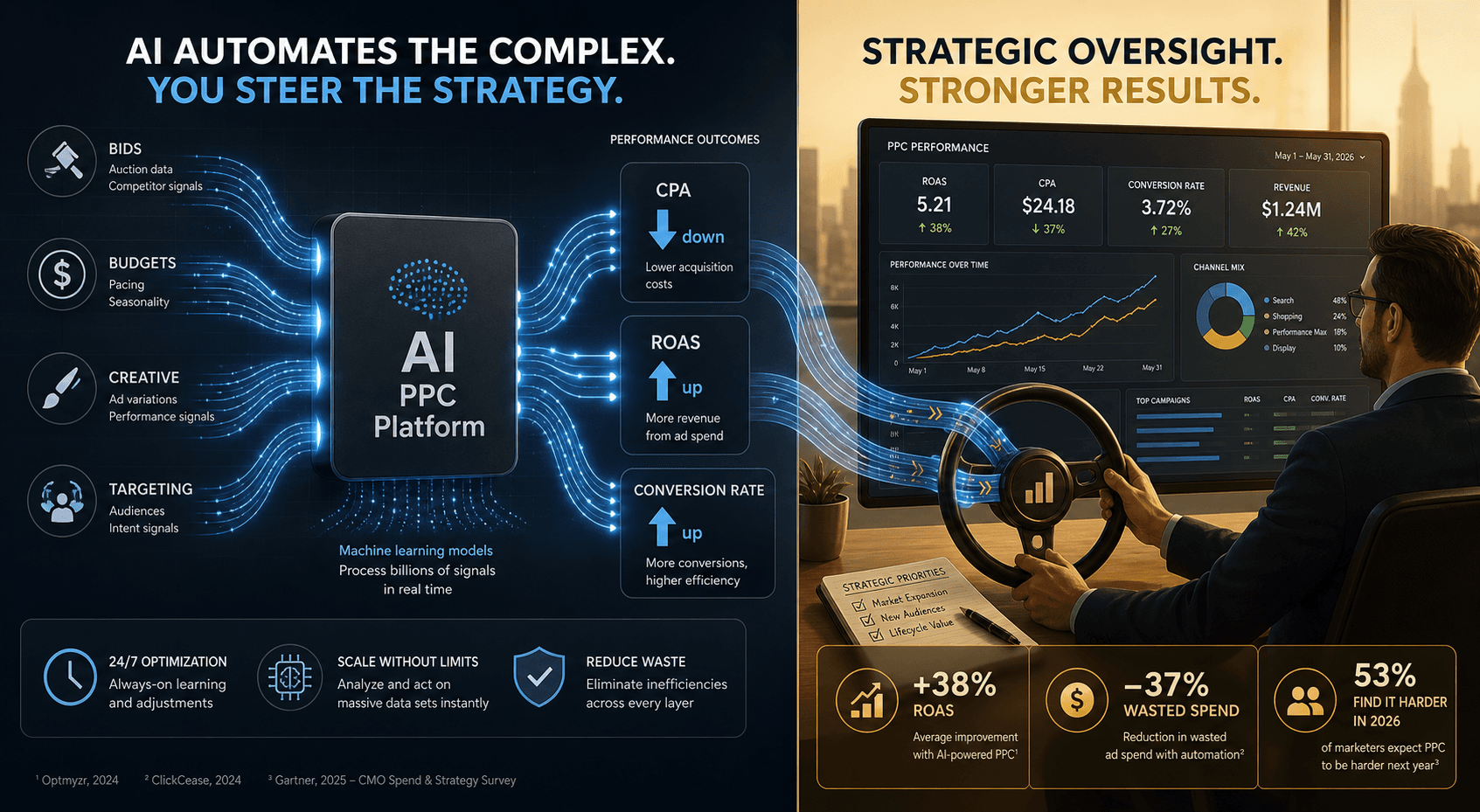
AI PPC Automation: A Reality Check on Where It Delivers and Where It Fails
For paid media specialists already using AI, this article provides a cross-platform audit of verified performance gains, a catalog of five predictable failure scenarios, and a decision framework for when to automate, when to intervene, and when to stay manual.
If you manage paid media for a living, you have likely already crossed the adoption threshold. Over 80% of Google advertisers now use Smart Bidding strategies, according to Market Vantage data cited by Whitehat. The question is no longer whether to use AI in PPC, but how to calibrate the degree of automation across your account portfolio without leaving performance on the table or walking into predictable failure modes.
This article is a cross-platform reality check for practitioners who have already integrated AI into their workflows. We will walk through the verified performance data, catalog the five scenarios where AI predictions break down, examine the transparency trade-offs baked into platforms like Performance Max and Smart Bidding, and provide a decision framework — including the 70/20/10 budgeting model and Brad Geddes' evaluation criteria — so you can decide when to automate, when to intervene, and when to stay manual.
What AI PPC Automation Actually Delivers: The Verified Performance Data
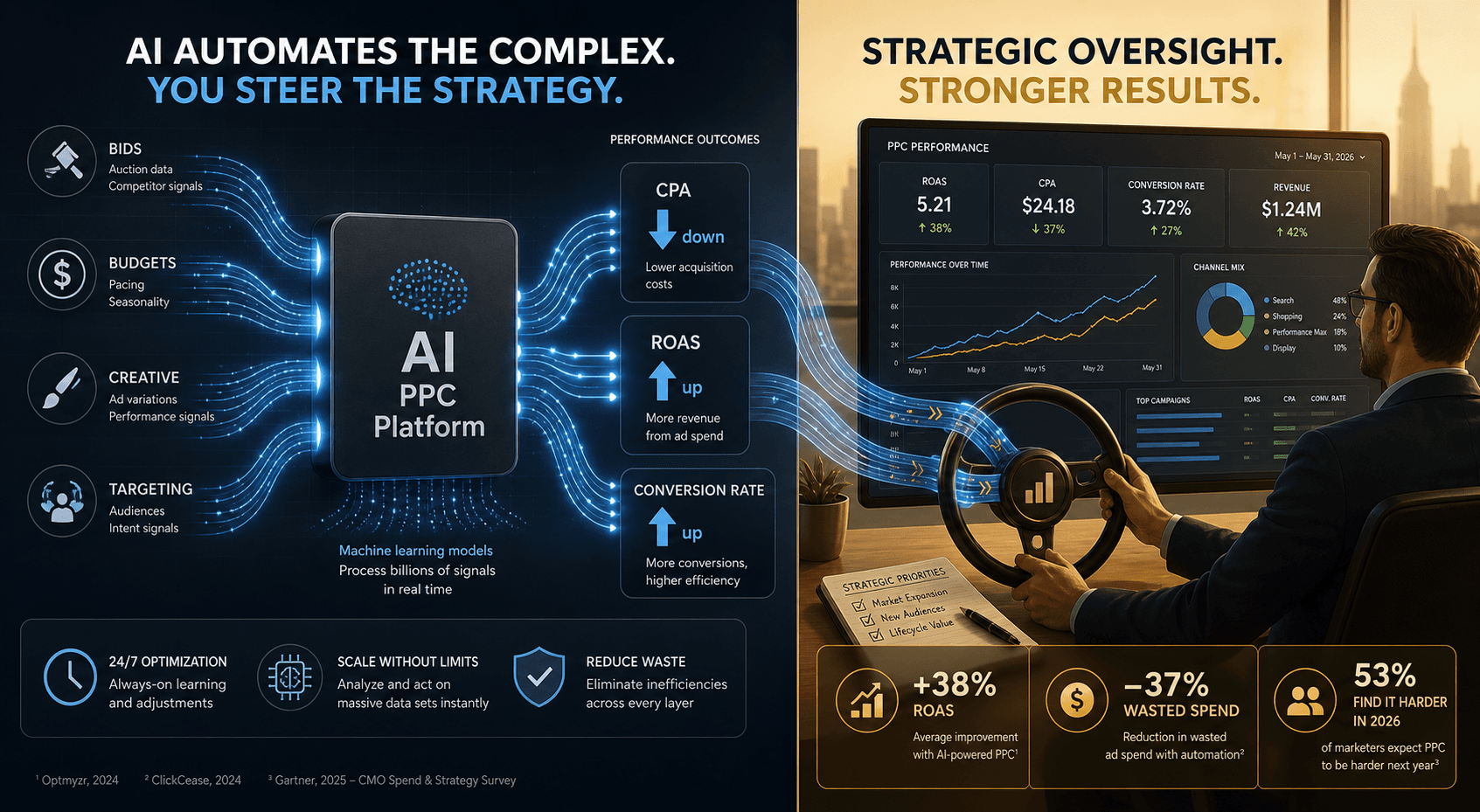
The aggregate performance data across multiple case studies and vendor reports paints a picture of significant, but not universal, improvement. The table below consolidates the most frequently cited figures from the sources we reviewed. Note that many of these figures originate from vendor-published case studies or aggregated analyses — we have flagged the source and methodology where possible so you can assess reliability for your own account context.
| Metric | Reported Improvement | Source | Caveat |
|---|---|---|---|
| Conversion rate (forecasting) | 30–76% improvement over manual | Whitehat SEO (aggregating Premiere Creative, Octoboard, Columbus Agency data) | Wide range reflects varying methodologies and account sizes; not a single controlled study |
| Wasted ad spend reduction | 37% reduction | Zebracat via MarketerHire | Single vendor blog post; treat as directional |
| ROI increase | 50% increase | Zebracat via MarketerHire | Single vendor blog post; treat as directional |
| Click-through rate (AI-generated creative) | 47% improvement | Zebracat via MarketerHire | Single vendor blog post; treat as directional |
| Cost per acquisition reduction | 29% drop | Zebracat via MarketerHire | Single vendor blog post; treat as directional |
| ROAS increase (AI-led optimization) | 72% increase | Zebracat via MarketerHire | Single vendor blog post; treat as directional |
| Conversion lift (Skai, Amazon campaigns) | 467% lift, 60% CPA drop | Skai case study via RevvGrowth | Fortune 50 electronics brand; specific vertical and platform context |
| Revenue increase (Optmyzr) | 28% increase | Optmyzr case study via RevvGrowth | Practitioner Matthieu Tran-Van; individual account result |
| Wasted spend reduction (Revealbot) | 76% reduction | Revealbot case study via RevvGrowth | Advertiser-specific result; may not generalize |
| Smart Bidding Exploration (conversion lift) | 18% increase in unique converting search query categories, 19% increase in total conversions | Google internal data (March–April 2025) via Whitehat | Google-published internal test; limited time window |
| AI Max for Search (conversion uplift) | 14% more conversions at similar CPA/ROAS; up to 27% with exact/phrase match | Google internal data via Whitehat | Google-published internal test; specific match type conditions |
| Performance Max (quality improvements) | 10%+ conversion increase with 90+ quality signals | Google internal data via Whitehat | Google-published internal test; quality score dependency |
Beyond bidding and creative, AI-powered audience segmentation has shown a 26% improvement in targeting accuracy and a 32% lift in conversion rates, per the same Zebracat-sourced data. AI-enhanced retargeting reportedly drives 44% more conversions than standard approaches. These figures align with the broader industry pattern: AI performs best when it has clean, high-volume data to learn from, and its advantage narrows as data quality or volume degrades.
For a deeper look at B2B-specific paid search results, see our case study on AI in B2B paid search, which documents campaign-level outcomes with sourced data.
The Five Scenarios Where AI Predictions Break Down
AI bidding models and creative optimization engines are fundamentally pattern-recognition systems. They require historical data to establish baselines, detect signals, and predict outcomes. When that data is absent, unstable, or structurally different from the training distribution, performance degrades — sometimes catastrophically. Based on practitioner reports and Google's own recommendations, these five scenarios produce the most consistent failures.
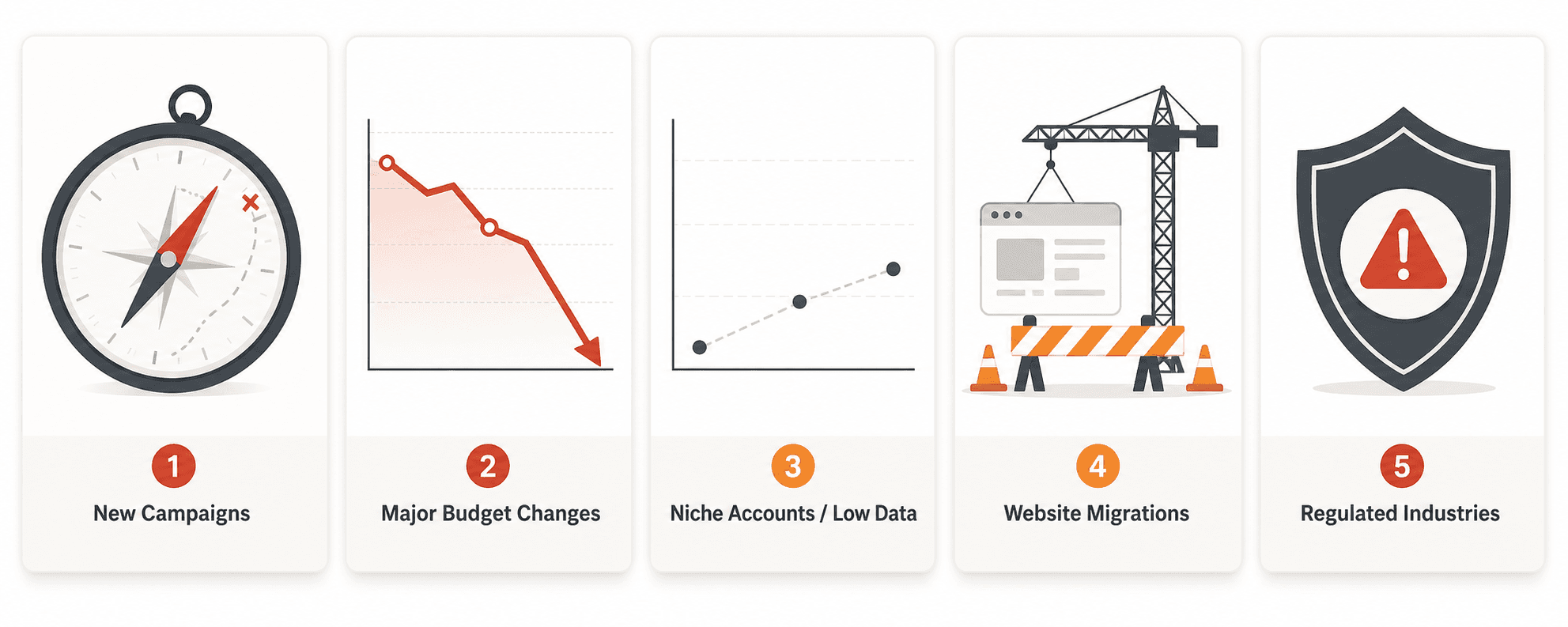
- New campaigns with no historical data. AI models have nothing to learn from. Google recommends a minimum of 30–60 conversions per month for Smart Bidding to work reliably. Launching a new campaign without this baseline means the algorithm will explore inefficiently, often spending heavily on low-relevance traffic before converging.
- Major budget changes. A sudden 2x or 3x budget increase (or decrease) resets the model's understanding of the auction landscape. The algorithm needs time to recalibrate, and during that window, CPA can spike 50–100% above target. Gradual scaling — 20–30% per week — gives the model a chance to adjust without destabilizing performance.
- Niche accounts with low conversion volume. If your account operates in a small market with fewer than 30 conversions per month, AI bidding models lack the signal density to distinguish between noise and real patterns. In these accounts, manual bidding or rule-based automation often outperforms machine learning models.
- Website migrations or landing page overhauls. When the conversion path changes — new URL structure, different checkout flow, altered tracking setup — the historical conversion data becomes partially invalid. AI models trained on the old conversion patterns will make incorrect bid and targeting decisions until sufficient post-migration data accumulates.
- Regulated industries with compliance constraints. Financial services, healthcare, legal, and other regulated verticals often require exact-match keyword targeting, pre-approved ad copy, and strict audience exclusions. AI's tendency to expand into broad match, generate novel creative variants, and explore new audience segments directly conflicts with these requirements. The result is frequent disapprovals, compliance violations, or wasted spend on non-compliant traffic.
If you are running programmatic campaigns and encountering similar underperformance patterns, our article on five operational failures in AI programmatic campaigns provides a parallel diagnostic framework for the programmatic channel.
The Transparency Trade-Off: Blind Spots in Performance Max and Smart Bidding
Platform-native automation — Google's Performance Max, Smart Bidding, and Meta's Advantage+ — operates as a black box. You set a target CPA or ROAS, provide assets and audience signals, and the algorithm decides how to allocate budget across channels, placements, and creative combinations. The results can be impressive, but the lack of granular control creates specific blind spots that paid media managers need to account for.
The 2026 State of PPC Report, cited by Smarter Ecommerce, quantifies the frustration: 53% of advertisers find managing Google Ads harder in 2026 than two years ago, and 43% of PPC managers actively complain about the lack of granular control. These numbers reflect a structural tension — the platforms are pushing automation faster than practitioners can adapt their oversight workflows.
| Blind Spot | What Happens | Impact on Performance |
|---|---|---|
| Search term transparency | Performance Max does not report individual search queries; you see aggregated data only | Cannot identify and exclude irrelevant queries; wasted spend on non-converting terms |
| Placement control | Smart Bidding and PMax automatically distribute across Search, Shopping, Display, YouTube, Discovery, and Gmail | Brand safety risks on low-quality placements; inability to optimize channel mix manually |
| Creative rotation | AI dynamically assembles ad combinations from your asset pool; you cannot force specific pairings | Hard to A/B test individual creative elements; algorithm may over-rotate on one asset |
| Bid adjustment granularity | Device, location, and audience adjustments are algorithm-managed; manual overrides may conflict | Reduced ability to apply account manager expertise on known seasonal or geographic patterns |
| Attribution model | Platform uses its own attribution logic; you cannot force last-click or data-driven models | Misalignment with internal reporting; difficulty reconciling platform-reported ROAS with actual business outcomes |
The response from many practitioners has been to deliberately bypass certain automation features. According to the State of PPC Report, 37% of advertisers run Standard Shopping Hybrid campaigns — a setup that combines automated bidding with manual campaign structure — and 17% force 'feed-only' builds to prevent the algorithm from making creative choices. These are not Luddite reactions; they are rational responses to observed performance degradation when automation is applied without guardrails.
For a detailed walkthrough on how to steer Performance Max rather than letting it run unconstrained, see our practitioner's guide to Google Ads Performance Max AI features. For Meta-specific automation boundaries, our Meta AI Advertising in 2026 guide covers where Advantage+ delivers and where human control is still essential.
The 70/20/10 Budgeting Model for AI PPC
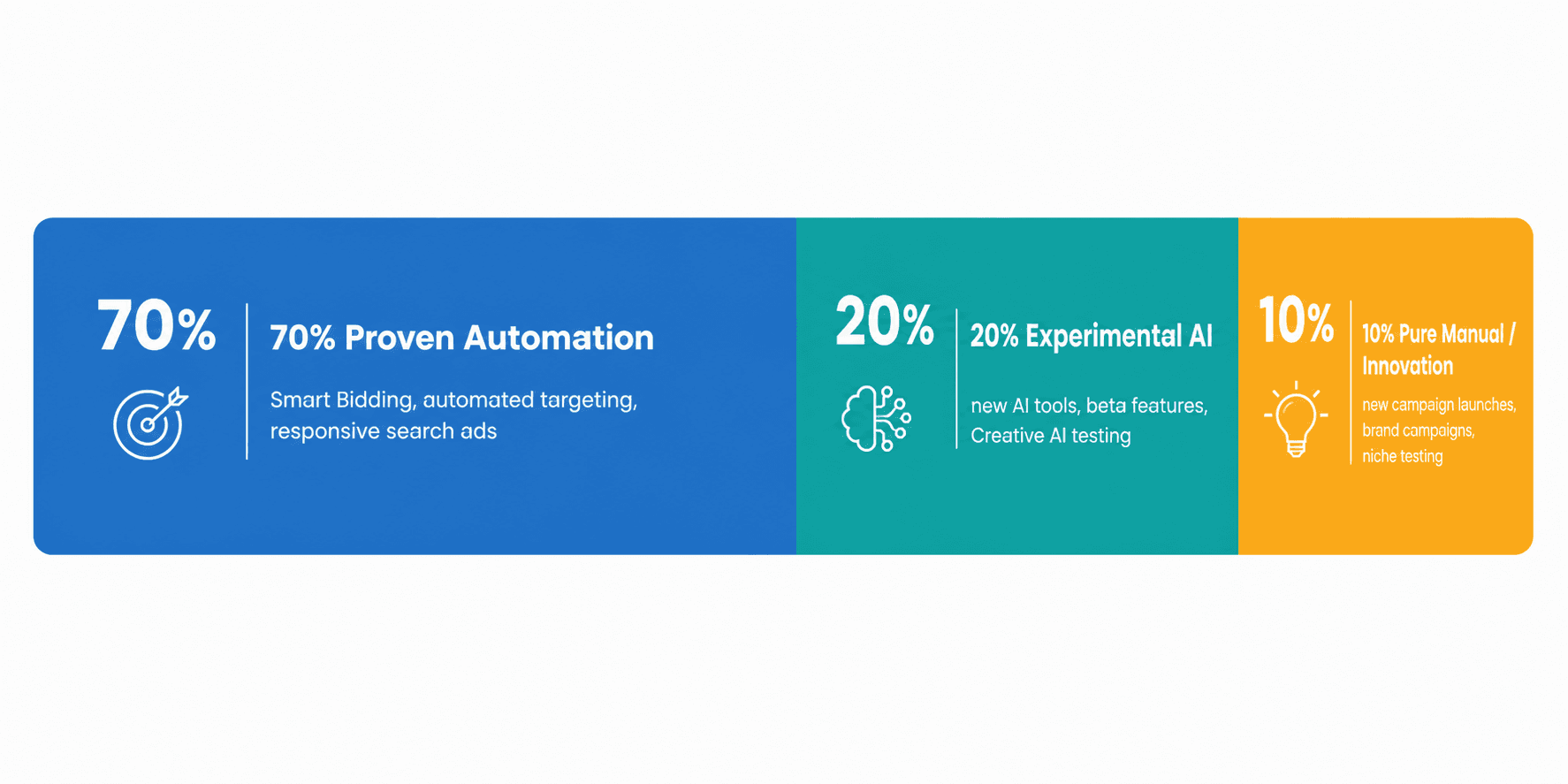
A practical way to manage the risk-reward balance of AI automation is to segment your budget using the 70/20/10 framework. This model, adapted from innovation portfolio theory, ensures that you capture the efficiency gains of proven automation while systematically testing new AI features and maintaining a safety valve for manual oversight.
| Allocation | What It Funds | Examples | Risk Profile |
|---|---|---|---|
| 70% — Proven Automation | Campaigns using established AI features with documented performance history | Smart Bidding on high-volume accounts, Performance Max with quality signals, Advantage+ Shopping | Low — these are the workhorses; monitor for drift but do not over-optimize |
| 20% — Experimental AI | New platform features, beta programs, AI creative testing, novel audience strategies | AI Max for Search, Smart Bidding Exploration, AI-generated video ads, new audience expansion models | Medium — structured testing with clear success criteria; kill underperformers after 2–3 weeks |
| 10% — Pure Manual / Innovation | Campaigns where human judgment is non-negotiable; high-risk, high-reward tests | New product launches, regulated industry campaigns, niche accounts, radical creative concepts | High — these are learning investments; accept higher CPA in exchange for strategic insights |
The key discipline in this model is not the allocation itself — it is the review cadence. Proven automation campaigns need weekly performance reviews to catch drift. Experimental campaigns need a defined test window (typically 2–4 weeks) and a go/no-go decision point. Manual campaigns need clear strategic hypotheses; if they are not generating learnings, reallocate that 10% to proven automation.
Brad Geddes' Evaluation Framework for AI Recommendations
Frederick Vallaeys, a well-known figure in the PPC community, has stated that 'even the best GenAI models only get things right around 80% of the time, and most models perform much worse than that.' This means every AI-generated recommendation — whether a bid adjustment, a new keyword, a creative variant, or a budget suggestion — needs human validation before implementation. The question is how to validate efficiently without creating a bottleneck.
Brad Geddes' evaluation framework provides a structured approach. Before accepting any AI recommendation, ask these five questions:
- Does the account have sufficient data to support this recommendation? Minimum thresholds: 30–60 conversions per month for bidding changes, 1,000+ impressions for creative tests, 90+ quality signals for Performance Max optimizations.
- Does the recommendation align with the campaign's strategic objective? AI models optimize for the metric you give them (CPA, ROAS, conversion volume). If your objective is brand awareness or lead quality, a CPA-optimized recommendation may be actively harmful.
- What is the expected impact magnitude? If the recommendation promises a 1–2% improvement, the implementation cost (time, risk of disruption) may exceed the benefit. Reserve human attention for recommendations with 5%+ projected impact.
- Is the recommendation reversible? Bid adjustments and budget changes are easily reversible. Account structure changes, campaign type migrations, and creative asset deletions are not. Apply stricter scrutiny to irreversible recommendations.
- Does the recommendation account for external context? AI models do not know about seasonal events, competitor launches, market shifts, or internal business changes. If the recommendation was generated during a period of external disruption, treat it as suspect until validated against current conditions.
Best Practices for AI-Human Collaboration Loops
The most effective AI PPC setups are not fully autonomous nor fully manual — they are structured collaboration loops where the AI handles tactical execution at scale and the human focuses on strategic direction, exception handling, and continuous calibration. The State of PPC Report found that PPC managers report saving only 1 to 5 hours a week using AI, which suggests that many are still spending that time on oversight rather than strategic work. The goal is to shift that ratio.
Here are the core practices for building effective AI-human collaboration loops:
- Weekly performance reviews with exception-based alerting. Do not review every campaign every week. Set up automated alerts for: CPA exceeding target by 20%+, conversion volume dropping 30%+ week-over-week, impression share dropping below 50%, or any campaign with zero conversions in 7 days. Review only the exceptions in detail.
- Monthly strategic recalibration. Review the 70/20/10 allocation. Move experimental campaigns that met success criteria into the proven automation bucket. Kill campaigns that failed. Rebalance the 10% manual allocation based on new strategic priorities.
- Quarterly model health audit. Check that your conversion tracking is clean, your audience signals are up to date, and your quality signals (landing page experience, ad relevance) are strong. AI models are only as good as the data they ingest; degraded input data is the most common cause of gradual performance decline.
- Shift from tactical execution to strategic orchestration. The 62% of PPC managers who rely entirely on the native Google Ads UI or Editor (per the State of PPC Report) are spending their time on tasks that AI can handle. The value a human adds is in campaign architecture, budget strategy, competitive positioning, and creative direction — not in setting bid adjustments.
For a deeper look at the underlying data architecture that supports this kind of structured collaboration, see our guide to the 5-Layer AI Performance Marketing Stack. For practical B2B deployment lessons, our B2B paid search case study with AI bidding documents how one team structured their human-in-the-loop workflow.
When to Stay Manual: Scenarios Where Automation Adds Risk, Not Value
Despite the impressive aggregate performance data, there are specific conditions where manual management still outperforms AI automation. The decision to stay manual is not a rejection of AI — it is a recognition that the conditions for AI success are not met. Based on the failure scenarios outlined earlier and the transparency trade-offs documented above, here are the conditions where manual management is the lower-risk choice.
- Highly regulated verticals. If your ad copy must be pre-approved by legal, your keywords must be exact match only, and your audience targeting must exclude specific demographics, AI's exploration behavior is a liability, not an asset. Manual campaigns with tight controls will outperform AI-driven campaigns that generate disapprovals and compliance violations.
- Low-volume niche accounts. If your account generates fewer than 30 conversions per month, AI bidding models lack the signal density to outperform simple rule-based bidding (e.g., manual CPC with position targets). The algorithm will spend its budget exploring rather than exploiting, and your CPA will reflect that inefficiency.
- Brand-new product launches. When you launch a product in a new category with no historical demand data, AI models have nothing to learn from. Manual bidding with aggressive bid adjustments on high-intent keywords, combined with close monitoring of search term reports, will generate cleaner data for future automation than letting an algorithm guess from scratch.
- Accounts undergoing structural changes. If you are migrating to a new tracking system, restructuring your account hierarchy, or changing your attribution model, pause automation until the new data pipeline has stabilized. Implementing AI automation on top of broken tracking is a fast path to wasted spend.
The 37% of advertisers running Standard Shopping Hybrid campaigns and the 17% forcing feed-only builds are not outliers — they are practitioners who have tested the limits of automation and found the boundary where human control still delivers better results. The key is to know where that boundary is for each of your accounts, and to move deliberately between manual and automated modes as conditions change.
AI PPC automation is not a set-and-forget solution. It is a powerful tool that delivers verified performance improvements when deployed in the right conditions, with the right data, and with the right oversight. The practitioners who will outperform the market in 2026 are not the ones who automate everything or the ones who automate nothing — they are the ones who know exactly when to do each.

Comments
Join the discussion with an anonymous comment.