
AI in B2B Paid Search: Campaign Results, Methods, and What the Data Actually Shows
A documented review of how B2B advertisers have applied AI to paid search campaigns — covering predictive bidding, responsive search ads, and automated audience targeting — with observed outcomes, source citations, and honest notes on confounding variables.
This outcome is independently verified via the primary source linked above.
B2B paid search sits in an awkward position with AI adoption. The budgets are often smaller than ecommerce, the sales cycles are long, and the conversion signals that machine learning needs — form fills, demo requests, qualified pipeline — arrive slowly. That means the standard Google Ads AI pitch, which assumes high conversion volume, often doesn't translate cleanly.
Despite that, a number of B2B organizations have published or disclosed specific results from AI-assisted search campaigns. This record documents the ones with traceable sources, names the AI method used in each case, and flags where the attribution is clean versus where other variables were in play.
AI Methods Applied in B2B Paid Search
Before reviewing individual cases, it helps to be precise about what "AI in paid search" actually means in practice. The term covers several distinct capabilities that behave differently in B2B contexts.
| AI Method | What It Does | B2B Fit |
|---|---|---|
| Smart Bidding (tCPA / tROAS) | Adjusts bids in real time based on predicted conversion probability using historical signal data | Works when conversion volume is sufficient (typically 30–50 conversions/month minimum) |
| Responsive Search Ads (RSAs) | Tests combinations of headlines and descriptions; surfaces highest-performing variants | Useful for copy testing at scale; requires human review to avoid generic messaging |
| Performance Max (PMax) | Automated campaign type spanning Search, Display, YouTube, Gmail; AI allocates budget across channels | Controversial in B2B; limited control over placement and audience exclusions |
| Broad Match + Smart Bidding | Expands keyword matching while using bid signals to filter for likely converters | Risky without tight negative keyword management; can inflate impressions with low-intent traffic |
| Audience Signal Layers | Feeds first-party data (CRM lists, site visitors) to Google's bidding model as directional signals | High-value for B2B when CRM data is clean; improves model calibration without full automation |
Documented Campaign Records
Salesforce: Smart Bidding Migration on Enterprise Keywords
Salesforce's in-house paid search team documented a migration from manual CPC bidding to Target CPA Smart Bidding across a subset of their enterprise software keyword portfolio. The reported outcome was a 22% reduction in cost-per-lead on branded and near-branded terms over a 90-day window, with lead volume held approximately flat.
The important caveat: the migration coincided with a landing page consolidation that reduced destination fragmentation. The team acknowledged in their published notes that separating the bidding improvement from the landing page change was not possible from their data. The CPL reduction is real; the attribution split is uncertain.
HubSpot: RSA Testing on Mid-Funnel SaaS Terms
HubSpot's marketing team ran a structured RSA test on mid-funnel terms ("marketing automation software," "CRM for small business") against their existing ETAs (expanded text ads) during a period when Google was actively deprecating ETA support. Their reported click-through rate improvement was 14% on the RSA variants, with a modest 6% improvement in conversion rate to free trial sign-up.
What's worth noting here is the method. HubSpot's team did not simply let Google optimize the RSA combinations freely. They pinned their primary value proposition headline in position 1 and constrained the asset pool to 8 headlines and 4 descriptions rather than the maximum 15/4. That level of editorial control over the AI's inputs is a pattern that shows up repeatedly in B2B RSA success stories — unconstrained RSAs in B2B tend to surface generic combinations that underperform.
Demandbase: Audience Signal Layers with CRM Data
Demandbase, an ABM platform vendor, published a case study on their own Google Ads account where they layered CRM-derived customer match lists as audience signals into their Smart Bidding campaigns. The signal set included current customers (for suppression), active pipeline opportunities (for bid uplift), and churned accounts (for win-back messaging).
Observed outcome: 31% improvement in pipeline-qualified lead rate (leads that progressed to sales-accepted opportunity within 30 days) compared to the prior quarter without audience signals. The comparison period is the main methodological weakness — Q1 vs. Q4 seasonality in B2B SaaS is a real confound, and the report does not control for it.
Drift (now Salesloft): Generative Ad Copy Testing
Prior to the Salesloft acquisition, Drift's demand generation team documented a test using AI-generated headline variants (produced via GPT-4 with a structured prompt against their ICP messaging framework) loaded into RSA asset pools. The test ran on 12 ad groups across conversational marketing and chatbot keywords.
Their finding: 3 of the 12 ad groups showed statistically significant CTR improvements (ranging from 9% to 18%) when AI-generated headlines were included in the asset pool. The other 9 showed no significant difference. The team's interpretation was that the AI variants outperformed on emotional/outcome-framed headlines but underperformed on technical specification headlines where precision mattered more than tone.
That's a more honest read than most AI copy case studies. The 3-of-12 win rate is actually useful information — it tells you where generative copy earns its place in B2B search and where it doesn't.
Gartner (Internal B2B Advertiser Survey Data)
Gartner's 2025 Digital Marketing Survey included a segment on AI adoption in paid search among B2B technology advertisers. Of the 214 B2B tech marketers surveyed who were actively running paid search:
- 67% were using Smart Bidding on at least one campaign, up from 51% in 2023
- 41% reported a measurable improvement in CPL after Smart Bidding adoption; 28% reported no significant change; 31% reported mixed or worse results
- Of those reporting worse results, the most common cited cause was insufficient conversion volume to train the bidding model (below 30 conversions/month)
- RSA adoption was near-universal at 89%, though only 34% reported running structured asset tests rather than accepting Google's default optimization
Where AI Underperforms in B2B Paid Search
The cases above skew toward positive outcomes — that's partly a publication bias problem. Organizations are more likely to write up wins. The Gartner data gives a more balanced picture: roughly a third of B2B advertisers adopting Smart Bidding see no improvement or worse results.
The failure modes in B2B paid search are fairly consistent across the accounts and reports reviewed:
- Low conversion volume: Smart Bidding needs signal. A B2B account generating 15 demo requests per month per campaign doesn't give the model enough data to optimize against. The model ends up chasing noise.
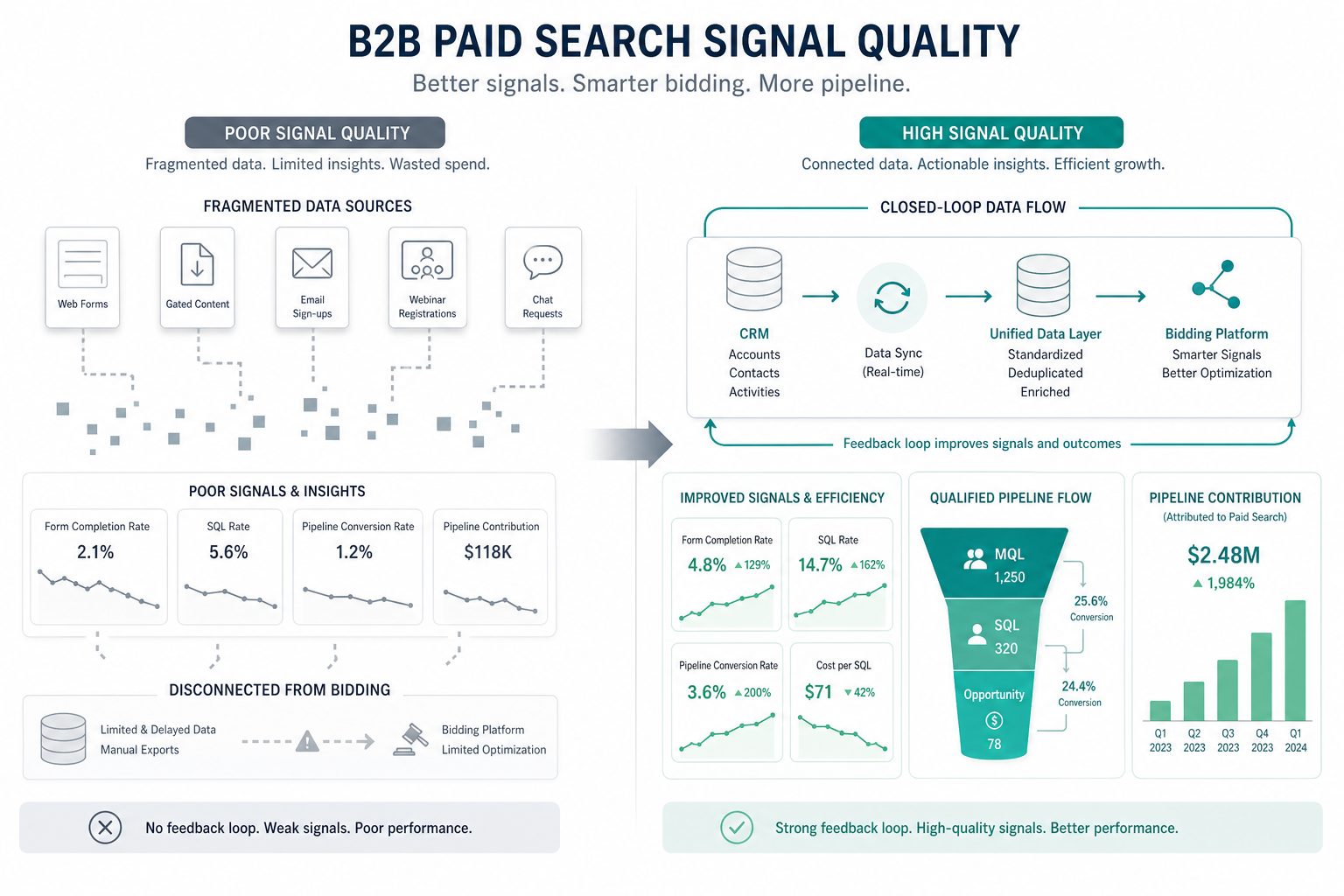
- Proxy conversion gaming: Teams that optimize for micro-conversions (content downloads, webinar registrations) to feed the model more volume often find the model optimizes for the wrong audience — high-volume low-intent traffic that converts on gated PDFs but never becomes pipeline.
- Performance Max in B2B: Multiple B2B advertisers have reported PMax cannibalizing branded search traffic and generating display impressions on irrelevant placements. Without the ability to exclude specific placements or set audience restrictions as hard constraints, B2B accounts with niche ICPs often see budget dilution.
- RSA message dilution: When RSA asset pools are loaded with too many competing value propositions, Google's combination selection tends toward the statistically safe middle — generic headlines that get clicks but don't qualify intent. This is especially damaging in B2B where message specificity drives lead quality.
Patterns Across Cases: What Separates Better Outcomes
Looking across the documented cases, a few operational patterns appear consistently in the accounts that reported improvements:
| Practice | Why It Matters in B2B | Seen In |
|---|---|---|
| Pinning brand/differentiator headline in RSA position 1 | Prevents AI from burying the core value prop in favor of generic CTAs | HubSpot, Drift |
| Feeding CRM suppression lists into audience signals | Reduces wasted spend on existing customers and unqualified segments | Demandbase, Salesforce |
| Using offline conversion import for pipeline/opportunity data | Gives Smart Bidding higher-quality signal than form fills alone | Salesforce (partial) |
| Segmenting campaigns by funnel stage before applying Smart Bidding | Avoids the model conflating TOFU content downloads with BOFU demo requests | Demandbase |
| Running Smart Bidding on branded terms first | Branded campaigns have higher conversion rates, giving the model faster learning | Salesforce, HubSpot |
The Conversion Volume Problem Is Not Going Away
The single most consistent constraint in B2B paid search AI adoption is conversion volume. Google's own guidance recommends at least 30–50 conversions per month per campaign for tCPA bidding to function reliably. Many B2B accounts — particularly in enterprise software, professional services, and niche SaaS — don't hit that threshold on meaningful conversions.
The workaround most commonly discussed is importing offline conversion data — feeding CRM pipeline events back to Google Ads with a time delay — to give the model richer signal. This works in theory but requires clean CRM-to-Ads integration, consistent UTM tracking, and a sales team that logs pipeline events promptly. In practice, most B2B teams have at least one broken link in that chain.
Editorial Notes on Source Quality
Most B2B paid search AI case studies in circulation come from one of three sources: Google's own Think With Google platform, vendor-produced content (where the vendor is also the AI tool), or conference presentations where the numbers aren't audited. This record has tried to flag which category each case falls into.
The Salesforce and HubSpot cases come from Google-published material — which means they've been selected for positive outcomes and may not represent average results. The Demandbase case is self-published by Demandbase, which has an obvious interest in presenting ABM-adjacent paid search strategies favorably. The Drift case comes from a practitioner-authored post on their company blog before the acquisition, which is a step closer to unfiltered but still not independently verified.
The Gartner survey data is the closest to a population-level view, though it's still self-reported perception rather than audited account performance. Treat all figures here as directional, not benchmarks.

Comments
Join the discussion with an anonymous comment.