
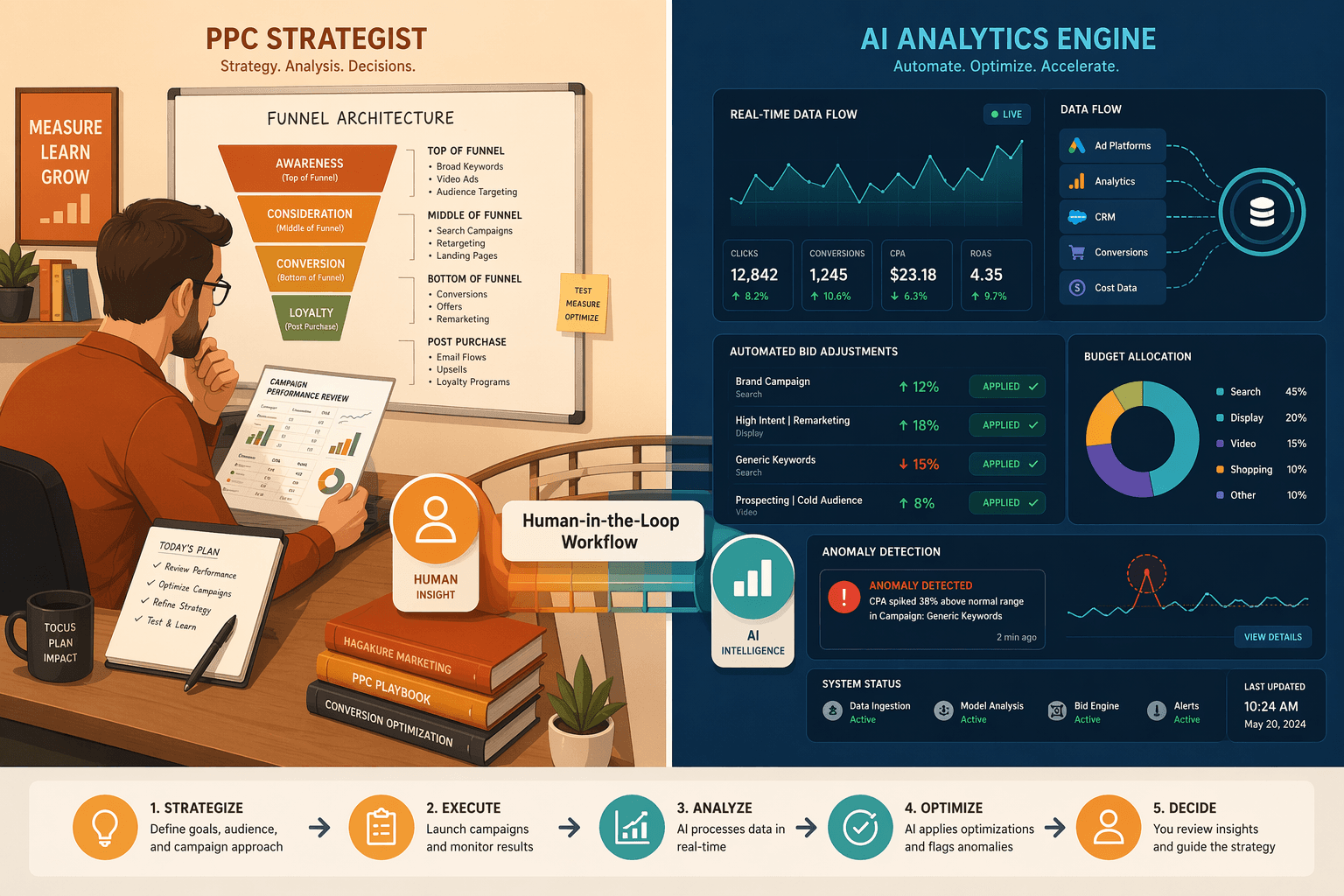
When AI PPC Automation Fails: Diagnosing Smart Bidding Performance Cliffs and Building Effective Human-in-the-Loop Workflows
This article helps PPC practitioners and agency leads diagnose why AI-driven Smart Bidding fails in predictable scenarios—like low-conversion accounts, seasonal businesses, and demand surges—and provides a structured diagnostic framework and a human-in-the-loop workflow to prevent performance cliffs and skill atrophy.
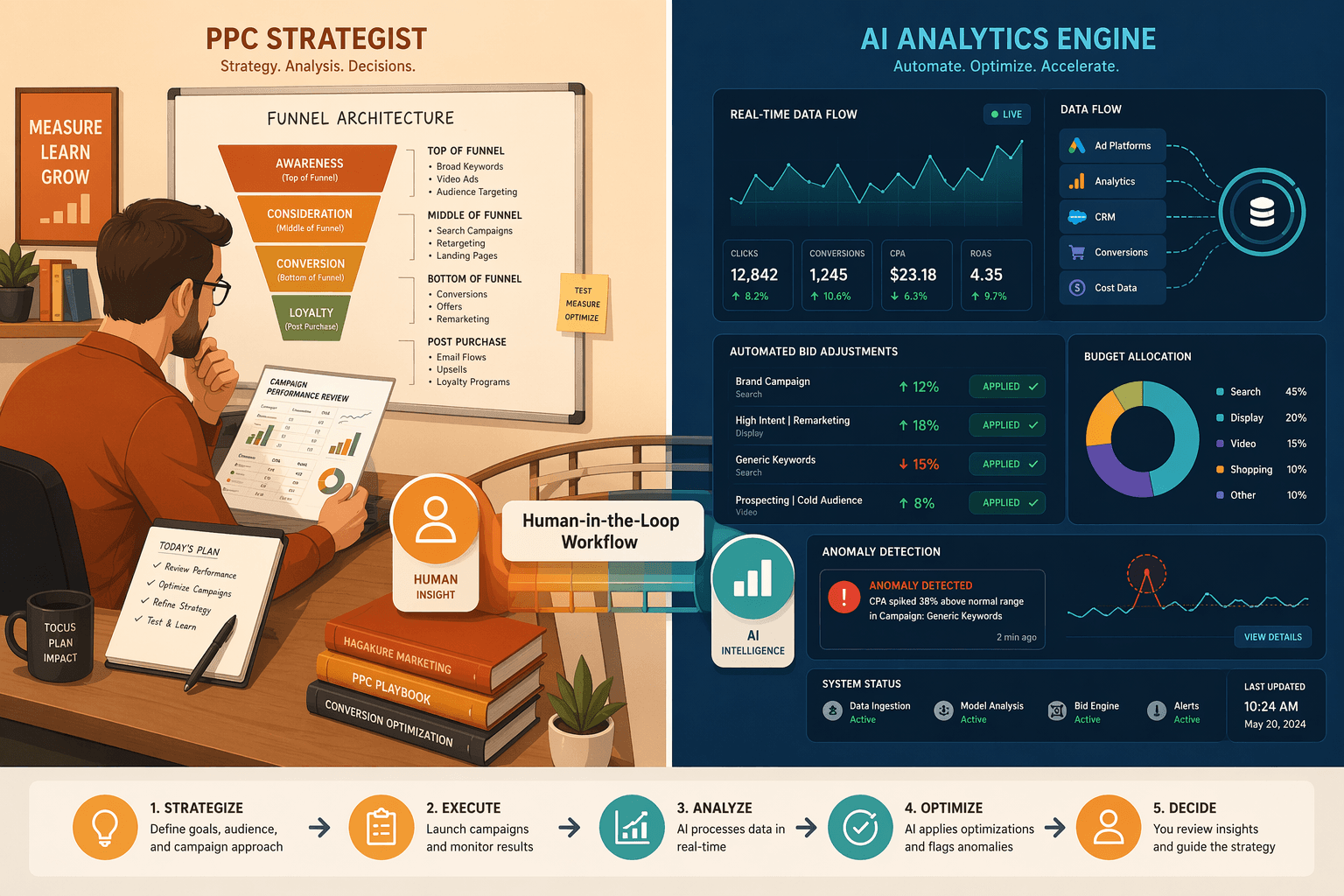
The Aggregate Stat Trap: Why Google’s 14–18% CVR Improvement Isn’t the Whole Story
Google’s Smart Bidding now manages 78% of all Google Ads spend, up from 64% in 2024. Advertisers using Smart Bidding report an average of 14% higher conversion rates. These aggregate figures appear in nearly every industry roundup and platform keynote, and they are not wrong. But they are incomplete in a way that costs practitioners real money.
The problem with averages is that they hide systematic failure cases. A 14% lift across thousands of accounts can coexist with individual campaigns where automation underperforms manual bidding by 30–50%. When a paid media manager reads “Smart Bidding delivers 14% higher CVR” and applies it as a universal truth, they are making a category error: treating a population statistic as a guarantee for every campaign.
The real question for practitioners is not “Does Smart Bidding work?” It is “Under what conditions does Smart Bidding fail, and how do I detect those conditions before my account bleeds budget?” This article answers that question by examining the specific failure patterns that aggregate statistics obscure, then providing a diagnostic framework and a human-in-the-loop workflow that prevents both performance cliffs and the skill atrophy that comes from full automation reliance.
Smart Bidding’s Conversion Volume Floor: The Sub-100 Conversions Problem
Smart Bidding is a machine learning system, and machine learning systems need signal density. Google’s own documentation recommends at least 100 conversions per campaign per month for Smart Bidding to function effectively. Below that threshold, the algorithm lacks enough data points to distinguish signal from noise, and the results are predictable — and expensive.
Analysis of accounts running Smart Bidding with fewer than 100 monthly conversions reveals three consistent problems:
- CPA volatility of 20–30% week-over-week, making budget forecasting and performance reporting unreliable
- Learning periods lasting 4–6 weeks, compared to 2–3 weeks for high-volume accounts, during which the algorithm is effectively guessing
- Impression share loss due to overly cautious bidding, as the algorithm tightens bids to stay within Target CPA rather than competing aggressively
The financial impact is not trivial. During the 2–4 week learning period that follows any campaign switch, CPA typically increases 20–30%. For a $50,000/month account, that translates to $2,500–$3,750 in wasted spend per campaign switch. An agency managing ten such accounts and switching strategies twice a year is looking at $50,000–$75,000 in annual efficiency loss — money that goes to Google instead of contributing to client outcomes.
| Conversion Volume | CPA Volatility | Learning Period | Risk Level |
|---|---|---|---|
| > 300 / month | < 10% WoW | 1–2 weeks | Low |
| 100–300 / month | 10–20% WoW | 2–3 weeks | Moderate |
| 50–100 / month | 20–30% WoW | 4–6 weeks | High |
| < 50 / month | > 30% WoW | 6+ weeks or never stabilizes | Critical |
This constraint matters most for three account types: seasonal businesses that accumulate conversions only during peak months, B2B SaaS companies with long sales cycles that compress monthly conversion counts, and local service providers whose conversion volume fluctuates with demand. These are precisely the account types where Smart Bidding’s aggregate 14% lift is least likely to hold.
Three Real-World Failure Patterns (Beyond B2B Signal Quality)
The existing literature on AI bidding failures tends to focus on B2B signal quality issues — long sales cycles, offline conversions, and lead quality degradation. Those are real problems, and we have covered them in detail in our B2B Paid Search with AI Bidding case study. But three additional failure patterns affect a much wider range of accounts and are less frequently discussed.
Pattern 1: Seasonal Businesses and the Off-Season Collapse
A ski equipment retailer running Smart Bidding year-round lost 65% of impression share during the off-season months. The algorithm, trained on winter conversion data, could not adapt to the summer demand environment where conversion rates dropped naturally. Instead of adjusting its expectations, it tightened bids to maintain the same Target CPA, effectively pricing itself out of the auction. The result: near-zero visibility during the months when the retailer was trying to build brand awareness for the next season.
This pattern repeats across any business with predictable demand cycles — tax preparation services, landscaping companies, event vendors, and holiday retailers. Smart Bidding treats the off-season as a performance problem to be solved by reducing bids, when the correct response is to accept lower conversion rates and maintain visibility.
Pattern 2: B2B SaaS with Long Sales Cycles
A B2B SaaS company with a 6–9 month sales cycle saw Smart Bidding systematically over-invest in low-quality leads. The algorithm, optimizing for conversions within its 30-day attribution window, favored users who completed demo requests and free trial signups — the easiest conversions to generate. But these early-funnel actions did not correlate with closed-won revenue. The algorithm was optimizing for volume, not value, because the value signal (a closed deal) fell outside its optimization window.
The result: a 40% increase in demo requests but no measurable increase in pipeline revenue. The account spent more to generate more of the wrong kind of conversions.
Pattern 3: Local Service Demand Surges
A local HVAC repair company experienced a demand surge during an extreme weather event. Smart Bidding, constrained by its Target CPA, could not scale spend fast enough to capture the increased search volume. The algorithm’s cautious bidding meant the company missed an estimated $200,000 in revenue opportunity during a two-week period when demand was at its peak.
This failure mode is particularly frustrating because it is the opposite of what automation is supposed to do. The algorithm should be able to detect demand spikes and increase bids accordingly. But Smart Bidding’s optimization is backward-looking — it learns from historical conversion rates and applies them to current auctions. When current demand significantly exceeds historical patterns, the algorithm systematically underbids.
Five Warning Signals: A Diagnostic Framework for Performance Cliffs
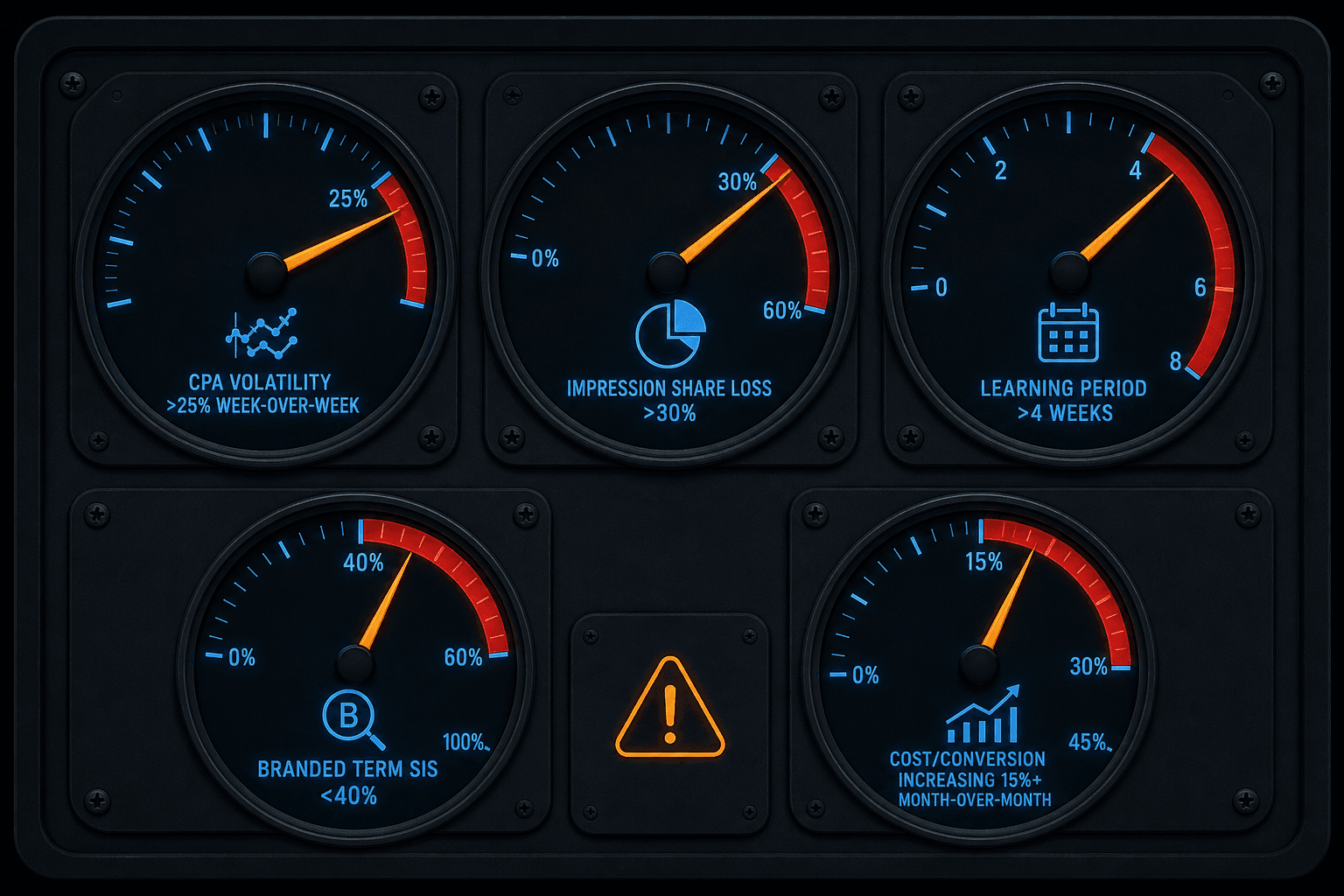
Performance cliffs rarely appear without warning. The problem is that most practitioners do not know which metrics to monitor or what thresholds indicate real trouble versus normal fluctuation. The following framework provides five specific signals, each with an escalation threshold and a recommended action.
| Signal | Warning Threshold | Escalation Threshold | Recommended Action |
|---|---|---|---|
| CPA volatility | > 25% week-over-week for 2 consecutive weeks | > 25% for 3+ consecutive weeks | Revert to Manual CPC for affected campaigns |
| Impression share loss | > 20% due to budget or rank | > 30% due to budget | Increase budget or switch to Maximize Clicks |
| Learning period duration | > 3 weeks in ‘Learning’ status | > 4 weeks in ‘Learning’ status | Pause campaign, increase conversion volume, or switch strategy |
| Branded term search impression share | < 50% | < 40% | Create separate branded campaign with manual bidding |
| Cost per conversion trend | Increasing 10%+ month-over-month | Increasing 15%+ for 2+ months | Audit search terms, check for broad match over-expansion |
These five signals are not independent. A campaign showing CPA volatility above 25% for three weeks is likely also experiencing impression share loss and extended learning periods. The framework is designed to catch problems early, at the warning threshold, before they compound into a full performance cliff.
The branded term signal deserves special attention. A branded search impression share below 40% means the algorithm is prioritizing efficiency over coverage on your own brand terms. This is almost never the right trade-off. Branded terms typically have the highest conversion rates and the lowest CPA in any account. If Smart Bidding is underbidding on branded terms, it is a clear sign that the algorithm’s optimization logic is misaligned with your business priorities.
The Human-in-the-Loop Workflow: Partitioning Spend Between Automation and Manual Control
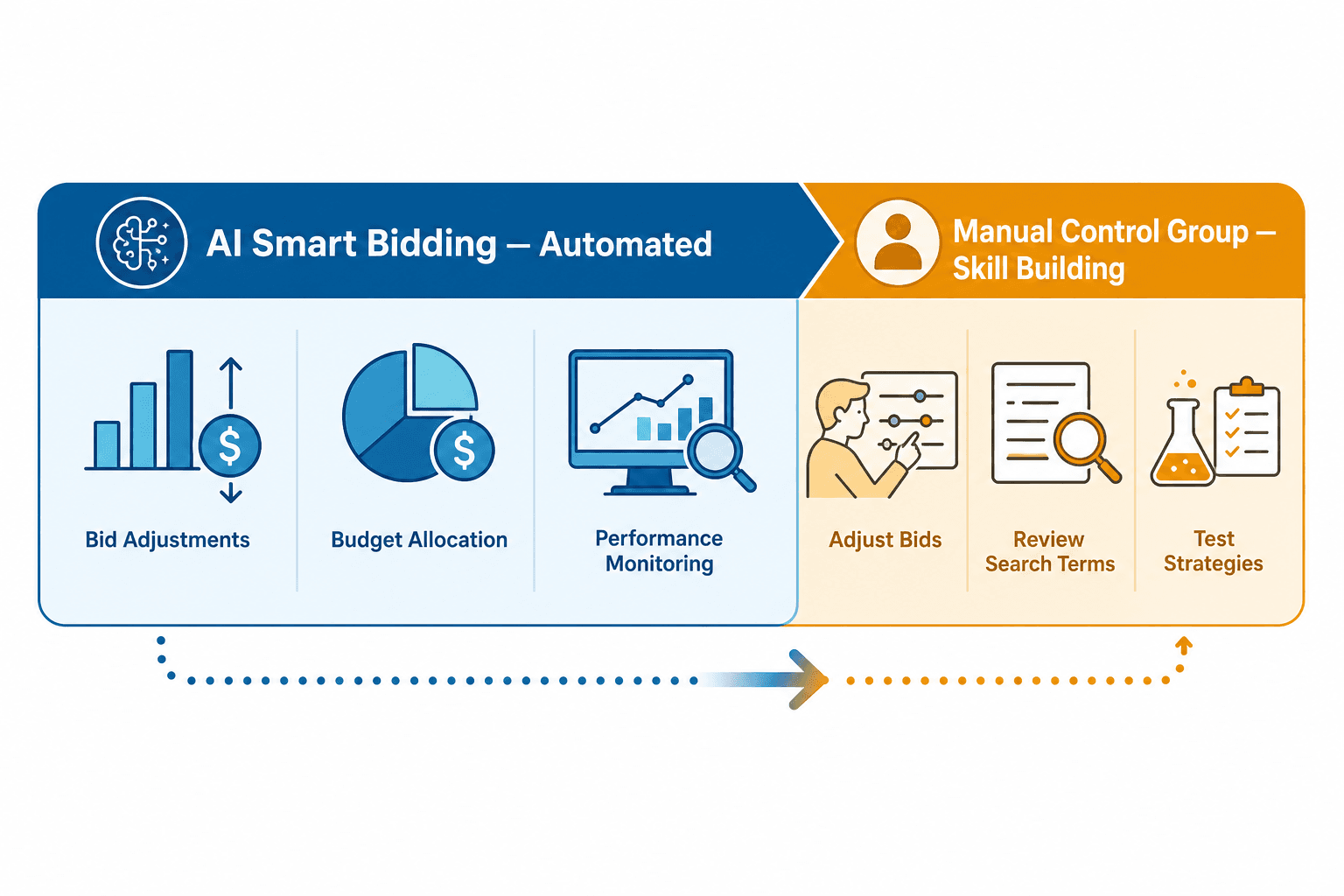
The most successful PPC teams do not choose between full automation and full manual control. They partition their spend into two groups: a primary group that runs on Smart Bidding and a control group that runs on manual or semi-manual strategies. The recommended split is 70–80% automated, 20–30% manual.
This hybrid model serves two purposes. First, it provides a performance baseline. When Smart Bidding campaigns show a 14% CVR improvement over the manual control group, you have direct, account-specific evidence that automation is working. When the automated campaigns underperform, you have a manual fallback that is already running and optimized.
Second, the manual control group functions as a skill-building sandbox. Teams that maintain active manual bid management retain the diagnostic ability to understand auction dynamics, keyword-level performance, and bid landscape changes. Teams that go fully automated lose this ability within 3–6 months.
| Approach | Best For | Key Risk | Skill Retention |
|---|---|---|---|
| 100% Smart Bidding | High-volume, stable accounts | Blindness to failure modes | Low — teams lose diagnostic ability |
| 100% Manual CPC | Low-volume, seasonal, or new accounts | Misses efficiency gains from automation | High — teams maintain full understanding |
| Hybrid (70–80% automated, 20–30% manual) | Most accounts | Requires disciplined campaign structure | High — teams retain skills while benefiting from automation |
Implementing the hybrid model requires thoughtful campaign structure. The manual control group should be a representative subset of your account — not just the low-priority campaigns. Include your highest-volume keywords, your branded terms, and at least one campaign from each major product or service line. This ensures the manual group provides a valid performance benchmark across all account segments.
For practitioners deciding how to structure their campaign splits, our Google AI Max for Search vs. Performance Max guide provides detailed configuration options, and our Power Pack guide covers how to run both products together without cannibalization.
Practical Escalation Triggers and Intervention Playbook
When a diagnostic signal crosses its escalation threshold, you need a clear intervention playbook. The following actions are ordered by increasing severity and should be applied based on the specific failure pattern you observe.
- Adjust Target CPA/ROAS by 20–30%. If the algorithm is underbidding during a demand surge or seasonal shift, raising the Target CPA temporarily can restore impression share. This is the least disruptive intervention and should be tried first.
- Pause automated campaign and revert to Manual CPC for affected campaigns. This is the appropriate response when CPA volatility exceeds 25% for three consecutive weeks or when the learning period extends beyond four weeks. Keep the automated campaign paused until you have accumulated enough conversion data to restart.
- Create separate branded and non-branded campaigns. Branded term underperformance (SIS < 40%) requires structural separation. Move branded keywords to a dedicated campaign with manual bidding or a separate Smart Bidding strategy with a more aggressive Target Impression Share.
- Audit search terms for broad match over-expansion. Performance Max and Smart Shopping automatically expand to broad match. Analysis of 200+ accounts shows 15–40% of spend goes to irrelevant broad match queries. Add negative keywords aggressively and consider switching to phrase or exact match for high-spend campaigns.
- Restructure campaigns by conversion volume. If multiple campaigns are below the 100-conversion threshold, consider merging them into a single campaign to increase signal density. This is a structural change that should be planned carefully to avoid disrupting existing performance.
For practitioners who need deeper configuration tactics, our Performance Max AI steering guide covers how to use asset groups, audience signals, and placement exclusions to guide the algorithm’s behavior without reverting to full manual control.
The Hidden Cost of Full Automation: Skill Atrophy and Diagnostic Blindness
There is a cost to full automation that does not appear in any P&L statement or performance report: the gradual erosion of your team’s ability to diagnose and fix problems when automation fails.
Bid management is a skill, not a configuration setting. Practitioners who spend 100% of their time managing automated campaigns lose the intuitive understanding of auction dynamics, keyword-level bid landscapes, and the relationship between match types and conversion performance. They become operators of a black box, not managers of a marketing channel.
The hybrid model addresses this directly. By maintaining 20–30% of spend in manual campaigns, teams retain the hands-on experience needed to diagnose automation failures. The manual group becomes a training ground where practitioners develop the pattern recognition skills that make them effective automation managers.
The practitioners who will thrive in the AI-driven PPC landscape are not those who adopt automation most aggressively. They are those who maintain the diagnostic skills to know when automation is working, when it is failing, and how to intervene effectively. The human-in-the-loop model is not a compromise between old and new approaches. It is the only approach that preserves both performance and capability over the long term.

Comments
Join the discussion with an anonymous comment.