
The 5-Layer AI Performance Marketing Stack: A Practical Architecture for Mid-Market Teams
This article provides a structured framework for mid-market marketing managers and growth leads to build or audit their AI performance marketing stack, covering five interconnected layers from research and creative to measurement and iteration, with specific operational thresholds and common pitfalls.
Why Single-Tool AI Adoption Fails
The most common mistake mid-market teams make when adopting AI in performance marketing is treating it as a tool-level decision. A team picks an AI creative generator, or flips on Google Smart Bidding, or buys an attribution platform — and then wonders why the aggregate lift is marginal. The reason is structural: AI performance marketing is not a feature you toggle. It is a system of interconnected layers, and deploying AI in only one layer while leaving the others manual creates bottlenecks that cap the overall return.
Consider a common scenario: a growth team invests in an AI creative tool that produces dozens of ad variants, but their targeting and bidding layer still relies on manual audience definitions and fixed bid adjustments. The creative volume generates more combinations than the targeting system can effectively test, so most variants never reach statistically meaningful spend. The result is wasted production effort and no measurable performance gain. The same dynamic plays out in reverse when a team automates bidding without feeding it enough creative diversity — the AI optimizes toward a narrow set of signals because it has nothing else to explore.
The data supports this. A Forrester survey found that 2 out of 3 enterprise B2C marketing leaders believe AI-driven creative testing and analytics improve efficiency and creative quality, and more than half said it would improve ROI and drive both brand and revenue growth. But those gains depend on the creative layer being connected to a measurement layer that can actually isolate incremental impact — not just report platform-attributed conversions. When the layers are disconnected, the AI optimizes toward the wrong signal, and the reported ROAS diverges from real business impact.
The solution is not to buy more tools. It is to build or audit your stack as a five-layer architecture where each layer feeds the next and receives feedback from the one after it. The following framework gives mid-market teams a concrete structure to evaluate their current setup and identify the gaps that are leaking performance.
The Five-Layer Architecture Defined
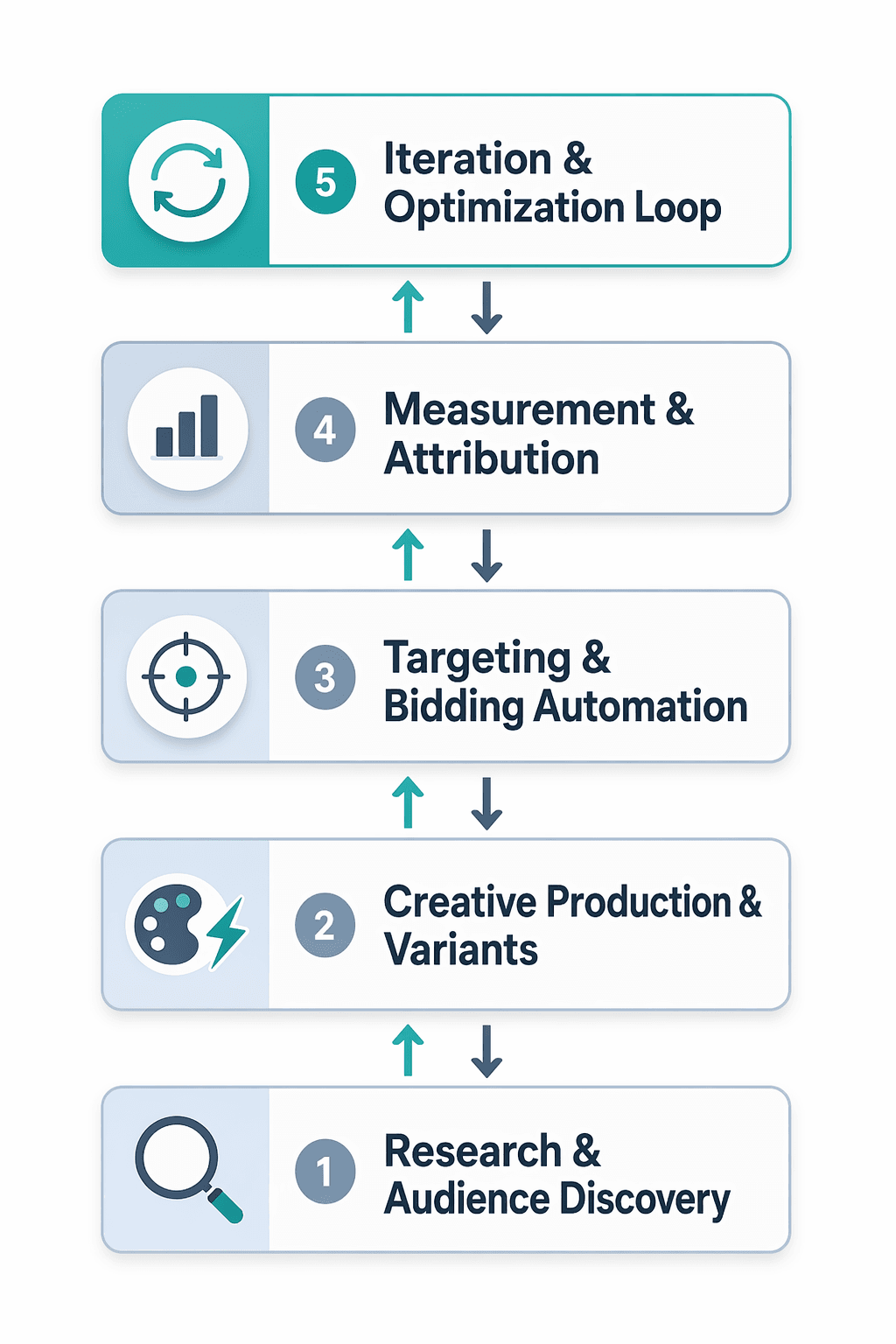
The AI performance marketing stack consists of five distinct layers, each with a specific function and a defined interface to the layers above and below it. They are not sequential in a strict waterfall sense — the system is designed for continuous feedback — but they do have a logical dependency order.
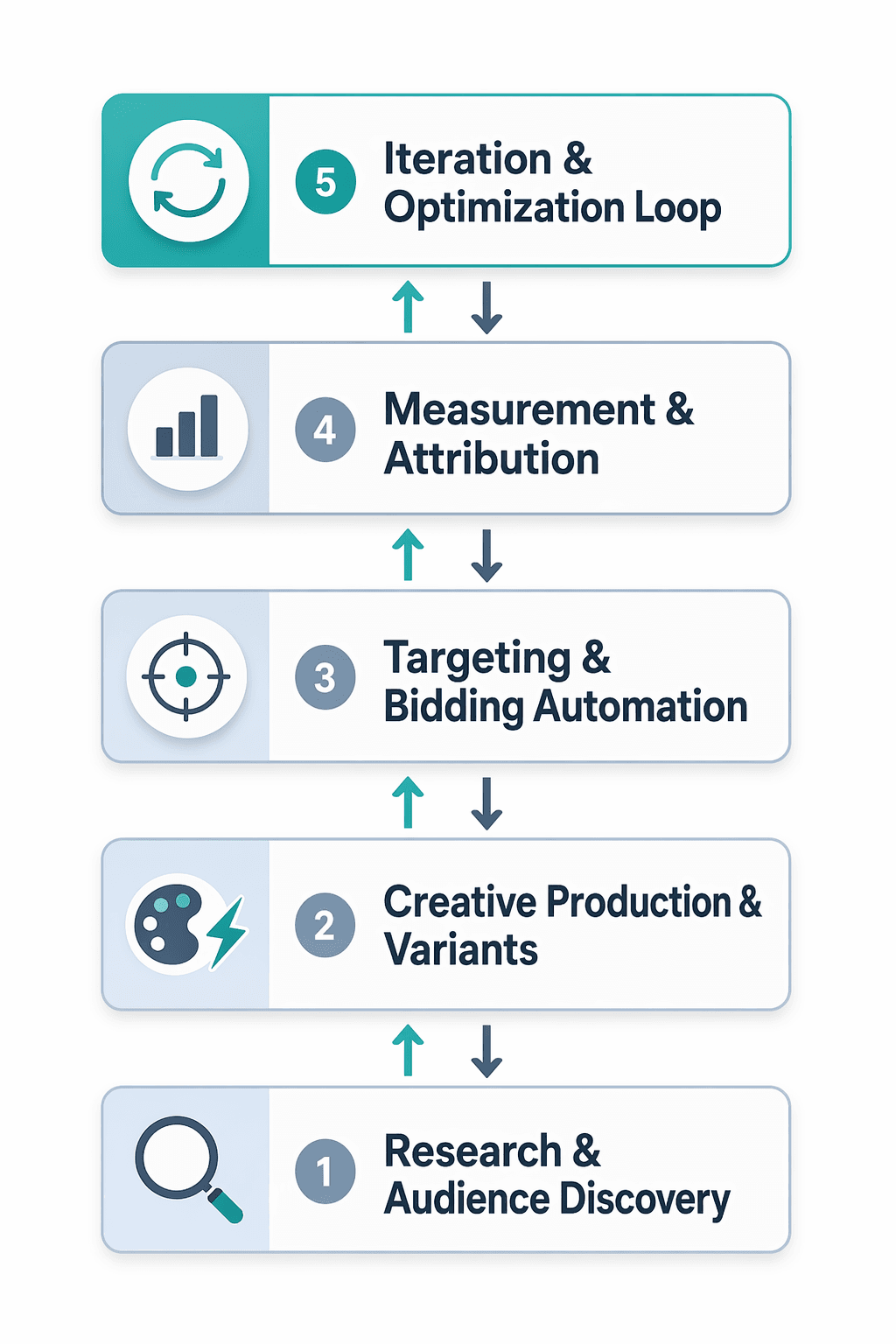
- Layer 1: Research & Audience Discovery — AI-driven analysis of audience segments, intent signals, and competitive landscape to inform creative strategy and targeting parameters.
- Layer 2: Creative Production & Variants — Generative AI tools that produce ad copy, images, video, and CTAs at scale, with systematic variation for testing.
- Layer 3: Targeting & Bidding Automation — AI-powered platforms that manage audience selection, bid adjustments, and budget allocation in real time.
- Layer 4: Measurement & Attribution — Systems that track performance, attribute conversions, and — critically — isolate incremental impact through causal methods like geo-based incrementality testing.
- Layer 5: Iteration & Optimization Loop — The process by which measurement outputs feed back into research and creative layers, closing the loop and enabling continuous improvement.
Each layer is described in detail below, with specific operational thresholds, platform examples, and the most common failure modes that mid-market teams encounter.
Layer 1: Research & Audience Discovery
The research layer is where AI moves beyond reactive optimization into proactive strategy. Instead of relying on last-click attribution or platform-demographic defaults, AI tools in this layer analyze first-party data, intent signals, and behavioral patterns to surface high-value audience segments that might not be obvious from a standard platform dashboard.
For mid-market teams, the practical output of this layer is a set of audience hypotheses that feed directly into creative production. For example, an AI audience discovery tool might identify that visitors who read three or more blog posts on a specific topic convert at a 4.4x higher engagement value than average — a finding that then dictates the creative angle and messaging for the next campaign wave. This is not a one-time exercise; the research layer should be refreshed as new data flows in from the measurement layer.
- Use predictive audience models to identify lookalike segments based on high-LTV customer attributes, not just conversion events.
- Analyze search query data and AI Overviews impact — AI search traffic has grown 527% year-over-year, and understanding which queries drive AI-referred traffic can inform both SEO and paid search audience strategies.
- Feed audience insights into creative briefs as structured inputs (e.g., primary pain point, preferred channel, content format preference), not as vague personas.
Layer 2: Creative Production & Variants
This is the layer where most teams start their AI journey, and for good reason: generative AI has made it dramatically faster and cheaper to produce ad creative. But the real performance lever is not the speed of production — it is the volume of systematic variation. The difference between uploading 3 creative variants and 12 is not linear. It can be dramatic.
The operational threshold here is clear: when launching on any major platform, upload at least 8 to 12 creative variants per campaign. This gives the AI in the targeting and bidding layer enough combinatorial surface to explore different audience-creative pairings. Fewer than 5 variants, and the bidding AI has limited room to optimize — it will converge quickly on a narrow set of signals, often the ones that are easiest to attribute rather than the ones that drive incremental business.
A Forrester survey found that 2 out of 3 enterprise B2C marketing leaders believe AI-driven creative testing and analytics improve efficiency and creative quality. But that improvement depends on the creative layer being connected to a measurement layer that can actually evaluate which variants drive incremental lift — not just which ones get the most impressions or clicks.
Layer 3: Targeting & Bidding Automation
The targeting and bidding layer is where AI automation has the most visible impact — and where the most common mistakes happen. Platforms like Google Ads and Meta Advantage+ now offer sophisticated AI-driven bidding strategies that can adjust bids in real time based on user signals, device, time of day, and hundreds of other contextual factors.
Google's Smart Bidding Exploration, for example, has been shown to deliver 27% more unique converting users while reducing manual budget adjustments by 66%. These are real efficiency gains, but they come with a critical caveat: the AI performs best when it has enough conversion signal to learn from.
| Signal Volume | Recommended Approach | Rationale |
|---|---|---|
| Fewer than 50 conversions per month per campaign | Manual bidding with human-defined audience constraints | Low signal volume causes AI to overfit to noise; manual controls provide necessary guardrails |
| 50-200 conversions per month per campaign | Hybrid: automated bidding with manual audience exclusions and bid caps | AI has enough signal to optimize within boundaries, but still benefits from human-defined constraints |
| 200+ conversions per month per campaign | Full AI automated bidding with broad audience targeting | Sufficient signal density for AI to explore and optimize across a wide range of variables |
The key insight is that AI bidding automation is not universally superior to manual bidding. In low-signal environments — defined as fewer than 50 conversions per month per campaign — manual bidding with human-defined audience constraints often outperforms full automation. The AI simply does not have enough data to distinguish signal from noise, and it will chase spurious correlations that degrade performance over time.
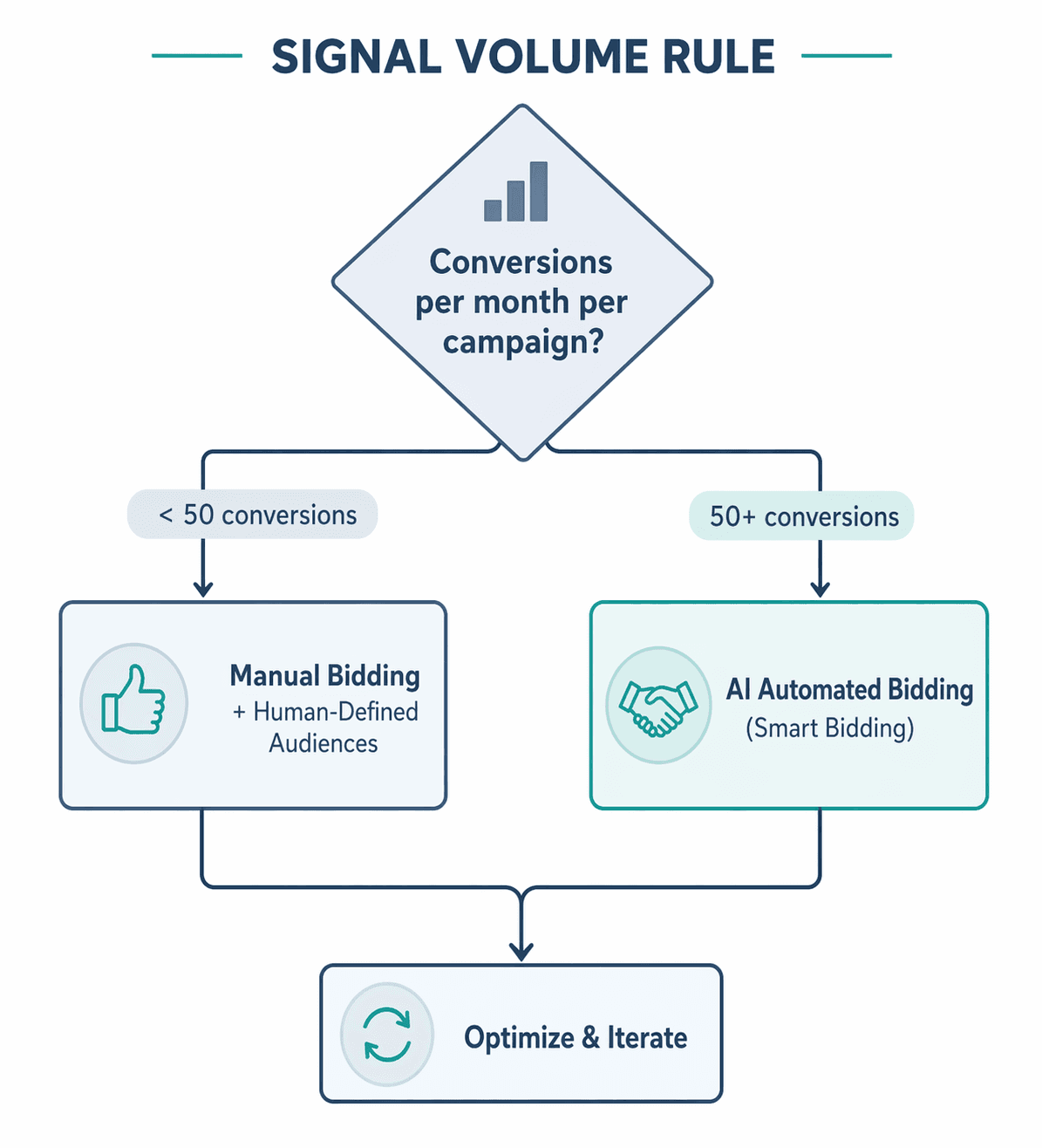
For mid-market teams, the practical takeaway is to audit your campaigns by conversion volume before deciding on a bidding strategy. A campaign with 30 conversions per month is not a candidate for full automation — it is a candidate for manual bidding with tight audience controls and a plan to increase signal density before scaling.
Layer 4: Measurement & Attribution
This is the layer where most AI performance marketing stacks break down. The reason is simple: platform-reported ROAS is not the same as actual business impact. An AI system optimizing toward attributed conversions will chase the easiest-to-attribute signals, which are often customers who would have converted anyway. The result is a reported ROAS that looks impressive but masks a much smaller incremental lift.
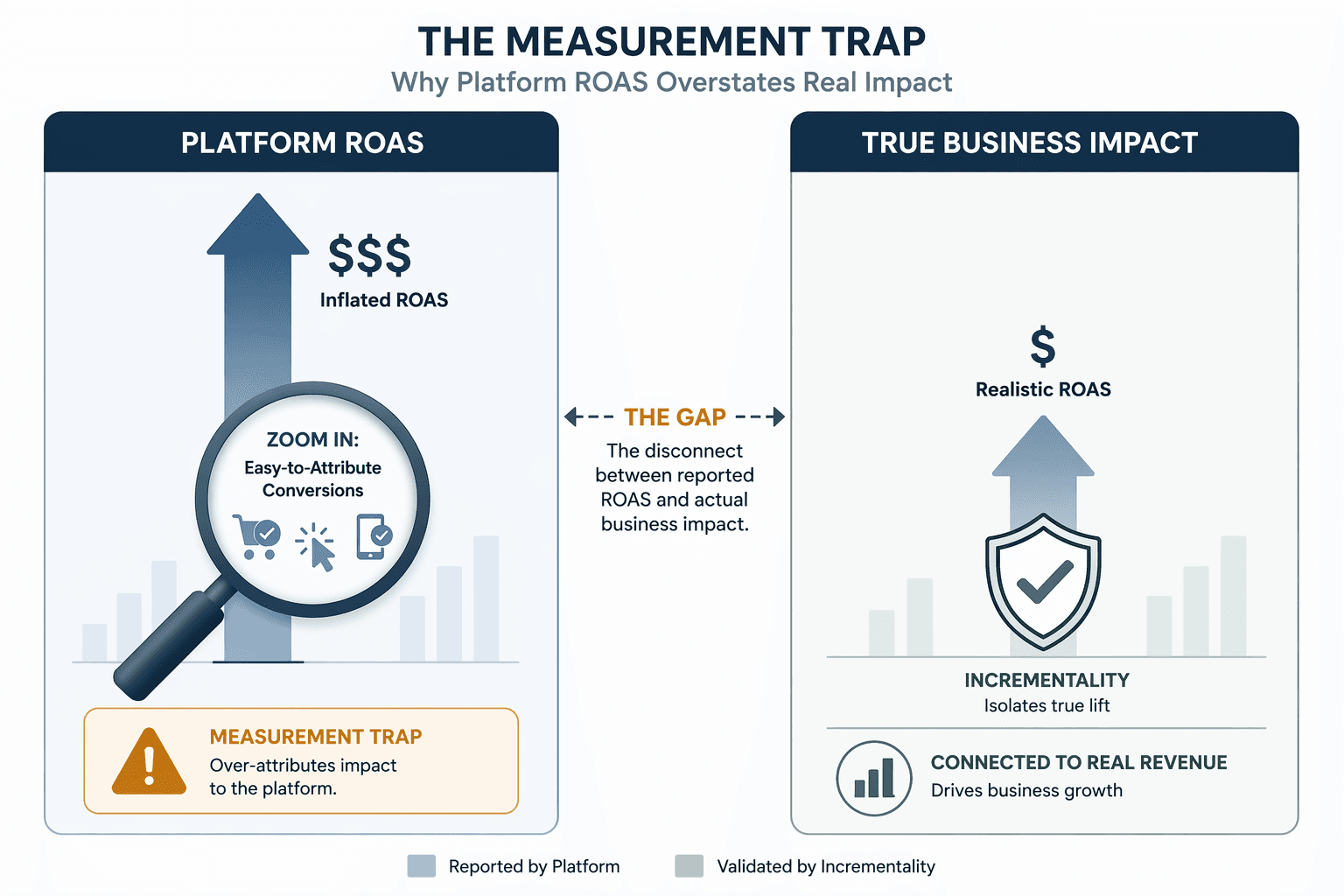
The solution is geo-based incrementality testing. Instead of comparing campaign periods or relying on last-click attribution, geo-based tests split a market into control and test regions, run the campaign only in the test region, and measure the difference in outcomes. This method isolates the causal impact of the campaign from external factors like seasonality, competitor activity, and organic trends.
| Requirement | Threshold | Why It Matters |
|---|---|---|
| Minimum conversions per test | 200 | Below this threshold, the statistical noise is too high to detect a reliable lift signal |
| Baseline period | 4-8 weeks | A shorter baseline cannot capture seasonal and weekly patterns, leading to false positives |
| Expected detectable lift range | 15-30% | Geo tests are designed to detect moderate-to-large lifts; smaller effects require larger samples or longer timeframes |
| Number of test/control pairs | At least 3 per region | Multiple pairs reduce the risk that a single anomalous region skews the result |
For teams that cannot run full geo tests, a practical alternative is to compare the performance of AI-optimized campaigns against a holdout segment that uses manual bidding and static creative. This is not as rigorous as a geo test, but it provides a directional signal that is more reliable than platform-reported ROAS alone.
Layer 5: Iteration & Optimization Loop
The iteration layer is where the stack becomes a system rather than a collection of tools. Its function is to take the outputs of the measurement layer — which creative variants drove incremental lift, which audience segments responded best, which bidding strategies minimized waste — and feed them back into the research and creative layers.
This is the layer most teams skip. They run a campaign, measure the results, and then start the next campaign from scratch — repeating the same research, producing new creative without learning from the old, and resetting the bidding strategy. The result is a series of isolated experiments rather than a compounding optimization process.
- Schedule a weekly or bi-weekly review where measurement outputs are translated into specific changes for the research and creative layers. For example: 'Variant D drove 22% higher incremental lift than the control. The creative angle used in Variant D should become the baseline for the next wave of variants.'
- Maintain a structured creative performance log that tracks which variants were tested, in which campaigns, and what the incrementality test showed. This prevents the team from re-testing the same failed concepts.
- Set a minimum spend threshold per variant before declaring a winner. In low-volume campaigns, this might mean running a variant for 2-3 weeks before making a decision, even if early data looks clear.
- Use the iteration loop to update audience definitions. If the measurement layer shows that a particular segment consistently underperforms, feed that signal back into the research layer to refine or retire that segment.
Operational Pitfalls to Avoid
Even with a clear architecture, mid-market teams encounter recurring problems that degrade the performance of their AI stack. The following pitfalls are the most common and the most damaging.
- Sparse conversion data: Running AI bidding automation on campaigns with fewer than 50 conversions per month. The AI overfits to noise, and performance degrades over time. Solution: use manual bidding until signal density increases, or consolidate campaigns to reach the threshold.
- Attribution volatility: Relying on platform-reported ROAS as the primary success metric. The AI optimizes toward easy-to-attribute conversions, inflating reported ROAS while incremental lift remains flat. Solution: implement geo-based incrementality testing or at minimum a holdout segment.
- Creative test leakage: Running too many creative variants simultaneously without sufficient budget per variant to reach statistical significance. The AI spreads spend thinly, and no variant gets enough data to inform a decision. Solution: limit simultaneous tests to 4-6 variants and set a minimum spend threshold per variant.
- Stalled optimization loop: Running a campaign, measuring results, and then starting the next campaign without feeding learnings back into research and creative. Each campaign starts from zero. Solution: schedule a structured iteration review and maintain a creative performance log.
- Ignoring AI Overviews impact: AI Overviews now appear for 15% of search queries, reducing organic CTR by 18% on average and up to 47% for informational queries. This changes the traffic landscape for paid search and should inform both keyword strategy and audience targeting.
Audit Checklist: Does Your Stack Connect All Five Layers?
Use the following checklist to evaluate your current AI performance marketing stack. For each layer, assess whether you have the capability in place and whether it is connected to the adjacent layers. A checkmark in every row does not guarantee success, but a missing row guarantees a bottleneck.
| Layer | Key Question | Pass Criteria | Common Failure Mode |
|---|---|---|---|
| 1. Research & Audience Discovery | Do you use AI to identify high-value audience segments before creating creative? | Audience insights are documented and fed into creative briefs as structured inputs | Skipping this layer entirely; jumping straight to creative production |
| 2. Creative Production & Variants | Do you produce at least 8-12 distinct creative variants per campaign? | Each variant tests a different angle, offer, or visual approach; minor text swaps do not count | Producing 3-4 variants and expecting the bidding AI to optimize effectively |
| 3. Targeting & Bidding Automation | Is your bidding strategy matched to your conversion signal volume? | Campaigns with <50 conversions/month use manual bidding; 50+ use automated bidding with appropriate guardrails | Running full automation on low-signal campaigns |
| 4. Measurement & Attribution | Do you measure incremental lift, not just platform-reported ROAS? | Geo-based incrementality testing or holdout segment in place; platform ROAS is not the primary metric | Relying on platform ROAS as the success metric |
| 5. Iteration & Optimization Loop | Do measurement outputs feed back into research and creative layers? | Structured iteration review scheduled; creative performance log maintained; learnings applied to next cycle | Starting each campaign from scratch without incorporating prior learnings |
If your team is missing one or more layers, start by filling the gap in the order presented. The research layer is the most common missing piece, but the measurement layer is the most critical for long-term performance. Without reliable measurement, the iteration loop has no signal to act on, and the entire stack degrades into a series of disconnected experiments.
The five-layer architecture is not a theoretical model. It is a practical framework that mid-market teams can use to audit their current setup, identify the specific gaps that are limiting performance, and build a roadmap for connecting the layers into a single, compounding system. The teams that do this consistently outperform those that treat AI as a set of isolated tools.


Comments
Join the discussion with an anonymous comment.