
AI Advertising Companies: A Practical Category Guide for Paid Media Teams
The AI advertising market is crowded, but most evaluations fail because they treat all vendors as comparable. This guide maps companies by functional category — creative generation, campaign automation, signal-based targeting, platform-native AI, and measurement — so paid media teams can match company type to use case with realistic criteria.
Most searches for AI advertising companies run into the same problem: the market looks like one category until someone has to buy, integrate, launch, QA, and explain the thing. A creative generation platform, a campaign automation system, an AI-enabled DSP, a contextual targeting vendor, and an attribution tool may all promise “better performance,” but they are not solving the same problem.
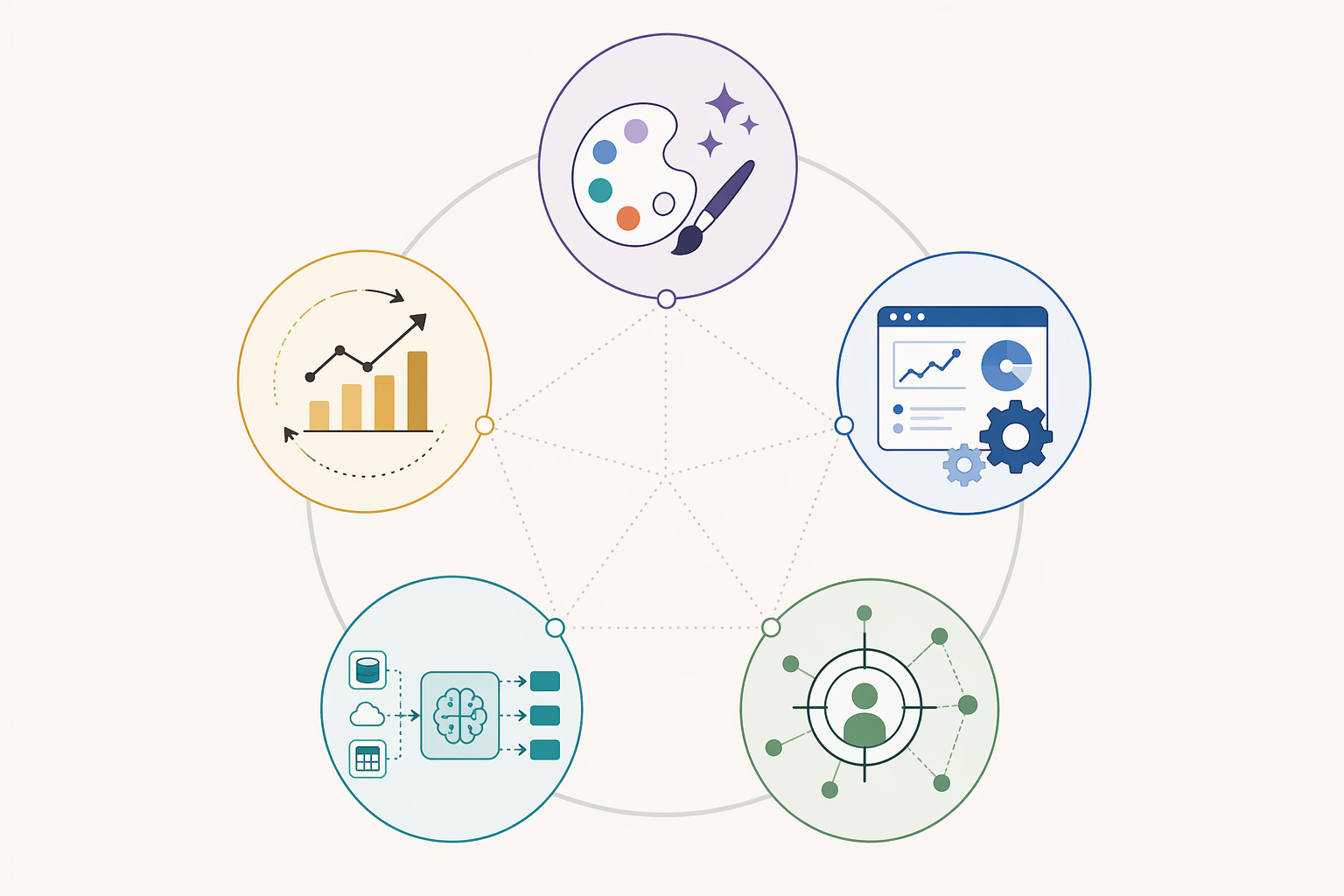
A more useful map starts with five functional buckets:
- Creative generation: tools that help produce, adapt, localize, or version ad creative.
- Campaign automation and optimization: systems that reduce manual work across setup, pacing, bidding, budget movement, testing, and reporting.
- Signal-based targeting: companies that use contextual, behavioral, predictive, or first-party signals to improve audience selection or media relevance.
- Platform-native AI in DSPs and ad platforms: AI built directly into the media-buying environment.
- Measurement and attribution: tools that help teams decide what worked, where budget should move, and how much confidence to place in the result.
That distinction matters because adoption is no longer the interesting part on its own. The IAB reports that 83% of ad executives have deployed AI in the creative process, up from 60% in 2024, and that cost efficiency has become the top cited benefit at 64% [1]. Smartly’s 2026 report highlights a similar tension: 95% of marketers are testing AI for creative production, yet 42% still classify themselves as being in “initial testing” [2]. In other words, a lot of teams are touching the tools. Fewer have turned them into dependable operating systems.
| Company type | Best buying question | Typical fit | Main overpromising pattern |
|---|---|---|---|
| Creative generation | Can we produce more useful variants without breaking brand, legal, or channel standards? | Teams with high creative volume, many formats, many markets, or frequent refresh cycles | Treating faster asset production as proof of better creative strategy |
| Campaign automation and optimization | Which manual decisions can the system safely handle, and which still need human control? | Paid media teams managing multiple campaigns, channels, budgets, or clients | Bundling workflow savings and performance lift into one vague promise |
| Signal-based targeting | What signals does the company use, and are they durable enough for our media mix? | Teams trying to improve relevance, reduce dependence on legacy identifiers, or scale contextual buying | Presenting platform-specific lift as a universal benchmark |
| Platform-native AI | Does the AI improve buying inside the platform we already use? | Programmatic teams already operating in DSPs or large ad platforms | Making black-box optimization sound like strategy |
| Measurement and attribution | Will this improve decision confidence, or only create another reporting layer? | Teams with fragmented data, unclear incrementality, or internal pressure to justify budget movement | Confusing modeled certainty with real-world proof |
Creative generation companies: useful when volume is the bottleneck
Creative generation is usually the first AI advertising category teams encounter because the pain is obvious. Paid social needs more variants. Retail media needs more product-specific assets. Video teams need cutdowns. Regional teams need localized copy. Someone is always waiting on the next round of assets before a test can go live.
The best creative AI companies do not simply generate images or copy. They sit somewhere inside the production workflow: brief intake, concepting, versioning, resizing, translation, compliance review, dynamic creative assembly, or post-launch learning. That placement matters more than the demo output. A tool that produces attractive mockups but cannot preserve required claims, naming conventions, aspect ratios, usage rights, or approval history will become another side workflow for the media team to babysit.
The buying question is not “Can this tool make ads?” It is “Where does this tool remove friction from the creative supply chain, and who still owns judgment?” A lean growth team may want rapid concept variation and channel-ready exports. A regulated brand may care more about locked templates, approval trails, and claim control. An agency may need client-level workspaces, permissioning, and reporting that shows what changed between rounds.
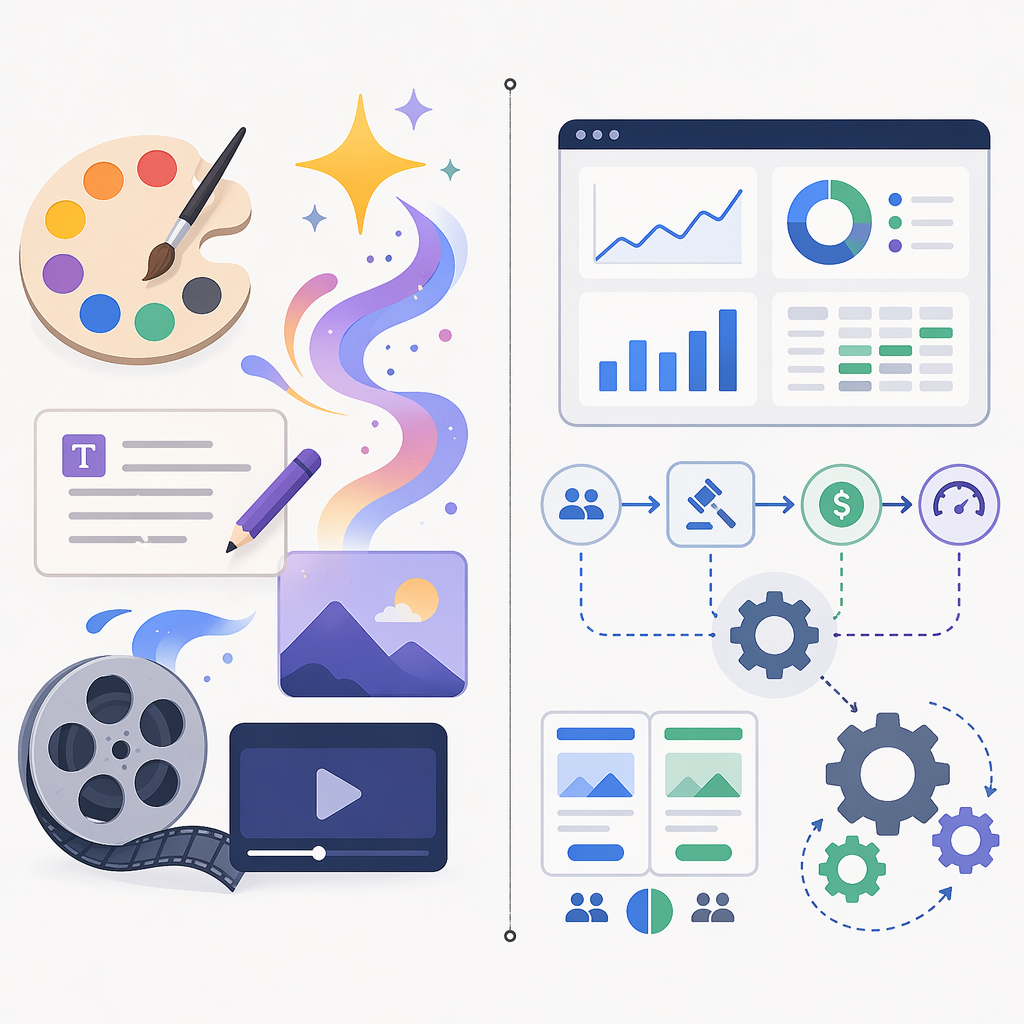
This is also where inflated expectations show up quickly. A shorter production cycle can give media buyers more shots on goal, but it does not automatically produce sharper positioning, better offers, or cleaner testing design. If a team feeds the same weak brief into a faster system, the output usually becomes a larger pile of similar assets. The operational win is real; the strategic win still has to be earned.
For teams evaluating this category, the pilot should look like actual work, not a gallery review. Give the vendor a real campaign brief, brand constraints, channel specs, approval requirements, and a deadline. Then inspect what happens after the first draft: how variants are tracked, how feedback is applied, how rejected concepts are handled, and whether the final files reduce production burden for the people launching campaigns.
For a deeper workflow lens, the AI creative advertising playbook is the more useful next read than another generic list of image and copy tools.
Campaign automation and optimization: the control problem hiding behind the performance promise
Campaign automation companies tend to sound broader than creative tools because they touch more of the media operation. They may automate buildouts, budget allocation, bid adjustments, pacing alerts, audience expansion, creative rotation, anomaly detection, or reporting. Some are channel-specific. Some sit across paid social, search, programmatic, and retail media. Some are closer to workflow software than performance engines.
That breadth is useful, but it makes vendor comparisons messy. One platform may save trafficking time. Another may improve budget reallocation. Another may surface underperforming segments faster than a human analyst would. Those are different outcomes, and they should not be collapsed into one “AI optimization” bucket.
Smartly reports that 41% of marketers still take three to four weeks to launch a campaign from asset creation to execution [2]. That figure is a reminder that automation often creates value before it touches an algorithmic bidding decision. If campaign setup requires too many handoffs, duplicated naming conventions, manual exports, approval loops, and spreadsheet checks, the first gain may be cycle-time reduction rather than lower CPA.
The hard part is deciding what the system is allowed to change. A media buyer can usually tolerate automation that drafts naming structures, flags pacing risk, or recommends budget shifts. Letting a platform move budget across campaigns, expand audiences, or pause creative without review is a different level of trust. The more directly the tool changes spend, the more the team needs guardrails, audit logs, override controls, and a clear escalation path when performance moves for reasons the model did not anticipate.
A practical evaluation should separate four questions:
- What work disappears? This is the workflow question: build time, QA time, reporting time, or analysis time.
- What decisions move faster? This is the operating question: pacing, testing, budget movement, creative refresh, or channel allocation.
- What decisions become automated? This is the control question, and it should be explicit before a pilot starts.
- What proof will count? This is the measurement question: time saved, fewer errors, better spend allocation, or performance lift against a defined baseline.
The common mistake is to buy the category as if automation and optimization are the same thing. They overlap, but they are not interchangeable. A system can be excellent at reducing manual campaign work while having only modest direct impact on conversion efficiency. Another can improve bidding or budget movement but require enough integration and oversight that a small team struggles to operate it well.
This is where team size and media complexity matter. A two-person paid media team may need fewer dashboards and more reliable defaults. A multi-brand agency may need permissions, client separation, repeatable workflows, and review trails. An in-house performance team with mature analytics may care less about prebuilt recommendations and more about whether the tool can pass data cleanly into its existing decision process.
If the real decision is whether to hire outside help or adopt software, the adjacent question is covered more directly in AI Marketing Companies in 2026: Agency vs. Platform – How to Decide. If the team already knows it wants software but needs a governance model, the automation-versus-oversight framework in AI Performance Marketing in 2026 is the better next step.
Signal-based targeting companies: inspect the signal before the lift claim
Signal-based targeting companies sell a more specific promise: better relevance. They may use contextual signals, page-level semantics, predictive audience modeling, first-party data enrichment, commerce signals, attention signals, or combinations of these inputs. The category has become more important as teams look for ways to reduce dependence on brittle audience assumptions and platform defaults.
This is also a category where the headline claim can get ahead of the evidence. Vendor-reported ROAS improvements can be useful as directional proof that a method has worked inside a platform or customer set, but they are not neutral market benchmarks unless the methodology is transparent. A claim based on internal platform data is not the same thing as an independent audit, and a strong result in one vertical does not guarantee the same effect in another.
The first evaluation question should be boring in the best way: what signals are actually being used? “AI-powered targeting” is too broad to evaluate. A contextual engine that classifies content in real time, a predictive model trained on conversion patterns, and a clean-room activation partner are different buying decisions. They have different data requirements, different privacy implications, and different failure modes.
Paid media teams should ask vendors to show how targeting logic changes campaign setup. Does the tool replace audience selection, enrich it, or only recommend segments? Does it require first-party data? Can the team exclude sensitive categories? How are brand suitability, frequency, and reach controlled? If the vendor cannot explain the input signals in plain operational language, the platform will be difficult to defend when performance fluctuates.
Platform-native AI: strongest when the team already buys that way
Platform-native AI shows up inside DSPs, social platforms, search platforms, retail media networks, and other buying environments. This includes automated bidding, budget pacing, audience expansion, creative rotation, inventory selection, forecasting, and recommendation systems. The advantage is obvious: the AI is close to the auction, the delivery data, and the controls media buyers already use.
The tradeoff is that platform-native intelligence is usually bounded by the platform’s own incentives, data access, and reporting model. It may be very good at optimizing within a walled environment while giving the advertiser less clarity about cross-channel effects. That does not make it bad; it makes fit more specific.
For teams already active in programmatic, the evaluation should focus on how the AI affects buying mechanics: inventory access, bid logic, frequency control, supply-path decisions, creative decisioning, and reporting transparency. A team that does not have programmatic operations, data hygiene, and media governance in place may find that a powerful DSP creates more operational surface area than it can manage.
The deeper channel-specific questions belong in a programmatic guide, not in a generic vendor list. For that, see AI in Programmatic Advertising or the more comparison-oriented guide on choosing an AI-powered programmatic platform.
Measurement and attribution companies: where confidence is either earned or manufactured
Measurement and attribution AI companies are less glamorous than creative generators and less visible than buying platforms, but they often determine whether the rest of the stack gets renewed. Their job is to help teams interpret fragmented performance signals, model outcomes, spot anomalies, forecast budget impact, or reconcile platform-reported results with business metrics.
The danger in this category is false precision. A model can make reporting look more complete without making the decision more reliable. Before buying, teams should be clear about which decision the tool is meant to improve: weekly budget reallocation, channel mix planning, incrementality testing, creative learning, executive reporting, or finance reconciliation. “Better attribution” means very different things in each of those rooms.
Integration burden usually shows up here first. Measurement tools need access to ad platform data, web analytics, CRM or conversion data, cost data, naming conventions, and sometimes offline outcomes. If those inputs are inconsistent, the AI layer may spend more time smoothing messy data than producing trustworthy recommendations. A vendor that asks hard questions about data quality during the sales process is often doing the buyer a favor.
This category should be evaluated with a small set of real decisions. Give the vendor recent campaign data and ask what budget, creative, or channel action would have changed. Then compare that recommendation against what the team knew at the time, what it learned later, and what the business actually cared about. The output does not need to be magical. It needs to be defensible.
How to compare AI advertising companies without turning the process into a demo contest
A decent shortlist starts by removing vendors that are not solving the current bottleneck. If the team cannot produce enough compliant assets, start with creative generation. If campaigns take too long to launch or optimize, look at automation. If reach and relevance are the problem, inspect targeting signals. If the team already spends heavily in programmatic, evaluate platform-native AI. If stakeholders do not trust the results, measurement comes first.
Criteo’s 2026 guidance on AI advertising platforms points to evaluation areas such as data quality, transparency, privacy, optimization capability, creative relevance, and measurement [3]. Those are reasonable criteria, but they become much more useful when tied to the specific company type being evaluated. Transparency in a creative tool means knowing how assets are generated, approved, and reused. Transparency in a DSP means understanding bidding, inventory, and delivery controls. Transparency in attribution means seeing assumptions, data inputs, and model limitations.
A paid media team can usually make the first cut with six checks:
- Use case fit: the vendor should map to one primary job, not every marketing ambition in the deck.
- Workflow fit: the tool should reduce work in the places where the team actually loses time.
- Control model: the buyer should know which actions are recommended, automated, or blocked without approval.
- Data requirements: the team should understand what data the system needs, where it comes from, and who maintains it.
- Evidence quality: performance claims should be labeled as independent, vendor-commissioned, or vendor-reported.
- Operating cost: pricing is only part of the burden; integration, QA, training, and governance also consume budget.
The fastest way to waste evaluation time is to compare companies across categories as if they are substitutes. A creative platform and an attribution platform may both influence performance, but they do it from opposite ends of the operating system. A DSP’s AI and an independent targeting vendor may both affect audience quality, but one is embedded in the buying environment while the other may be evaluated on portability and signal differentiation.
Pilots should be designed around the category’s real claim. For creative generation, measure production speed, usable variant rate, approval friction, and downstream test quality. For automation, measure launch time, manual touches removed, error reduction, and decision latency. For targeting, measure reach quality, conversion efficiency, and signal explainability against a defined baseline. For platform-native AI, measure performance inside the buying environment while watching control and transparency. For measurement, test whether the tool changes a decision that the team can later defend.
Match the company type to the next decision
The practical next step is not to find the “best” AI advertising company in the abstract. It is to name the decision the team needs to improve.
| If the current problem is... | Start with... |
|---|---|
| Too few usable assets, slow refresh cycles, or too much manual versioning | Creative generation companies |
| Slow launches, scattered workflows, inconsistent optimization, or too much manual campaign management | Campaign automation and optimization companies |
| Weak relevance, overdependence on legacy audiences, or poor signal clarity | Signal-based targeting companies |
| Programmatic buying complexity, auction-level optimization, or DSP workflow questions | Platform-native AI |
| Unclear performance truth, budget confidence issues, or fragmented reporting | Measurement and attribution companies |
Once that match is clear, the shortlist gets smaller and the sales conversation gets better. Ask the creative vendor to show governed production, not just attractive samples. Ask the automation vendor what it will and will not change without approval. Ask the targeting vendor to explain the signal. Ask the DSP how its AI changes buying mechanics. Ask the measurement company which decision it would have changed last month.
That is enough structure to move from browsing to a real comparison, pilot, or channel-specific deep dive without pretending every AI advertising company belongs in the same race.
References
- The AI Ad Gap Widens, IAB.
- 2026 Digital Advertising Trends Report, Smartly, 2026.
- What to look for in an AI advertising platform in 2026, Criteo, 2026.
Comments
Join the discussion with an anonymous comment.