
The AI Creative Advertising Playbook: How to Build Governed Workflows That Actually Deliver Performance
A practical playbook for senior marketing managers and agency leaders moving from ad-hoc AI experiments to repeatable, governed ad creative workflows. Covers the five-pattern system behind winning 2026 campaigns, a reusable governance template, and how to measure success without sacrificing brand quality.
Why Most AI Ad Creative Experiments Stall
The adoption numbers look impressive on paper. According to the IAB's January 2026 survey of 104 ad industry executives, 83% of ad executives now say their company has deployed AI in the creative process, up from 60% in 2024. That is a rapid climb by any standard. But a closer look at how those deployments are structured tells a different story.
Smartly's 7th Annual Digital Advertising Trends Report, based on a survey of 450 marketing leaders worldwide, found that 46% of marketers now use AI to scale creative, but 42% of those using generative AI still classify their approach as 'initial testing'. Nearly half the organizations that have adopted AI for creative work have not moved beyond the experimental phase. They are generating assets, but they have not built the operational structure needed to produce consistent, on-brand work at scale.
The failure pattern is consistent across teams: they prioritize speed and volume over structure and governance. A creative director asks a designer to "run some prompts through Midjourney" for a campaign. The designer produces fifty variations in an afternoon. The team picks three. The campaign launches. The results are mediocre, the brand voice is inconsistent, and the process is impossible to replicate for the next campaign. The team concludes that AI creative is overhyped and goes back to their old workflow.
This is not an AI capability problem. It is a workflow problem. The tools are powerful enough. What is missing is the system around them — the source material strategy, the brand guardrails, the human quality gates, and the repeatable process that turns a one-off experiment into a reliable production line.
The 5-Pattern System Behind Winning AI Ad Campaigns
When you examine the campaigns that have delivered measurable results with AI-generated creative — not just press releases, but campaigns with sourced outcomes — a consistent structural pattern emerges. These campaigns do not share a specific tool or model. They share a workflow architecture. Across the case studies documented by Pragmatic Digital, Superside, and StackAdapt, five patterns recur.
- Proprietary source material shapes the output. The most effective campaigns do not ask AI to generate creative from scratch. They feed it proprietary data, brand-specific imagery, or first-party audience signals that constrain the output toward something unique to the brand.
- Brand standards are built into the workflow, not bolted on after. Successful teams encode brand voice guidelines, visual style rules, and messaging hierarchies into the prompt frameworks and model fine-tuning before generation begins.
- Human review remains the quality gate. AI generates volume. Humans curate, edit, and approve. The ratio varies by campaign, but the gate is never removed.
- AI is applied to a defined use case, not scattered across everything. The teams that get results pick one specific creative task — personalization at scale, localization, rapid concepting, or asset variation — and build a workflow around that task before expanding.
- The process is repeatable and improves over time. Each campaign generates not just creative assets but also workflow data — which prompts worked, which review criteria caught issues, which source material produced the best outputs — that feeds back into the next cycle.
These five patterns are not theoretical. They are observable across the four campaigns detailed in the next section, each of which demonstrates one pattern in action while supporting the broader system.
Pattern in Practice: Four Campaigns That Built Governed Workflows
The following four campaigns are drawn from documented case studies published by Pragmatic Digital and Superside. Each illustrates one of the five patterns as the primary driver of success, but all four exhibit the full system to some degree.
Kalshi: Speed and Cost Through a Defined Use Case
The prediction market platform Kalshi needed a commercial for the NBA Finals on an impossible timeline and budget. Using AI video tools including Google's Veo 3 and OpenAI's Sora, the team produced a finished ad in under 72 hours for approximately $2,000 — a fraction of the typical production cost and timeline for a national sports event spot.
What made this work was not the tools themselves. It was the tight definition of the use case. The team did not ask AI to generate a brand strategy or a creative concept. They had a specific brief — a 30-second spot for a specific event — and they constrained the AI's role to execution within that brief. The human team handled concept, script, and final edit. AI handled the visual generation and iteration. The defined use case prevented scope creep and kept the workflow fast.
Virgin Voyages: Personalization Through Proprietary Source Material
Virgin Voyages' 'Jen AI' campaign used a virtual Jennifer Lopez to create personalized, interactive cruise invitations at scale. The key structural decision was the source material: the campaign drew on first-party customer data and brand-specific content to shape the AI output, rather than relying on generic generative models.
This is the proprietary source material pattern in action. By feeding the AI model with real customer preferences, booking history, and brand interaction data, Virgin Voyages ensured that each personalized invitation was genuinely relevant to the recipient, not just a name-swapped template. The result was a personalization effort that felt bespoke because it was built on proprietary inputs that competitors could not replicate.
H&M: Scale Through Built-In Brand Guardrails
H&M created 30 AI-generated digital twins of real models to scale global advertising production. The challenge was maintaining brand consistency across hundreds of assets while producing them faster than traditional photoshoots would allow.
H&M's solution was to encode brand standards directly into the AI workflow before generation began. The digital twins were built from controlled source photography. The visual style, lighting, and composition parameters were locked into the model configuration. The AI could generate variations within those constraints, but it could not deviate from the brand's visual identity. This is the brand guardrails pattern: the standards were not applied as a post-production filter — they were the production framework.
British Council: Localization Through a Repeatable Process
The British Council used AI design automation tools like Creatopy to localize over 1,000 ad assets across seven languages. The scale of this task — producing culturally and linguistically appropriate creative for dozens of markets — would have been prohibitively expensive and slow with a traditional production workflow.
The repeatable process pattern is the standout here. The British Council did not treat each market as a one-off creative project. They built a standardized localization workflow: source template → language adaptation → cultural review → output. Each asset passed through the same process, and the process itself improved as the team learned which localization parameters produced the best results in each market. The workflow became a production line, not a series of isolated tasks.
The Governance-First Workflow Template
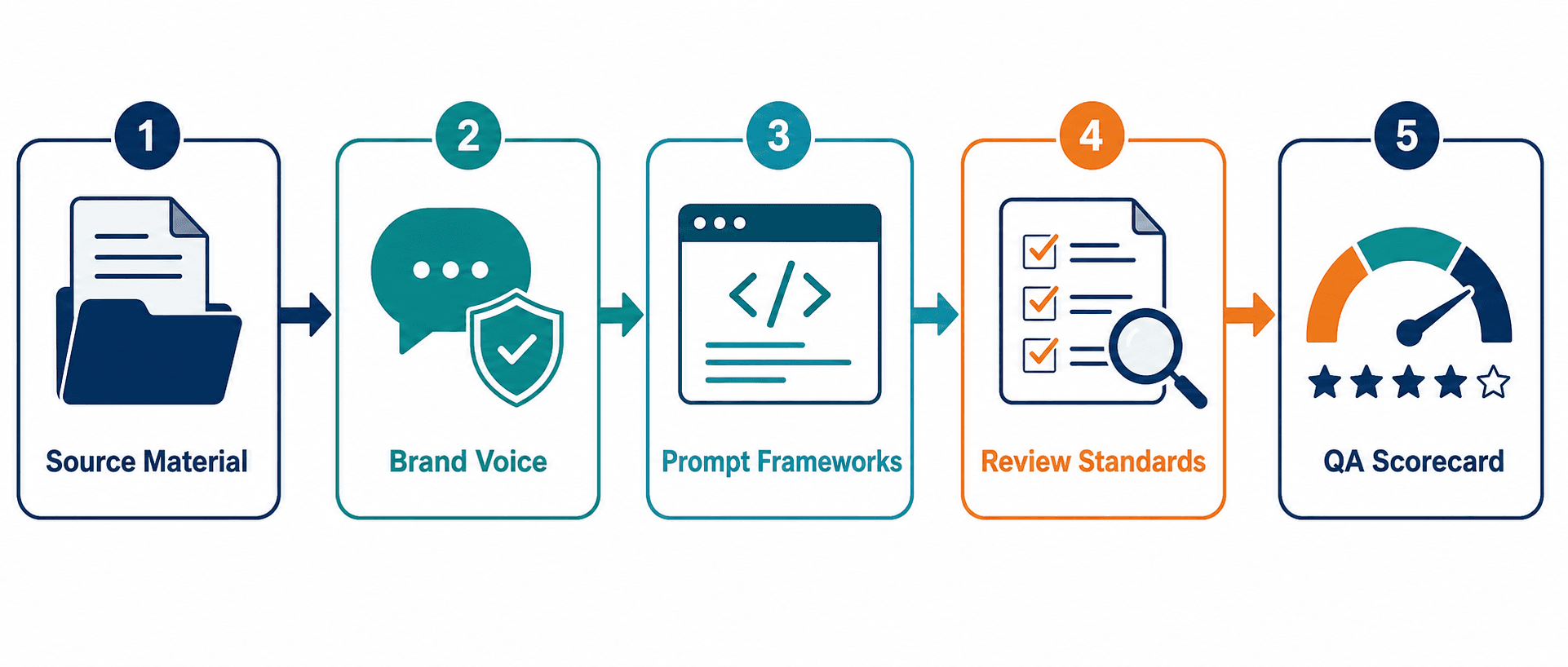
The five patterns are useful as a diagnostic framework, but they become actionable only when translated into a concrete workflow. The following template is designed to be adapted for any team size, campaign type, or AI tool stack. It consists of five stages, each with a specific purpose and a defined output.
| Stage | Purpose | Key Output |
|---|---|---|
| Source Material Mapping | Identify and prepare the proprietary data, imagery, and brand assets that will constrain and guide AI output. Without this stage, the AI has no reference for what makes your brand distinct. | A source material inventory: brand photography, product images, customer data segments, voice guidelines, and past high-performing creative. |
| Brand Voice Capture | Translate brand guidelines into machine-readable prompt parameters. This includes tone descriptors, vocabulary rules, messaging hierarchies, and visual style constraints. | A brand voice specification document formatted for prompt injection or model fine-tuning. |
| Prompt Frameworks | Build reusable prompt templates for each defined use case (headline generation, image creation, video concepting, localization). Each template includes fixed brand parameters and variable campaign-specific inputs. | A prompt library with tested templates, versioned against the specific AI model generation they were verified on. |
| Review Standards | Define the human quality gate criteria: what constitutes a pass, a revise, or a reject. Include brand voice adherence, factual accuracy, visual consistency, and regulatory compliance checks. | A review scorecard with specific, measurable criteria for each asset type. |
| QA Scorecard | Track quality metrics across campaigns: revision rate, brand voice adherence score, time-to-launch, and revision cycle reduction. Use this data to refine source material, prompts, and review standards for the next cycle. | A per-campaign QA report that feeds back into Stage 1. |
This template is not a one-time setup. It is a living system. Each campaign generates data that improves the next cycle. The source material inventory expands as new brand assets are created. The prompt library is updated when models change. The review scorecard becomes more precise as the team identifies recurring quality issues.
How to Measure Success Beyond CTR and CPC
Performance metrics like CTR, CPC, and ROAS remain essential for evaluating campaign effectiveness. StackAdapt's internal data from their 'State of Programmatic Advertising 2026' report shows that campaigns using dynamic creative optimization (DCO) deliver a 32% higher click-through rate and a 56% lower cost per click. Advertisers using AI-powered first-party data targeting see up to 2X higher return on ad spend compared to third-party targeting. These are meaningful benchmarks.
But performance metrics alone do not tell you whether your AI creative workflow is healthy. A campaign with strong CTRs might still be eroding brand distinctiveness if the creative looks like every other brand in the category. Smartly's data confirms that 86% of marketers have seen AI outputs that resemble competitor content — a problem that CTR cannot detect.
A complete measurement framework for governed AI creative workflows should include both performance metrics and output quality metrics.
| Metric Category | Specific Metric | Why It Matters |
|---|---|---|
| Performance | CTR, CPC, ROAS, conversion rate | Standard campaign effectiveness measures. Use DCO benchmarks (32% higher CTR, 56% lower CPC) as reference points. |
| Speed | Time-to-launch (days from brief to live campaign) | Smartly found that only 3.6% of marketers can launch a campaign in under a week. Track your improvement against this baseline. |
| Quality | Revision cycle reduction (average number of revisions per asset) | A governed workflow should reduce revisions over time as prompts and review standards improve. |
| Quality | Brand voice adherence score (% of assets passing brand review on first submission) | Measures whether your brand guardrails are working. Low scores indicate a gap between prompt frameworks and actual output. |
| Quality | Asset distinctiveness score (internal audit against competitor creative) | A qualitative check: does the AI-generated creative look like it could belong to another brand? If yes, your source material or guardrails need adjustment. |
Common Pitfalls and How to Avoid Them
Even with a governed workflow in place, teams encounter recurring problems. The following three pitfalls are the most frequently documented across the campaigns and surveys reviewed for this playbook.
Pitfall 1: AI Sameness
The data is stark. Smartly's 2026 report found that 86% of marketers have seen AI outputs that resemble competitor content, and 3 in 4 respondents are concerned that AI-generated creative risks making brands 'look and sound the same.' This is not a theoretical risk — it is the current state of the market.
Mitigation: The proprietary source material pattern is your primary defense. The more unique data and brand-specific content you feed into the AI workflow, the less likely the output is to resemble generic or competitor creative. If your prompt framework consists of "write a Facebook ad for [product]" with no brand-specific constraints, you will get generic output. If your prompt framework includes your brand voice document, your top-performing past headlines, and your audience segmentation data, the output will be distinct.
Pitfall 2: Consumer Trust Erosion
The IAB's January 2026 survey documented a 37-point perception gap between advertiser and consumer sentiment about AI-generated ads: 82% of ad executives believe consumers feel positive about AI-generated ads, but only 45% of consumers actually do. That gap has widened from 32 points in 2024. Meanwhile, the percentage of consumers calling a brand 'innovative' for using AI dropped from 30% in 2024 to 23%, while advertiser belief that AI signals innovation increased from 40% to 49%.
Mitigation: Disclosure is not optional. The IAB data shows that disclosure is the third-highest driver of consumer attention, behind high-quality visuals and funny content. More than half of consumers want AI video (57%) and AI images (54%) disclosed. A governed workflow should include a disclosure check as part of the review standards stage. Additionally, 69% of consumers feel manipulated when brands use AI for advertising without disclosing it, according to a Smartly consumer study cited by BCG.
Pitfall 3: Legal Grey Zones in AI-Generated Creative
Copyright uncertainty around AI-generated content remains unresolved. A survey cited by StackAdapt from the IAPP and multiple organizations identifies IP issues as one of the top AI risks, alongside algorithmic bias, hallucinations, and data privacy. Over 70% of marketers have encountered an AI-related issue, but fewer than 35% plan to increase AI governance investment in 2026.
Mitigation: Treat every AI-generated asset as requiring human provenance review. Ensure that source material used for model training or prompt injection is either owned by your organization or properly licensed. Document the creative chain — what was AI-generated, what was human-created, and what was modified — for each asset. This documentation is not just legal protection; it is also the foundation for the QA scorecard stage of your workflow.
The gap between AI adoption and operational readiness is the defining challenge for advertising teams in 2026. The tools are not the bottleneck. The workflow is. Teams that invest in governed, repeatable systems — built around proprietary source material, brand guardrails, human quality gates, defined use cases, and continuous improvement — will produce better creative, faster, with less risk. Teams that continue to treat AI as a speed-and-volume shortcut will produce generic work that erodes brand distinctiveness and consumer trust.

Comments
Join the discussion with an anonymous comment.