

AI Marketing Agency vs Platform Decision Guide
Confused whether to hire an AI marketing agency or buy a self-serve AI platform? This article provides a six-factor decision framework—channel complexity, internal capability, timeline, budget, measurement sophistication, and risk tolerance—to help mid-market marketing managers make a defensible call and present it to leadership.
Marketing Categories
The phrase “AI marketing companies” has become too broad to be useful on its own. In 2026, it can mean an agency that uses AI-native workflows to deliver campaigns for you, or it can mean a self-serve platform your team uses to produce, analyze, or automate work internally. Those are not variations of the same purchase. They create different obligations after the contract is signed.
That distinction matters because AI usage is no longer rare enough to be a differentiator by itself. Salesforce reports that 87% of marketers now use generative AI in at least one workflow, which means “we use AI” should be treated as a starting claim, not a buying argument.[1] The better question is whether you are buying outside operating capacity or internal software leverage.
A useful budget conversation does not start with “Which AI marketing company is best?” It starts with “Which buying model fits our constraints?” The six factors below are the simplest way to keep that conversation from drifting into vendor theater.
| Decision factor | Usually points toward an agency when... | Usually points toward a platform when... |
|---|---|---|
| Channel complexity | You need strategy, production, testing, and reporting across several channels that affect each other. | You have a narrow, repeatable use case such as content drafting, asset variation, or campaign analysis. |
| Internal capability maturity | Your team lacks AI workflow design, prompt operations, QA discipline, or time to manage the system. | Your team already has trained users, clear processes, and an owner for adoption. |
| Timeline pressure | Leadership needs visible movement quickly and the internal team cannot absorb the ramp. | You can tolerate onboarding, experimentation, and slower internal process change. |
| Budget band | You can fund managed delivery and need scope that justifies agency fees. | You need a lower recurring software cost and can supply the labor internally. |
| Measurement sophistication | You need help defining what success should mean across channels and funnel stages. | You already know which metrics matter and can connect platform activity to business outcomes. |
| Risk tolerance | A failed implementation would create meaningful revenue, brand, compliance, or executive risk. | The use case is contained enough that mistakes are recoverable and easy to inspect. |
What You Actually Buy With an AI Marketing Agency
An agency purchase is a capacity purchase before it is a technology purchase. The useful agencies are not merely faster copy shops with ChatGPT accounts. They bring a delivery model: research intake, channel planning, production workflows, review checkpoints, experimentation cadence, and reporting rituals. If they have rebuilt those steps around AI, the client is buying a managed operating system for marketing execution.
That is also why the category has split into specialties. RZLT’s 2026 guide groups AI marketing agencies into buckets such as full-service AI, SEO/AEO, paid media AI, content AI, and influencer AI.[2] That spread is useful, but it also creates the first failure mode: hiring a credible AI agency for the wrong job. A team with a search visibility problem does not need the same partner as a team trying to rebuild lifecycle marketing, paid acquisition, and creative testing at once.
Directional pricing reflects that spread. Third-party agency guides show benchmarks ranging from about $2,500 per month for specialist AEO or SEO work to about $50,000 per month for full-service enterprise transformation, with actual pricing depending on scope, market, vertical, and geography.[2][3][4] That is too wide to treat “agency” as one budget line. It is a clue that the underlying purchase can be anything from a focused specialist retainer to a quasi-operating partner.
The strongest agency cases are specific about what changed. Omniscient reports that Monks delivered a 62% higher conversion rate for Headspace, and M1-Project reports examples such as Daydream generating 19.8 million programmatic clicks and NoGood driving a 23x increase in AI search traffic for SteelSeries.[4][5] Those are not universal agency outcomes. They are examples of why the workflow behind the claim matters: the result came from applying AI to a defined marketing system, not from using a generic model somewhere inside the creative process.
The red flag is the agency whose AI explanation stops at “we use ChatGPT for copy” or “we have AI tools in our process.” A more serious evaluation asks for the actual workflow: how customer language becomes prompts, where proprietary agents or repeatable templates sit, who reviews outputs, what gets tested, what is rejected, and how learning flows back into the next cycle. If that sounds like too much detail for a sales call, it is exactly the detail your team will wish it had asked for six weeks later.
What You Actually Buy With an AI Marketing Platform
A platform purchase is different. You are buying software leverage, not managed execution. The platform may draft content, generate variants, automate research, analyze audiences, score leads, or orchestrate agents. But the internal team still has to decide where the tool fits, who uses it, how outputs are reviewed, and which metric proves it is worth renewing.
Digital Applied reports that median mid-market AI tool spend reached $3,400 per month in Q1 2026, up from $1,200, with a 4.2-month median payback period.[3] That makes platforms look financially approachable compared with many agency retainers. It also makes them easy to under-budget operationally. The invoice may sit in software, but the real cost includes training, workflow design, governance, QA, and management attention.
The ROI spread by use case is the part worth bringing into a finance conversation. Digital Applied, citing McKinsey’s 2026 global AI survey, reports 3.2x ROI for content drafting, 2.7x for personalization, 2.4x for audience research, and 1.4x for lead scoring; AI video tools are reported at 1.1x to 1.6x.[3] The point is not that one use case is permanently good and another is permanently bad. The point is that “AI platform” is not a single ROI category. The payback depends heavily on the job you assign to the software.
This is where many platform purchases quietly disappoint. The team buys a capable tool, runs two onboarding sessions, and assumes adoption will spread because the interface is impressive. But if no one owns prompt quality, output review, data hygiene, experiment design, or reporting, the tool becomes another tab people open when they remember it exists.
Start With Channel Complexity
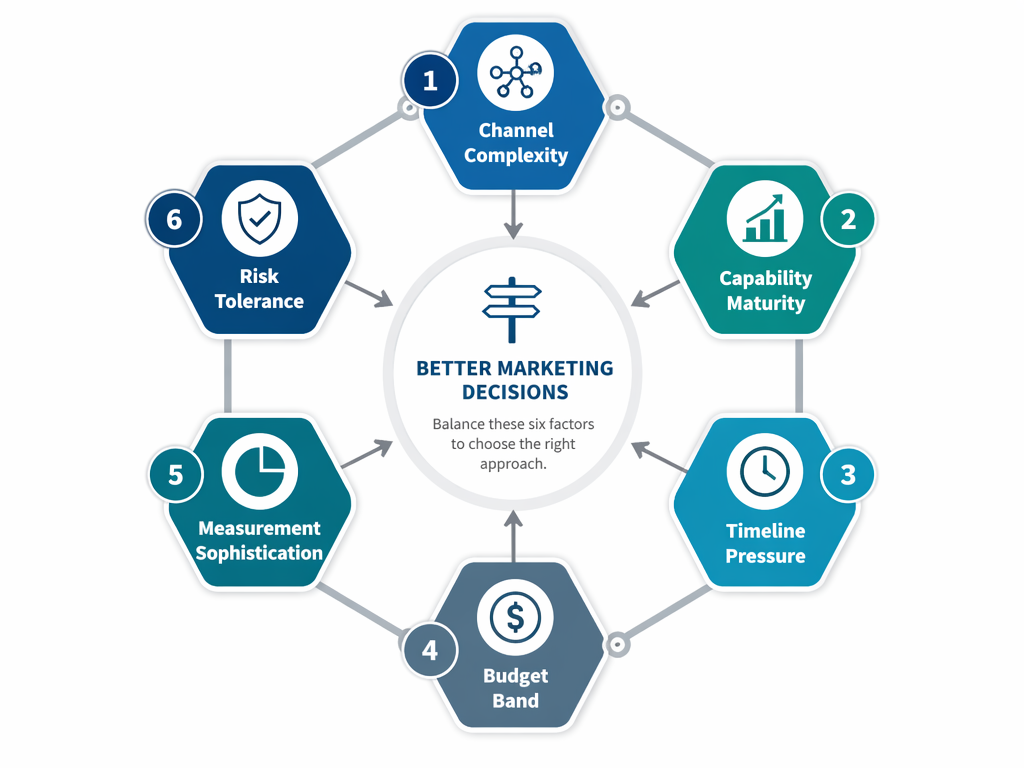
Channel complexity does more sorting work than almost any other factor. If the problem sits inside one contained workflow, a platform deserves a serious look. If the problem cuts across search, paid media, lifecycle, website conversion, content operations, sales enablement, and reporting, software alone may simply expose how many disconnected decisions your team has been holding together manually.
A narrow content operation is a platform-friendly case. For example, a team that already has a strong editorial lead, documented brand voice, clear review rules, and a backlog of product-led topics may use an AI writing or repurposing platform effectively. The work is high-volume, repeatable, and inspectable. The team can see whether the tool is reducing draft time, increasing output, or improving reuse of existing material.
A multi-channel demand generation problem is less forgiving. If paid search performance depends on landing page messaging, which depends on audience segmentation, which depends on sales feedback, which affects nurture content and retargeting creative, the tool is not the whole answer. Someone has to sequence the work, decide what to test first, maintain creative and data feedback loops, and prevent each channel owner from optimizing in isolation.
The newer GEO and AEO work makes this more visible. Agencies are now packaging services around AI search visibility and answer-engine discovery, while many internal teams are still trying to determine how those surfaces connect to SEO, PR, content structure, and demand capture.[2] That does not automatically mean an agency is required. It does mean the channel question has changed: discovery no longer lives only in the search results page your team already knows how to measure.
Then Be Honest About Internal Capability
Capability maturity is where the budget deck often gets too optimistic. A platform proposal can look efficient because the vendor demo compresses the hard parts: clean inputs, skilled users, fast review, clear success metrics, and no competing priorities. Real teams have calendar conflicts, partial training, old campaign taxonomies, and three people who know how the lead source fields actually work.
The adoption numbers are revealing. Salesforce reports broad generative AI usage, but Digital Applied notes that only 17% of professionals have received comprehensive AI training.[1][3] That gap is the platform trap. Adoption at the individual workflow level does not mean the organization can operate an AI-enabled marketing system reliably.
A capable internal team has more than curiosity. It has named owners for tool administration, enablement, governance, and measurement. It has standards for what can be generated, what must be reviewed, what data can be used, and what outputs are unacceptable. It has enough marketing judgment to know when an AI-generated recommendation is plausible but wrong.
If those pieces are missing, an agency can be the safer first move, even if a platform looks cheaper. The agency is not magically better because it is external. It is better when it supplies the operating muscle the internal team does not yet have. That may include workflow design, prompt systems, production QA, campaign sequencing, and executive reporting.
If those pieces are present, buying a platform may be the stronger call. A trained internal team that already knows its audience, channels, data quirks, and approval process can extract more value from a tool than an outside partner can from a limited onboarding window. In that case, hiring an agency may add coordination overhead rather than capacity.
Use Timeline Pressure as a Constraint, Not an Excuse
Timeline pressure changes the answer, but it should not suspend judgment. If the board wants pipeline movement this quarter, and the team is already overloaded, an agency may be the only realistic way to add execution capacity quickly. That is especially true when the work requires strategy, production, testing, and reporting to move together.
A platform can also move fast when the use case is already defined. Content variant production, sales email personalization, keyword clustering, ad copy exploration, and campaign reporting are all more plausible quick-start cases than a full marketing operating model rebuild. The smaller the workflow surface area, the more believable the platform timeline.
The warning sign is a platform business case that counts software activation as implementation. Procurement, security review, integration, training, workflow redesign, approval rules, and measurement setup all take time. If those steps are not in the plan, they will appear later as delays, inconsistent usage, or messy outputs that someone on the marketing team has to clean up.
Budget Band Should Include Labor, Not Just Vendor Cost
On paper, platforms usually look easier to approve. A few thousand dollars per month can fit into a software line, especially when compared with a five-figure agency retainer. But that comparison is incomplete if the platform requires internal labor your team does not actually have.
Agency spend should be judged against the work it removes or accelerates: strategy time, production time, analysis time, coordination time, and management time. Platform spend should be judged against the value of the internal capacity it amplifies. If the team is already at capacity, the lower invoice may simply move the cost from finance-visible vendor spend into less visible staff strain.
Digital Applied reports that 33% to 50% cost savings versus traditional agencies may be possible for comparable production deliverables, but also reports that 29% of agent deployments are abandoned within 90 days.[3] That combination is the useful lesson. AI can reduce production cost when the operating model works. It can also burn budget quickly when the organization buys capability it cannot absorb.
Measurement Decides Whether the Bet Can Be Defended
Measurement sophistication is not just a reporting issue. It affects which buying model is safer. If your team can connect activity to business outcomes, run clean tests, and distinguish leading indicators from revenue impact, a platform can be measured and tuned internally. If not, you may need a partner that can help define the scorecard before the work scales.
This is especially important because AI marketing returns vary by use case. A team using AI for content drafting should not borrow the ROI assumption for personalization, lead scoring, or video production. The business case should name the workflow, the baseline, the expected improvement, the measurement window, and the person accountable for interpreting the result.
For a platform, the metric owner usually sits inside the company. For an agency, the agency may produce the reporting, but the internal team still owns the business interpretation. Either way, “the vendor will show us ROI” is not a measurement plan. It is a hope with a dashboard attached.
Risk Tolerance Is the Final Check
Some AI marketing work is low-risk. A draft outline, a campaign brief, a first-pass keyword cluster, or an internal summary can be reviewed before it reaches the market. Other work touches regulated claims, sensitive customer data, executive communications, paid media waste, or public brand reputation. Those should not be treated as the same implementation risk.
A platform is easier to justify when the blast radius is small and the team has review discipline. An agency is easier to justify when mistakes would be expensive, visible, or hard to unwind, provided the agency can show its own governance model. That includes human review checkpoints, escalation rules, source handling, permissions, and a clear explanation of who is accountable when AI-assisted work goes wrong.
Autonomous agents make this check more important. Digital Applied reports that 34% of enterprise teams run autonomous agents in production, up from 14% in Q4 2025, while 29% of agent deployments fail within 90 days.[3] Those figures support a narrow conclusion: agent adoption is moving, but operational failure is common enough that governance cannot be treated as a post-launch cleanup task.
How to Present the Decision Internally
A defensible recommendation should sound less like a vendor endorsement and more like an operating choice. The cleanest version is short: “We are choosing an agency because the work is multi-channel, the internal team lacks mature AI operations, the timeline is tight, and the risk of poor execution is high.” Or: “We are choosing a platform because the use case is narrow, the team is trained, the workflow is repeatable, and we can measure payback internally.”
For leadership, put the six factors into a simple scorecard before vendor comparison begins. That prevents the most polished demo from redefining the problem. It also makes tradeoffs visible: a lower platform cost may come with higher internal labor; a higher agency retainer may reduce implementation risk; a specialist agency may beat a full-service partner when the problem is narrow; a platform may beat both when the team already has the muscle to use it.
- Choose an agency when the work crosses channels, the team needs operating capacity, the timeline is compressed, and mistakes would be costly.
- Choose a platform when the use case is narrow, repeatable, measurable, and owned by a trained internal team.
- Delay or narrow the purchase when the team cannot name the workflow, metric owner, review process, or adoption plan.
- Treat hybrid models carefully: an agency plus platform can work, but only if ownership is explicit and the team avoids paying twice for the same capability.
If you need a deeper vendor evaluation layer after choosing the buying model, use an AI agency evaluation framework for agency due diligence, or compare software options with a marketing AI stack comparison. Those are second-stage decisions. The first-stage decision is whether you need an external operator or an internal tool.
The Practical Answer
There is no useful winner between AI marketing agencies and AI marketing platforms in the abstract. The agency is the better purchase when the company needs managed execution across messy, interdependent work. The platform is the better purchase when the company has a capable team and a contained workflow where software can multiply output without creating unmanaged risk.
The budget line should name the buying model, not just the category. “AI marketing company” is too vague to defend. “Agency-led execution for a complex multi-channel problem” or “platform-led production for a trained internal team” is a decision a VP or CFO can inspect. That is the standard the purchase has to meet.
References
- State of Marketing 2026, Salesforce, https://www.salesforce.com/marketing/marketing-statistics/
- Best AI Marketing Agencies in 2026: The Definitive Guide by Specialty, RZLT, https://www.rzlt.io/blog/best-ai-marketing-agencies-in-2026-the-definitive-guide-by-specialty
- AI Marketing Statistics 2026: Adoption Data Points, Digital Applied, https://www.digitalapplied.com/blog/ai-marketing-statistics-2026-adoption-data-points
- Best AI Marketing Agencies, Omniscient, https://beomniscient.com/blog/best-ai-marketing-agencies/
- 10 Best AI Marketing Agencies: In-Depth Comparison, M1-Project, https://www.m1-project.com/blog/10-best-ai-marketing-agencies-in-depth-comparison

Comments
Join the discussion with an anonymous comment.