
AI Marketing Agency
Learn how to separate genuine AI integration from rebranded services with a practical, vendor-neutral framework for evaluating AI marketing agencies, grounded in observable criteria and real market data.
Marketing Categories
⚠ Notable Limitations
Label overused; many agencies rebrand traditional services as AI; requires verifying claims with process artifacts
The problem with evaluating an artificial intelligence marketing agency is that the label now covers too much ground. One agency uses AI to draft ad variations faster. Another builds workflow automations between your CRM, analytics stack, and sales team. Another sells synthetic product imagery. Another claims to be “AI-first” because someone added ChatGPT to the content process.
Those are not the same offer. They do not solve the same business problem, they do not require the same operating model, and they should not be evaluated with the same questions. If the pitch collapses strategy, creative, media, analytics, automation, and proprietary tooling into one impressive-sounding sentence, the buyer’s job is to uncollapse it.
There is also a timing issue. Search behavior is already shifting toward AI-mediated discovery: one industry-cited figure says 51% of B2B buyers now begin research with AI chatbots. Treat that as a signal, not a mandate. It does not mean every brand needs the same kind of AI agency. It means vendors, competitors, and buyers are all moving faster than the old agency vocabulary can handle.
A useful evaluation starts by refusing to ask, “Is this agency AI?” That question gives agencies too much room to perform. The better question is: Which kind of AI capability are we actually buying, and can the agency show it in the way work gets done?
The four models behind the same overused label
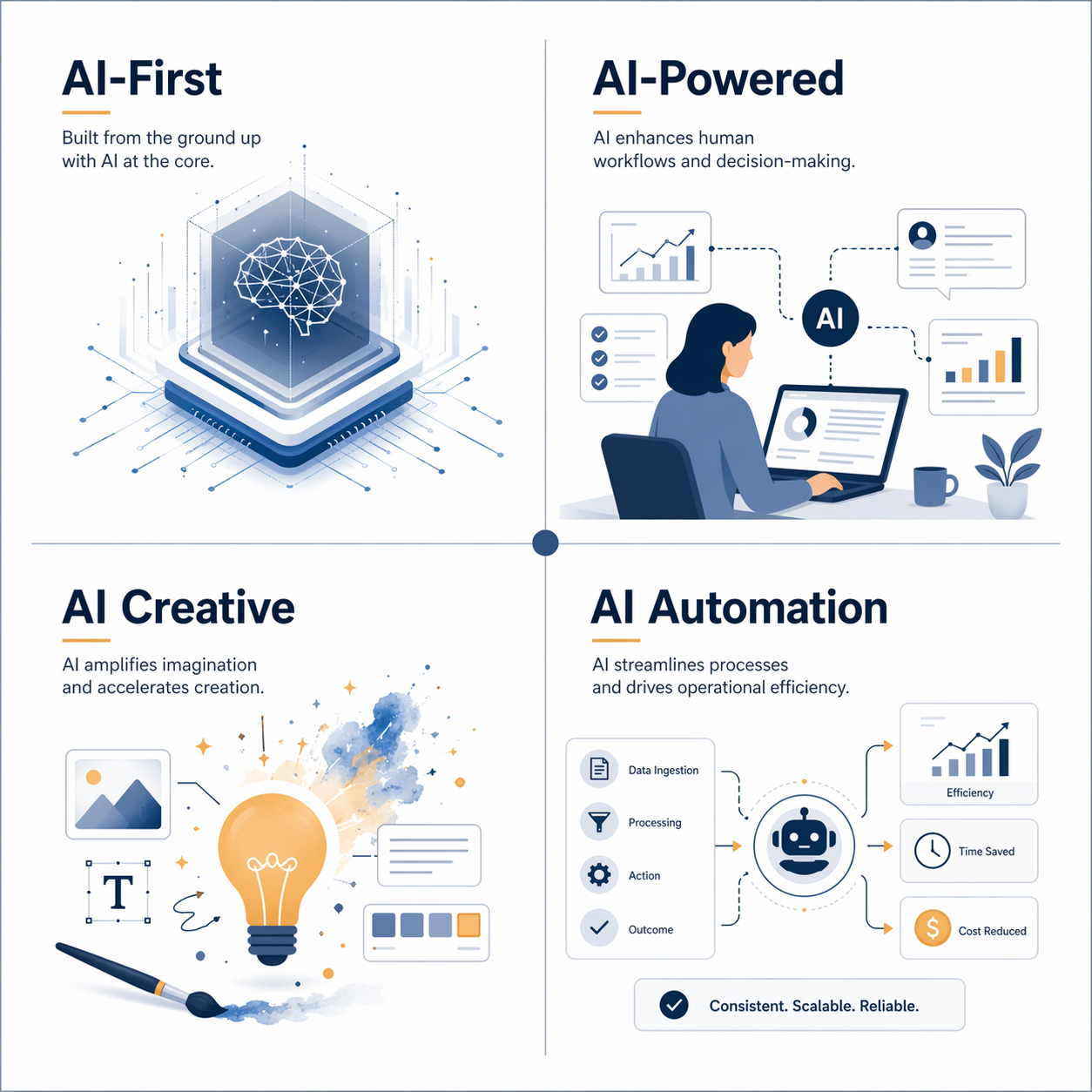
Digital Agency Network’s 2026 agency taxonomy is helpful because it separates the market into four models: AI-First, AI-Powered, AI Creative, and AI Automation agencies. The point is not that every agency will fit perfectly into a quadrant. The point is that the buyer finally gets a cleaner way to ask what is actually being sold. [1]
| Agency model | What the AI capability usually centers on | Best-fit buyer problem | What should be visible in evaluation |
|---|---|---|---|
| AI-First | The agency’s core operating model, services, and delivery process are built around AI from the start. | You need a new AI-led growth, content, research, or campaign operating system rather than a conventional agency with added tools. | AI appears in the workflow architecture, staffing model, production process, QA process, and reporting—not just in the pitch deck. |
| AI-Powered | A traditional agency discipline is made faster or broader through AI-assisted research, planning, production, optimization, or analysis. | You still need familiar marketing services, but you expect higher speed, volume, or insight quality. | The agency can show where AI changes time-to-output, iteration cycles, analysis depth, or campaign optimization. |
| AI Creative | AI is used heavily in ideation, design, copy, video, imagery, personalization, or creative testing. | You need more creative variation, concept exploration, asset production, or personalization than a standard creative process can support. | The agency can show prompt systems, creative controls, review gates, brand safeguards, and examples of human-edited final work. |
| AI Automation | AI and automation are used to connect systems, trigger workflows, route information, score leads, or reduce manual operational tasks. | Your bottleneck is process: handoffs, reporting, lead routing, lifecycle marketing, sales enablement, or campaign operations. | The agency can map the workflow before and after, name the systems involved, define failure points, and show who owns monitoring. |
This taxonomy matters because most bad agency evaluations fail at the first step. The buyer compares a creative production shop against a workflow automation partner against a paid media agency that has added AI-assisted reporting, then tries to decide which one is “more AI.” That is not a procurement process. That is a vocabulary problem.
AI-First agencies: ask whether the operating model is genuinely different
An AI-First agency should not feel like a conventional strategy, content, or performance agency with a few AI tools in the margins. The claim is bigger than that. It implies that AI changes how the agency scopes work, staffs work, produces work, reviews work, and learns from work.
That is the claim to test. In a discovery call, do not ask, “What AI tools do you use?” You will get a familiar list of platforms, some vague language about proprietary workflows, and possibly a demo that looks suspiciously like a polished prompt library. Ask instead:
- Where does AI enter the work before a human makes the first strategic decision?
- Which parts of delivery would be impossible, too slow, or too expensive without AI?
- How does your team review AI-generated research, strategy, or content before it reaches the client?
- What does your staffing model look like compared with a traditional agency doing similar work?
- Can you show a recent anonymized workflow from intake to final delivery?
The last question tends to separate the real operators from the performance. A genuine AI-First agency should be able to show a process artifact: a workflow map, a QA checklist, a research synthesis layer, a model evaluation step, a prompt governance system, or a structured way of turning inputs into outputs. It does not need to expose confidential client work. It does need to prove that AI is not just a backstage intern producing first drafts.
This model fits when the buyer wants a fundamentally different delivery engine. It is less convincing when the buyer simply needs better paid search management, sharper creative, or fewer manual CRM tasks. An AI-First agency may still do those things, but breadth is not proof. In fact, breadth is often where the pitch starts to get slippery.
AI-Powered agencies: the familiar service should perform differently
AI-Powered is probably the broadest and easiest model to abuse. A strong AI-Powered agency starts with an existing discipline—SEO, paid media, lifecycle marketing, analytics, content, CRO, or brand strategy—and uses AI to improve how that discipline is delivered. A weak one uses the same service model as before and adds “AI-enhanced” to the proposal.
The evaluation should stay close to the service being purchased. If the agency sells AI-powered SEO, the evidence should appear in topic discovery, SERP analysis, content briefs, internal linking, technical prioritization, or performance interpretation. If it sells AI-powered paid media, the evidence should appear in testing velocity, audience analysis, creative variation, budget recommendations, or reporting. The buyer should not accept a general AI philosophy as proof of a specific operating advantage.
Good evaluation questions sound operational:
- Which steps in your existing service process are now faster because of AI?
- Which steps are better, not just faster?
- Where do humans still make final decisions?
- What gets reviewed before it reaches us?
- How do you prevent AI-assisted analysis from becoming confident summarization of weak data?
The better agencies will answer with process. The weaker ones will answer with tool names. Tool names are not irrelevant, but they are not differentiation. Most buyers do not need to pay agency fees to learn that a team has access to common AI software. The value is in how the agency uses those tools inside a repeatable, reviewed, client-relevant workflow.
For this model, ask for before-and-after evidence. Not necessarily a grand case study with heroic numbers; anonymized process comparisons can be more useful. A credible agency can show that a research phase now takes fewer handoffs, that more creative variants reach testing, that reporting includes sharper anomaly detection, or that content briefs arrive with better source structure. If nothing observable changes, the AI claim is cosmetic.
AI Creative agencies: volume is not the same as taste
AI Creative agencies are often the easiest to demo and the easiest to overrate. A few generated images, video concepts, ad variations, or landing page mockups can make a meeting feel productive very quickly. That does not mean the agency can protect a brand, find an idea, or make useful creative decisions under real constraints.
The buyer should look past the spectacle of generation and inspect the editorial system around it. Who decides what is on-brand? Who rejects outputs? Who checks claims? Who keeps a campaign from becoming a pile of plausible variations with no point of view? AI can expand the creative surface area, but someone still has to decide what deserves to ship.
Useful evidence includes:
- A creative workflow that shows ideation, generation, selection, editing, legal or claims review, and final approval.
- Examples of rough AI-assisted exploration alongside the final human-edited asset.
- A clear explanation of brand voice controls, visual guardrails, and usage rights review.
- A testing plan that explains what the additional creative volume is supposed to learn.
- A refusal to pretend every generated variation is strategically meaningful.
That last point matters. Creative volume is seductive because it is easy to count. More hooks, more thumbnails, more emails, more ad concepts. But the business case is not “we can make more things.” The business case is “we can explore more directions, learn faster, and still protect the quality of what reaches the market.”
This model is a good fit when the bottleneck is asset development, creative testing, personalization, or concept exploration. It is a poor fit when the real issue is positioning, sales process, data quality, or campaign operations. AI Creative work can make weak strategy look busy. That is not an upgrade.
AI Automation agencies: make them draw the workflow
AI Automation agencies should be evaluated with less tolerance for abstraction. If the work is about automation, the agency should be able to draw the workflow. Inputs, triggers, systems, owners, exceptions, outputs, monitoring. If that map does not appear early, the buyer is probably hearing ambition instead of implementation.
This model fits buyers whose marketing problems are operational: leads are not routed properly, sales does not trust scoring, campaign reporting takes too long, lifecycle journeys rely on manual updates, content operations stall in approvals, or customer signals sit unused across disconnected tools. The agency’s value is not that it “uses AI.” The value is that fewer people spend fewer hours moving information between systems while the business gets a more reliable process.
The discovery call should get specific quickly:
- Which systems will this automation touch?
- What data fields or events trigger the workflow?
- What happens when the data is missing, duplicated, stale, or contradictory?
- Who receives alerts when the workflow fails?
- Who owns maintenance after launch?
- What parts should not be automated?
The best answer to an automation question is rarely a grand promise. It is a diagram with unglamorous details. The agency should be comfortable talking about edge cases, permissions, handoffs, data hygiene, and fallback steps. If every example assumes clean data and perfect adoption, the implementation burden will probably land on your internal team later.
How to test an agency’s AI claims without getting trapped in the demo
Demos are useful, but they are also theater. A well-run demo shows the best version of a workflow, often with clean inputs, friendly use cases, and a controlled path to the desired output. The buyer needs a more neutral test: one that reveals how the agency works when the situation is ordinary, messy, and constrained.
Start with the business bottleneck, not the agency category
Before comparing vendors, write down the actual bottleneck in plain language. “We need an AI marketing agency” is too vague to evaluate. Better versions sound like this:
- Our team cannot produce enough tested creative variations for paid channels.
- Our content process is too slow from research to publish-ready draft.
- Our lead routing and nurture workflows depend on manual cleanup.
- Our reporting explains what happened but not what to do next.
- Our search and discovery strategy needs to account for AI-mediated buyer behavior.
Once the bottleneck is specific, the right model becomes easier to see. Creative volume points toward AI Creative. Process friction points toward AI Automation. Existing channel performance improved by AI points toward AI-Powered. A need to rebuild the marketing operating model may justify AI-First.
Ask for artifacts, not assurances
A serious agency should be able to show how work moves. The artifact will vary by model, but there should be something concrete enough to inspect.
| If the agency claims this | Ask to see this | What you are checking |
|---|---|---|
| AI-First | An anonymized end-to-end workflow from client intake to delivery | Whether AI changes the operating system or only assists production |
| AI-Powered | A before-and-after process comparison inside the specific service you are buying | Whether speed, depth, iteration, or decision quality actually changed |
| AI Creative | A creative development trail from prompts or inputs to edited final assets | Whether there is judgment, governance, and brand control around generation |
| AI Automation | A workflow map showing triggers, systems, exceptions, owners, and monitoring | Whether the agency understands implementation risk |
The artifact does not need to be beautiful. In fact, the overly polished version can be less useful than the working version. You want the thing the team actually uses: the checklist, the system map, the QA sequence, the review rubric, the handoff document. That is where the operating truth usually lives.
Separate adoption from advantage
Many agencies have adopted AI tools. That does not mean they have an AI advantage. Adoption means the tool is present. Advantage means the agency has changed the work in a way that improves delivery, quality, speed, learning, or cost structure for the client.
This distinction is especially important when an agency talks about internal productivity. If AI helps the agency produce the same work with fewer internal hours, that may improve the agency’s margin. It only improves the client’s situation if it changes price, turnaround, testing volume, insight quality, service depth, or outcomes the client can actually observe.
Give them an ordinary test case
Do not evaluate only the agency’s chosen showcase. Bring a small, ordinary version of your own problem. A page that needs a content brief. A campaign with weak creative fatigue. A lifecycle handoff that keeps breaking. A reporting question your team actually argues about.
You are not asking for free strategy. You are asking the agency to explain how it would handle the case: what inputs it would request, where AI would be used, where humans would review, what output you would receive, and what could go wrong. The quality of that explanation is often more revealing than the final answer.
Red flags that the agency is repackaging traditional services
The market is not short on confident language. The buyer’s job is to notice when the language is carrying more weight than the operating model.
- The agency describes itself as AI-native but cannot explain how delivery differs from a traditional engagement.
- The pitch emphasizes tools more than workflow, review, staffing, or outputs.
- Every service line is suddenly AI-enabled, but no one can name which capability is strongest.
- The demo uses ideal inputs and avoids edge cases, governance, or failure modes.
- The agency promises speed but cannot say what review steps remain in place.
- The agency promises personalization or automation without discussing data quality.
- The agency treats AI-generated volume as inherently valuable.
- The agency cannot explain who is accountable when AI-assisted work is wrong.
A narrower claim is often more trustworthy than a broad one. “We use AI to accelerate paid social creative testing, with human review at these stages” is easier to evaluate than “We transform marketing through AI.” The first claim gives the buyer something to inspect. The second mostly creates a meeting.
Match the agency model to the decision you actually need to make
The cleanest way to choose an artificial intelligence marketing agency is to stop ranking vendors by how futuristic they sound. Rank them by fit.
| Your actual need | Most likely model to evaluate first | Main proof to request |
|---|---|---|
| Rebuild how marketing research, planning, production, and optimization happen across the team | AI-First | Operating model, workflow architecture, QA process, and delivery artifacts |
| Improve an existing channel or discipline without replacing the whole agency model | AI-Powered | Service-specific process changes and before-and-after workflow evidence |
| Produce and test more creative concepts, assets, or variations while keeping brand control | AI Creative | Creative development trail, review gates, brand safeguards, and final edited examples |
| Reduce manual work across systems, handoffs, lead management, reporting, or lifecycle operations | AI Automation | Workflow map, systems integration plan, exception handling, and maintenance ownership |
This also makes internal justification easier. A budget holder does not need another abstract argument about AI transformation. They need to know what problem is being solved, why this type of agency is suited to it, what evidence was reviewed, and what the internal team will have to support after the contract is signed.
The final decision should come down to observable fit: the agency’s specialty matches the buyer’s bottleneck, and its claims survive a neutral look at process, outputs, review habits, and operating responsibility. If the capability cannot be shown there, it is not differentiation. It is decoration.
References
- AI Agency Types 2026: The 4 Models Redefining Marketing and Automation, Digital Agency Network

Comments
Join the discussion with an anonymous comment.