

AI in Programmatic Advertising: What Delivers, What Doesn’t, and How to Scale
A practical decision framework for paid media managers: where AI actually delivers measurable results in programmatic, where it still falls short, and how to set up campaigns that the AI can optimize against without falling into the black-box trap.
AI programmatic advertising is already past the novelty phase. The uncomfortable part is that use is common while mature deployment is still relatively rare: a Q4 2024 baseline cited by EMARKETER put AI use for programmatic at 61% of brand and agency marketers worldwide, but only 30% had fully scaled AI across entire campaign cycles.[1] That gap matters more than the vendor label on the platform. The real question is not which system says “AI” most often; it is what the system can be trusted to optimize, with what data, inside which guardrails.
That distinction gets easy to lose because the market is large enough for every automation claim to sound plausible. U.S. programmatic display ad spending is forecast to exceed $220 billion in 2026, inside a global ad market expected to top $1 trillion.[1] In a market that big, even small bidding, targeting, pacing, or creative improvements can be meaningful. But scale also magnifies bad inputs. A model optimizing against a messy conversion feed does not become strategic because it has more impressions to work with.
The Platform Landscape Has Two Different Layers
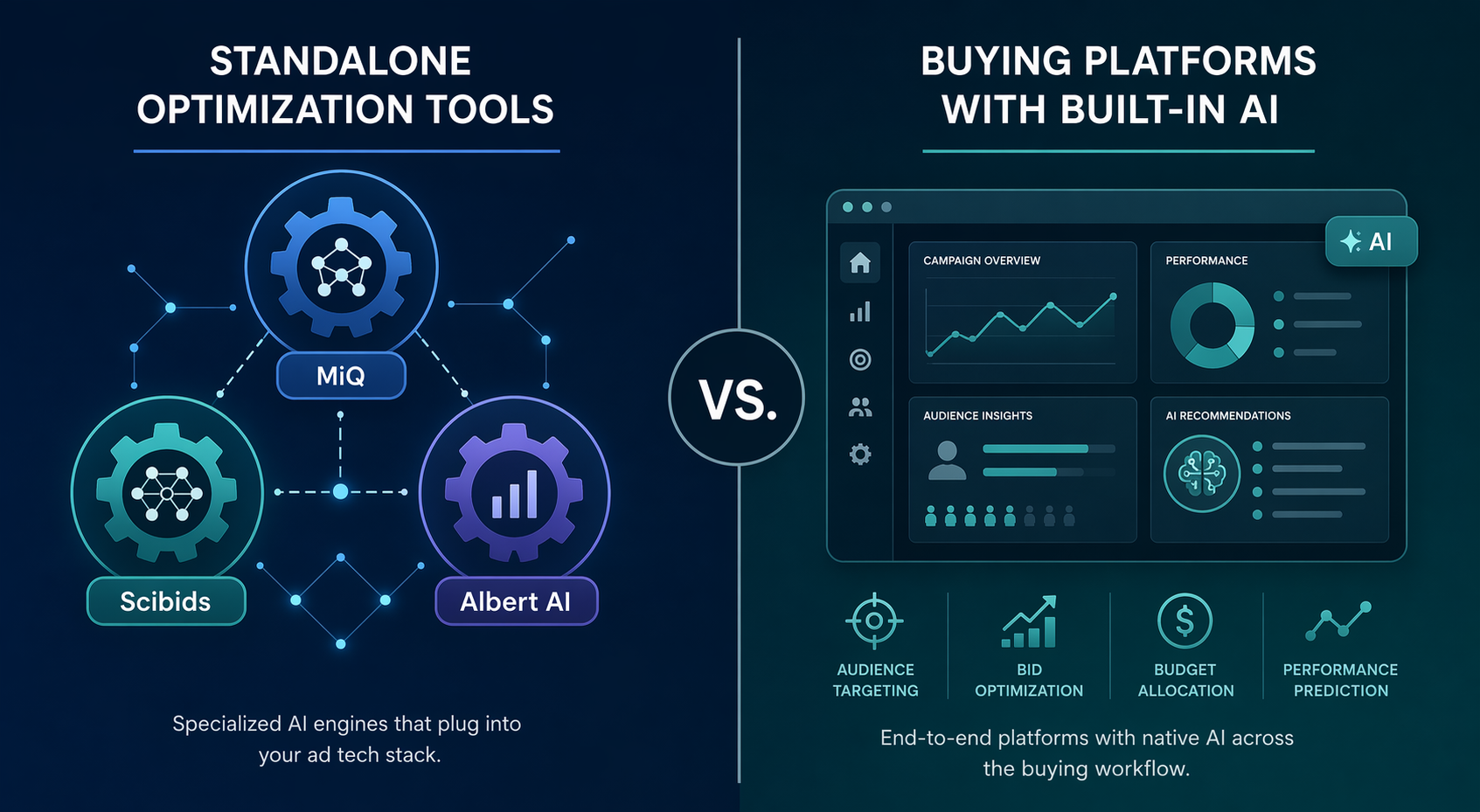
One source of confusion is that “AI platform” gets used for two different things. EMARKETER’s field-guide framing separates standalone optimization tools from buying platforms with built-in AI features.[1] That split is useful because the operating questions are different.
| Layer | Examples | What It Usually Changes |
|---|---|---|
| Standalone optimization tools | MiQ, Scibids, Albert AI | Optimization logic layered into or around buying workflows, often focused on bidding, budget allocation, audience expansion, or performance prediction |
| Buying platforms with built-in AI | DV360, Amazon DSP Performance+, The Trade Desk Kokai, RTB House, StackAdapt, Viant, Basis | AI embedded directly in planning, activation, bidding, measurement, creative, or workflow automation inside the buying environment |
The difference is not academic. A standalone optimization layer may improve a specific decision loop without replacing the buyer’s platform workflow. A DSP-native AI feature may have more direct access to inventory, bidding, pacing, and reporting signals, but it can also make it harder to see exactly which levers moved. Either way, the buyer still has to decide what the system is allowed to learn from and what it is not allowed to trade away.
Where AI Actually Delivers
The strongest use cases are still the ones where programmatic already had too many variables for manual management: bid shading, pacing, frequency, audience expansion, supply-path choices, creative rotation, and budget reallocation. AI does not need to be mystical to be useful here. It needs to evaluate more signals than a trader can watch manually and respond faster than a weekly optimization meeting.
Industry efficacy data cited by Marketing LTB says AI-powered bidding can produce up to a 2.7x performance lift, but that number should be treated as an upper-bound claim, not a planning assumption.[3] The same optimization engine that improves outcomes against a clean purchase event can also chase cheap proxy conversions if that is what the campaign feeds it. A lift claim without the KPI, attribution window, conversion quality, and baseline setup is not enough to make a buying decision.
The mechanism is straightforward. AI performs best when the campaign gives it a consolidated signal, enough volume to learn, and a KPI that maps to the business outcome. If the campaign objective is qualified leads, the model should not be judged mainly on click-through rate. If the objective is profitable acquisition, the conversion event should not be a top-of-funnel page view. If the feed is delayed by a week, the system is optimizing yesterday’s version of the market.
Vendor case studies can be useful when they are read as examples rather than guarantees. Quantcast reports that American Express saw a 57% improvement in delivery efficiency and that Standard Chartered saw a 68% lower CPA in published AI programmatic case studies.[4] Those are meaningful outcomes, but they are vendor-published examples, not independent audits. The useful takeaway is not that every campaign should expect the same result. It is that performance gains tend to show up when the system has enough signal quality and freedom inside a defined performance boundary.
Creative is another area where adoption has moved faster than governance. IAB data cited for 2026 says 83% of ad executives have deployed AI in creative.[2] In programmatic workflows, that usually matters less as a standalone creative experiment and more as a speed problem: generating variants, matching creative to audience or context, and retiring weak assets faster. The risk is that teams confuse more variations with better learning. Dynamic creative only helps if the taxonomy, review process, and performance readout are clean enough to explain which message, format, audience, or context actually changed the result.
The Failure Modes Are Operational, Not Abstract
Most AI programmatic failures do not look dramatic at first. They look like a campaign that spends smoothly, reports improving platform metrics, and then disappoints when finance, sales, or incrementality analysis gets involved. The model did what it was asked to do. The problem was that it was asked to optimize the wrong thing, or it was trained on signals that did not represent the outcome leadership actually cared about.
Transparency is the first real constraint. IAB data cited by EMARKETER says 60% of professionals identify accuracy and transparency as the top barrier to AI adoption in media campaigns.[2] That is not just a philosophical complaint about black boxes. If a buyer cannot see why spend shifted, which audience expanded, which inventory got more budget, or which conversion signal carried the most weight, troubleshooting becomes guesswork. The campaign may still work, but the team cannot explain it, repeat it, or safely scale it.
Data fragmentation is the second constraint, and it is usually the less glamorous one. Basis cites survey findings that fewer than 1 in 5 professionals say their first-party data is extensive and well-structured.[2] That explains a lot of the gap between AI adoption and full-cycle scaling. If CRM events, site conversions, offline sales, product margins, clean-room matches, and media exposure data live in disconnected systems, the model does not see the business. It sees whichever partial signal is easiest to pass back into the DSP.
The third constraint is media quality. Basis cites ANA findings of $26.8 billion in programmatic waste, while DoubleVerify data cited in the same 2025 context says 54% of advertisers believe generative AI has contributed to a decline in overall media quality.[2] Those numbers should make buyers slower, not more timid. AI can help detect anomalies and optimize supply, but it can also accelerate spend into cheap, low-quality, or unsafe environments if the guardrails are loose and the campaign is rewarded for surface-level efficiency.
Proxy KPI drift is where the damage often becomes visible. A prospecting campaign optimized to low-cost conversions may find repeat form-fillers, coupon hunters, accidental visits, or placements that generate cheap engagement without pipeline. A retail campaign optimized to ROAS may over-credit audiences that were already close to purchase. A CTV campaign optimized only to completed views may overpay for inventory that looks clean in the platform but does not move brand or demand metrics. None of these are AI-specific mistakes, but automation can make them happen faster and at larger scale.
What Has to Be in Place Before More Autonomy Is Safe
Scaling AI in programmatic is not the same as turning on every automated feature. It is a workflow maturity problem. The campaign needs enough structure that the model can make decisions quickly without forcing the human team to reconstruct the logic after the budget is gone.
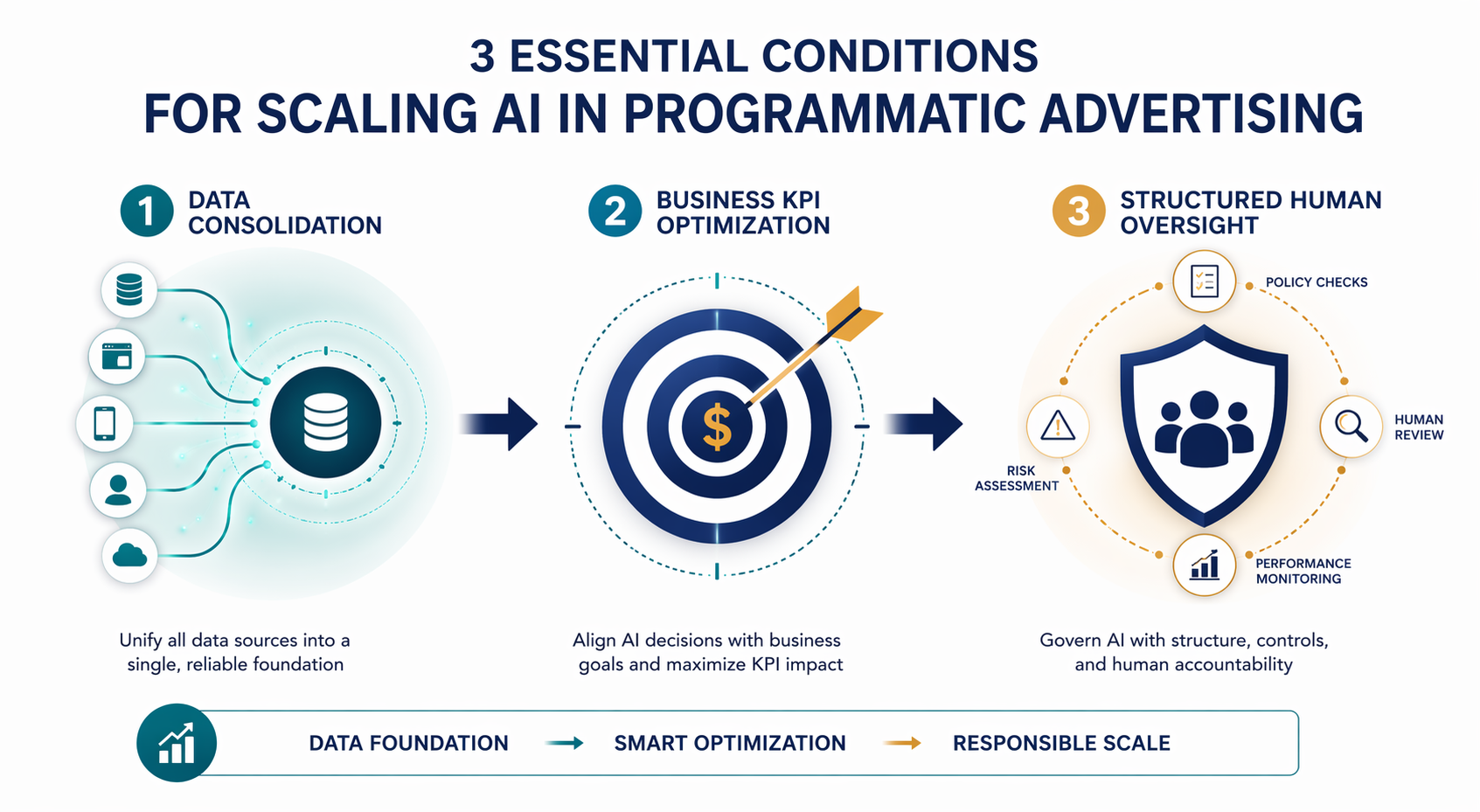
| Requirement | What It Means in the Workflow | Why It Matters |
|---|---|---|
| Consolidated data | Conversion events, audience files, CRM outcomes, and measurement inputs are cleaned and connected before launch | The model learns from a business signal instead of whichever platform event is easiest to capture |
| KPI discipline | The optimization target is tied to revenue, qualified demand, margin, acquisition quality, or another real business outcome | The system does not over-optimize toward cheap proxy metrics |
| Pre-set guardrails | Bid floors, budget caps, frequency caps, exclusions, brand-safety rules, and supply constraints are defined before autonomous optimization expands | The model can move quickly without crossing boundaries the buyer would never approve manually |
| Structured review | Humans review spend shifts, audience expansion, placement quality, creative winners, and conversion quality on a planned cadence | Oversight becomes part of the operating model, not a cleanup task after performance drops |
| Privacy-safe identity and context | Clean-room workflows, contextual targeting, and consent-aware identity resolution are treated as core setup choices | Optimization remains usable as addressability changes and cookie-based signals weaken |
The order matters. Consolidate the data before asking the system to learn. Define the KPI before giving the model budget flexibility. Set the guardrails before enabling expansion. Then review against the same business logic used to launch the campaign. A human review loop that only checks whether the dashboard is green is not governance; it is decoration.
Retail media shows why this operating model is becoming more important. Basis reports that retail media programmatic display spend grew more than twice as fast as total programmatic display in 2025.[2] That growth gives AI more commerce signals to work with, but it also makes measurement choices more consequential. If a platform can optimize against retailer purchase data, the buyer still has to ask whether the result is incremental, whether the audience was already likely to buy, and whether the same signal can be compared across other channels.
The Guardrails Should Be Decided Before Launch
The worst time to decide brand-safety tolerance is after an automated campaign has found cheap reach. Before launch, the team should define the inventory rules, exclusion categories, suitability thresholds, frequency limits, budget pacing constraints, and escalation triggers. Some of these settings will live inside the DSP. Some will live in verification tools. Some will live in the team’s own QA process. The point is to make the boundaries explicit before the model starts discovering loopholes.
- Set minimum and maximum bids where the buying strategy requires them, especially in inventory with volatile clearing prices.
- Use frequency caps that match the channel role instead of letting retargeting efficiency dictate exposure.
- Define brand-safety and suitability exclusions before scale testing, not after a placement report looks wrong.
- Separate learning budgets from performance budgets when a model is testing new supply, audiences, or creative combinations.
- Review conversion quality, not only conversion volume, when automated bidding starts improving.
Human Review Should Be Structured, Not Heroic
A good oversight process does not require a trader to second-guess every bid. It requires the team to know which decisions the system is allowed to make alone, which decisions require review, and which decisions are blocked entirely. That can be as simple as a weekly review of budget shifts, supply sources, audience expansion, creative performance, and conversion quality for stable campaigns. For aggressive scaling, the cadence should tighten until the team trusts the pattern.
Power Digital’s practitioner guidance points to the same basic implementation issue: AI programmatic systems need clean, structured, timely conversion data and human oversight loops around bid floors, frequency caps, and brand-safety settings.[5] That is not a glamorous recommendation, but it is the difference between useful automation and a black box that only gets opened when someone asks why spend moved.
How to Decide What to Automate
The practical decision is not “AI or manual.” It is which parts of the workflow have enough signal quality and risk control to automate now. Bid optimization against a clean purchase event is different from letting a platform expand into unknown inventory with a loose conversion definition. Creative rotation across approved assets is different from generating net-new claims without review. Budget reallocation across proven line items is different from letting the system decide that low-cost traffic is the same as profitable demand.
| Workflow Area | Usually Safer to Automate When | Keep Tighter Human Control When |
|---|---|---|
| Bidding and pacing | The conversion signal is timely, stable, and tied to the real KPI | The campaign is using soft conversions, delayed offline data, or a new attribution setup |
| Audience expansion | Seed audiences are high quality and exclusions are clear | The system is optimizing toward volume without enough quality feedback |
| Creative rotation | Assets are approved, tagged consistently, and measured against the same objective | Creative variants differ in claims, compliance risk, or offer structure |
| Supply-path optimization | Inventory rules, verification settings, and quality thresholds are already defined | The campaign is under pressure to chase lower CPMs without quality review |
| Budget allocation | Channels and line items are measured against comparable business outcomes | Each platform is grading itself with incompatible attribution logic |
This is also where platform selection becomes more grounded. A buyer comparing DSP-native AI features with standalone optimization tools should not start with the longest feature list. Start with the workflow problem: bidding efficiency, creative decisioning, supply quality, audience expansion, retail media activation, privacy-safe identity, or cross-channel budget allocation. Then ask what the tool can see, what it can change, what it explains, and what the team can override.
For teams that do need a deeper platform-by-platform evaluation, a separate comparison such as How to Choose an AI-Powered Programmatic Platform: DSP Comparison for 2026 is the better place to get into product differences. In this decision, the key filter is simpler: do not buy more autonomy than the data, KPI, and oversight process can support.
What Scaling Looks Like in Practice
A sensible scaling path usually starts narrow. Pick a campaign where the conversion signal is reliable, the KPI is not ambiguous, and the brand-safety rules are already documented. Let the AI optimize a defined part of the workflow, such as bidding or budget allocation inside a bounded set of line items. Compare performance not only against platform-reported efficiency, but against conversion quality, marginal cost, placement quality, and any downstream revenue or pipeline metric the business uses.
Then expand only where the system has earned more freedom. If bidding improves without degrading quality, broaden inventory or audience testing. If creative rotation identifies useful patterns, improve the taxonomy and increase the asset pool. If retail media signals improve purchase optimization, test whether the gain holds outside the platform’s own attribution view. Each expansion should answer one question. The fastest way to make AI unreadable is to change the audience, bid logic, creative, supply, and KPI at the same time.
The same logic applies to privacy-safe targeting. Contextual targeting, clean-room identity resolution, and consent-aware audience workflows are not side projects anymore; they shape what the model can learn from. As cookie-based signals continue to weaken, the campaigns with durable inputs will have an advantage over campaigns that depend on easy retargeting pools and platform-specific identity shortcuts.
AI in programmatic is already real. It can make bidding faster, creative testing more responsive, audience discovery broader, and budget allocation less manual. But it does not remove the operator’s responsibility for the signal, the target, or the boundary conditions. Scaling depends less on choosing the flashiest AI programmatic advertising platform than on whether the marketer has the data discipline, KPI discipline, and oversight discipline to let the system optimize without losing control.
References
- FAQ: How Programmatic Ad Platforms Are Evolving with AI Features, EMARKETER.
- 7 Programmatic Advertising Trends Shaping 2026, Basis.
- Programmatic Advertising Statistics 2026, Marketing LTB.
- AI in Programmatic Advertising, Quantcast.
- How AI Is Revolutionizing Programmatic Advertising in 2026, Power Digital.
Comments
Join the discussion with an anonymous comment.