
How to Choose an AI-Powered Programmatic Platform: DSP Comparison for 2026
A practitioner-focused comparison of the major AI-powered DSPs and creative intelligence tools for paid media managers and agency buyers. This guide breaks down the two-layer tool stack, provides honest trade-offs for each platform, and offers a decision framework based on your existing tech stack, primary channel, and team depth.
The Two-Layer Framework: Media Buying vs. Creative Intelligence
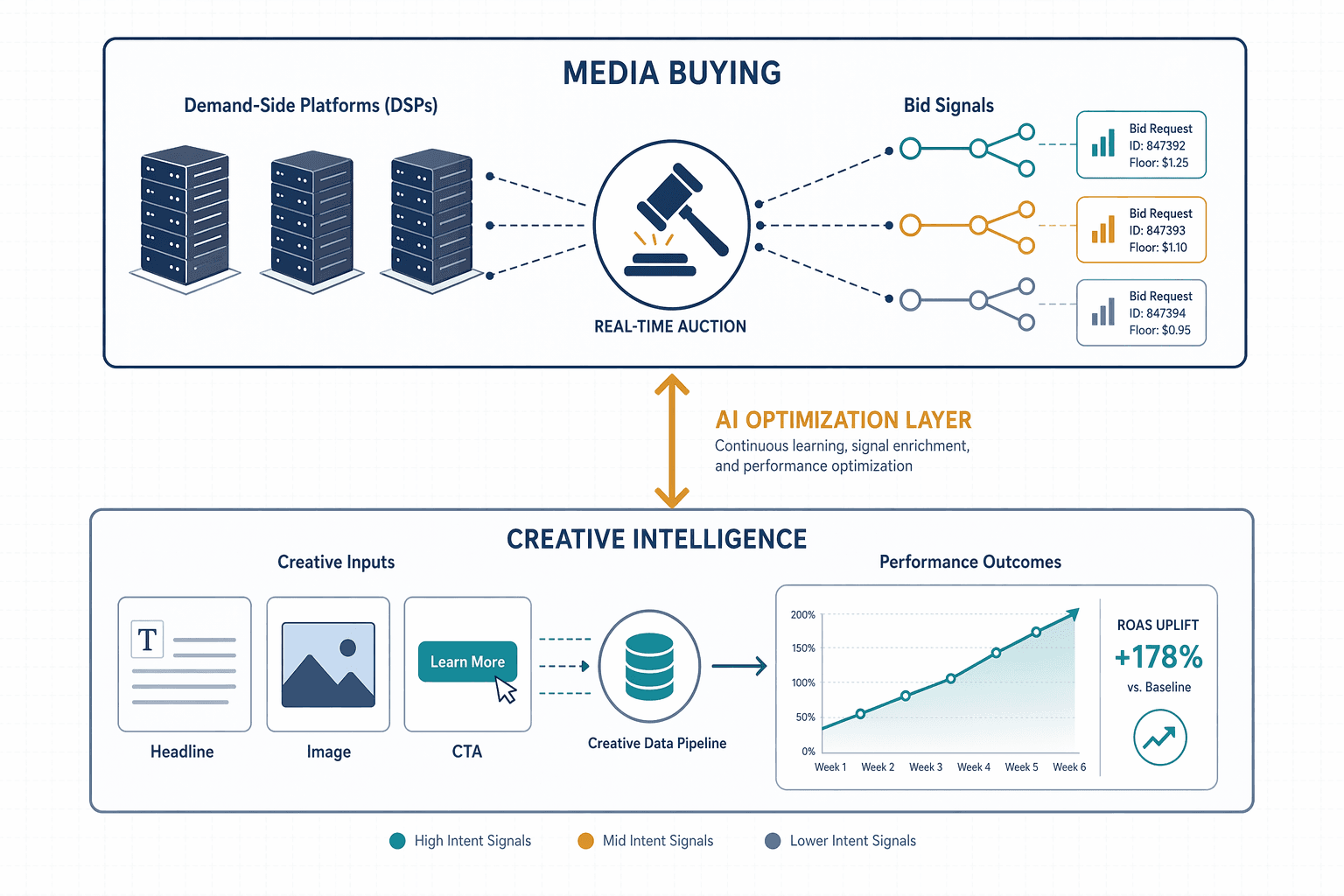
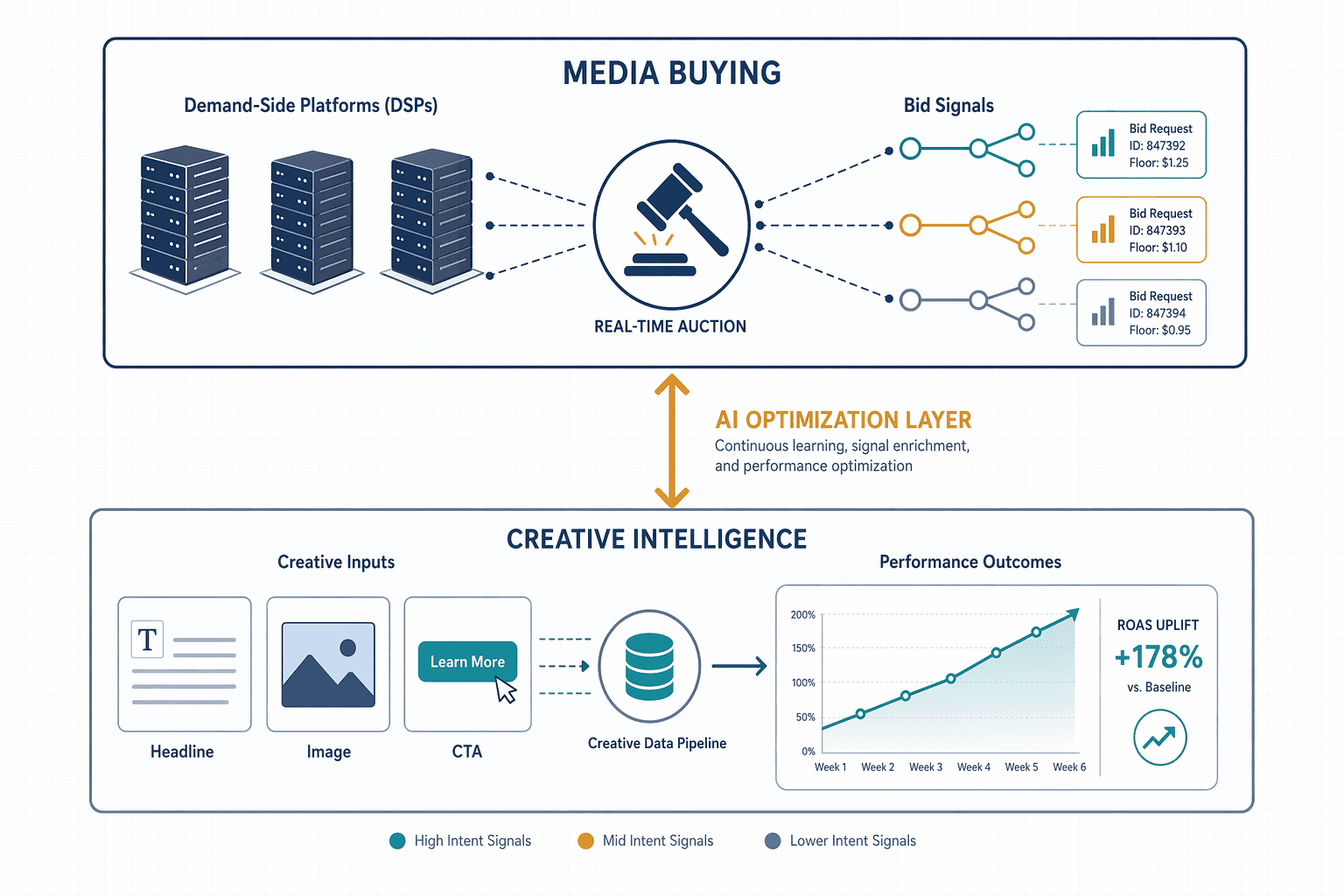
If you are evaluating programmatic platforms in mid-2026, the first thing to understand is that the tool landscape has split into two distinct layers. One layer handles media buying — bid price, placement, audience targeting, and inventory access. The other handles creative intelligence — what goes inside the ad, how it performs across networks, and when it fatigues. Most teams over-invest in the first layer and under-invest in the second, and that imbalance is where a significant portion of programmatic waste originates.
The media buying layer is dominated by demand-side platforms (DSPs) that have embedded AI into their core bidding and optimization engines. The Trade Desk's Koa AI, Google DV360's automated bidding, Amazon DSP Performance+, StackAdapt's Page Context AI, Quantcast's Ara, Adobe's Sensei, and Yahoo's ConnectID-driven targeting all fall here. These platforms decide which impression to buy, at what price, and for which user segment. Their AI is trained on auction outcomes, conversion signals, and — in some cases — first-party data streams.
The creative intelligence layer is newer and less understood. Platforms like Segwise use multimodal AI to tag and track every creative element — headline, visual, CTA, offer — across 15 or more ad networks and multiple mobile measurement partners (MMPs). They detect creative fatigue before it drags down ROAS, identify which specific hook or image variant drives performance, and feed those insights back into the creative production cycle. No DSP does this natively. DSPs optimize the bid; they do not optimize the ad itself.
This distinction matters because the two layers solve different problems and require different evaluation criteria. Choosing a DSP without a creative intelligence strategy is like optimizing a supply chain while ignoring product quality. The rest of this guide walks through each layer in detail, provides honest trade-offs for the major platforms, and offers a decision framework based on your existing tech stack, primary channel, and team depth.
For a broader overview of how AI is reshaping programmatic channels, see our AI in Programmatic Display Advertising: A Channel Guide.
DSP Comparison: The Major Platforms and Their Honest Trade-Offs
Every major DSP has invested heavily in AI features over the past two years. According to October 2024 Digiday data cited by EMARKETER, 61% of brand and agency marketers worldwide already use AI for programmatic advertising, with 77% of those users applying it to campaign management automation and 61% to customer journey personalization. Yet only 30% of ad industry professionals report having fully scaled AI across their media campaign cycles, per IAB data from January 2025. The gap between adoption and full integration is where platform choice matters most.
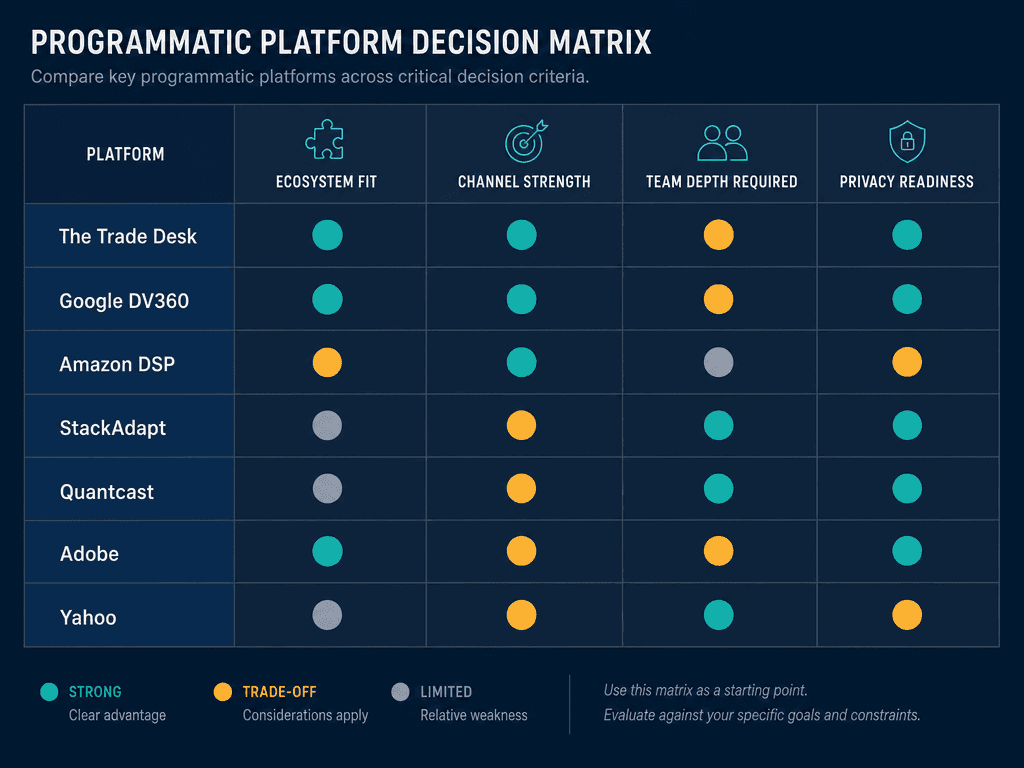
Below is a comparison of the seven major DSPs across the dimensions that actually affect day-to-day performance: ecosystem fit, channel strength, team depth required, and privacy readiness. Pricing is excluded from this table because every DSP on this list uses custom, contracted pricing — no public rate cards exist.
| Platform | AI Engine | Best Channel | Team Depth Required | Key Limitation |
|---|---|---|---|---|
| The Trade Desk | Koa AI (Kokai) | CTV, omnichannel open web | Specialist team | Depth rewards dedicated buyers; steep learning curve for lean teams |
| Google DV360 | Automated bidding + custom Python scripts | YouTube, Google Display Network, open web | Technical (Python for custom bidding) | Custom bidding requires Python familiarity; Google ecosystem lock-in |
| Amazon DSP Performance+ | Performance+ (commerce signal AI) | Amazon retail, Fire TV, Amazon-owned inventory | Moderate | Signals degrade significantly outside Amazon surfaces |
| StackAdapt | Page Context AI (semantic contextual) | Open web, native, connected TV | Lean teams, self-serve | Smaller inventory scale than TTD or DV360 |
| Quantcast Ara | Ara (real-time behavioral audience AI) | Open web, mid-funnel growth | Moderate | Commerce signals weaker than Amazon DSP |
| Adobe Advertising DSP | Adobe Sensei | Adobe Experience Cloud ecosystem | Adobe ecosystem users | Best value only for existing Adobe stack adopters |
| Yahoo DSP | Yahoo ConnectID + Comscore AI ID-free | Open web, cookieless targeting | Moderate | Smaller CTV inventory compared to TTD |
The Trade Desk (Kokai / Koa AI)
The Trade Desk's Koa AI is one of the most visible examples of machine learning embedded in a DSP. It analyzes campaign inputs to generate audience and channel recommendations, identifies performance patterns, and adjusts bids in real time. The platform is particularly strong for CTV inventory and omnichannel campaigns that span display, video, audio, and native. Its UID2 identity framework gives it a privacy-forward edge in a cookieless environment.
The honest trade-off: The Trade Desk rewards specialist teams. Its depth of controls, data layers, and optimization levers means that a generalist paid media manager will likely underutilize the platform. Agencies and in-house teams with dedicated programmatic buyers see strong results; lean teams may find the learning curve outweighs the capability advantage.
Google DV360
DV360 integrates tightly with Google's advertising ecosystem — YouTube, Google Display Network, and Google Ads — and offers automated bidding alongside custom Python-based bidding scripts. This gives technically proficient teams fine-grained control over bid logic that no other DSP matches.
The honest trade-off: Custom bidding requires Python familiarity. If your team does not have someone comfortable writing and debugging bidding scripts, you will rely on DV360's automated defaults, which reduces the platform's differentiation. Additionally, DV360's strongest signals come from within Google's ecosystem; performance on non-Google inventory can be less competitive than The Trade Desk's independent reach.
Amazon DSP Performance+
Amazon DSP Performance+ uses Amazon's first-party commerce data — purchase history, browsing behavior, and product interest signals — to drive ad targeting. For brands selling on Amazon or with strong retail media budgets, this is the most intent-rich data available in programmatic advertising.
The honest trade-off: Those commerce signals degrade sharply outside Amazon-owned surfaces. Once your campaign targets inventory on the open web or non-Amazon CTV apps, the data advantage diminishes. Amazon DSP is a strong choice for retail media campaigns but a weaker one for brand awareness or upper-funnel reach across the open internet.
StackAdapt
StackAdapt's Page Context AI provides semantic contextual targeting — analyzing page content in real time to match ads with relevant environments without relying on user-level cookies. The platform is self-serve and designed for lean teams that want programmatic capability without a dedicated buying desk.
The honest trade-off: StackAdapt's inventory scale is smaller than The Trade Desk or DV360, particularly in CTV. For teams whose primary channel is open-web display and native, it is a strong fit. For teams needing premium CTV reach at scale, it may fall short.
Quantcast Ara, Adobe Advertising DSP, and Yahoo DSP
Quantcast's Ara AI focuses on real-time behavioral audience discovery and mid-funnel growth. It is a solid option for advertisers who want to find new audiences without relying on third-party cookies, but its commerce signals are weaker than Amazon's. Adobe Advertising DSP is the natural choice for organizations already invested in Adobe Experience Cloud — the integration with Audience Manager, Analytics, and Experience Manager creates workflow efficiencies that standalone DSPs cannot match. Yahoo DSP differentiates through its ConnectID and Comscore AI ID-free audiences, making it a viable option for cookieless targeting, though its CTV inventory lags behind The Trade Desk.
The Creative Intelligence Layer: Why You Need a Second Tool
No DSP tells you whether your ad creative is fatigued. No DSP tells you which specific headline variant drove a 2x ROAS difference across Meta versus programmatic display. No DSP tracks performance across 15 ad networks in a single view and surfaces the insight that your blue CTA button outperforms your red one by 34%. These are creative intelligence functions, and they exist in a separate tool category that most programmatic buyers have not yet added to their stack.
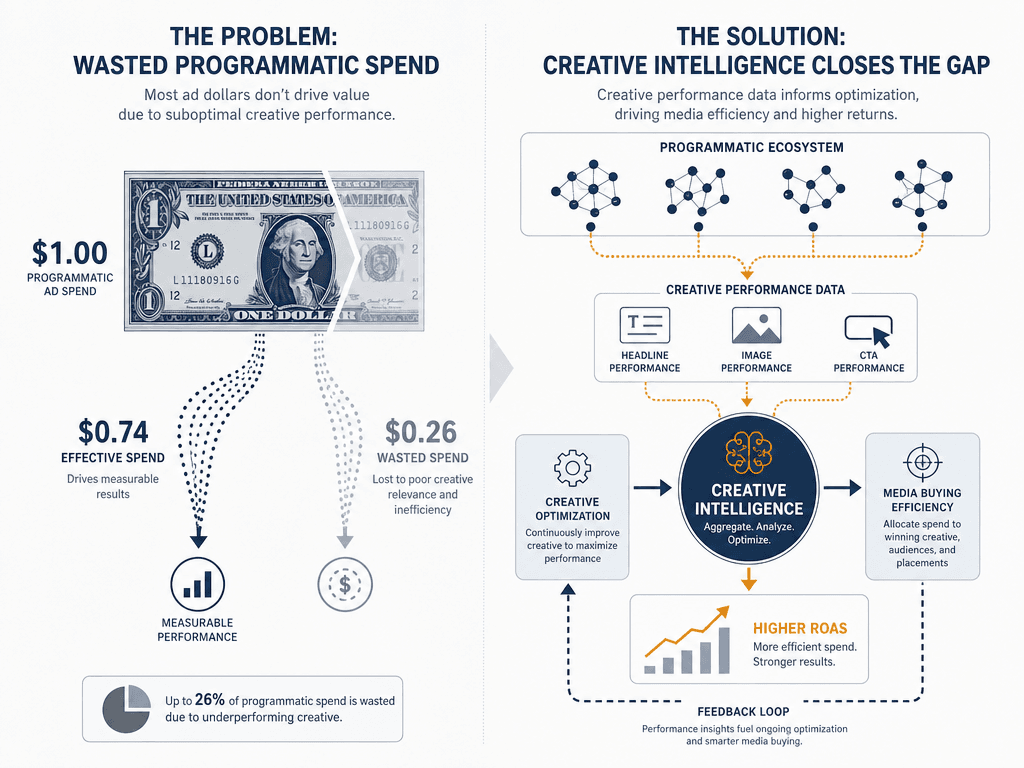
Creative intelligence platforms like Segwise fill this gap. They use multimodal AI to automatically tag every creative element — copy, image, video frame, CTA, offer — and track its performance across connected ad networks and MMPs. The output is a unified view of creative performance that answers questions like: Which hook is driving the highest CTR this week? At what impression count does this video creative start to fatigue? What creative pattern consistently delivers above-average ROAS across campaigns?
The impact is measurable. Teams using Segwise report saving up to 20 hours per week on manual creative tagging and up to 50% ROAS improvement by catching fatigue early. These figures come from the vendor's own reporting and should be cross-referenced with independent benchmarks, but the underlying logic is sound: if you cannot measure creative performance systematically, you cannot optimize it.
Key capabilities to look for in a creative intelligence platform:
- Multimodal AI tagging that automatically classifies creative elements (headlines, visuals, CTAs, offers, colors, layouts) without manual input
- Cross-network performance aggregation across 15+ ad networks and multiple MMPs in a single dashboard
- Fatigue detection that flags when a creative's performance begins to decline based on impression count, frequency, or time-in-market
- Competitive creative tracking (currently available for Meta) to benchmark your ad performance against competitor patterns
- Generative creative iteration that uses performance data to suggest new creative variants
The critical distinction: a creative intelligence platform does not replace your DSP. It sits alongside it, feeding performance data back into the creative production cycle while your DSP continues to handle bid optimization and placement. The two tools optimize different variables — one optimizes the price and placement of the impression, the other optimizes what the impression contains.
Decision Criteria Matrix: Matching Platforms to Your Context
The right platform choice depends on four contextual factors: your existing tech stack, your primary channel, your team's technical depth, and your privacy/identity requirements. The matrix below maps each DSP to these criteria so you can identify the best fit for your specific situation.
Use the following decision logic to narrow your options:
- If your primary channel is retail media and you sell on Amazon, start with Amazon DSP Performance+. Its commerce signal advantage is unmatched for retail campaigns. Add a creative intelligence tool to compensate for signal degradation outside Amazon surfaces.
- If you are deeply embedded in Google's ecosystem (YouTube, Google Ads, Google Analytics 4), DV360 is the natural choice. Ensure your team has Python capability to unlock custom bidding — otherwise, you are paying for a feature you cannot use.
- If you need independent omnichannel reach with strong CTV inventory and have a dedicated programmatic buying team, The Trade Desk is the strongest option. Its Koa AI and UID2 framework provide both performance and privacy readiness.
- If you are a lean team or agency without dedicated programmatic specialists, StackAdapt offers the most accessible self-serve experience with strong contextual targeting. Accept the trade-off in CTV scale.
- If you are already using Adobe Experience Cloud, Adobe Advertising DSP will integrate more cleanly than any alternative. If you are not in the Adobe ecosystem, the integration benefits do not apply.
- If cookieless targeting is your primary concern and you are willing to trade CTV scale for privacy-forward identity solutions, Yahoo DSP's ConnectID and Comscore AI ID-free audiences are worth evaluating.
- Regardless of DSP choice, evaluate a creative intelligence platform as a complementary investment. The DSP optimizes the bid; the creative intelligence platform optimizes the ad. Both are necessary for a complete programmatic strategy.
Common Mistakes When Selecting a Programmatic Platform
After evaluating dozens of programmatic stack decisions across agencies and in-house teams, four patterns of misselection recur frequently. Avoiding these mistakes will save you both budget and implementation time.
Over-indexing on media buying while ignoring creative performance
This is the most common error. Teams spend weeks evaluating DSPs — comparing bid algorithms, inventory access, and data partnerships — then run campaigns with static creative that fatigues within days. The DSP may be optimizing bids perfectly, but if the creative is stale, the bid optimization has diminishing returns. A creative intelligence platform that catches fatigue early and identifies winning creative patterns can improve ROAS more than switching from one DSP to another.
Choosing a platform for brand association rather than fit
The Trade Desk has strong brand recognition in programmatic. Google DV360 benefits from the Google brand halo. Amazon DSP carries the weight of Amazon's commerce dominance. But brand cachet does not translate to performance if the platform does not match your channel mix, team capability, or data environment. A smaller platform like StackAdapt may outperform a larger one if your primary channel is open-web display and your team is lean.
Underestimating the learning window for platform-specific AI features
Every DSP's AI engine requires a learning period — typically two to four weeks — during which it gathers data on your campaigns, audience segments, and conversion patterns. Teams that judge a platform's AI performance within the first week often make premature switch decisions. Budget for a 30-day learning window before evaluating AI-driven performance improvements.
Ignoring the privacy readiness gap
According to a Deloitte survey, 70% of consumers are worried about data privacy. Meanwhile, fewer than one in five industry professionals say their first-party data is extensive and well-structured, per Basis's AI Marketing Report, and 34% describe it as limited or disconnected. Choosing a DSP without evaluating its identity framework — UID2, ConnectID, or alternative cookieless solutions — creates future risk as third-party cookie deprecation continues to reshape the addressable market.
The Two-Tool Stack High-Performing Teams Use in 2026
The programmatic teams seeing the strongest performance in 2026 are not those with the most expensive DSP or the largest media budget. They are the teams that have built a two-tool stack: one DSP matched to their ecosystem and channel, plus one creative intelligence platform that closes the optimization gap no DSP addresses.
The DSP handles the media buying layer — bid optimization, audience targeting, inventory access, and cross-channel reach. The creative intelligence platform handles the creative layer — fatigue detection, cross-network performance aggregation, winning pattern identification, and generative iteration. Together, they form a complete optimization loop: the DSP tells you where and at what price to buy impressions; the creative intelligence platform tells you what to put in those impressions and when to refresh it.
The data supports this approach. Programmatic campaigns improve conversion rates by 10–30% when paired with audience data, and retargeting through programmatic increases ROAS by 2–4x on average, per Marketing LTB's analysis of industry statistics. Brands using dynamic creative optimization (DCO) see 20–60% higher CTRs, and advertisers using AI optimization experience up to 2.7x performance lift. These gains compound when both layers are optimized simultaneously.
If you are building or rebuilding your programmatic stack in 2026, start with the two-layer framework. Evaluate DSPs based on ecosystem fit, channel strength, team depth, and privacy readiness — not brand recognition or feature checklists. Then add a creative intelligence platform that can measure and optimize what your DSP cannot. The combination of both layers is what separates high-performing programmatic programs from those that leave 26 cents of every dollar on the table.
For deeper spend statistics and adoption benchmarks, refer to our AI Ad Spend 2024: eMarketer Benchmark Data Reference.

Comments
Join the discussion with an anonymous comment.