
AI Performance Marketing in 2026: Where to Automate, Where to Hold the Line
A practical cross-channel decision framework for paid media managers and growth marketers navigating an AI-native landscape. This guide maps where AI now handles execution by default across PPC, paid social, and programmatic — and where deliberate human oversight still determines campaign profitability.
AI Is Now the Infrastructure, Not a Layer
The conversation about AI in performance marketing has shifted. It is no longer about whether to adopt a given tool or which efficiency gains to expect. In 2026, AI is the operating system that bidding, targeting, budget distribution, and creative selection run on by default. The global AI marketing market reached $57.99 billion in 2026, up from $6.46 billion in 2018, and 87% of marketers now use generative AI in at least one workflow, according to data compiled by Digital Applied. Among enterprise marketing teams, 34% run at least one autonomous agent in production — more than double the rate from late 2025.
These numbers reflect a structural change, not a temporary spike. Manual bid management, keyword-level optimization, and hands-on creative A/B testing are no longer the defining skills of a high-performing media team. The MTM Agency playbook for 2026 puts it directly: AI is no longer an efficiency layer but the core infrastructure through which PPC, paid social, and programmatic operate.
But the data also reveals a gap that matters more than the adoption rate. Only 6% to 30% of marketing organizations have fully integrated AI across their workflows, depending on the survey. The rest operate in a hybrid state — some channels automated, others manual, with no consistent framework for deciding which is which. That gap is where this article sits.
This article maps the current state of AI across the three major performance channels — PPC, paid social, and programmatic — and provides a practical decision framework for where to let automation run and where to hold the line with human judgment. It is written for paid media managers and growth marketing leads who already understand the basics of AI-powered campaigns and need a cross-channel framework, not another tool list or platform tutorial.
PPC: Where Strategy Now Lives
In the PPC channel, the automation debate is effectively settled. Google Ads has moved broad match, automated bidding, and responsive search ads to default positions. Smart Bidding handles auction-time adjustments that no human team could replicate at scale. The question is no longer whether to automate PPC execution — it is whether the data feeding those automated systems is good enough.
The MTM Agency playbook warns that the danger in PPC is passive acceptance. Platform recommendations are designed to drive platform success — higher spend, broader reach, more clicks — not necessarily business profitability. A Smart Bidding strategy that optimizes for conversions will deliver conversions, but it will not distinguish between a high-value lead and a low-intent click unless the conversion signal it receives makes that distinction.
This is where human oversight now concentrates:
- Conversion data quality. If your offline conversion import is incomplete, delayed, or mapped to the wrong stage of the funnel, the algorithm optimizes for a distorted signal. Teams that invest in clean, complete, and timely conversion data gain a structural advantage over those that rely on platform-reported micro-conversions alone.
- Offline signal integration. B2B teams that feed CRM-stage data back into Google Ads — lead status, demo completion, closed-won — give Smart Bidding a richer optimization target. The B2B paid search case study on this site documents how one team used offline conversion import to shift from lead-volume optimization to pipeline-value optimization, with measurable improvements in cost per qualified opportunity.
- Challenging platform recommendations. Google's automated recommendations are not always wrong, but they are always optimized for Google's ecosystem. The discipline of reviewing, questioning, and sometimes overriding platform suggestions is a human skill that directly affects campaign profitability.
For a deeper look at where Smart Bidding fails and how to build human-in-the-loop workflows, see the existing article on AI PPC automation failure modes. For a broader reality check on PPC automation outcomes, the AI PPC automation reality check covers where automation delivers and where it consistently underperforms.
Paid Social: Creative Is the Primary Signal
Paid social has undergone a different kind of transformation. Where PPC automation centers on bidding and targeting, social platform AI — particularly Meta's Advantage+ and the broader Andromeda architecture — has shifted optimization toward creative as the primary signal. The algorithm now decides which ad variant to show to which user based on predicted engagement, and it makes that decision in real time across millions of combinations.
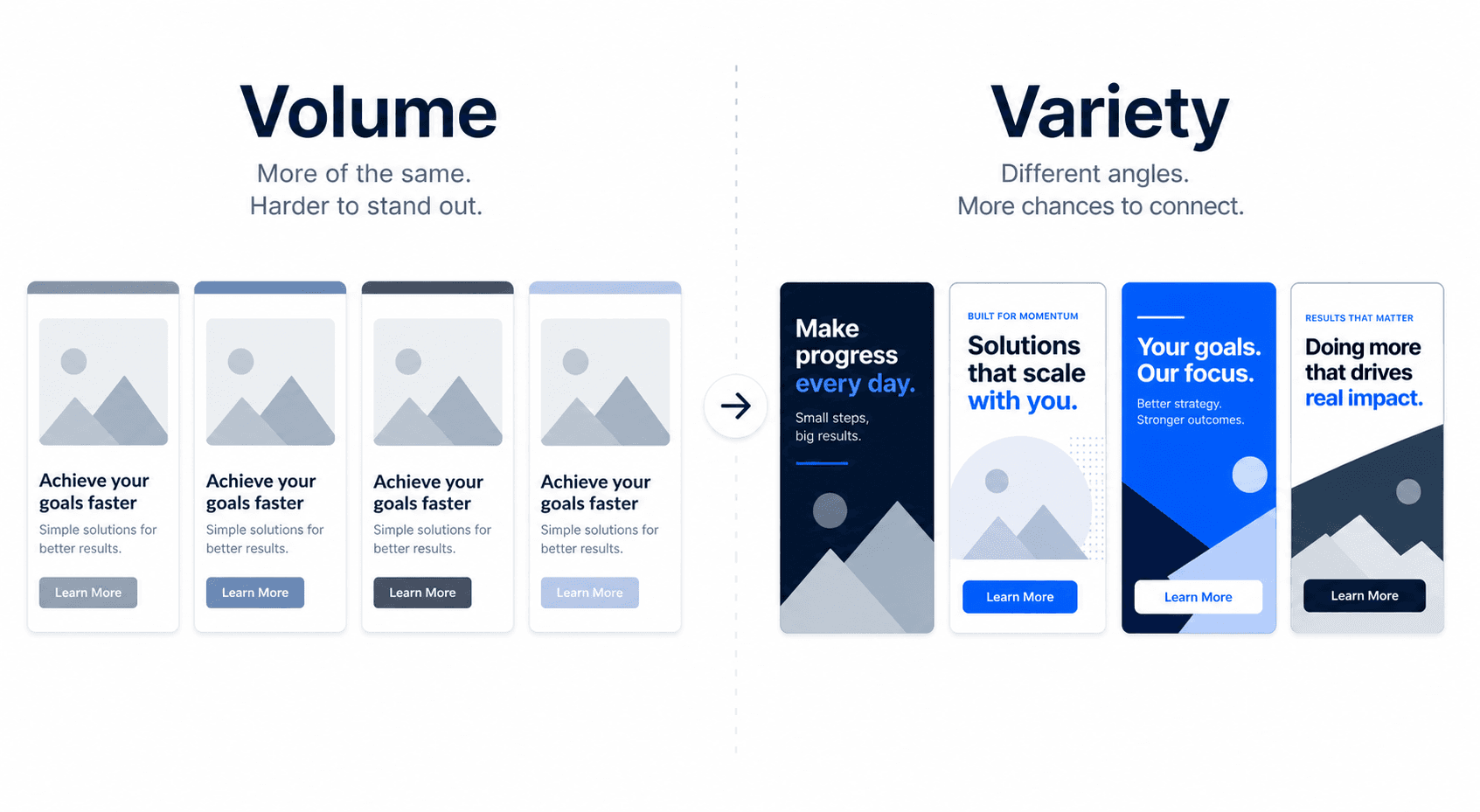
This creates a counterintuitive problem. Advertisers who respond by generating more creative variants — 20 headlines, 10 images, 5 calls to action — often see performance degrade rather than improve. The reason is that AI does not need more volume; it needs more variety. Ten variants of the same ad with different background colors or slightly reworded headlines do not give the algorithm meaningfully different options. They give it noise.
The MTM Agency playbook identifies this as the single biggest mistake in paid social: mistaking volume for variety. AI needs ads that differ in structure, hook, visual approach, and audience angle — not cosmetic variations of the same concept.
There is an additional complication that practitioners need to account for. Multiple agency performance studies, cited by both Digital Applied and BizIQ, indicate that Meta, TikTok, and Google all quietly down-rank obvious AI-generated creative in their 2026 ranking updates. This is not a published platform policy — it is an observed pattern across thousands of campaigns. Ads that carry the visual or textual hallmarks of generative AI — overly smooth imagery, generic stock aesthetics, repetitive phrasing — appear to receive lower organic distribution before paid delivery even begins.
The practical implication is that generative AI tools remain useful for creative production, but their output needs human editing, variation, and strategic framing before it enters the ad auction. Teams that treat AI-generated creative as a starting point rather than a finished asset — and that invest in genuinely diverse creative angles rather than high-volume cosmetic variants — consistently outperform those that do not.
For platform-specific guidance on configuring Advantage+ campaigns and structuring creative for AI-driven delivery, see the Meta Advantage+ decision framework. For documented campaign results from generative creative in paid social, the generative creative case study provides real outcome data.
Programmatic: Where Abstraction Creates Risk
Programmatic advertising presents a different challenge from PPC or paid social. It operates at the highest level of abstraction and opacity of the three channels. Bidding, targeting, budget allocation, and creative selection are handled by demand-side platforms (DSPs) that function as black boxes to most advertisers. The MTM Agency playbook notes that this abstraction creates a specific risk: when you cannot see how decisions are made, you cannot easily audit whether they are correct.
In PPC, a practitioner can review search term reports, examine impression share data, and compare automated bid adjustments against manual baselines. In paid social, creative-level reporting provides visibility into which variants drive results. In programmatic, the chain from impression to conversion passes through multiple intermediaries, data partners, and algorithmic layers, each of which can introduce bias, latency, or misattribution.
The risk is not that programmatic automation is broken — it is that the incentives are misaligned. DSPs and supply-side platforms are compensated on spend volume, not on advertiser profitability. An algorithm that optimizes for cheap impressions or high viewability may not optimize for outcomes that matter to the business, and the opacity of the system makes it difficult to detect the divergence until spend has accumulated.
The broader automation risk arguments from MarTech and Improvado sources apply here with particular force. AI excels at pattern recognition within its training data but struggles with unstructured context. In programmatic, where the context includes brand safety, audience quality, and supply path optimization, the cost of an algorithmic blind spot can be significant. Human oversight in programmatic should focus on three areas: independent verification of platform-reported metrics, regular review of supply path quality, and explicit guardrails on audience targeting to prevent the algorithm from drifting into low-quality inventory.
Measurement Is the Battleground
If there is a single capability that separates high-performing teams from the rest in 2026, it is measurement. The MTM Agency playbook states that platform-reported performance is increasingly optimistic, and strong teams accept that no single view of performance is definitive. This is not a theoretical concern — it has practical consequences for budget allocation, channel mix decisions, and internal reporting.
The challenge is that every measurement method has a blind spot. Platform attribution models overcredit the last click. Media mix models (MMM) aggregate at the channel level and cannot inform creative or audience decisions. Incrementality testing is the gold standard for causal measurement but is expensive and slow. The solution is not to choose one method — it is to triangulate across multiple views and accept that each one is incomplete.
Practitioners should build a measurement practice around three questions:
- Consistency: Do the trends across platform reports, MMM, and incrementality tests point in the same direction? If platform data shows a 15% ROAS improvement but MMM shows flat returns, the divergence needs investigation.
- Directionality: Are the relative rankings of channels and campaigns stable across measurement methods? If one method says paid search outperforms paid social and another says the opposite, the team does not yet have a reliable signal.
- Incrementality: What portion of attributed conversions would have happened without the ad? This is the hardest question to answer but the most important for understanding true channel contribution.
The Improvado analysis adds another dimension: Google AI Overviews now reduce organic CTR by 18% to 47% depending on query type, which means the traffic landscape that paid search competes against is itself shifting. Teams that rely on platform-reported assisted conversions without accounting for organic traffic displacement risk overvaluing paid channels.
The Human Role Reset: Orchestrator, Not Optimizer
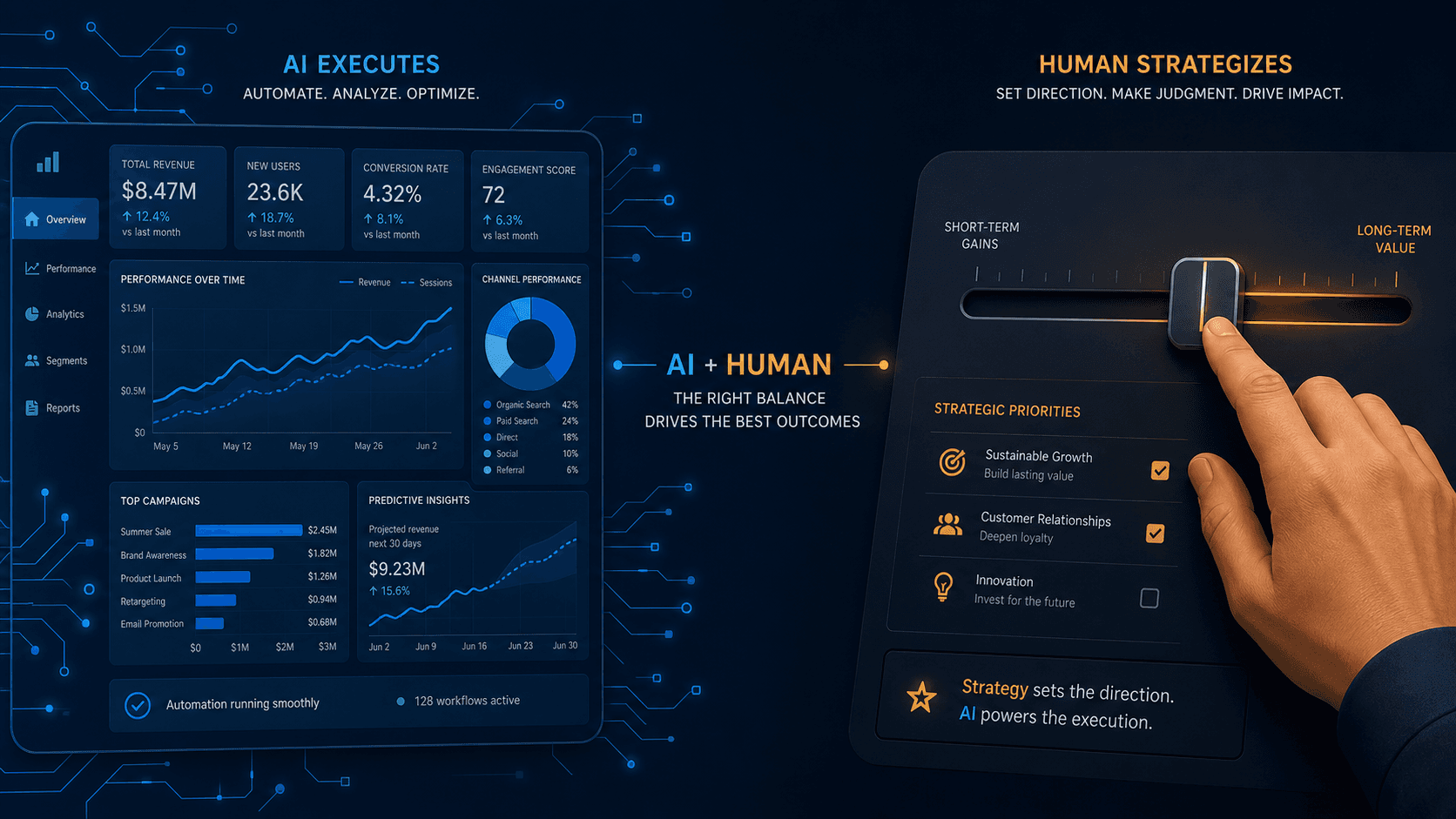
If AI now handles bidding, targeting, budget distribution, and creative selection by default, what is left for the human practitioner? The answer is not less work — it is different work. Human value has moved upstream into strategy, insight, and interpretation. The MTM Agency playbook describes this as a shift from optimizer to orchestrator: defining the problem the algorithm is being asked to solve matters more than making tactical bid adjustments.
The Improvado analysis provides a concrete example of why this matters. A global brand deployed an AI system to schedule email campaigns based on optimal send-time prediction. The algorithm selected a date that happened to fall on a national day of mourning in a key market. Open rates dropped 68%. The AI had correctly identified a high-engagement time slot based on historical data, but it had no mechanism to reason about cultural context that fell outside its training distribution.
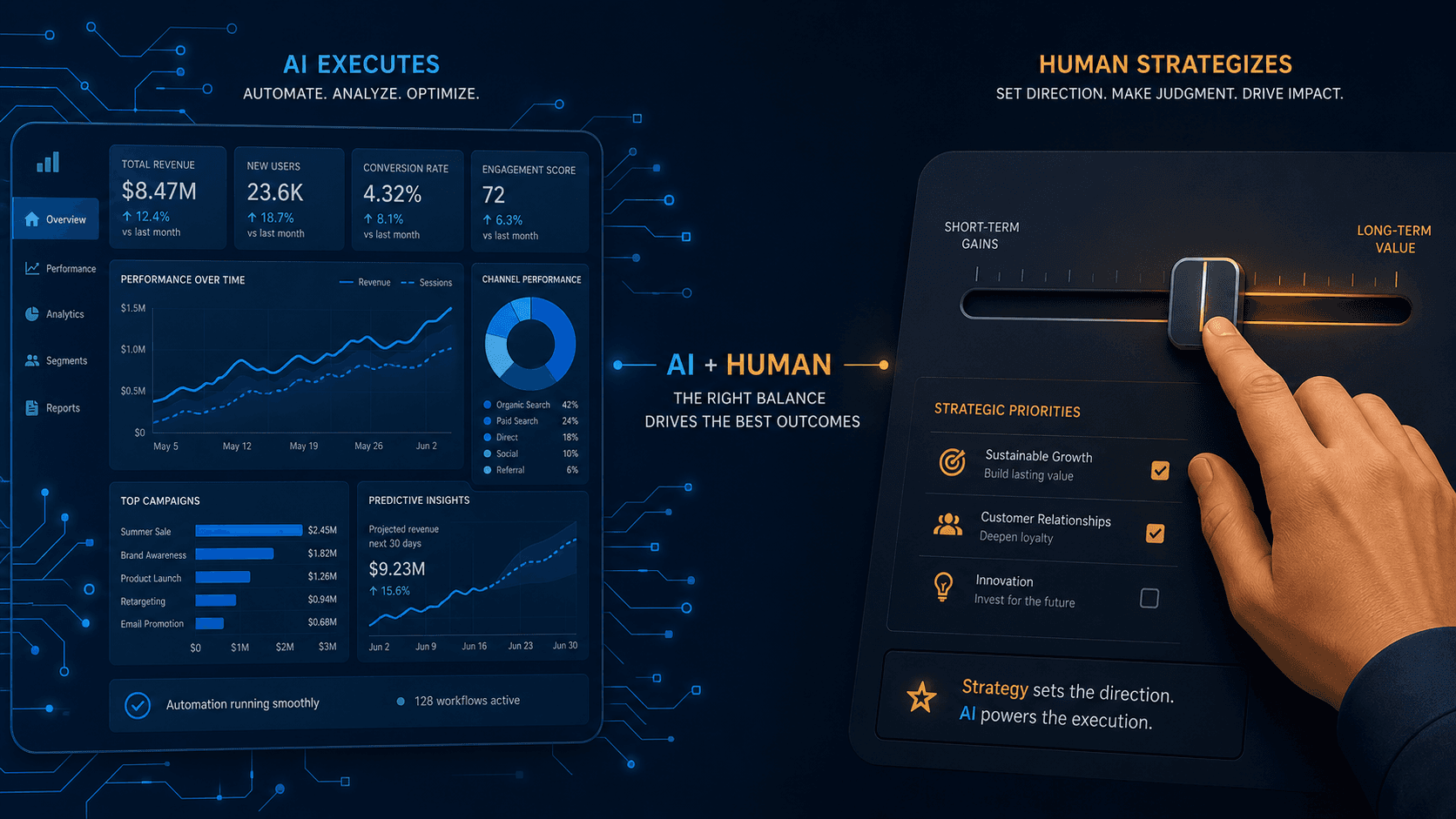
This is the centaur model in practice: AI handles execution at scale, humans provide the context, judgment, and strategic framing that the algorithm cannot access. The competitive advantage in 2026 comes from asking better questions — not from being faster at bid adjustments that the platform already handles.
For the structural view of how the AI marketing stack is organized across data, decisioning, and execution layers, see the 5-layer AI performance marketing stack article. It provides the architectural context that complements the decision framework in this piece.
Decision Matrix: What to Automate vs. Where to Hold the Line
The following matrix maps each channel against the automation-versus-oversight axis. It is designed to be a practical reference for campaign audits, team role definitions, and budget allocation discussions.
| Channel | AI Handles by Default | Human Oversight Critical | Primary Risk of Full Automation |
|---|---|---|---|
| PPC | Bidding, keyword matching, ad rotation, budget distribution | Conversion data quality, offline signal integration, platform recommendation review | Optimizing for platform success metrics rather than business profitability |
| Paid Social | Audience targeting, creative selection, delivery optimization | Creative diversity strategy, AI-generated creative editing, brand safety context | Volume-without-variety creative strategy; down-ranking of obvious AI creative |
| Programmatic | Bidding, audience targeting, supply path selection, creative rotation | Independent measurement, supply path quality review, audience targeting guardrails | Opacity makes misaligned incentives undetectable until spend is committed |
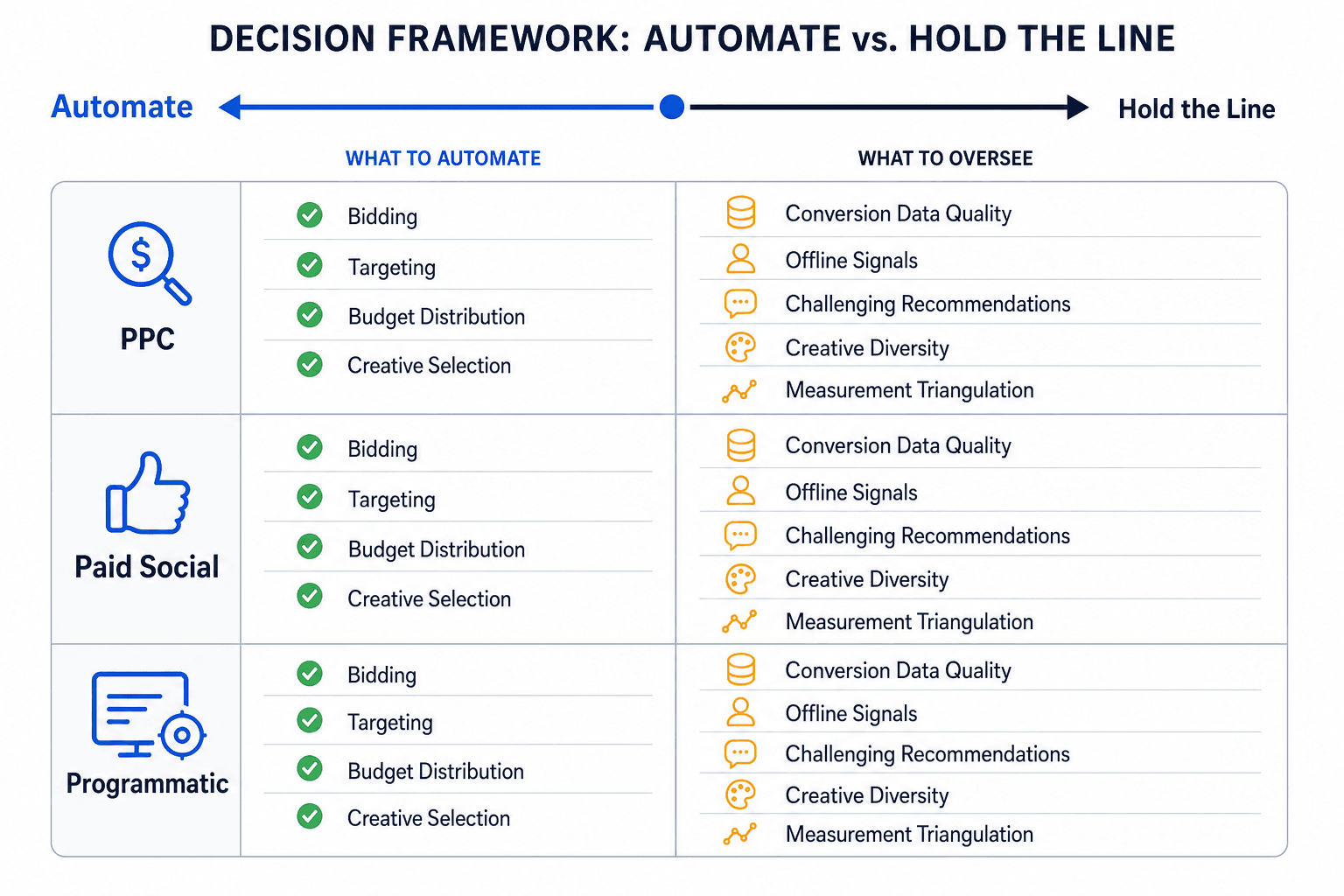
Use this matrix as a diagnostic tool. For each channel in your current campaigns, ask: Is the data feeding the automated system clean and complete? Are the creative inputs meaningfully diverse? Is there an independent measurement layer that can challenge platform-reported performance? If the answer to any of these is no, that is where human attention should go before adding more automation.
Key Takeaway: Trust Execution, Challenge Assumptions
The 2026 performance marketing landscape rewards a specific kind of discipline: trust the automation to execute, but challenge the assumptions that guide it. AI handles bidding, targeting, budget distribution, and creative selection with a speed and scale that no human team can match. But the quality of that execution depends entirely on the quality of the inputs — conversion data, creative strategy, measurement design — and the strategic context that only human judgment can provide.
The teams that win are those that stop treating AI as a tool to be managed and start treating it as infrastructure to be directed. They invest in data quality because they know the algorithm is only as good as its signal. They invest in creative diversity because they know the algorithm needs real options, not cosmetic variations. They invest in independent measurement because they know platform-reported performance is not the full picture.


Comments
Join the discussion with an anonymous comment.