
Do AI Data Center Protests by State Affect AI Ads?
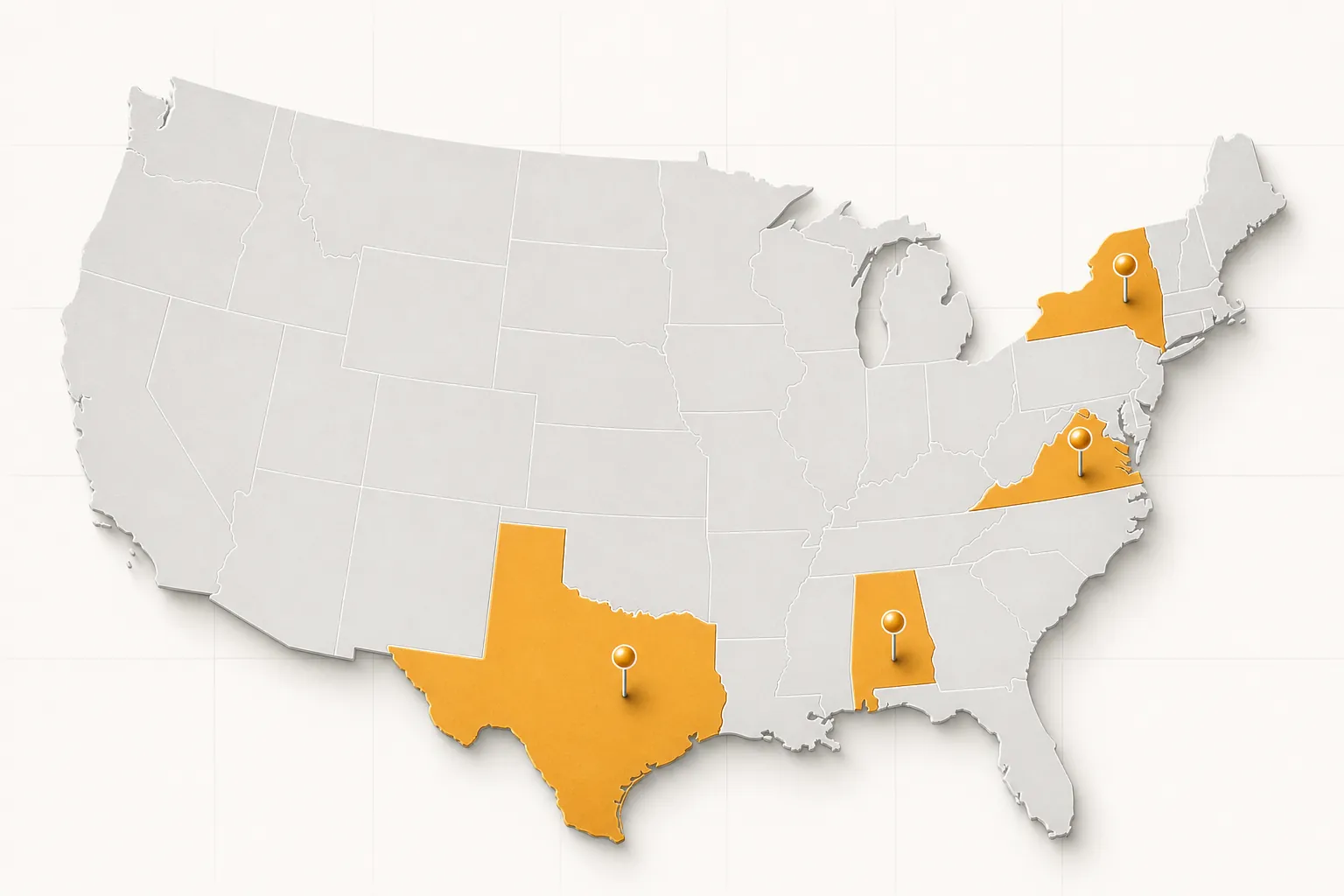
Media buyers facing "AI data center protests" headlines get a dated, checkable map of state opposition and policy actions across New York, Texas, Virginia, and Alabama. The ad-impact side is a documented null: in the reviewed record, no primary vendor disclosure or dated ad-platform entry links those constraints to AI ad availability, cost, or performance.
- Platform
- State and federal regulators
- Change category
- policy
- Change type
- policy shift
- Impact level
- None
Reviewed through September 1, 2026, the reviewed record shows real opposition to AI data centers: a permit moratorium in New York, a reported interconnection pause in Texas, pending legislation in Virginia and Alabama, voter concern over electricity costs, and organized national protest activity. It does not show a resulting change to AI advertising. No primary vendor disclosure or dated ad-platform entry in the reviewed material connects these developments to the availability, cost, delivery, or performance of Performance Max, Advantage+, AI Max, or Symphony.
| Geography | Date or period | Opposition or policy signal | Legal or evidentiary status | AI ads impact |
|---|---|---|---|---|
| New York | Reviewed through September 1, 2026; exact signing date and order number were not supplied | State environmental permits for new hyperscale data centers paused while a framework addressing grid costs is developed | Governor and ABC accounts describe a moratorium lasting up to one year; a MultiState heading describes a “Three-Year Halt,” creating an unresolved source conflict [1][2][5] | Not proven |
| Texas | Reported in the 2026 record; effective date not supplied | Reported pause on data center interconnections amid approximately 474 GW of interconnection requests | A reported operational pause, but its scope, effective date, affected projects, and exit conditions are absent from the supplied material [3] | Not proven |
| Virginia | January–February 2026 | An advocacy-commissioned survey found roughly three-quarters of voters blamed data centers for rising electricity costs; HB 961 and HB 897 would change conditions attached to data center incentives | The survey measures stated voter attitudes, not behavior or causation. Both bills were pending, not enacted [4][5] | Not proven |
| Alabama | Tracked February 20, 2026 | SB 270 would require large-load permit applicants to fund interconnection infrastructure and demonstrate a statewide ratepayer benefit | Pending bill, not enacted law; no supplied source ties it to a particular protest event [5] | Not proven |
| Federal layer | Executive order issued July 2025; state interaction tracked in April 2026 | Federal permitting support for projects involving more than 100 MW of new load or at least $500 million in investment | The order does not displace state land-use, zoning, or utility authority [6] | Not proven |
These entries are not interchangeable. New York presents a primary-verifiable permitting constraint. Texas presents a reported grid-connection action with important implementation details missing. Virginia combines public sentiment with pending incentive bills, while Alabama contributes another pending large-load proposal. The federal entry defines the division of authority rather than recording state opposition. Treating every row as a completed “protest” would overstate the available evidence.
New York has the clearest constraint—and a duration conflict
The New York governor’s announcement describes the first statewide moratorium on new hyperscale data centers and says state environmental permitting will be paused for up to one year. The stated purpose is to allow work on a framework under which developers contribute toward grid costs rather than shifting those costs to ratepayers.[1] ABC likewise reports that Governor Kathy Hochul expected the grid-funding framework to be completed “within the year” before the moratorium lifts, while noting that local zoning requirements continue to apply.[2]
That account cannot be cleanly merged with MultiState’s outline, whose New York heading says “Three-Year Halt.”[5] The supplied excerpts do not explain whether the heading refers to a different proposal, a broader legislative period, or a characterization of the same action. The primary governor material therefore supports “up to one year,” but the conflicting secondary heading remains part of the record and should not be silently corrected or converted into certainty.
Even the primary version is narrower than a statewide ban on data center development. It concerns state environmental permits for new hyperscale facilities, while local zoning still operates. The supplied passages also omit the signing date and executive-order number. Those gaps matter to anyone maintaining a project timeline, but neither the moratorium nor its uncertain duration establishes an effect on an advertising platform. The separate analysis of the New York moratorium and AI ads applies the same requirement for a product-level record.
Texas has a large queue and an incompletely specified pause
Texas is operationally significant because Utility Dive reports a pause on data center interconnections against an estimated 474 GW of interconnection requests.[3] That number describes requested grid connections, not completed data center capacity, capacity removed from service, or compute made unavailable to a particular technology company.
The packet does not supply the pause’s effective date, complete scope, project eligibility rules, duration, or conditions for resuming connections. It therefore cannot support claims that every Texas data center project stopped, that already operating facilities were curtailed, or that a specified amount of future capacity was canceled. The checkable finding is narrower: a grid operator facing an unusually large request queue reportedly paused data center interconnections, and the implementation details needed to calculate a capacity consequence are missing.
That makes Texas worth monitoring, but the reviewed record still lacks the links needed to assess an account effect. A media buyer would need to identify which cloud or AI provider relied on the affected projects, when the capacity was expected to enter service, whether workloads could move elsewhere, and whether the provider subsequently changed an ad product. None of those links appears in the reviewed record.
Virginia and Alabama show political pressure, not completed restrictions
A January 2026 statewide Virginia survey reported that roughly three-quarters of voters blamed data centers for rising electricity costs.[4] The survey was advocacy-commissioned, and the supplied material does not include a respondent count. It records attitudes among surveyed voters; it does not establish how much data centers caused rates to rise, whether respondents acted on those views, or whether the result produced a permitting decision.
Virginia HB 961 would reduce incentives associated with equipment replacement and repairs, while HB 897 would require emission-free backup generators as a condition for retaining incentives. Alabama SB 270 would require large-load applicants to pay for interconnection infrastructure and show a statewide benefit to ratepayers. All three were pending in the reviewed tracker, which placed them among more than 30 large-load bills across 18 states.[5] Pending introductions can change, stall, or fail; they should not be modeled as enacted operating costs.
The federal layer does not eliminate these state channels. The July 2025 executive order eases federal permitting for qualifying projects above the stated load or investment thresholds, but state land-use, zoning, and utility authority remains in place.[6] The practical consequence is that federal support and state constraints can coexist. The federal data center order tracker likewise found no verifiable ad-price change merely from the order.
The supplied record does not support a state protest calendar
Organized opposition extends beyond legislation. The Hill reported that Humans First and its chair, Amy Kremer, were leading dozens of planned protests against AI data centers on a Saturday across the country.[7] That is evidence of a coordinated nationwide movement, but the supplied material does not recover a complete event-level record containing a state, municipality, calendar date, organizer, and stated local cause for each action.
The distinction prevents a misleading map. New York and Texas can be mapped because they have identifiable government or grid actions. Virginia supplies both survey sentiment and pending bills; Alabama supplies a pending bill. The national organizer signal establishes broader mobilization. It does not convert every policy entry into a protest event or prove that a protest caused a bill, moratorium, or interconnection decision.

Where the proposed causal chain breaks
For state opposition to affect an AI advertising account, three separate transitions would need evidence:
- A protest, permit decision, interconnection action, or enacted law constrains planned or operating data center capacity.
- That capacity constraint changes the availability, latency, throughput, reliability, or cost of an AI service despite workload routing and other mitigation.
- The service-level change reaches an advertising product and produces an attributable change in feature availability, campaign delivery, auction cost, or measured performance.
New York supplies evidence at the beginning of the first transition, although no amount of constrained capacity is provided. Texas reports an interconnection pause but lacks enough scope information to quantify the capacity consequence. The Virginia and Alabama bills have not become operating requirements in the reviewed record. None of these sources completes the second transition, and none reaches the third.
Brookings provides the packet’s only concrete illustration of how an electricity constraint can reach an AI workload. In an Oracle field trial reported through Brookings and NVIDIA, inference work was rerouted for three hours, reducing power draw by 25% while holding service quality. Brookings also describes inference caching as an energy-reduction technique.[8] This is evidence that workload placement can respond to grid conditions; it is not evidence that an advertising product deteriorated.
The field trial does not disclose latency or cost deltas in the supplied account. It also does not identify Performance Max, Advantage+, AI Max, Symphony, an ad auction, or a campaign metric. Indeed, maintaining service quality while reducing power draw cautions against assuming that grid stress automatically becomes user-visible degradation. Rerouting could introduce costs or limits under other conditions, but that possibility is not a measured ad effect.
What changes in an ad account now
On this record alone, there is no basis for changing budgets, bids, geographic targeting, creative automation, or performance forecasts. That is a bounded operational conclusion, not proof that infrastructure constraints could never reach advertising. It means the reviewed sources do not identify a platform change or campaign effect attributable to the state actions.
A dated campaign change log should separate infrastructure news from account evidence. A qualifying update would include at least one of the following:
- A primary vendor disclosure connecting regional capacity or power constraints to a named advertising product.
- A dated platform changelog or status entry identifying a rollout delay, availability limit, delivery disruption, or pricing consequence.
- Attributable campaign evidence showing when a change began, which accounts or regions were affected, which metrics moved, and why the infrastructure event is a better explanation than auctions, seasonality, tracking, policy enforcement, or campaign edits.
Large investment estimates, rising electricity demand, and rapid construction can justify monitoring, but they do not substitute for that product-level record. The same evidence threshold applies in the site’s capex-to-auction audit, data center buildout analysis, and power-to-ad-cost tracker.
State opposition is real, increasingly organized, and consequential for permitting, interconnection, incentives, and the distribution of infrastructure costs. As of September 1, 2026, the reviewed record stops short of AI ads. The account-level null stands unless a vendor disclosure, dated platform entry, or attributable campaign record supplies the missing link.
References
- First Statewide Moratorium on New Hyperscale Data Centers Launched by Governor Kathy Hochul — Office of the Governor of New York
- New York Gov. Kathy Hochul announces moratorium on data centers — ABC News
- Facing an estimated 474 GW of interconnection requests, Texas hits pause on data centers — Utility Dive
- AI Data Centers Impact on Electric Bills, Water, and More — Consumer Reports
- State Data Center Legislation in 2026 Tackles Energy and Tax Issues — MultiState, February 20, 2026
- State Data Center Laws vs. Federal AI Push: 2026 Tracker — MultiState, April 14, 2026
- Dozens of protests against AI data centers set for this weekend — The Hill
- Global energy demands within the AI regulatory landscape — Brookings Institution
Primary source: https://www.governor.ny.gov/news/first-statewide-moratorium-new-hyperscale-data-centers-launched-governor-kathy-hochul