
How AI data center growth actually reaches your ad costs
Maps the four channels through which the AI data-center buildout can reach paid-ad costs, ranked by verifiability. Media buyers get a clear read on why the electricity-to-CPM story is the weakest link, which channels are supported by dated evidence versus inference, and which account-level signals are worth monitoring.
- Platform
- Cross-platform
- Bid strategy
- Automated bidding
- Last reviewed
- 0-08-27
Grounded in benchmark case file: Nvidia Guarantee Gives ChatGPT Ads the Infrastructure Edge case file
The AI data-center buildout does not translate directly into higher CPMs or CPCs. The infrastructure boom is real, but the claim that a larger power bill simply flows into an ad auction skips the steps a media buyer would need to verify. The more credible transmission routes run through platform pricing decisions, changes in creative supply, and competition from AI-native ad platforms. Electricity is a possible input-cost pressure, but it is the least demonstrated route to an account-level ad-price increase.

The scale is large enough to warrant attention. Global investment in data centers reached roughly $500 billion in 2024, nearly double the 2022 level. Data centers consumed about 415 terawatt-hours of electricity that year—around 1.5% of global electricity consumption—and the International Energy Agency projects demand to exceed 945 terawatt-hours by 2030. It also estimates that approximately 20% of planned data-center projects could face delays because of grid constraints.[1]
Those figures establish infrastructure growth, not an ad-cost outcome. To assess the AI data center infrastructure growth impact on paid ads, each proposed channel needs a documented starting fact, an identifiable business decision, and an observable signal in platform or account records.
| Transmission channel | Documented starting point | Inferred step | What is still missing | Signal a media buyer could test |
|---|---|---|---|---|
| Platform pricing power | Large infrastructure commitments and a dated financing-and-infrastructure bridge to an AI ad business | Platforms seek more revenue or margin to support capital requirements | Evidence that capex caused a specific pricing or auction-policy change | Platform impressions and pricing reported separately; account CPM/CPC movement after a dated platform change |
| AI-generated creative supply | Google promoted AI-assisted creative production in August 2026.[2] | Lower production costs allow more advertisers or more creative variants to compete | Measured growth in auction participants attributable to the tools | New creative volume, advertiser density, impression share and auction overlap |
| AI-native ad platforms | OpenAI launched its ads business in February 2026 and has recruited substantial ad-platform experience.[3] | A new ad surface changes budget allocation and competitive pressure | Measured effects on incumbent auctions or advertiser clearing prices | Accessible inventory, auction rules, adoption and documented budget migration |
| Electricity input costs | Data-center electricity demand is growing, but average wholesale prices fell in several major markets in 2024.[1][4] | Higher electricity expense is allocated to ad serving and passed into auction prices | Ad-serving cost share, allocation, pass-through decision and resulting auction effect | Platform cost disclosure tied to a dated pricing change—not a general electricity-demand forecast |
Capital pressure can create a pricing incentive without setting an auction price
The capex-to-pricing route is the most plausible commercial mechanism and still falls short of measured causation. A company committing heavily to compute, facilities and long-term infrastructure has a reason to increase revenue and protect margins. If the company also controls valuable ad inventory, pricing power is one way to pursue that objective.
There is now a more concrete bridge between AI infrastructure and an emerging ad platform. The Nvidia Guarantee Gives ChatGPT Ads the Infrastructure Edge case file follows a reported $250 billion financing guarantee and a 10-gigawatt Ohio data-center lease. That is considerably more useful than placing unrelated capex and CPM charts beside each other: it connects infrastructure financing to a company building an advertising business.
It does not show that the infrastructure commitment increased ad prices. The missing decision sits inside the platform. Management could seek returns through ad load, subscription revenue, licensing, commerce fees, higher utilization, lower serving costs, or some combination of them. Even if advertising bears part of the burden, the platform could change seller fees, reserve prices, inventory availability or optimization rules rather than impose a uniform CPM increase.
Auction prices also do not behave like a cost-plus invoice. In a competitive auction, a higher platform operating cost does not automatically alter the next advertiser's bid. Something in auction design, inventory supply, advertiser demand or platform bidding behavior must change first. Automated campaign systems make that distinction especially important because a buyer can see CPC rise after a change in query mix, predicted conversion value, placement mix or competitive density even when the platform has not made any capex-related pricing decision.
Separate volume from price before explaining the movement
A useful reading model is the site's Pinterest Q3 2026 revenue guidance tracker, which records impressions increasing 16% while pricing increased 1%. The split prevents revenue growth from being misread as a broad price surge. A platform can generate more advertising revenue mainly by serving more impressions, mainly through higher prices, or through both. Those are different mechanisms with different implications for buyers.
For a capex-to-pricing claim, platform reporting should therefore be read alongside the account record. A platform-level pricing increase is relevant, but it still does not prove why the price changed. The account should show a dated break after controlling for the factors the buyer can actually inspect: campaign structure, budgets, bid strategy, conversion settings, placement or query mix, geography, seasonality, promotions and competitive overlap.
CPM and CPC also need separate diagnoses. CPM can rise while CPC remains stable if click-through rate improves. CPC can rise without a comparable CPM increase if the account attracts fewer clicks per impression. A generalized infrastructure explanation becomes less credible when the movement can be accounted for by delivery and engagement metrics already visible in the campaign.
The electricity-to-CPM chain breaks in the middle
Electricity is a genuine data-center input, and its importance is increasing. The United States accounted for 45% of global data-center electricity consumption in 2024, and the IEA expects data centers to contribute nearly half of the growth in US electricity demand through 2030.[1] That is evidence about power demand. It is not evidence about the cost of serving an ad, the share of that cost attributable to electricity, or the rules of an ad auction.
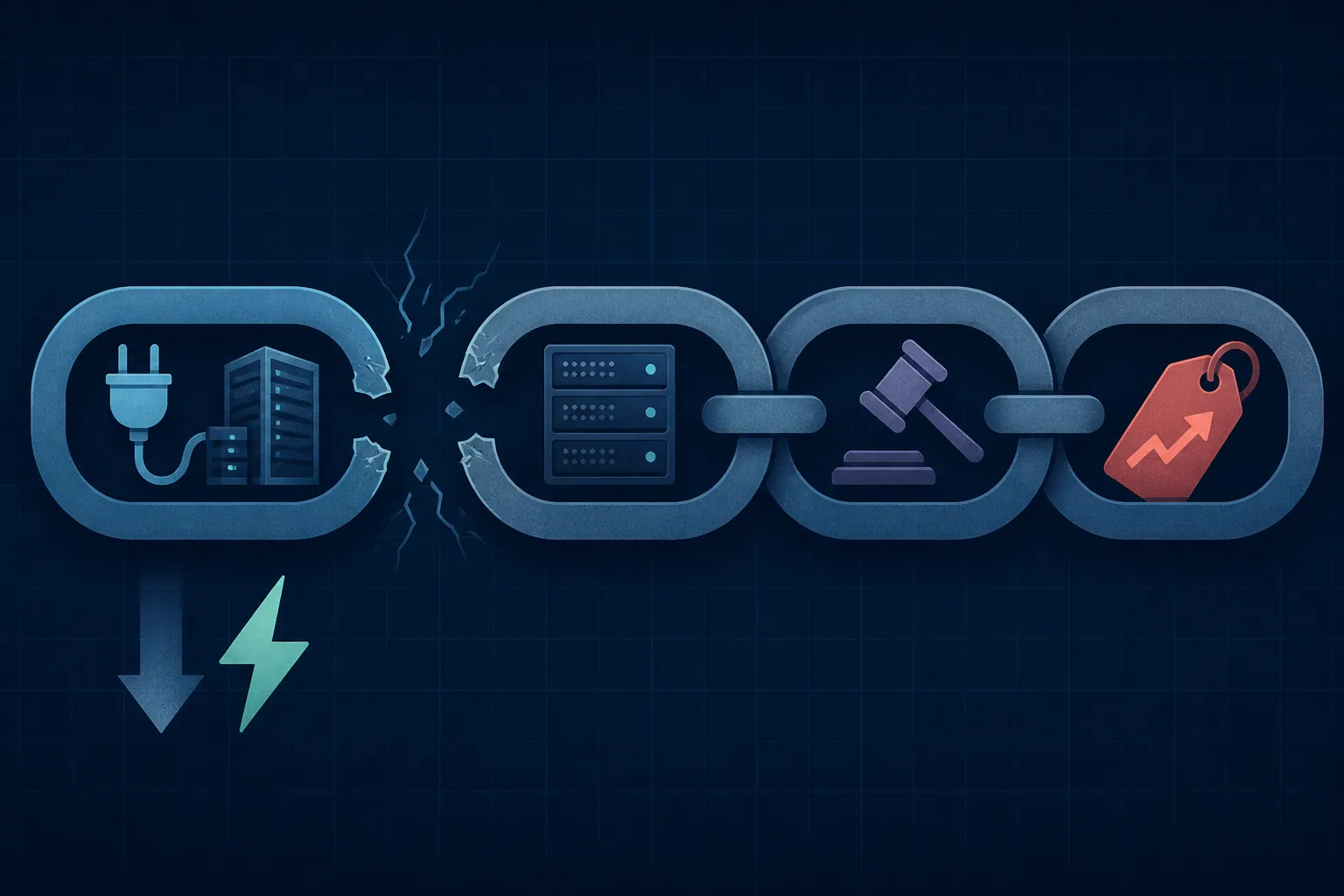
A direct pass-through claim requires every link below to hold:
- The relevant platform experiences a material increase in the electricity cost of the facilities serving its advertising workloads.
- The platform allocates a measurable portion of that increase to ad serving rather than model training, consumer AI products, cloud services or other workloads.
- Management chooses to recover that allocated cost through advertising rather than absorb it, offset it with efficiency gains or recover it elsewhere.
- The recovery decision changes an auction lever, fee, reserve, inventory policy or automated bidding system.
- That platform change produces a distinguishable CPM or CPC movement in the buyer's account.
The available materials document none of those links from end to end. In particular, they do not quantify what share of data-center electricity is consumed by advertising workloads. A global data-center consumption figure combines many activities, including model training, inference, storage, cloud computing and ordinary enterprise workloads. Treating the entire load as an ad-serving expense overstates the relevant cost base before pass-through is even considered.
The contemporaneous price evidence also complicates the neatest version of the story. Average wholesale electricity prices fell by approximately 20% in 2024 across the European Union, India, the United Kingdom and the United States compared with 2023. US electricity demand still grew 2%, partly because of data centers.[4] Rising data-center demand and falling average wholesale prices coexisted over that period.
That does not prove electricity can never increase platform costs. Wholesale averages can obscure local congestion, contract structures, utility tariffs and timing differences. Grid constraints could delay projects or make particular locations more expensive. The narrower conclusion is that the cited demand growth did not produce a broad, simultaneous rise in the reported wholesale-price average—and the materials do not demonstrate a later pass-through into ad auctions.
Even a future electricity-price increase would only establish the first part of the chain. To connect it to paid media, a platform would need to disclose a relevant cost increase or make a dated pricing change that could be tested against delivery records. Without that operational link, “power demand will rise” and “your CPM will rise” remain two separate propositions.
Cheaper creative can change who and what enters auctions
The creative-supply channel requires fewer unsupported steps. In August 2026, Google promoted work produced by creatives using Flow, presenting generative tools as a way to develop advertising concepts and assets.[2] This establishes a platform push toward AI-assisted production. It does not establish that the tools have already increased the number of advertisers bidding in any particular auction.
The plausible mechanism is lower production friction. An advertiser that previously lacked the time or budget to create multiple videos, localized assets or frequent variations may be able to launch more material. Existing buyers may test more concepts and refresh them more often. If that activity expands the number of eligible ads or active advertisers, some auctions could become more competitive.
More creative output is not synonymous with higher prices. Variants may come from advertisers already participating, poor assets may fail eligibility or quality thresholds, and better creative can improve click-through or conversion rates enough to change effective CPC or cost per acquisition in the buyer's favor. The useful account signals are active asset count, refresh frequency, new advertiser overlap, impression share, click-through rate and conversion performance—not the mere availability of a generation tool.
OpenAI adds an ad surface, not proven pressure on incumbent auctions
OpenAI launched its advertising business in February 2026. As of August, about 10% of its staff listed Meta in their LinkedIn employment histories, while the company had set a $100 billion advertising-revenue target that eMarketer forecast it would miss by roughly 90%.[3] The launch, recruitment base and revenue ambition make OpenAI a credible ad-market entrant. The forecast also warns against treating ambition as adoption.
Experienced platform staff can shorten the time required to build sales, measurement, safety and auction operations. They cannot establish advertiser demand, inventory quality or clearing prices before those outcomes appear. The relevant verification layer belongs in dated records such as the OpenAI ads tracker and the analysis of OpenAI's possible 2027 IPO implications, where launch dates, product access and commercial claims can be checked as they change.
A new OpenAI ad product would not automatically enter the same auction as a Google Search or Meta impression. It could instead create a separate inventory pool competing for advertiser budgets. Budget migration might reduce demand on incumbent platforms, while incremental budgets could expand the total market. Incumbents might also respond through new formats, pricing, incentives or increased ad load. None of those auction effects is measured in the supplied evidence.
The wider movement of ad-platform talent shows that AI-native and rebuilt platforms are investing in operational capability. The same August 2026 reporting notes that Amazon Ads rebuilt its DSP under former Meta leadership and that TikTok employed approximately 700 former Meta staff.[3] Staffing is strategically relevant, but it remains an input. Media buyers need product availability, auction mechanics, measurable delivery and actual budget movement before calling it price pressure.
What to monitor before changing bids
The IEA's July 2026 mid-year electricity update is the freshest dated energy checkpoint in these materials.[5] It belongs on a watchlist, but an updated demand outlook is not a bid signal. The same discipline applies to capex announcements, creative-tool launches and platform hiring: record the event first, then look for the operational change it could produce.
| Area | Record | What would strengthen the connection to ad costs | What is insufficient |
|---|---|---|---|
| Platform pricing and delivery | Impressions, reported pricing, ad load, fees, reserve or auction-policy changes | A dated platform change followed by a consistent price-versus-volume pattern | Revenue growth without separating impressions from pricing |
| Own CPM and CPC | CPM, CPC, CTR, conversion rate, placement and query mix, impression share, budgets and bid strategy | A named Benchmarks record showing movement after account changes, seasonality and competition are examined | An undated account screenshot or a cross-platform average |
| Creative supply | Active assets, refresh frequency, new advertiser overlap and adoption of generation tools | More eligible competitors or auction overlap after a documented tool rollout | A platform demonstration or launch announcement by itself |
| New AI-native platforms | Product access, formats, inventory, auction rules, measurement support and actual spend | Documented budget migration or clearing-price behavior | Hiring, revenue targets or infrastructure capacity alone |
| Electricity | Wholesale prices, utility tariffs, grid constraints and platform cost disclosures | A platform disclosure linking a material serving-cost increase to a dated advertising-pricing decision | Data-center demand growth without workload allocation and pass-through evidence |
Do not adjust bids because of a generalized power-cost narrative. Capital commitments, creative production and new ad-platform supply deserve monitoring because each has an identifiable route to commercial behavior, even though none yet proves a specific CPM or CPC effect. Make an account-level claim only when the movement can be linked to a dated platform event and preserved in a named Benchmarks record after the account's own changes, competition and seasonality have been checked.
References
- Energy and AI – Executive summary — International Energy Agency, April 10, 2025.
- What 3 creatives built with unlimited access to Google Flow — Google Ads & Commerce, August 19, 2026.
- The Great Meta Migration — AdExchanger, August 26, 2026.
- Electricity 2025 – Executive summary — International Energy Agency, February 14, 2025.
- Electricity Mid-Year Update 2026 — International Energy Agency, July 23, 2026.