
What OpenAI's 2027 IPO Means for AI Ad Platforms
A dated, source-linked record of OpenAI's path to a 2027 IPO and what each milestone changes for media buyers evaluating AI ad platforms. Going public would force OpenAI to report ad revenue quarterly — the most verifiable check yet on ChatGPT Ads claims.
- Platform
- OpenAI
- Change category
- policy
- Effective date
- 0
- Change type
- regulatory shift
As of Aug. 25, 2026, the cleanest way to read OpenAI’s reported 2027 IPO target, for anyone evaluating AI advertising tools, is not as a victory lap for ChatGPT Ads. It is as a future disclosure event. If OpenAI becomes public, media buyers will no longer have to rely only on product demos, private-company forecasts, and executive language about “inflection.” They will get recurring public numbers to compare against the claims.
The listing path is reported, dated, and still not guaranteed. CNBC reported that OpenAI CFO Sarah Friar told employees at an Aug. 19, 2026 all-hands meeting that OpenAI “will be a public company in 2027,” while also saying the company could debut sooner “if our business continues to inflect.”[1] Reuters reported that OpenAI confidentially filed an S-1 with the SEC on June 8, 2026, after Anthropic’s parallel filing.[2] Marketing Brew, covering the ads rollout, separately framed OpenAI as aiming to IPO “as soon as Q4” 2026.[3]
Those three facts belong together. The 2027 date is not a filed public timetable. The confidential S-1 is not a priced IPO. The Q4 2026 possibility is not the same as a completed listing. What has changed is that OpenAI now has a checkable path toward public-company reporting at the same time it is turning ChatGPT Ads from a limited pilot into an international ad product.

The IPO matters because it changes the evidence standard
Private-company ad forecasts can be useful for expectation-setting. They are not the same thing as quarterly revenue, segment commentary, risk factors, customer concentration language, margin disclosures, or management discussion that a public company has to keep updating. For a buyer deciding whether to move dollars out of Performance Max, Advantage+, AI Max, or Symphony, that distinction is not pedantic. It is the difference between a slide and a ledger.
A public OpenAI would have to report financials on a recurring cadence. The exact format of ad disclosure would depend on how the company organizes its reporting, but an IPO would create a new pressure: if ChatGPT Ads becomes material, the business can no longer live only in launch posts, conference comments, or leaked projections. Investors will ask how much revenue the line contributes, how fast it is growing, what costs support it, and whether growth is coming from durable advertiser demand or one-time test budgets.
That is why the confidential S-1 matters more than another 2030 market-size chart. A confidential filing does not disclose the numbers to buyers today, but it starts the process that could eventually put OpenAI’s actual revenue base, losses, growth rates, and business mix into public documents. Reuters’ June 8 report also places OpenAI beside Anthropic in the same public-market lane, which makes the timeline less like a distant strategic option and more like a current financing track.[2] For more on the Anthropic side of that competitive filing context, see this Anthropic company explainer.
The financing backdrop explains the urgency without proving ad-market fit. OpenAI reportedly raised $122 billion at an $852 billion valuation in March 2026, generated $6.7 billion of revenue in Q2 2026, grew revenue 18% quarter over quarter, and recently topped a $40 billion annualized run rate.[1] Those are scale facts. They help explain why a listing path is plausible and why new revenue lines matter. They do not tell a media buyer whether a sponsored card inside ChatGPT will beat a shopping campaign in Google or a broad Advantage+ setup in Meta.
The ads rollout is now large enough to make disclosure worth watching
If ChatGPT Ads were still only a brand-only experiment in one market, the IPO angle would be interesting but less operational. The reason it now belongs in the AI ad platform conversation is that OpenAI has shipped enough buying, pricing, measurement, and market-expansion changes to give future public numbers something concrete to attach to.
| Date | Ads milestone | Why it matters for buyers |
|---|---|---|
| Feb. 9, 2026 | OpenAI began testing ads in ChatGPT for users on Free and Go tiers in the U.S. | Creates the first observable ChatGPT Ads inventory base. |
| Mar. 26, 2026 | The pilot expanded to Canada, Australia, and New Zealand. | Moves the test beyond a single domestic market. |
| May 5, 2026 | OpenAI introduced Ads Manager self-serve buying, CPC pricing, and a Conversions API. | Makes the product more comparable to performance-ad buying workflows. |
| Aug. 11, 2026 | Expansion added the U.K., Mexico, Brazil, Japan, and South Korea. | Adds major English-language, Latin American, and Asia-Pacific markets. |
| Aug. 18, 2026 | OpenAI expanded ChatGPT Ads across 31 European markets. | Turns the six-month rollout into a multi-region commercial product. |
OpenAI’s first ad test placed sponsored product cards inside ChatGPT responses for Free and Go users in the U.S., with the company saying ads were labeled and separated from organic answers.[4] The early format matters because it is not a search results page and not a social feed. It sits inside a conversational interface, which is exactly why buyers want proof before treating it like intent inventory with Google-level reliability.
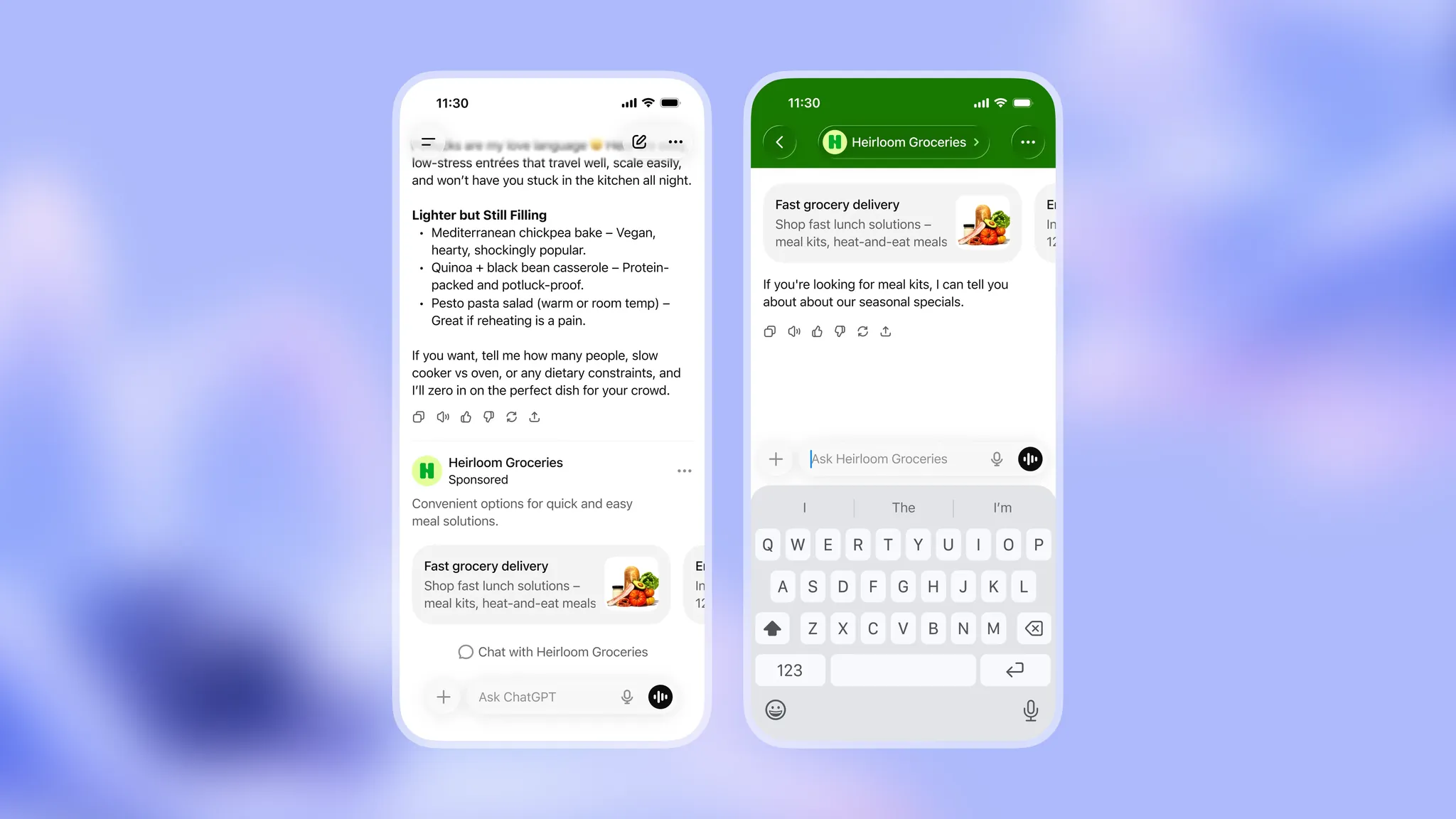
The pricing path also changed quickly. Digiday reported that the initial pilot used a $60 CPM and roughly $200,000 minimums, aimed at brand advertisers.[5] On May 5, OpenAI announced Ads Manager, self-serve access, cost-per-click buying, and a Conversions API.[6] Digiday later reported CPMs as low as about $25 after the move toward CPC buying.[5] That does not prove efficiency; it does show OpenAI moving from scarce, high-minimum experimental inventory toward a buying model that performance teams can at least test.
For platform-level details, the cleaner place to maintain the product ledger is the ChatGPT self-serve ad platform tracker. The IPO record has a narrower job: to track when those shipped features may start being tested against public revenue rather than launch cadence.
By mid-August, the geographic rollout had become harder to dismiss as a contained pilot. Marketing Brew reported that ChatGPT Ads expanded from one market to more than 39 markets in six months, including the Aug. 11 additions of the U.K., Mexico, Brazil, Japan, and South Korea, and the Aug. 18 expansion into 31 European markets.[3] OpenAI’s European expansion post described the same regional push and said advertisers could reach Free and Go users in those markets.[7]

Marketing Brew also reported OpenAI’s claim that daily ad revenue had grown by more than 25% since Aug. 1, 2026.[3] That is a vendor-reported growth claim, not a public financial statement. It can be logged as momentum. It should not be treated as a budget-allocation benchmark.
Forecasts explain the noise around the IPO, not the performance of the ad product
The temptation is to turn every leaked forecast into an implied media plan. That is where the record gets loose. Business Insider reported OpenAI internal projections of $2.4 billion in ad revenue in 2026, about $11 billion in 2027, and roughly $100 billion to $102 billion by 2030.[8] In a separate Business Insider piece, Evercore analysts framed ChatGPT Ads as a potential $25 billion business by 2030.[9] eMarketer estimated that ChatGPT ad revenues may fall about 90% short of OpenAI’s 2030 target, with the important caveat that eMarketer’s comparison was U.S.-only.[10] Adweek covered the same forecast-gap issue through the lens of analyst skepticism.[11]
Those numbers belong in the file because they tell buyers what expectations are being sold around the platform. They do not settle the question buyers care about at quarter-end: whether spend placed into ChatGPT Ads produced incremental, measurable business results at an acceptable cost. For sorting these kinds of forecast-definition problems across AI ad markets, see the AI bubble and ad budget tracker.
Advertiser-count claims deserve the same treatment. The research record contains conflicting figures by source, date, and definition: Criteo-related figures moving from 1,000 to 2,000 advertisers, OpenAI’s Aug. 18 claim of “tens of thousands,” and Ad Age ranges that do not use the same measurement frame. Without a consistent definition of active advertiser, onboarded account, campaign spender, or marketplace participant, those figures are directional color rather than comparable adoption data.
There is also a competitive reason not to overread ChatGPT’s early expansion. Google is not waiting outside the building. AI Mode ads and related campaign changes are already pulling AI-generated answers, shopping surfaces, and performance automation into Google’s existing ad machine. That is a different kind of evidence base: less novel, but attached to budgets, conversion data, and auction behavior buyers already reconcile. The competitive counterweight is tracked separately in the Google AI Mode ads campaign-change log.
What remains unverified before OpenAI is public
The current record supports a narrower conclusion than the market narrative usually wants. OpenAI has a reported 2027 public-company target, a confidential S-1 filing, large private-market financing, fast revenue growth at the company level, and a six-month ChatGPT Ads rollout across more than 39 markets. It also has press-reported internal ad projections and analyst counter-estimates that disagree sharply. None of that is first-party campaign evidence for a media buyer.
Before public filings or quarterly reports exist, the biggest open items are basic but material: how OpenAI defines ad revenue; whether ads are reported separately or folded into a broader consumer or business line; how much revenue comes from direct IOs versus self-serve buying; whether CPC campaigns produce enough conversion volume for reliable optimization; how much of the reported growth is from new-market launches; and whether advertisers renew after initial tests.
Measurement is the other missing ledger. The May 5 Conversions API announcement gives performance buyers a familiar plumbing concept, but the presence of conversion tracking is not the same as independent incrementality. Buyers still need to know whether ChatGPT Ads is creating demand, capturing demand, assisting conversion paths, or simply taking credit inside a new interface. For creative-format implications around the single text-plus-image unit, the related GPT-5.5 window log is maintained in the AI ad creative impact tracker.
There is a delay scenario as well. Morningstar’s discussion of what could happen if OpenAI delays its 2027 IPO is useful because the disclosure checkpoint depends on the listing actually happening.[12] If the IPO slips, the ad business may keep expanding, but buyers would remain in the weaker evidence environment: product announcements, reported projections, partner comments, and scattered advertiser tests.
That weaker environment also matters for companies building on OpenAI-dependent ad stacks. If a workflow depends on OpenAI models, APIs, or ad inventory, the diligence question is broader than media efficiency. Operational concentration, platform policy changes, pricing, and availability can all move underneath the buying plan. The related risk file is tracked in the OpenAI-dependent ad stack diligence record.
The useful checkpoint is not the IPO headline. It is the reporting that follows.
A 2027 OpenAI IPO would not prove that ChatGPT Ads works. It would not make conversational ad inventory comparable to search overnight. It would not tell a buyer whether to move money out of Performance Max, Advantage+, AI Max, or Symphony.
It would, however, create the clearest future checkpoint buyers have had so far. The ads product has moved from a U.S. pilot to a multi-market, self-serve, CPC-capable platform in six months. The company has started a reported path toward public-market disclosure. If those two tracks meet, ChatGPT Ads stops being only a private experiment surrounded by projections and becomes a business line that has to survive recurring, comparable public numbers.
References
- OpenAI IPO timing 2027 Friar, CNBC, Aug. 19, 2026.
- OpenAI files US IPO after Anthropic as AI giants head to public markets, Reuters, June 8, 2026.
- OpenAI ChatGPT Ads 31 new international markets expansion, Marketing Brew.
- Testing ads in ChatGPT, OpenAI, Feb. 9, 2026.
- OpenAI turns on cost-per-click ads inside ChatGPT, Digiday.
- New ways to buy ChatGPT ads, OpenAI, May 5, 2026.
- ChatGPT Ads expands across Europe, OpenAI, Aug. 18, 2026.
- OpenAI projects ChatGPT ad growth, market doubts, Business Insider.
- OpenAI ads ChatGPT $25B business 2030 advertising Google Meta, Business Insider.
- ChatGPT ad revenues may fall 90% short of OpenAI’s 2030 target, eMarketer.
- OpenAI’s ad business is on pace to miss its own forecast by 90%, analyst says, Adweek.
- What happens if OpenAI delays its IPO to 2027, Morningstar.
Primary source: https://www.cnbc.com/2026/08/19/openai-ipo-2027.html