
AI Market Research Tools
Not all AI market research tools serve the same purpose. This article provides a decision framework that maps tools to five distinct research job types, helping marketing teams choose the right two or three tools for their actual workflow instead of drowning in feature lists.
Marketing Categories
⚠ Notable Limitations
Unverified sources, signal misinterpretation, sample fraud
The wrong way to evaluate AI market research tools is to open twenty tabs, compare feature lists, and hope a winner appears. The useful question comes earlier: what research job are you trying to complete, and what decision will the output change?
That sounds obvious until procurement starts. A desk research copilot, a social listening platform, an AI-moderated interview tool, a survey automation platform, and a competitive intelligence system may all be sold as AI research software. They do not answer the same kind of question, use the same evidence, or fail in the same way. Factors.ai’s market research tool guide gets the starting point right: map the tool to the research question before comparing vendors.[1]
The category is noisy for a reason. The global insights industry is roughly $140 billion, though that figure covers the broader research market rather than AI tools alone.[2] At the same time, 88% of organizations now use AI regularly, according to McKinsey 2025 data cited by Shopify.[3] Put those together and every workflow in research suddenly has an AI label attached to it.
Start With the Research Job, Not the Vendor
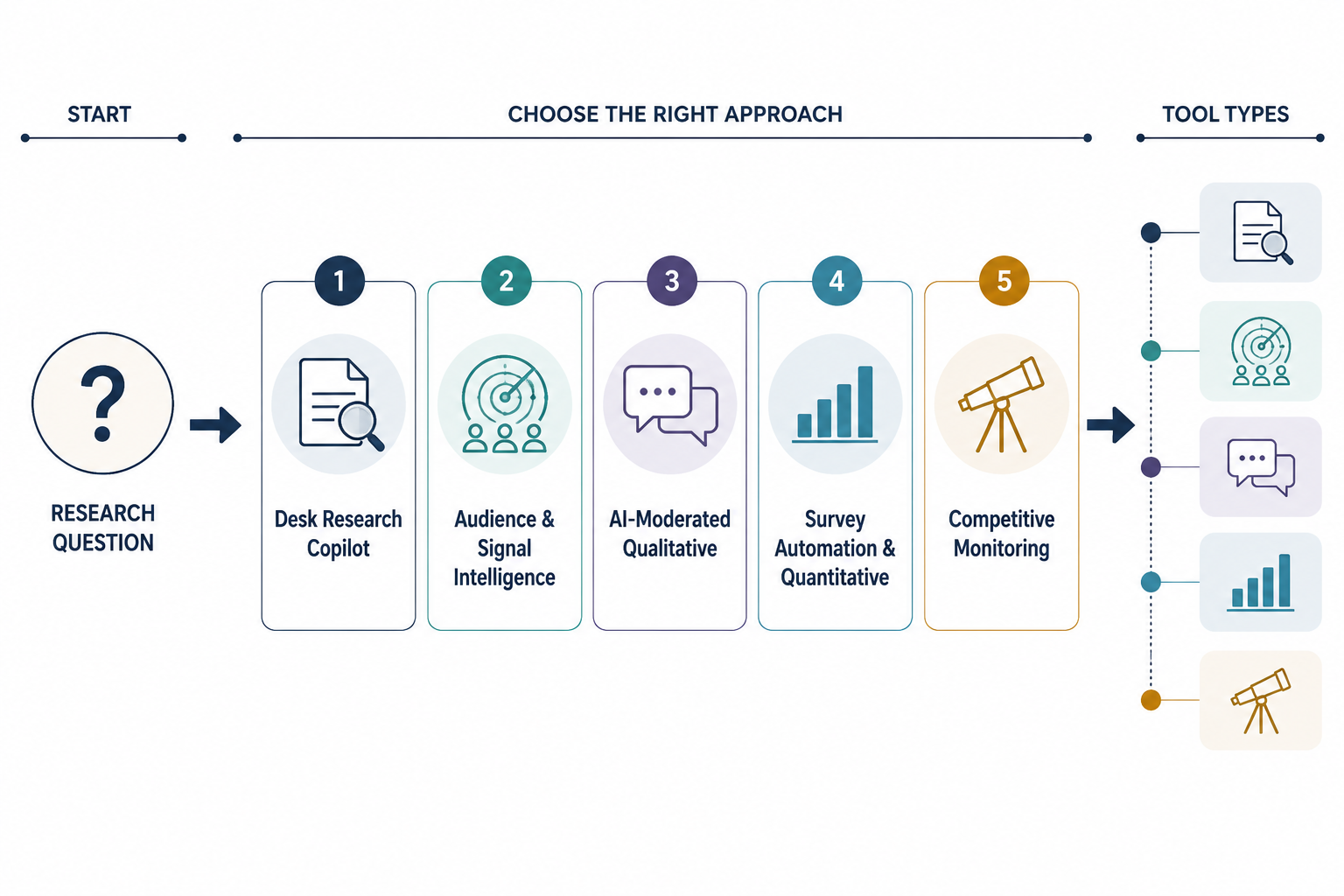
Most teams can sort their needs into five recurring research jobs. H-in-Q’s 2026 decision matrix uses the same practical logic: choose the category from the question, not from a generic ranking table.[4]
| Research job | What the team is trying to learn | Representative tools | Main failure mode |
|---|---|---|---|
| Desk research copilot | Frame a market, synthesize sources, draft hypotheses, prepare briefs | ChatGPT, Perplexity, Claude | Confident synthesis from weak or unverified inputs |
| Audience and signal intelligence | Understand what audiences talk about, follow, search, compare, or respond to | SparkToro, GWI Spark, Crayon | Treating signals as proof of motivation |
| AI-moderated qualitative | Collect open-ended customer responses with more depth than a structured survey | Perspective AI, Outset | Mistaking fluent answers for validated customer evidence |
| Survey automation and quantitative | Measure preferences, attitudes, claims, concepts, or segments at scale | Quantilope, Standard Insights | Poor sample quality, bad questionnaire design, or panel fraud |
| Competitive monitoring | Track competitor messaging, launches, content, pricing signals, and market moves | Crayon, Brandwatch | Collecting alerts that no one converts into decisions |
A team may eventually need more than one category. But the first buying decision should identify the job that happens repeatedly, creates the most drag, or blocks an important decision. A tool that is excellent for synthesis will not fix a sample-quality problem. A survey platform will not tell you which competitor changed its messaging last week unless it was designed to monitor that environment.
Desk Research Copilots: Fast Framing, Not Final Evidence
Use a desk research copilot when the work is synthesis: preparing a market scan, comparing public positioning, turning interview notes into themes, drafting a research brief, or pressure-testing early hypotheses before spending money on primary research.
ChatGPT, Claude, and Perplexity belong in this layer. They are useful when a marketer needs to move from scattered inputs to a coherent starting point. Perplexity is often better suited when source discovery and citation trails matter. Claude is useful for long documents, interview notes, and structured synthesis. ChatGPT is flexible for ideation, repeatable workflows, and research templates.
The output should still be treated as a working brief. It can shape the next research question, identify gaps, and produce a first-pass competitor or audience hypothesis. It should not become the customer’s voice unless the underlying material actually came from customers. Teams building this layer can pair it with practical patterns such as persona research prompt templates for Claude when they need reusable desk research workflows.
The evaluation question is simple: can the tool show where an important claim came from, and can the team reproduce the workflow next month? If not, it may still be useful for drafting, but it should not be trusted as a research system.
Audience and Signal Intelligence: What People Appear to Do
Audience and signal intelligence tools answer a different question: where does this audience spend attention, what topics cluster around them, which brands or creators show up nearby, and what market signals are changing?
SparkToro, GWI Spark, and Crayon sit closer to this job than to primary research. They help a marketer move from broad demographic assumptions to observable signals: websites followed, topics discussed, content consumed, competitors watched, or categories mentioned. Those signals are valuable when choosing channels, building audience hypotheses, planning content angles, or deciding which competitors deserve closer tracking.
The trap is to turn behavioral or audience signals into a claim about why customers buy. A social pattern can show that a topic is visible. It does not, by itself, prove purchase motivation, unmet need, or willingness to pay. For those questions, the signal layer should feed a survey, interview, or experiment rather than replace it.
Evaluate this category by asking what data sources the tool uses, how current the signals are, whether the audience definition can be inspected, and whether exported insights fit the team’s planning workflow. An integration only matters if it prevents someone from copying screenshots into a deck at midnight.
AI-Moderated Qualitative: Depth per Response Matters
AI-moderated qualitative tools are easy to misunderstand because they often look like surveys from the outside. The better distinction is not whether the interface has questions. It is whether the system can follow up, probe, clarify, and produce richer open-ended responses than a fixed questionnaire.
Perspective AI frames this as research depth: AI-moderated qualitative platforms can produce interview-like depth per response that structured survey tools are not designed to capture.[5] That is a useful dividing line. If the team needs to understand how customers describe a problem, what language they use, where confusion appears, or why a concept feels credible or not, tools such as Perspective AI or Outset belong on the shortlist.
This category is especially useful before a survey, not only after one. A marketer can use AI-moderated qual to find the vocabulary customers actually use, then write better survey options. It can also help after a quantitative readout when the numbers show a pattern but the team still does not understand the reasoning behind it.
The risk is overconfidence. A fluent AI-moderated transcript still depends on who was recruited, what they were asked, how follow-ups were generated, and how the output was summarized. Synthetic respondents or AI-generated customer stand-ins deserve even more caution. If a team is tempted to replace primary research with simulated customer evidence, the safer next stop is a deeper review of documented synthetic customer research risks.
Survey Automation and Quantitative: Speed Is Useful Only After the Question Is Clean
Survey automation tools earn their place when the decision requires a measurable answer: which concept performs better, how a segment differs from another, whether a claim is credible, how buyers rank criteria, or how many respondents recognize a brand.
Quantilope and Standard Insights sit in this quantitative layer. Their value is not merely that AI can write questions faster. The better use is reducing the operational load around questionnaire design, fielding, analysis, and reporting while preserving enough methodological discipline that the answer can survive a leadership meeting.
This is where teams should be least impressed by surface-level automation. Bad answer options become bad charts faster. A biased sample becomes a more polished wrong answer. Panel-based tools need credible fraud prevention, sample controls, and transparent respondent sourcing. If the tool cannot explain those basics, the chart style is irrelevant.
Use this category when the decision needs directional or statistically interpretable evidence from a defined audience. Do not use it when the team has not yet learned the language customers use to describe the problem. In that case, run qualitative work first, then quantify.
Competitive Monitoring: Alerts Are Not Insight
Competitive monitoring tools answer a narrower, operational question: what changed in the market that our team should notice? Crayon and Brandwatch can help teams track competitor messaging, content, social signals, campaign shifts, category conversation, and public-facing changes.
This category becomes valuable when someone owns the response. Product marketing may use the output to update battlecards. Content teams may use it to spot topic saturation. Demand generation may use it to watch campaign themes. Leadership may use it to see whether a competitor is repositioning. Without that owner, monitoring becomes a feed of interesting noise.
Custom enterprise pricing is common in this part of the market, especially for tools such as Crayon and Brandwatch. That does not make them wrong choices, but it raises the bar for fit. A team should know which recurring decision the alerts support before it accepts a large annual contract.
The Criteria That Matter More Than Feature Count
Once the category is clear, feature comparison becomes more useful. Before that, it mostly creates false precision. A team evaluating AI market research tools should pressure-test four things.
- Data source quality: what evidence goes into the output, how current it is, and whether the source can be inspected.
- Method fit: whether the tool’s output matches the research method the decision actually requires.
- Depth per response: especially for qualitative tools, whether answers contain useful reasoning rather than shallow completions.
- Panel and respondent integrity: for quantitative and moderated studies, whether the platform can explain recruitment, screening, fraud prevention, and quality controls.
- Workflow integration: whether the tool reduces handoff friction for the people who brief, review, approve, and reuse the research.
The last point is where many expensive tools disappoint. A CRM integration, Slack alert, or slide export is not automatically valuable. It matters only if it removes a real handoff in the research workflow: the product marketer waiting for message evidence, the growth lead deciding which audience to test, the insights lead defending sample quality, or the executive asking whether the conclusion is reliable enough to act on.
For teams still deciding which research tasks should be automated at all, the broader question belongs in a separate workflow conversation, not a vendor demo. A useful companion is how to decide which market research tasks to automate with AI.
Lean Stack Patterns That Usually Beat the All-in-One Fantasy
There are teams that need enterprise research architecture. Most marketing teams are not there on day one. Predictable Innovation reports 25–40% time savings and 2x productivity from using a lean AI stack for market research, but those figures should be read as evidence that focused workflows can save time, not as a universal guarantee.[6]
Standard Insights recommends a 70/20/10 allocation: 70% on proven tools, 20% on growth capabilities, and 10% on experiments.[7] That is a healthy antidote to the “buy everything while the budget window is open” instinct.
| Team situation | Smallest useful stack | What to avoid |
|---|---|---|
| Solo marketer or early-stage team | Desk research copilot plus a lightweight signal or scraping tool | Buying enterprise monitoring before the team has a repeatable research cadence |
| Growing B2B marketing team | Desk research copilot, audience intelligence, and either survey automation or AI-moderated qualitative | Treating social or web signals as a substitute for customer evidence |
| Product marketing or insights-led team | Qualitative platform, quantitative survey platform, and competitive monitoring | Letting each department buy separate tools with no shared validation standard |
| Enterprise team | Hybrid stack with governed research platforms, monitoring, and documented handoffs into marketing systems | Choosing a workspace platform before mapping ownership and review rights |
Early-stage teams can start even smaller. Free-tier options across Perplexity, ChatGPT, and Browse AI can cover some early research needs for under $50 per month, according to Analythical’s 2026 roundup.[8] That setup will not replace primary research, but it can handle initial desk research, source discovery, and lightweight monitoring before the team commits to a paid stack.
For larger teams, the question shifts from “which tool is clever?” to “where does the output live, who approves it, and which system uses it next?” Enterprise buyers comparing point solutions, workspace platforms, and hybrids should separate that architecture decision from the first vendor shortlist. The more relevant next read is AI marketing stack architecture.
Pricing and Positioning Caveats for Mid-2026
Tool pricing and positioning are moving quickly in Q3 2026. Some products that looked like narrow research assistants in early 2026 now present themselves as broader AI workspaces. Others have added research features without becoming true research platforms. Enterprise tools such as Crayon, Brandwatch, and Outset may use custom pricing, which makes public comparison tables less useful than they appear.
That is another reason to avoid ranking lists as the buying mechanism. A price column cannot tell you whether a panel is clean, whether an AI moderator probes well, whether a competitive alert reaches the person who owns positioning, or whether the synthesis layer can be audited after the campaign has already launched.
A Practical Selection Rule
If the question is “What do we already know, and how should we frame the next investigation?” start with a desk research copilot. If the question is “Where is this audience showing attention or behavior?” use audience and signal intelligence. If the question is “Why do customers describe the problem this way?” use AI-moderated qualitative. If the question is “How many people in a defined audience prefer, believe, or recognize something?” use survey automation. If the question is “What changed in the competitive environment?” use competitive monitoring.
Most teams should end up with two or three tools, not a museum of demos. Pick the category that matches the recurring research job, assemble the smallest stack that covers the work, then validate the outputs before operationalizing them. That validation step is where trust is either earned or lost; a useful next step is how to validate AI market research tools before you trust them.
When leadership asks why the team is not buying the biggest platform, the answer should be tied to decisions, not preferences: this tool supports this research job, this output changes this decision, and this validation check tells us whether to trust it. If budget justification becomes the blocker, connect the stack to a clear ROI case rather than a vague AI transformation story. The relevant leadership-facing route is the AI in market research ROI case.
References
- 10 AI Market Research Tools Worth Using (Not Just Hype) — Factors.ai
- The AI Tools That Are Transforming Market Research — Harvard Business Review, November 2025
- 34 AI in Marketing Statistics: Industry Trends in 2026 — Shopify
- 7 Best AI Market Research Tools in 2026 (Free + Paid) — H-in-Q
- AI Market Research Platforms in 2026: 10 Tools Ranked by Research Depth — Perspective AI
- AI for Market Research — Predictable Innovation
- AI Market Research Tools — Standard Insights
- 8 Amazing Free AI Tools For Market Research (2026) — Analythical

Comments
Join the discussion with an anonymous comment.