
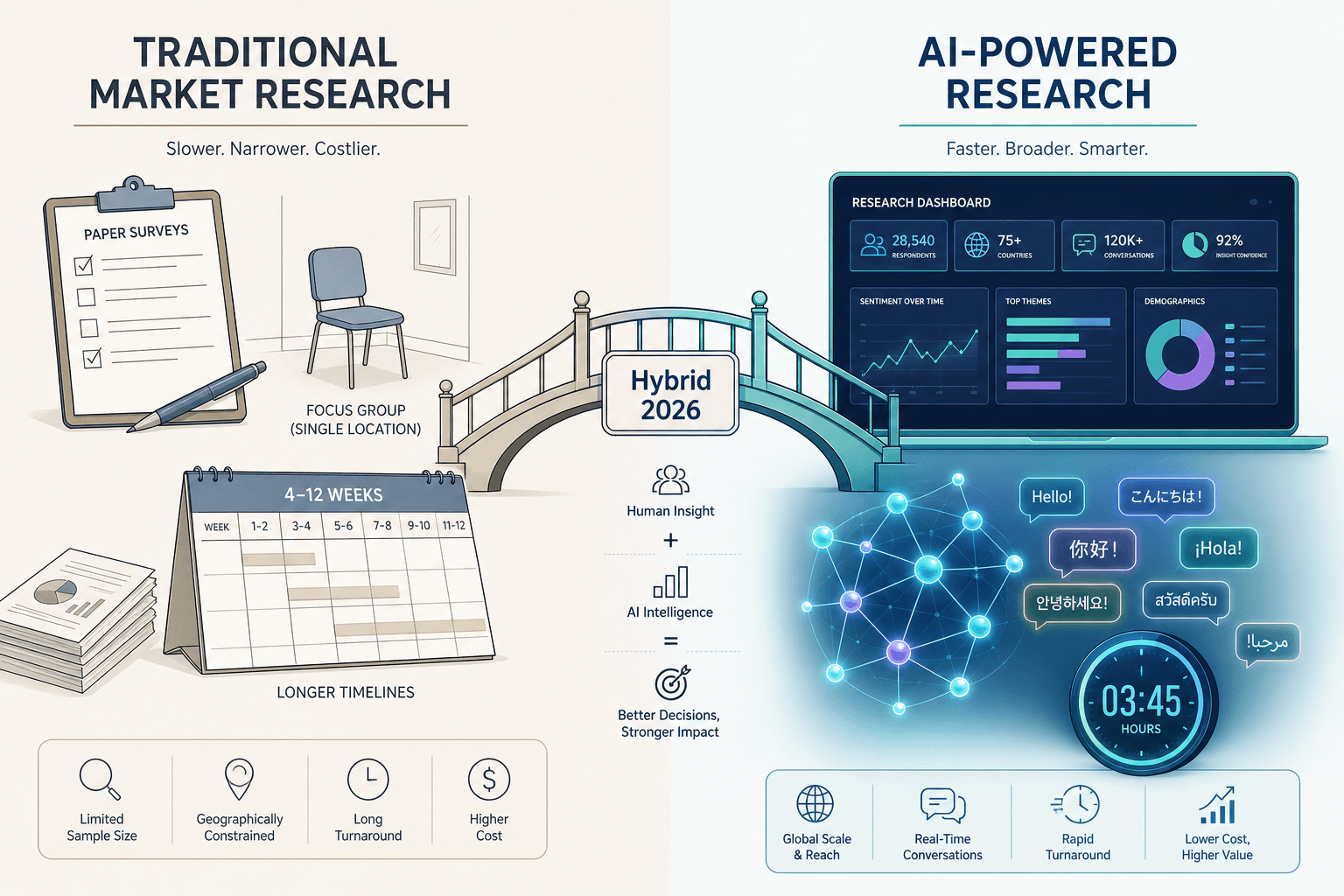
The AI in Market Research ROI Case That Will Convince Your Leadership Team
For mid-level marketing managers and insights team leads: a sourced, CFO-friendly framework for justifying AI research tool investment, covering cost deltas, speed gains, quality improvements, and a budget reallocation model.
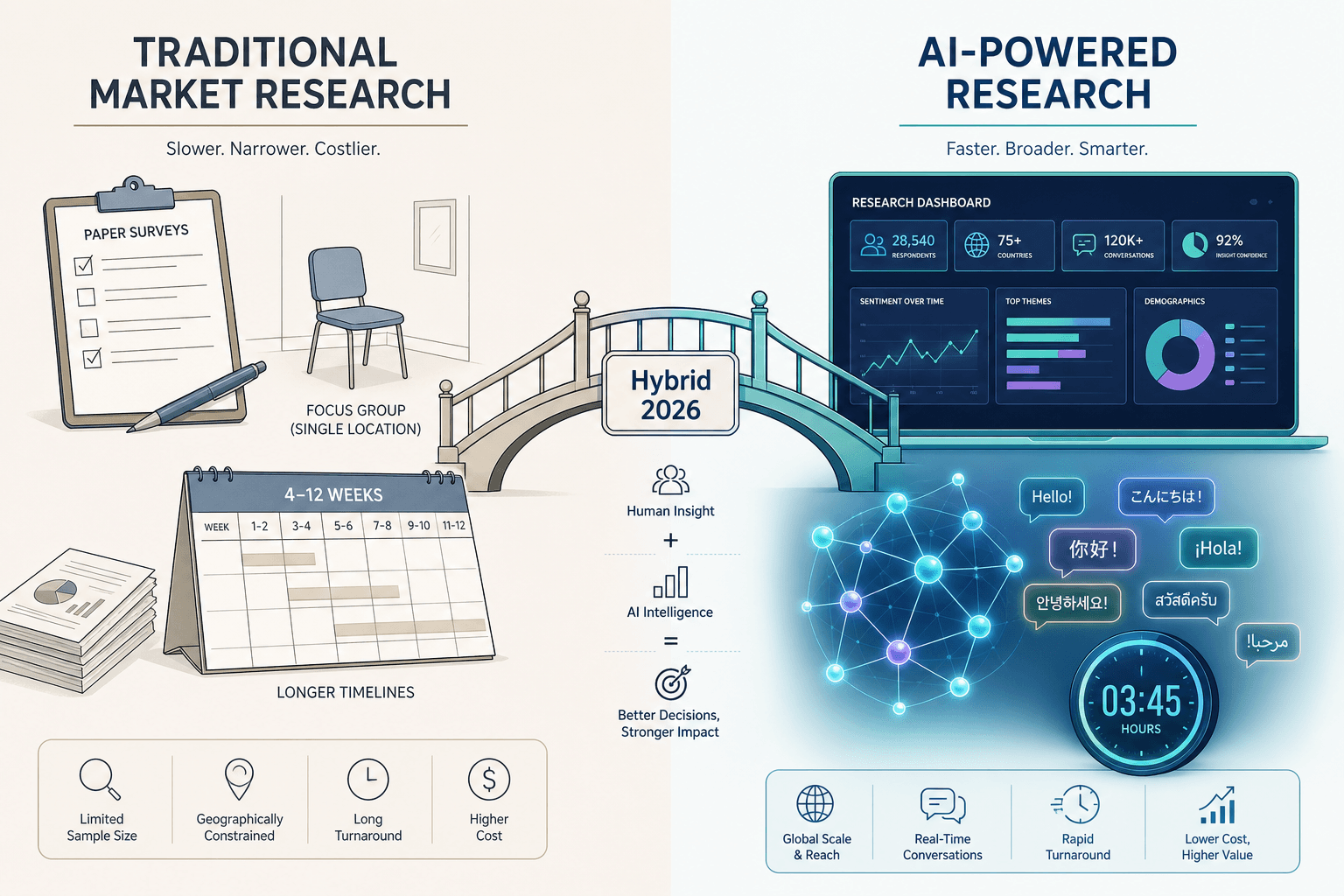
Why the Economics of AI in Market Research Demand a Leadership Conversation Now
For the past two years, most marketing teams have treated AI in market research as an experiment — a pilot project run by an early adopter on the insights team, funded out of discretionary budget, and evaluated on novelty rather than hard economics. That phase is over. The data from 2025 and early 2026 makes a clear case: the cost, speed, and volume advantages of AI-moderated research have crossed a threshold where the competitive risk of not adopting now outweighs the implementation risk of adopting.
Consider the headline numbers. The global market research industry is worth $140 billion and growing at 6.4% year over year, according to ESOMAR's 2025 Global Market Research Report. Within that market, AI-native methods are the only segment growing at double-digit rates. The Greenbook 2025 GRIT report found that 72% of insights buyers now use generative AI in at least one research stage, up from 23% in 2023. Qualtrics' 2026 Market Research Trends Report, surveying 3,000 professionals, puts the figure even higher: 95% of researchers now use AI tools regularly or are experimenting with them.
This is not a future trend. It is the current operating reality for the majority of the profession. The question for a marketing manager or insights team lead is no longer whether AI belongs in the research toolkit. It is how to build a business case that captures the full economic picture — cost savings, yes, but also decision velocity, research volume, and strategic capacity — in terms that a CFO will recognize as rigorous.
The Cost Delta: Traditional vs. AI-Moderated Research Economics
The most immediately graspable argument for AI in market research is the cost per completed interview. The gap is not incremental — it is structural.
According to the Quirk's 2025 Researcher SaaS Report and the Insights Association 2024 Pricing Study, the all-in cost for a traditional human-moderated qualitative interview averages approximately $487 per complete. This figure includes recruiter fees, moderator time, facility rental or platform costs, transcription, and analysis. The equivalent all-in cost for an AI-moderated interview averages approximately $22 per complete. The range for AI-moderated interviews is $8 to $22, while traditional human-moderated interviews range from $150 to $487.
| Cost Component | Traditional (Human-Moderated) | AI-Moderated |
|---|---|---|
| Per-interview cost range | $150 – $487 | $8 – $22 |
| All-in average per complete | ~$487 | ~$22 |
| Includes recruiter fees | Yes | Yes (automated) |
| Includes moderator time | Yes | No (AI-driven) |
| Includes transcription | Often separate cost | Included |
| Includes analysis | Often separate cost | Included |
A concept test that once required a budget of $15,000 and three weeks of calendar time can now be completed on a modern AI research platform for a fraction of that cost in a matter of hours, according to Ditto's 2026 buyer's guide. The monthly subscription for most mid-market AI research platforms runs between $500 and $5,000 — a range that replaces the $15,000 to $100,000+ per-study cost of traditional approaches.
The Speed Delta: From 6.2 Weeks to 2.1 Days
Cost savings alone rarely move a CFO. Speed, on the other hand, is a metric that maps directly to revenue — faster decisions mean faster product iterations, faster campaign adjustments, and faster responses to competitive moves.
The Greenbook GRIT timing benchmarks document a dramatic acceleration. The median time-to-decision for a traditional qualitative research project — from brief to actionable insight — was 6.2 weeks. For AI-moderated research, that figure drops to 2.1 days. That is a 95% reduction in the time required to go from question to answer.
| Phase | Traditional Timeline | AI-Moderated Timeline |
|---|---|---|
| Recruitment | 1–2 weeks | Hours (automated panel matching) |
| Fieldwork (20 interviews) | 1–2 weeks | 1–2 days (parallel moderation) |
| Transcription | 2–5 days | Instant (automated) |
| Analysis & synthesis | 1–2 weeks | Hours (automated thematic coding) |
| Total time-to-decision | 6.2 weeks (median) | 2.1 days (median) |
Three structural factors drive this acceleration. First, AI can moderate multiple interviews in parallel — a capability impossible for a single human moderator. Second, transcription and thematic analysis happen in real time, not as a separate post-fieldwork phase. Third, the synthesis layer — identifying patterns, surfacing outliers, generating summary reports — is automated rather than dependent on a researcher's manual review cycle.
The business implication is straightforward. When a product team needs to validate a concept before a quarterly planning deadline, waiting six weeks is often equivalent to not doing the research at all. A two-day turnaround means research can inform the decision rather than merely confirm it after the fact.
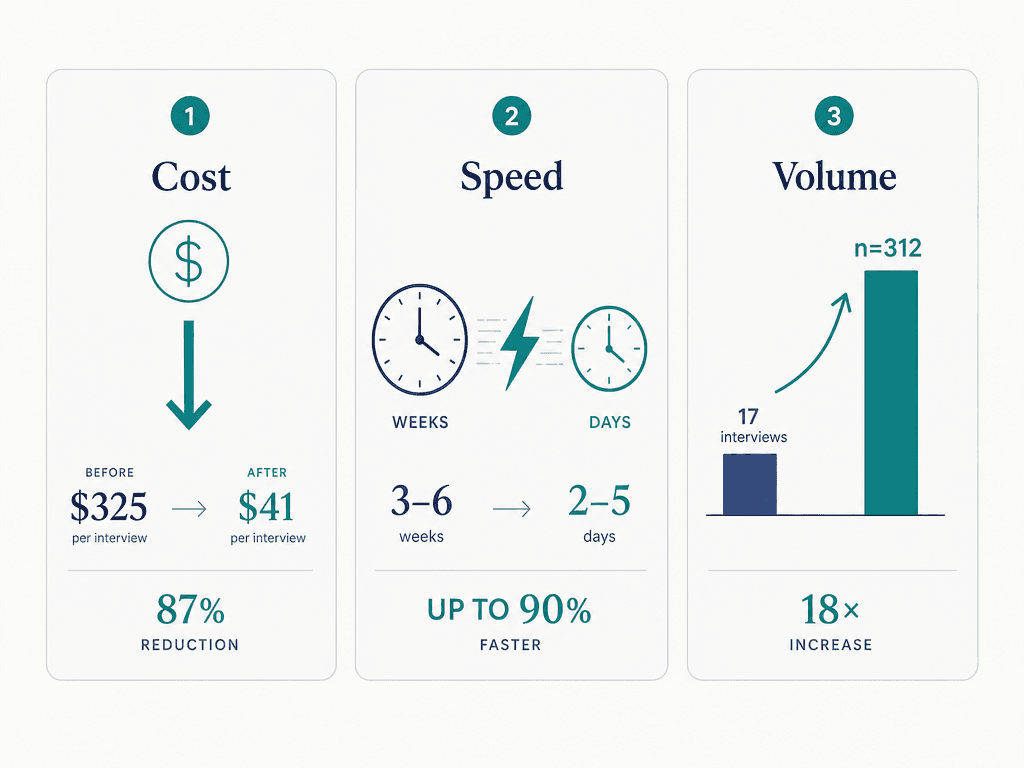
The Volume Delta: 14x More Qualitative Interviews per Quarter
When per-interview costs drop by 95% and turnaround time collapses from weeks to days, the volume of research a team can conduct is no longer constrained by budget and calendar. It is constrained only by the team's capacity to act on insights.
The Greenbook December 2025 reader survey of 1,200 insights professionals found that the average AI-native research platform user now runs 14 times more qualitative interviews per quarter than they did in 2023. The median sample size for AI-moderated qualitative studies has grown from 17 participants in 2022 to 312 in 2026. That is an 18-fold increase in the number of voices a research team can include in a single study.
- Median AI-moderated qualitative sample size: 312 (up from 17 in 2022)
- 14x more qualitative interviews per quarter for AI-native users (2026 vs. 2023)
- 41% of insights teams now run at least one always-on continuous tracking study
- 81% of researchers using AI report doing more strategic work, not less
This volume shift changes the fundamental research strategy for many teams. Instead of conducting a single point-in-time study per quarter — often with a sample too small to segment meaningfully — teams can run continuous, always-on research programs. The 41% of insights teams now running at least one always-on study are building a longitudinal data asset rather than a series of disconnected snapshots.
The strategic implication for a leadership conversation: more research volume does not mean more cost. It means better coverage across customer segments, faster detection of emerging trends, and the ability to track sentiment changes over time rather than relying on a single data point.
The Quality Delta: Better Coverage, Longer Responses, Lower Bias
A common objection from research traditionalists is that AI-moderated interviews must sacrifice quality for speed and cost. The available data suggests the opposite is true across several measurable dimensions.
The Greenbook 2025 Quality Audit compared AI-moderated and human-moderated interviews on three key metrics. AI-moderated interviews achieved 98% discussion-guide coverage — meaning the AI moderator asked every planned question and probe — compared to 76% for human moderators, who frequently skip or forget probes under time pressure. Respondents in AI-moderated interviews produced 4.2 times more words per probe, suggesting that the absence of social pressure and interviewer fatigue leads to more thoughtful, elaborated responses. Finally, AI-moderated interviews scored significantly lower on interviewer-bias metrics, because the AI applies the same questioning pattern to every participant without the subtle cues — tone, leading questions, selective follow-ups — that human moderators unconsciously introduce.
| Quality Metric | Traditional (Human-Moderated) | AI-Moderated |
|---|---|---|
| Discussion-guide coverage | 76% | 98% |
| Response length per probe | Baseline | 4.2x longer |
| Interviewer-bias score | Higher (variable by moderator) | Lower (consistent protocol) |
| Social desirability bias risk | Moderate to high | Lower (no human interviewer) |
| Consistency across sessions | Variable | High (same AI protocol) |
These quality advantages are not universal. AI moderation still underperforms in emotionally sensitive research contexts — topics involving trauma, grief, or deeply personal experiences where human empathy and rapport are essential. AI also struggles with primary data generation in entirely novel domains where there is no existing training data to draw on. For high-stakes strategic decisions — a multi-million dollar product launch, a brand repositioning — a hybrid approach that uses AI for breadth and human moderators for depth is the prudent path.
Building Your Business Case: Three Metrics That Matter to CFOs
CFOs evaluate technology investments on three dimensions: does it reduce cost, does it increase output per unit of input, and does it enable something the organization could not do before. The market research ROI case maps cleanly to these criteria when framed using the right metrics.
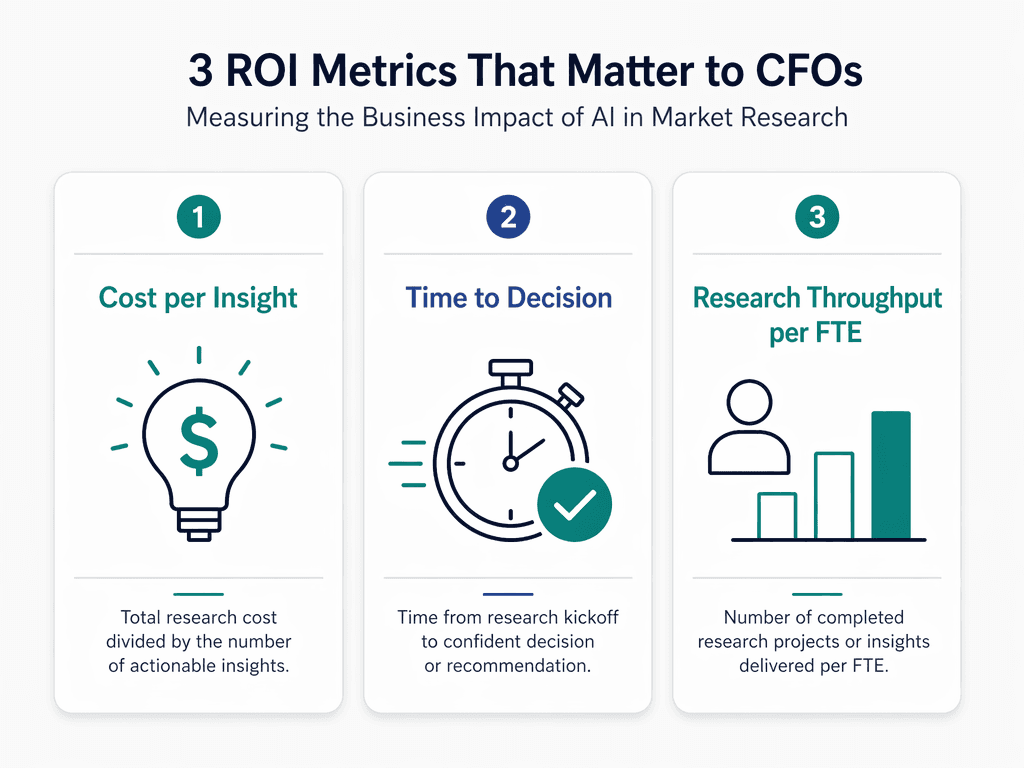
Metric one is cost per insight. Calculate this by dividing the total cost of a research project — including tools, recruitment, and analysis — by the number of distinct, actionable insights it produces. For a traditional $15,000 concept test that yields 10 insights, the cost per insight is $1,500. For an AI-moderated equivalent costing $500 that yields 15 insights, the cost per insight drops to $33. That is a 45x improvement in capital efficiency.
Metric two is time-to-decision. This is the interval between a business question being posed and a research-backed answer being delivered. The Greenbook benchmark of 6.2 weeks for traditional research versus 2.1 days for AI-moderated is a defensible starting point. The value of faster decisions varies by context, but a simple model — if a product team makes one better decision per quarter because they had research data in time, what is that worth? — is often enough to make the case.
Metric three is research throughput per FTE. Measure how many studies, interviews, or insights a single researcher can produce in a quarter. The Greenbook data showing 81% of AI-using researchers reporting more strategic work suggests that throughput gains are real. A team that previously completed four studies per quarter and now completes twelve — without adding headcount — has effectively tripled its research capacity.
- Cost per insight: total project cost ÷ number of actionable insights
- Time-to-decision: business question posed to research-backed answer delivered
- Research throughput per FTE: studies, interviews, or insights per researcher per quarter
For a deeper framework on measuring AI tool ROI beyond cost savings — including attribution models and time-value calculations — see our guide on closing the AI analytics ROI gap.
Risk Acknowledgment: Where AI Research Still Falls Short
A credible business case does not hide the risks. Leadership teams are more likely to approve an investment when the person proposing it demonstrates an understanding of the tool's limitations. Here are the documented gaps in AI market research that any proposal should address.
First, synthetic data — AI-generated survey respondents or personas — has known reliability issues. The Bisbee et al. (Vanderbilt, 2024) study found that synthetic data shows less variation than real human responses, is sensitive to question wording, and is not stable over three-month periods. A synthetic persona that accurately predicts brand preferences in January may produce unreliable results by April. This limits the usefulness of fully synthetic approaches for longitudinal tracking.
Second, bias remains a top concern. A Columbia Business School survey of over 170 market research practitioners found that 77% cite the potential for biased results as their primary concern about generative AI in research. AI models trained on historical data can perpetuate existing biases in sampling, question framing, and interpretation. This is not a theoretical risk — it requires active management through prompt design, diverse training data, and human review of outputs.
Third, AI moderation is not suitable for all research contexts. Emotionally sensitive topics, research with vulnerable populations, and studies requiring deep ethnographic observation remain areas where human moderators are irreplaceable. The quality advantages of AI — consistency, coverage, lower bias — are real, but they apply most strongly to structured or semi-structured interviews on non-sensitive topics.
- Synthetic data instability: less variation, sensitive to wording, degrades over 3-month periods (Bisbee et al. 2024)
- Bias risk: 77% of practitioners cite biased results as a top concern (Columbia Business School survey)
- Context limitations: AI underperforms on emotionally sensitive topics and deep ethnographic research
- Validation requirement: high-stakes decisions still need human oversight and statistical validation
The Budget Reallocation Model: What Teams Do With Freed-Up Resources
The most compelling part of the AI research ROI story is not what teams save — it is what they do with the savings. A 95% reduction in per-interview costs does not mean the research budget should shrink by 95%. It means the same budget can fund 20 times more research, or it can fund a mix of higher-volume AI research and deeper human-led strategic work.
The Greenbook GRIT data shows that 81% of researchers using AI report doing more strategic work. This is the opposite of the fear that AI would replace researchers. Instead, AI is automating the operational layers of research — recruitment, moderation, transcription, basic analysis — and freeing researchers to focus on higher-value activities: framing the right questions, interpreting ambiguous findings, connecting insights across studies, and presenting actionable recommendations to stakeholders.
A practical reallocation model looks like this:
- 40% of freed budget → larger sample sizes and more frequent studies (moving from quarterly to monthly or continuous tracking)
- 30% of freed budget → strategic research capacity (dedicated time for synthesis, cross-study analysis, stakeholder workshops)
- 20% of freed budget → complementary tools and platforms (social listening, behavioral analytics, survey automation)
- 10% of freed budget → quality assurance and validation (human review of AI outputs, bias audits, methodological research)
Aggregated industry benchmarks cited by h-in-q.com suggest that companies using AI for marketing research report an average 39% revenue increase and 37% cost reduction. These figures are directional rather than audited — they come from aggregated benchmarks without a single primary source — but they align with the pattern seen in the Greenbook and Qualtrics data: teams that adopt AI research tools do not simply spend less; they generate more business value from their research function.
The budget reallocation conversation is ultimately the most strategic one a marketing manager can have with their CFO. It reframes AI research investment not as a cost-cutting measure — which implies a shrinking function — but as a capacity-expansion investment that makes the research team more valuable to the organization. A team that can deliver insights in days instead of weeks, at 20 times the volume, with better coverage and lower bias, is not a team that costs less. It is a team that does more.
For a broader view of AI marketing adoption benchmarks across channels and functions, see our 2026 AI marketing adoption benchmarks and statistics reference. And for a reality check on AI ROI claims across sales and marketing, our AI for sales and marketing ROI reality check provides the broader context for these market research-specific findings.


Comments
Join the discussion with an anonymous comment.