

How to Decide Which Market Research Tasks to Automate with AI
A decision framework for marketing managers to evaluate which market research tasks to automate with AI, which to keep human-led, and how to measure ROI. Based on cost comparisons and real practitioner approaches, it provides a concrete task categorization matrix for building a hybrid research program.
The budget conversation around ai in marketing research usually starts in the least useful place: whether AI can “replace” traditional research. That is not the decision most marketing teams are actually making. The real decision is whether a recurring research question deserves a $15,000–$100,000+ study that takes 4–12 weeks, a $500–$5,000/month AI platform that can return directional reads in hours or days, or a workflow that uses both.[1]
Those ranges are not universal price tags. A complex global segmentation study and a lightweight message test do not belong in the same spreadsheet row. But the ranges are directionally useful because they explain why this decision has moved from “innovation project” to operating model. If a team can answer some questions continuously for the cost of a modest SaaS line item, it becomes harder to defend commissioning slow, calendar-based research for every market signal.
The global market research industry has been estimated at about $140 billion, and investors are already watching AI-native research companies absorb work that used to flow to traditional consulting and research firms.[2] That does not mean every insight should be automated. It means marketing leaders need a better sorting mechanism than “AI is cheaper” or “humans are deeper.”
Start with the task, not the tool
A useful AI research plan starts by breaking the research workflow into smaller jobs: collect signals, classify text, detect movement, draft hypotheses, recruit respondents, design instruments, interpret tradeoffs, and make a recommendation. Tim Bock at Displayr has argued that this kind of micro-task orchestration is a better fit for AI than asking one system to “do the research” end to end.[3]
That distinction matters inside a marketing team. “Customer sentiment is changing in mid-market accounts” is a monitoring problem before it becomes a positioning problem. “Which segment should we build the next year’s narrative around?” is a strategic problem before it becomes a dashboard problem. The same AI platform may touch both questions, but it should not have the same authority in both decisions.
Adoption data also needs this kind of discipline. One 2026 market research trends discussion cited by Displayr says 95% of researchers use or experiment with AI tools, while another 2026 market summary reports a much lower 47% regular-use figure.[3] Those numbers can coexist if “experimenting with” and “using regularly” are being measured differently. For a manager building a business case, the lesson is simple: the market is active, but operating maturity is uneven.
A practical task matrix for AI in marketing research
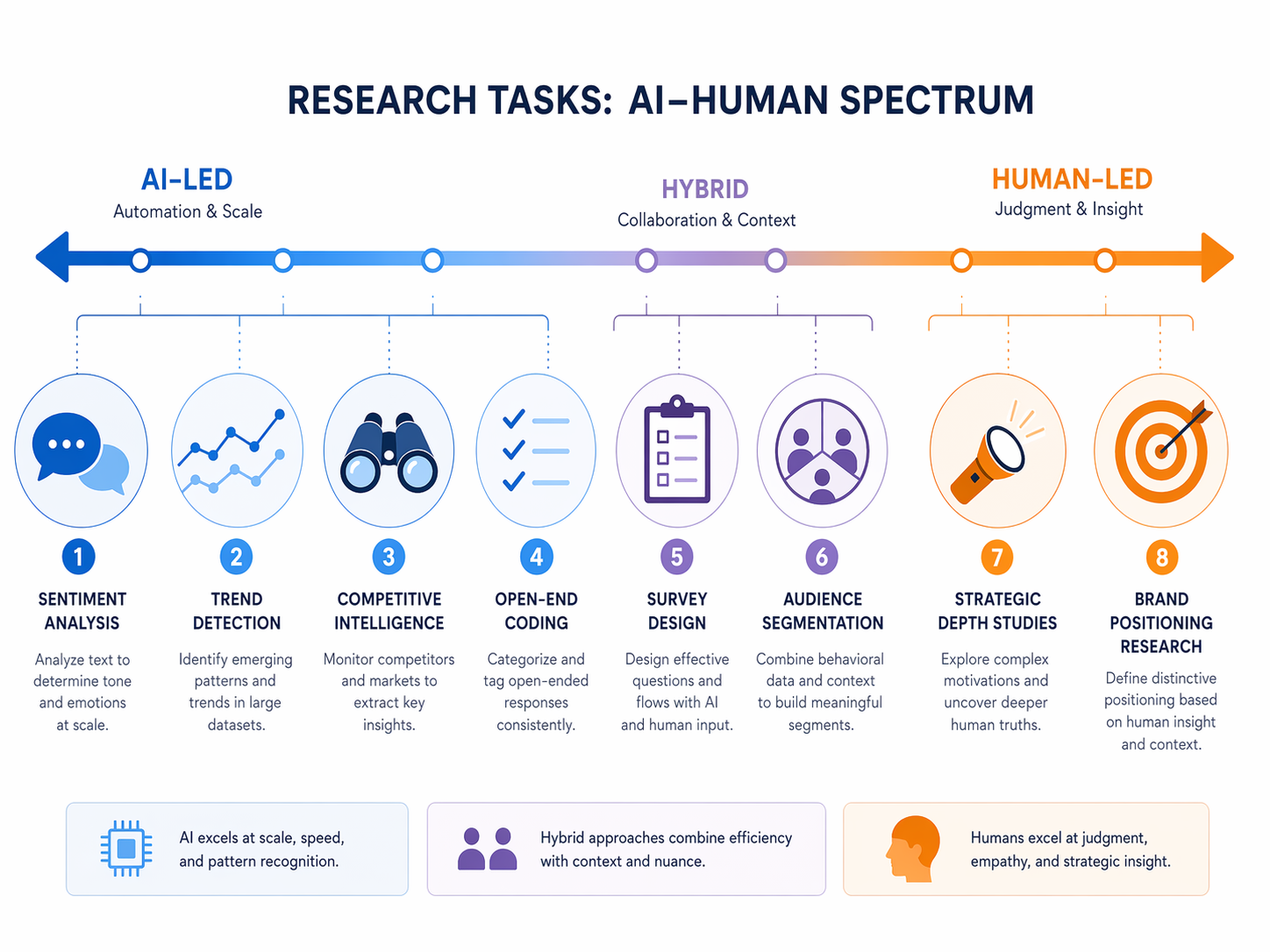
The following matrix is the place to start before buying software or cutting a research budget. It maps common marketing research tasks by operating mode: AI-led, AI-heavy with human review, hybrid, human-led with AI support, or human-led.
| Research task | Best operating mode | Why it fits there | Human role | ROI signal to track |
|---|---|---|---|---|
| Sentiment analysis across reviews, sales calls, social posts, communities, or support tickets | AI-led with human QA | High-volume, repetitive classification is where AI can reduce waiting time and surface directional movement quickly. | Audit samples, check misclassified themes, and investigate sudden shifts before leadership treats them as market truth. | Cycle time reduced; number of sources monitored; analyst hours avoided; false-positive review time |
| Trend detection from public content, category conversations, and customer language | AI-led for detection; human-led for interpretation | AI can notice recurring phrases or fast-moving topics earlier than a quarterly readout. | Separate noise from strategic change, especially when the trend would affect campaign, product, or positioning decisions. | Decision latency reduced; frequency of trend reviews; number of escalated themes that prove useful |
| Competitive intelligence monitoring | AI-heavy hybrid | AI can track website changes, messaging shifts, pricing-page language, launch announcements, and public content at a cadence humans usually cannot maintain manually. | Decide which competitor moves matter, brief sales or product marketing, and prevent overreaction to cosmetic changes. | Coverage expanded; manual monitoring hours avoided; time from competitor change to internal alert |
| Open-end survey coding and theme clustering | AI-led first pass; human validation | AI can group large volumes of text faster than manual coding, especially when the goal is to find initial patterns. | Review code frames, merge or split themes, inspect edge cases, and check whether minority responses are being flattened. | Coding time reduced; sample audit pass rate; cost per coded response |
| Survey drafting and questionnaire cleanup | Hybrid | AI can draft question variants, spot wording issues, and generate response-option ideas, but it does not own the research objective. | Define the decision the survey must support, remove leading language, check logic, and ensure the instrument can answer the business question. | Drafting time reduced; fewer review rounds; fewer unusable questions after fielding |
| Audience segmentation support | Hybrid, human-guided | AI can help explore patterns and describe candidate groups, but segmentation affects targeting, budgeting, messaging, and sometimes product strategy. | Choose the segmentation basis, test whether segments are reachable and commercially meaningful, and prevent attractive but unusable clusters. | Time to first segmentation cut; validation cost; segment usability in campaigns or sales motions |
| Strategic depth studies triggered by a specific business question | Human-led with AI support | Ambiguous questions require judgment about context, incentives, politics, and what respondents are not saying. | Frame the question, conduct or supervise qualitative work, interpret contradictions, and decide what evidence is strong enough for action. | Major study cost avoided only when scope is narrowed; quality of decision supported; stakeholder confidence |
| Brand positioning and narrative research | Human-led | Positioning decisions carry high downside risk if the team mistakes surface language patterns for buyer motivation. | Lead interviews, synthesize tradeoffs, connect findings to market strategy, and defend what should not change. | Cost of wrong decision avoided; strength of evidence behind messaging changes; executive alignment |
The split is not moral. AI-led does not mean low-value, and human-led does not mean prestigious. It means the task economics, error tolerance, and decision consequence are different.
Where AI should usually lead
AI earns its budget fastest when the work is continuous, repetitive, and too time-consuming for the team to do manually at the right cadence. Sentiment analysis, trend detection, competitive intelligence, and open-end coding all fit that pattern. These tasks do not become risk-free just because they are repetitive, but their first-order value comes from reducing lag.
A demand-generation manager does not need a six-week study to know that prospects have started repeating a new objection in sales calls. She needs an alert, a quick read on where the objection is appearing, and enough confidence to decide whether product marketing should investigate. AI can monitor the raw material; humans decide whether the signal deserves escalation.
The same logic applies to competitor monitoring. A platform can detect that a competitor has changed its homepage copy, added a comparison page, or shifted language around a category. The marketing team still has to decide whether that is a campaign issue, a sales enablement issue, a product packaging issue, or nothing worth reacting to.
Open-end coding is another strong candidate because the bottleneck is often mechanical. AI can create the first grouping of themes from survey comments or interview notes. A researcher or marketing analyst should still inspect the frame. Small but commercially important themes are easy to bury if the only goal is a clean cluster chart.
Where hybrid work is safer than full automation
Survey design and segmentation are tempting places to over-automate because AI can produce something polished very quickly. That polish is not the same as research quality. A questionnaire can look professional and still fail because it asks about preferences no one can answer reliably, omits the tradeoff that matters, or measures awareness when the decision requires buying intent.
Use AI here as a drafting and pressure-testing layer. Ask it for alternative phrasings, possible response options, or a list of ways a question could be misunderstood. Then have a person who understands the business decision cut the instrument down to what is actually needed. The owner of the decision should be able to point to each question and say what action would change if the answer came back high, low, or split.
Segmentation needs even more restraint. AI can explore data and suggest patterns, but a segment is only useful if the company can identify it, reach it, sell to it, and make different decisions because it exists. A cluster that is statistically neat but commercially unreachable is not a segment; it is a slide.
Where humans should still lead
Human-led research still belongs at the center of ambiguous, political, or high-consequence questions. Brand positioning, category narrative, pricing perception, lost-deal diagnosis, and new-market entry are not just pattern-recognition exercises. They require someone to notice when a respondent is being polite, when a stakeholder is protecting a prior decision, or when the apparent answer would create a worse downstream problem.
This is also where calendar-based research should be challenged. A team may not need a major brand study every fixed interval. It may need a human-led study when a real trigger appears: conversion quality changes, sales cycles lengthen, a new competitor reframes the category, win-loss patterns shift, or leadership is considering a positioning move that would be expensive to unwind.
AI can still support the work. It can summarize interview transcripts, compare themes across notes, prepare discussion-guide drafts, or help organize evidence. It should not be the final judge of what the company believes about the market when the decision affects strategy, budget, or brand direction.
Treat accuracy claims as operating assumptions, not promises
One of the more provocative observations from a16z is that some CMOs have expressed comfort with AI-generated research reaching roughly 70% of the accuracy of traditional consulting work when the outputs are cheaper, faster, and continuously refreshed.[2] That is useful as a signal of changing executive tolerance. It is not a benchmark to paste into a CFO deck as if 70% is good enough for every decision.
For monitoring tasks, a directional read that is refreshed weekly may be more useful than a more precise study that arrives after the campaign window closes. For positioning or segmentation, the same error level could be expensive. The acceptable error rate depends on the decision the insight will influence.
This is where validation discipline matters. Escalent’s guidance on human-guided AI emphasizes holdout testing, checking relationships rather than only frequency distributions, and accepting that some pilots should fail.[4] Those practices are not academic overhead. They are the cost of keeping an AI-assisted research system from producing confident nonsense at scale.
How to measure ROI without pretending every insight has a clean dollar value
The cleanest ROI story is not “AI replaced research.” It is “we reassigned research tasks by cost, cadence, and risk.” That gives a manager a defensible measurement plan because each task has a different economic logic.
| ROI metric | What to measure | How to use it in the business case |
|---|---|---|
| Cost avoided | Traditional studies, manual coding, analyst hours, or agency retainers no longer required for low-risk recurring tasks | Use only where the AI workflow genuinely replaces or reduces prior spend; do not count work that would never have been funded anyway. |
| Cycle time reduced | Time from question to usable readout before and after AI support | Useful for campaign, competitive, and sentiment decisions where late insight has little value. |
| Research frequency increased | How often the team reviews market signals after automation versus before | Shows whether AI created a continuous signal layer rather than a one-off experiment. |
| Decision latency reduced | Time between signal detection and action: brief sent, message changed, objection escalated, sales enablement updated | Connects research operations to marketing execution rather than dashboard production. |
| Quality-control cost | Human review time, sample audits, validation checks, failed pilots, and platform administration | Keeps the model honest; AI savings should be calculated after QA effort, not before. |
| Decision quality | Whether AI-assisted insights led to better-targeted campaigns, clearer briefs, fewer reversals, or stronger stakeholder alignment | Harder to quantify, but important for strategic and hybrid workflows. |
For example, if a team previously paid for periodic manual competitive scans, an AI-heavy monitoring workflow may create measurable savings and faster alerts. If the team adds a platform to monitor a category it never monitored before, the ROI case is different: the value is increased coverage, not cost replacement. Mixing those two claims is how AI business cases lose credibility.
Quality-control costs should be visible from the beginning. Budget for human review, exception handling, validation tests, and the time it takes to maintain AI instructions, taxonomies, source lists, and reporting rules. A cheap tool that requires constant cleanup may still be worth buying, but the cleanup belongs in the model.
A simple approval rule for AI research spend
Before approving a platform or reallocating research budget, force each proposed workflow through five questions:
- Is the task recurring enough that automation will actually be used?
- Is the cost of being directionally wrong acceptable for this decision?
- What human review is required before the output influences action?
- Which existing cost, delay, or decision bottleneck will improve?
- What validation standard will determine whether the workflow continues, changes, or gets shut down?
If the answer to the first question is weak, the team may be buying a demo, not an operating capability. If the answer to the second question is “no,” keep the work human-led. If no one can name the bottleneck being improved, the ROI slide is not ready.
The strongest 2026 model is hybrid and explicit: automate continuous signal collection and repetitive analysis; use humans for interpretation, validation, and strategic depth; fund AI only where the task economics, risk level, and measurement plan line up.

Comments
Join the discussion with an anonymous comment.