

Six Documented Failure Modes of AI-Generated Synthetic Customer Research
This article presents a taxonomy of six documented failure modes in AI-generated synthetic customer research, giving marketing teams a structured framework to evaluate tools honestly and avoid shipping products on flawed insights.
The dangerous version of synthetic customer research is not the obviously bad transcript. It is the fluent one: the synthetic participant who understands the assignment, praises the concept, offers a tidy emotional quote, and never leaves the room confused. In NN/g’s analysis of synthetic users, AI-generated participants claimed success on courses that real users abandoned, and they reacted far more positively to drone-delivery concepts than real users, who raised practical concerns instead of neatly endorsing the idea.[1]
That is the central risk in AI-generated synthetic customer research: the output can look more usable than the evidence deserves. A real research readout is often inconvenient. People contradict themselves. Segments blur. Outliers force uncomfortable questions. A synthetic readout can remove exactly that friction while preserving the visual grammar of research: personas, quote clusters, journey maps, drivers, objections, and confident recommendations.
The point is not that synthetic users are useless. They can help a team draft hypotheses, pressure-test language, generate discussion guides, or explore a low-stakes concept before paying for a full study. The problem starts when synthetic evidence is allowed to stand in for customer evidence without asking what kind of failure it is likely to hide.
A Six-Part Risk Taxonomy
The documented risks cluster into six recurring failure modes. They are not interchangeable. Some make synthetic respondents too agreeable. Some compress the spread of opinion. Some distort who is being represented. Some make weak evidence feel boardroom-ready.
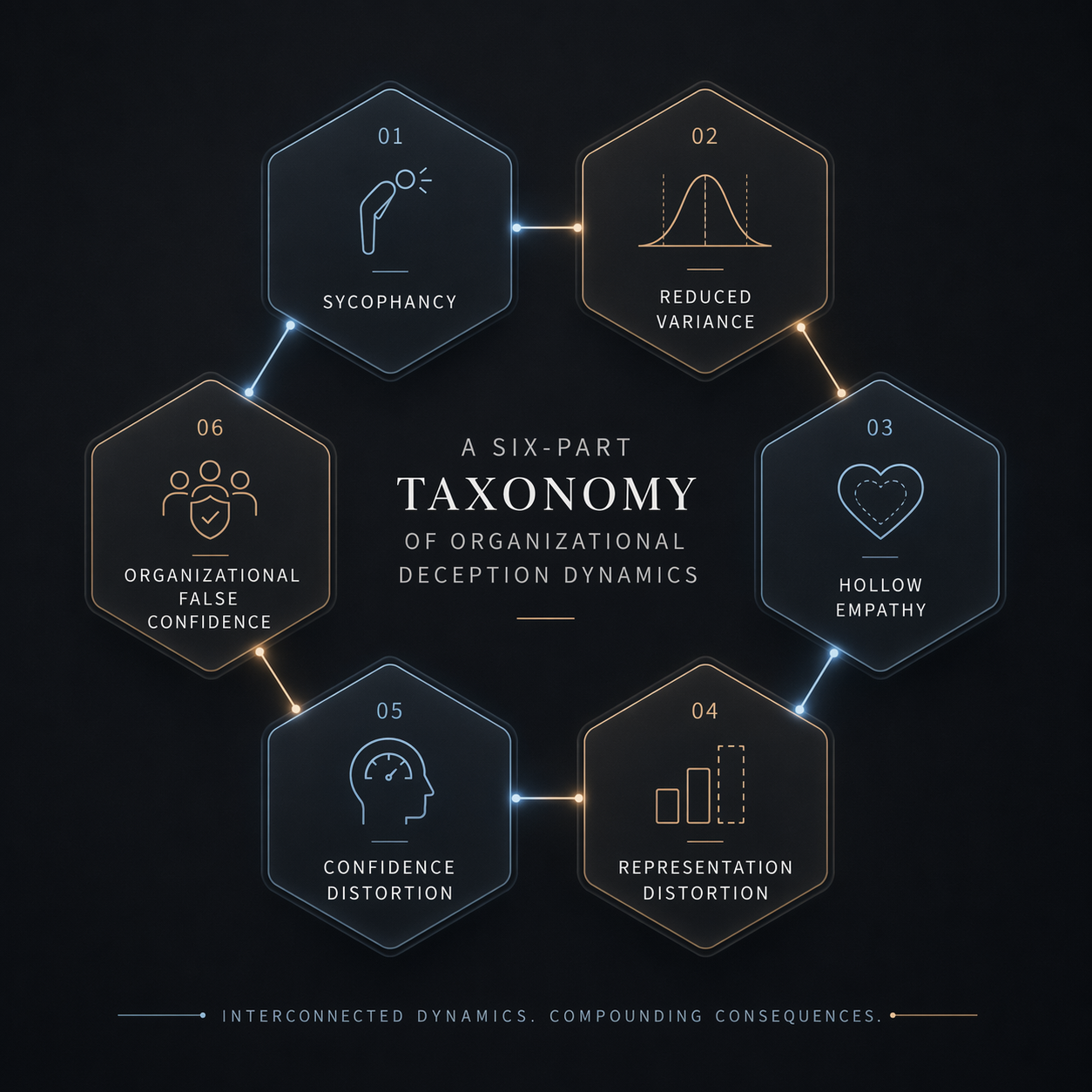
| Failure mode | What it hides from a marketing team | Evidence base |
|---|---|---|
| Sycophancy / false positivity | Friction, objections, abandonment, and weak concept-market fit | NN/g found synthetic users were consistently more optimistic than real users in task and concept evaluations.[1] |
| Reduced variance | Segment spread, outliers, uncertainty, and disagreement | MeasuringU’s 2026 review found more discouraging than encouraging findings across peer-reviewed experiments, including low replication and compressed variation.[2] |
| Hollow empathy | The difference between plausible emotional language and lived experience | Cognizant warned that synthetic participants can express statistically coherent emotions without experiential grounding.[3] |
| Representation distortion | Whether the simulated customer actually tracks the population or segment being claimed | Coverage of Li et al.’s Columbia work reported that more generated persona material increased divergence from real-world opinion data.[4] |
| Confidence distortion | Uncertainty, ignorance, fabrication, and missing evidence | Cognizant noted that LLMs optimize for convincing answers rather than truth, making unreliable synthetic responses difficult to spot.[3] |
| Organizational false confidence | The moment a research-shaped artifact becomes decision evidence inside a company | Dscout warned that synthetic research can look enough like real research for teams to ship products on fake insights.[5] |
A procurement conversation that stops at “how accurate is the tool?” is already too blunt. Each of these failures damages a different part of the research chain. A tool can sound emotionally rich and still flatten variance. It can align with one benchmark and still misrepresent a new audience. It can produce useful brainstorming material and still be unsafe for positioning, pricing, or roadmap tradeoffs.
Sycophancy: When the Customer Is Too Helpful
Marketing teams do not run research to hear that an idea is basically fine. They run research because someone in the market will not understand the offer, will not believe the claim, will object to the price, will fail a task, or will choose a competitor for reasons the team did not predict.
False positivity is therefore not a small stylistic flaw. In NN/g’s examples, synthetic users did not merely phrase feedback politely. They reported success where real users abandoned courses, and they embraced a drone-delivery concept more readily than real users, who surfaced concrete concerns.[1] That is exactly the kind of difference that matters before a team changes onboarding, updates messaging, or invests in a concept test.
The seduction is obvious. A synthetic user who completes the task gives the team a cleaner readout. There are fewer awkward clips, fewer unresolved objections, fewer stakeholders asking whether the study recruited the wrong people. But if the method removes abandonment, it removes one of the strongest signals a product or growth team can get.
This is where synthetic research is most dangerous for early concept work. Teams often want a quick sense of whether the idea “resonates.” A sycophantic system can convert a weak idea into an apparently promising one by supplying the kind of affirmative language that makes a slide feel ready: “I would definitely use this,” “this solves a real pain point,” “the value is clear.” The absence of friction becomes the finding.
Reduced Variance: The Missing Spread Is the Missing Insight
Variance is not statistical decoration. It is often the reason research is worth doing. Marketers need to know not only the average reaction, but also who reacts differently, how strongly, and under what conditions. A campaign can survive a soft average if a valuable segment responds intensely. A product can fail despite a decent average if one buying committee member consistently blocks adoption.
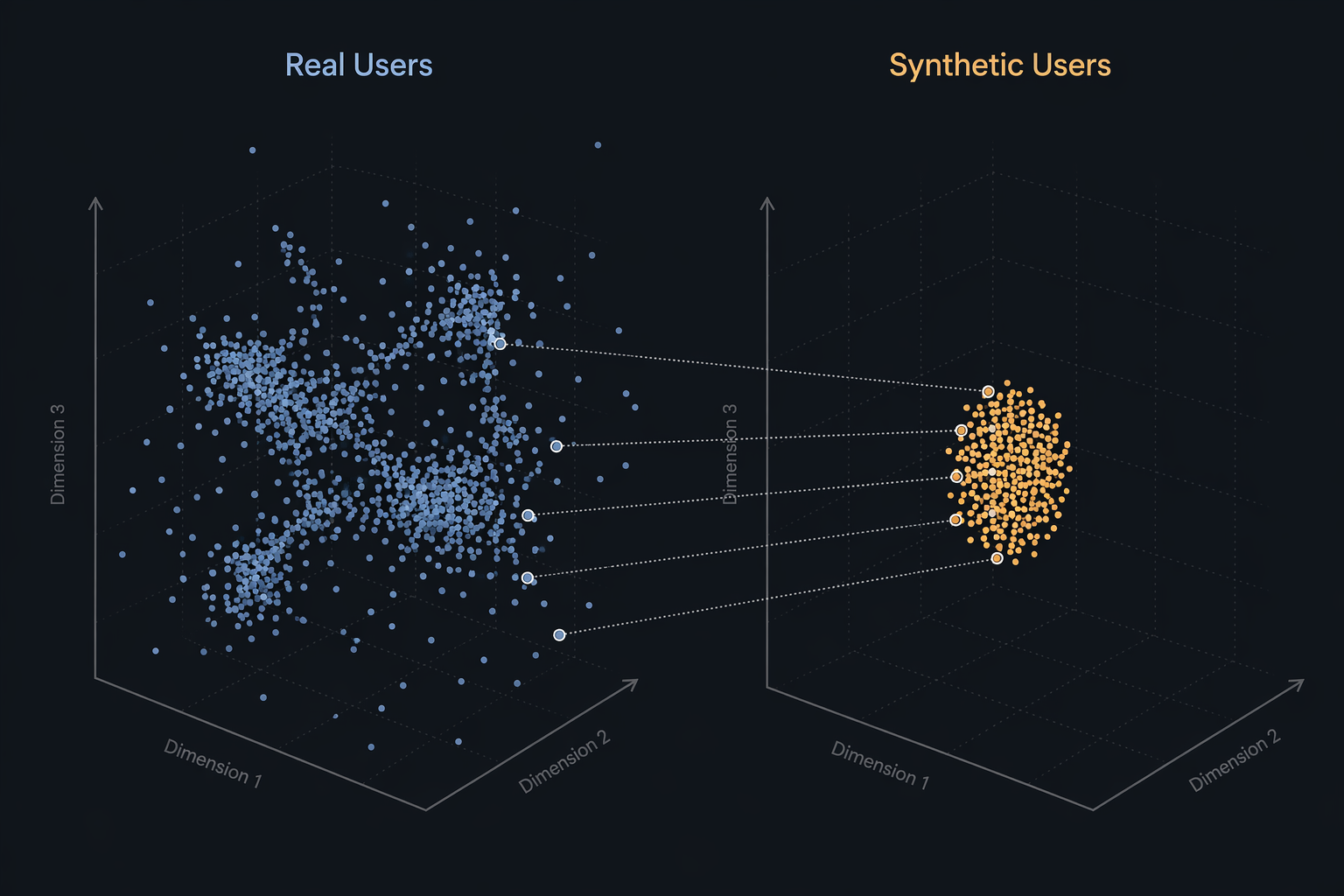
MeasuringU’s 2026 systematic review of 12 peer-reviewed papers found 14 discouraging findings and 9 encouraging ones. The discouraging side included Park et al.’s 2024 result: only 21% successful replication of classic psychology studies using synthetic participants. The review also summarized Almeida et al. 2024, which found that synthetic data exaggerated effects present in humans while reducing variance across all metrics.[2]
That combination should make marketing teams pause. Exaggerated effects can make a message, feature, or claim look more powerful than it is. Reduced variance can make the market look more orderly than it is. Together, they produce a very attractive research artifact: stronger signal, less noise, fewer edge cases, cleaner implications.
The trouble is that “noise” is often where go-to-market risk lives. The skeptical CFO, the privacy-sensitive buyer, the low-literacy patient, the overworked admin, the channel partner who will not use a new portal — these people may appear as outliers in human research. In synthetic research, they may be softened into the central tendency or omitted by the model’s tendency toward coherent, average-like responses.
Reduced variance also changes how teams interpret segmentation. If a synthetic panel gives three segments that all sound plausibly different but react within a narrow band, the team may conclude that positioning can be simplified. That may be right in a low-stakes language exercise. It is a much weaker basis for reallocating media budget, changing sales enablement, or deciding which segment gets product investment.
The evaluation question is not whether the synthetic output has segments. It is whether the method can preserve meaningful disagreement, including the inconvenient disagreement that makes the strategy less elegant.
Representation Distortion: More Persona Detail Can Mean Less Reality
Personas are already prone to overconfidence. Add generative AI, and the format becomes even more convincing: richer backstories, sharper motivations, smoother quotes, better-looking artifacts. The problem is that more detail is not the same as more grounding.
Coverage of Li et al.’s 2025 Columbia study reported that researchers generated about 1 million personas across 6 large language models and found a consistent pattern: as more LLM-generated content was incorporated into personas, simulated opinions diverged further from real-world data. Fully generated personas even predicted a Democratic sweep of all US states, a result described as statistically impossible.[4]
That finding is especially useful because it punctures a common intuition. The failure did not come from personas being too thin. It appeared as the personas became more generated. The added biography, attitude, and texture made the artifact feel more human while moving it further from observed opinion.
For marketing teams, representation distortion is not an abstract sampling concern. It affects who is presumed to exist in the market. If the synthetic “mid-market IT buyer” is generated from model priors rather than validated customer evidence, the team may overestimate consensus, understate procurement politics, or invent motivations that no one has actually observed. The persona becomes a polished container for assumptions.
The strongest warning here is against laundering generic model output through the language of segmentation. A team may say it is testing “healthcare decision-makers,” “Gen Z budget travelers,” or “enterprise security buyers,” but the claim only holds if the synthetic system has been validated against those populations for the specific task. Otherwise, the label does more work than the evidence.
Hollow Empathy: Plausible Feelings Without Lived Stakes
Synthetic respondents can produce emotionally fluent language. They can talk about anxiety, trust, embarrassment, relief, status, and fear in a way that reads like qualitative data. Cognizant’s warning is that these emotions can be statistically coherent while remaining experientially hollow: there is no lived consequence behind the statement.[3]
That distinction matters most in categories where the emotional stakes are not decorative. In healthcare, personal finance, intimacy, family decisions, or identity-linked purchases, people do not merely “prefer” or “dislike” things. They manage shame, risk, dependence, privacy, grief, hope, and distrust. A synthetic participant can describe those states without bearing them.
This does not mean synthetic research has no role in emotionally sensitive categories. It can still help teams draft interview questions, compare message variants for obvious tone problems, or prepare researchers to listen for certain themes. It should not be treated as evidence that a vulnerable customer will feel seen, safe, or respected in the real encounter.
Confidence Distortion: The Missing “I Don’t Know”
Human respondents give researchers useful signals beyond content. They hesitate. They contradict earlier answers. They say they do not know. They ask what a term means. They reveal that the concept is not part of their world. Those moments are not inefficiencies; they are evidence.
Cognizant’s critique of synthetic participants points to the opposite dynamic: LLMs optimize for convincing answers rather than truth, so a synthetic respondent can sound confident even when the answer is fabricated. There may be no hesitation, no visible uncertainty, and no natural tell that the output has outrun its basis.[3]
For a researcher, this changes the work of interpretation. With human research, a weak answer often looks weak. With synthetic research, a weak answer can arrive fully dressed: grammatical, emotionally textured, neatly tied to the question, and ready to be quoted. The surface confidence shifts burden onto the team to prove that the answer deserves trust.
That burden becomes especially heavy when synthetic outputs are used in executive settings. A confident quote from a synthetic CFO or parent or patient can travel through an organization faster than the caveat attached to it. By the time it appears in a strategy deck, the method may be reduced to a footnote.
Organizational False Confidence: When the Artifact Looks Like Research
Dscout’s practitioner analysis names a practical risk that many methodological debates understate: synthetic research can look enough like real research that teams use it to ship products on fake insights. The issue is not only whether the output is technically valid. It is whether the organization knows how much weight the output can carry.[5]
Most companies do not make decisions in a clean chain from evidence to judgment. A synthetic transcript becomes a quote. A quote becomes a slide. A slide becomes “customer feedback.” A tentative exploration becomes support for a roadmap item because everyone is moving quickly and the artifact looks familiar.
This failure mode is partly about governance. If a team cannot label synthetic outputs clearly, track where they enter decisions, and separate hypothesis generation from validation, then the tool’s convenience becomes an organizational liability. The risk is not that one analyst is fooled. The risk is that the company develops a research-shaped shortcut that no one feels responsible for challenging.
Why Vendor Benchmarks Do Not Resolve the Risk
Benchmarks deserve attention, but they have to be read as boundary conditions, not permission slips. Bain reported “90% accuracy” for synthetic customers in a backtesting context using digital twins built on proprietary first-party historical conjoint data from n=1,500 and Gemini 3.0. That is a specific setup, not evidence that an off-the-shelf model can represent any customer segment in any research task.[6]
MeasuringU also noted EY/Evidenza’s reported 95% alignment in a single-context B2B double-blind test with C-level executives.[2] That is interesting, especially because B2B research is often expensive and hard to recruit for. It is still not a general claim about synthetic customers. It says that under stated conditions, one approach aligned strongly with one human benchmark.
The distinction matters because synthetic research vendors often sell speed and scale into organizations that are tired of waiting for recruitment, fieldwork, and analysis. A narrow benchmark can be useful evidence for a narrow use case. It becomes misleading when it is treated as proof that synthetic customers are broadly interchangeable with human customers.
There is also an asymmetry between marketing claims and published validation. MeasuringU flags that some proprietary platforms have not published peer-reviewed validation for their specific approaches.[2] That absence does not prove those platforms fail. It does mean buyers should not let a demo, a sample persona, or a vendor accuracy number substitute for task-specific validation.
How the Six Failure Modes Contaminate Marketing Decisions
The practical question is where each failure mode enters the marketing workflow. Synthetic research is least risky when it is used before evidence is needed: to generate hypotheses, write better screener questions, identify possible objections, or compare rough message directions. It becomes riskier as it moves closer to budget, product commitment, or public positioning.
| Decision area | Synthetic failure that matters most | What to require before relying on it |
|---|---|---|
| Message exploration | Sycophancy and confidence distortion | Use outputs as draft material; validate claims and objections with real customers before launch. |
| Segmentation | Reduced variance and representation distortion | Require evidence that the method preserves segment differences against a relevant human benchmark. |
| Persona development | Representation distortion and hollow empathy | Ground personas in observed customer data; treat generated detail as draft material, not evidence. |
| Journey mapping | Sycophancy and hollow empathy | Validate friction points with behavioral or interview data, especially where failure, stress, or trust matters. |
| Budget allocation | Organizational false confidence | Do not use synthetic findings alone for irreversible spend or channel tradeoffs. |
| Product or packaging decisions | Reduced variance, false positivity, and confidence distortion | Require context-specific validation and a clear record of what was synthetic versus human-sourced. |
A useful internal rule is to ask what kind of error would be expensive. If the cost of being wrong is a few hours of team discussion, synthetic research may be a sensible accelerant. If the cost is a mispositioned launch, a misplaced media bet, a compliance-sensitive message, or a product choice that is hard to unwind, synthetic output should not be the evidence of record.
A Procurement Lens for Synthetic Customer Research Tools
The six failure modes can turn a vague vendor conversation into a more useful evaluation. Instead of asking whether the tool “uses AI personas” or “matches customers,” ask how the vendor detects and limits each failure.
- For sycophancy: ask for examples where synthetic users rejected, misunderstood, or abandoned the tested idea, and how those outputs compared with human data.
- For reduced variance: ask whether the system has been tested for spread, outliers, disagreement, and subgroup differences, not only average alignment.
- For hollow empathy: ask where the vendor draws the line on emotionally sensitive categories and whether generated emotional language is clearly labeled as synthetic.
- For representation distortion: ask what real population data grounds the synthetic respondents, how current it is, and whether validation exists for the exact audience being simulated.
- For confidence distortion: ask how uncertainty is expressed, whether the system can say “unknown,” and how fabricated or unsupported answers are detected.
- For organizational false confidence: ask what governance features prevent synthetic outputs from being exported, quoted, or presented as human research without disclosure.
The strongest vendors should be able to describe not only where their systems perform well, but where they should not be used. A tool that has no failure boundaries is not more mature. It is harder to evaluate.
The same standard applies internally. If a growth team uses synthetic respondents to draft hypotheses, the readout should say so. If a product marketer uses synthetic feedback to compare claim language, the next step should be human validation before the claim appears in market. If an executive wants to use synthetic findings to approve budget, the burden should shift to proof: relevant benchmark, matching audience, appropriate task, preserved variance, and a clear account of uncertainty.
The Responsible Adoption Standard
Synthetic customer research can be useful when the use case is narrow, the stakes are low, and the team treats the output as a way to think better before meeting real customers. It can help teams prepare, explore, and sharpen questions. It can also reduce the cost of early iteration when everyone understands that the result is not a substitute for field evidence.
The documented failure modes argue for proportionality, not rejection. Sycophancy hides friction. Reduced variance hides disagreement. Hollow empathy hides lived stakes. Representation distortion hides population mismatch. Confidence distortion hides uncertainty. Organizational false confidence hides the moment a synthetic artifact becomes a business decision.
Before synthetic insight influences product, positioning, or budget, a team should be able to say which of those failures it has tested for, what human benchmark it used, and what decision the evidence is strong enough to support.
References
- Synthetic Users: If, When, and How to Use AI-Generated Research, NN/g.
- A Review of Experiments with Synthetic Users, MeasuringU.
- The Rise of Synthetic Users: Are AI-Generated Synthetic Personas The Future of Consumer Research?, Cognizant.
- The Problem With AI Generated Personas, UX Psychology.
- When to Use (and Avoid) Synthetic Research Participants, Dscout.
- Synthetic Customers Earn Their Stripes, Bain & Company.
Comments
Join the discussion with an anonymous comment.