

AI Market Research Tools
Many AI market research outputs contain hallucinated data, synthetic respondent gaps, and survey fraud vectors. This guide provides a structured validation framework to help practitioners know when AI outputs are trustworthy and when to fall back on human methods.
Marketing Categories
⚠ Notable Limitations
Hallucinated data, synthetic response instability, survey fraud, stale sourcing
The risky moment with AI tools for market research is not when the output looks ridiculous. It is when the tool returns a clean audience summary, a plausible set of objections, a tidy synthetic segment, or a market-size claim that is formatted well enough to paste into a deck.
That is where validation has to begin. Not after the leadership meeting. Not after the positioning decision has already hardened. The question is not whether AI can help with research work; it can. The question is whether a specific output deserves to be treated as evidence.
First classify what the AI actually produced
Before judging accuracy, separate the output type. A transcript summary, a synthetic persona, a moderated interview, a panel response, and a market forecast do not fail in the same way. Treating them as one category called “AI insights” is how weak evidence gets promoted into organizational truth.
| AI output | What it usually depends on | Primary validation question |
|---|---|---|
| Transcript summary or theme clustering | Real recorded or written respondent material | Can each claim be traced back to respondent language? |
| AI-moderated interview | Real respondents plus AI probing and synthesis | Did the moderator cover the guide, probe appropriately, and preserve respondent meaning? |
| Synthetic respondent or digital twin | Modeled behavior based on training data, survey data, or prior inputs | Does the finding survive when tested with real people or a different question format? |
| Market-size, competitor, or trend claim | External sources, retrieval, model memory, or vendor databases | Are the sources current, named, and independently checkable? |
| Panel survey analysis | Human respondents, panel controls, fraud screening, and analysis layer | Are respondents real, qualified, attentive, and not using AI to fake open ends? |
This classification step sounds basic until a team skips it. A generated persona may be useful for brainstorming message angles, but it is not the same kind of evidence as an interview transcript. A source-backed trend scan may support category exploration, but it should not carry the same weight as a measured concept test. The validation burden should rise as the decision becomes more expensive, irreversible, or customer-facing.
The main failure modes are different enough to require different checks
Most bad AI research does not come from one universal flaw. It comes from several failure modes that can look similar in a finished deck: unsupported claims, unstable synthetic answers, weak behavioral prediction, fraudulent respondents, and stale or missing source context.
Synthetic respondents can sound consistent before they are tested
Synthetic respondents are appealing because they promise fast directional reads without recruiting delays. The problem is that a smooth synthetic answer can hide instability. Strat7 research cited by Monigle found that synthetic respondents showed only about 60% consistency when the same preference was asked using different formats, such as a ranking question versus a rating scale.[1]
That figure should be handled carefully because it is cited second-hand, not independently reproduced here. Still, the risk it points to is operationally important: if a synthetic segment changes its preference when the question format changes, the output may be coherent without being reliable.
This is where synthetic work needs a different validation standard. Do not only ask whether the simulated customer sounds realistic. Ask whether the same conclusion survives a different prompt, a different question format, and at least one real-human check before it informs messaging, targeting, or product prioritization. For a deeper treatment of this specific category, see Six Documented Failure Modes of AI-Generated Synthetic Customer Research.
Digital twins may reproduce stated responses better than experimental behavior
Harvard Business Review reported academic tests in which digital twins reached roughly 88% relative accuracy in reproducing human responses, but captured only about half of the experimental effects observed in real humans.[2]
That distinction matters. Reproducing what people say in a known context is not the same as predicting what changes when price, framing, social proof, risk, or competitive alternatives shift. A digital twin may help pressure-test hypotheses, but it should not be treated as a substitute for behavioral evidence when the decision depends on action rather than stated preference.
Human respondent data now has its own AI problem
Falling back to human panels does not automatically solve the data-quality problem. Monigle cites a Tremendous industry estimate that survey fraud costs market research more than $350 million annually, and AI-generated open-ended responses are making fraudulent participation harder to detect.[1]
That number is also a single-source industry estimate as presented in the available materials, so it should not be treated as a universal measurement. The practical lesson is narrower and still serious: when incentives exist, fraud follows them, and AI can make fake participation look more articulate. A panel result with polished open ends may need more scrutiny in 2026 than a panel result with messy, uneven, human-sounding responses.
Hallucination is a source problem before it is a writing problem
Market research hallucination is not limited to invented citations. It can show up as a plausible market estimate with no source trail, a competitor claim that was true two years ago, a local trend generalized from national data, or a B2B buyer insight inferred from consumer behavior. The danger is not the model’s confidence. The danger is a team accepting that confidence as provenance.
Any AI-generated claim about market size, segment behavior, adoption, channel performance, or competitor position should come with named sources, dates, and enough context to inspect what the number actually measures. If the tool cannot provide that trail, the output belongs in exploration, not evidence. For adjacent examples of hallucination costs in marketing work, see AI Hallucination in Marketing Content.
Where AI market research tools are genuinely useful
A skeptical validation process should not flatten all AI research into a warning label. Some use cases are already strong enough to change how much qualitative work teams can afford to do.
Greenbook’s 2025/2026 GRIT Quality Audit found that AI moderators produced 4.2 times more words per probe-and-follow-up sequence and achieved 98% discussion-guide coverage, compared with 76% for human moderators.[3]
Those are meaningful strengths. AI moderation can be patient in ways rushed human moderation is not. It can ask follow-ups consistently, cover the full guide, and create enough transcript volume for stronger early theme discovery. For lean teams, that can mean interviewing more people, exploring more objections, or testing more message territories before committing budget to a narrower study.
The cost shift is part of the attraction. Perspective AI cites Quirk’s and Insights Association benchmarks indicating traditional moderated qualitative research at about $487 per completed interview versus about $22 for AI-moderated alternatives, a directional comparison it frames as a 95% reduction.[4]
Those rates should not be treated as fixed 2026 pricing for every buyer, market, or recruit type. They do explain why the workflow is spreading. If a team can afford more exploratory interviews, it may find objections, language patterns, and use cases that would never surface in a smaller traditional study.

The safe boundary is methodological. AI is well suited for expanding exploration, improving probing consistency, summarizing transcripts, clustering themes, drafting discussion guides, and generating hypotheses. It becomes more fragile when asked to stand in for respondents, forecast behavior, validate demand, or produce board-ready market truth without independent checks.
A validation route before the output becomes evidence
The goal is not to slow every AI-assisted project into a full research audit. The goal is to match the validation burden to the decision. A tagline exploration does not need the same proof as a market entry decision. A transcript summary does not need the same scrutiny as a synthetic demand forecast.
1. Identify the evidence chain
Start with the simplest question: what would have to be true for this output to be reliable?
- If the output summarizes interviews, the evidence chain is the respondent sample, recording, transcript, coding, and synthesis.
- If the output reports a market number, the evidence chain is the original source, publication date, geography, category definition, and measurement method.
- If the output simulates customers, the evidence chain is the training input, modeling assumptions, prompt design, and real-world comparison set.
- If the output analyzes panel data, the evidence chain is recruit source, qualification, fraud screening, attention controls, and response review.
If the chain is invisible, the output can still be useful as a prompt for thinking. It should not be used as proof.
2. Verify sources before debating implications
Do not spend the first review meeting arguing about whether the finding is strategically convenient. Check whether the source exists, whether it says what the AI says it says, and whether the scope matches the decision.
- Open the cited source and confirm the claim appears there.
- Check the date and whether the market has materially changed since publication.
- Confirm the geography, audience, category, and sample match your use case.
- Separate vendor claims from independent research.
- Mark any second-hand statistic as directional unless the original report is available.
This step catches a surprising amount of trouble. A sourced claim can still be wrong for your decision if it measures a different market, a different buyer, or a different behavior.
3. Make respondent-level traceability non-negotiable
For qualitative work, every important theme should be traceable to respondent language. That does not mean every paragraph needs a quote in the final deck. It means the research owner should be able to click from theme to excerpt to transcript to respondent metadata.
A useful AI synthesis will preserve disagreement, minority signals, and uncertainty. A weak one will over-compress the mess into a managerial-sounding theme. If six respondents objected to implementation time in six different ways, the distinction may matter. “Buyers are concerned about onboarding” is not wrong, but it may be too smooth to guide messaging.
4. Triangulate across method, not just model
Running the same prompt through another model is a useful debugging step, but it is not true validation. If both models rely on similar public patterns, they can agree for the wrong reason.
Better triangulation changes the evidence format. Compare synthetic findings with recent sales-call notes. Compare AI-moderated interview themes with human-reviewed excerpts. Compare stated interest with behavioral signals such as demo requests, trial activation, renewal friction, or sales-cycle movement. If a conclusion only survives inside one AI workflow, keep it in the verify zone.
5. Audit the sample and response quality
Panel and interview validation should include a response-quality pass before synthesis. Look for duplicate phrasing, generic open ends, impossible job histories, suspicious completion patterns, inconsistent screening answers, and polished responses that never include concrete context.
The point is not to reject articulate respondents. The point is to avoid mistaking AI-assisted fraud for high-quality verbatims. When incentives, low-friction survey access, and generative writing tools meet, response quality becomes part of the method, not an administrative detail.
6. Check freshness against the decision clock
Some research ages slowly. Other research expires quickly. Buyer language around a stable operational pain may remain useful for a long time. Competitive positioning, channel economics, AI adoption behavior, pricing tolerance, and regulatory constraints can change fast enough that a dated source becomes misleading even if it was accurate when published.
A freshness review should ask whether the source predates a major market shift, product launch, pricing change, policy change, or category narrative change. If it does, the finding may still belong in background context, but it should not anchor a current decision without newer corroboration.
Use trust, verify, and bypass zones
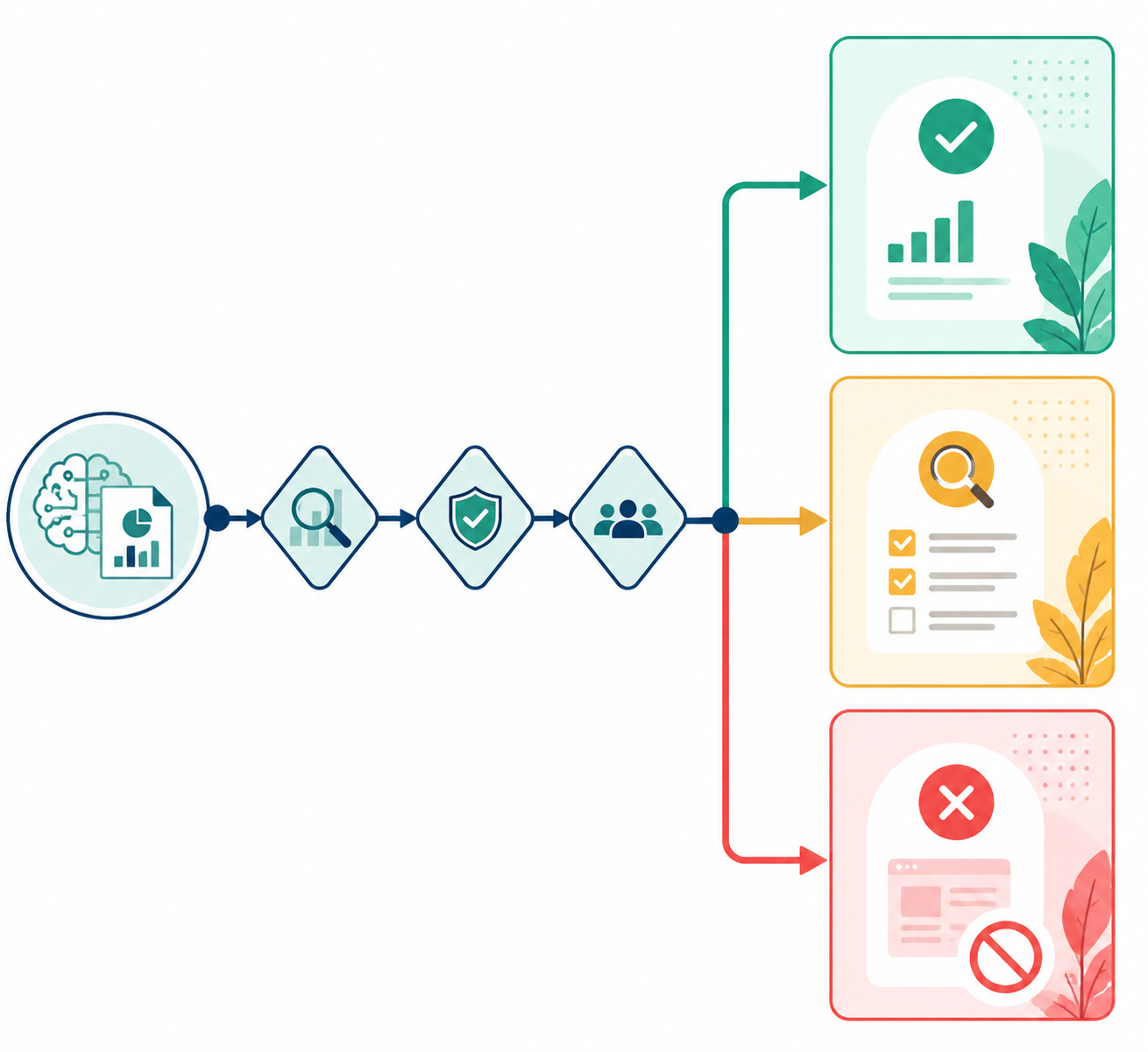
A practical review process needs more than approve or reject. Most AI market research outputs belong in one of three zones.
| Zone | When the output belongs there | How to use it |
|---|---|---|
| Trust | The output is traceable to real respondent data or named current sources, and the claim is low-risk or already corroborated. | Use it in synthesis, planning, and internal decision support with normal caveats. |
| Verify | The output is plausible but depends on synthetic respondents, second-hand statistics, thin sourcing, or one method. | Use it to form hypotheses, then test through another evidence format before making a material decision. |
| Bypass | The output cannot show sources, cannot trace to respondent evidence, predicts behavior without validation, or conflicts with reliable field evidence. | Do not use it as research evidence; replace it with human interviews, a qualified panel, behavioral data, or source-backed analysis. |
The zones are not moral judgments about tools. They are controls for decision risk. A synthetic respondent output may be perfectly acceptable in the verify zone for early message exploration. The same output may be unacceptable in the trust zone for a board-level market entry recommendation.
How this changes the way teams evaluate AI tools
Most vendor evaluations overemphasize interface quality, speed, and output polish. Those features matter, but they do not answer the research-quality question. A more useful evaluation asks what the tool makes inspectable.
- Can the tool preserve source links, timestamps, respondent IDs, and transcript references?
- Can it show how a theme was built from underlying excerpts?
- Can it distinguish observed respondent language from inferred interpretation?
- Can it flag stale sources, missing citations, and weak sample fit?
- Can the team export enough raw material to challenge the conclusion outside the platform?
A tool that produces a less elegant summary with stronger traceability is often safer than a tool that produces a beautiful answer with no audit trail. Speed is useful after provenance is established. Before that, speed just moves uncertainty downstream faster.
For teams still deciding which research tasks to automate, the validation lens pairs naturally with a task-level automation review. See How to Decide Which Market Research Tasks to Automate with AI for the companion decision framework.
The operating rule
AI market research tools are useful when they accelerate exploration, moderation, synthesis, and hypothesis generation under review. They become dangerous when their outputs are treated as primary evidence without validation.
Trust is earned by traceability, source quality, respondent integrity, cross-method survival, and freshness. If an AI output can pass those checks, use it. If it cannot, keep it out of the decision layer until another method has done the work.
References
- AI in Market Research, Monigle, January 2026
- The AI Tools That Are Transforming Market Research, Harvard Business Review, November 2025
- GRIT Insights Practice Edition, Greenbook
- The Future of Market Research with AI: 2026 Trends That Will Reshape the Industry, Perspective AI

Comments
Join the discussion with an anonymous comment.