

The Real ROI of Generative AI in Marketing: Which Use Cases Deliver and Which Disappoint
Aggregate AI marketing ROI numbers hide a wide performance gap between use cases. This article breaks down ROI by marketing function — from content drafting at 3.2x to AI video at 1.1x — and provides a decision framework for where to invest generative AI budget for maximum return.
The least useful sentence in a 2026 AI budget meeting is the one that says generative AI for marketing has “positive ROI.” It may be true, and still not help anyone decide what to fund. A content team using AI to turn briefs into first drafts is not making the same bet as a brand team trying to produce video assets, and a lifecycle marketer testing subject-line variants is not carrying the same operating cost as a demand gen team wiring AI into lead scoring. The spread matters more than the average.
The use-case-level data is blunt. Digital Applied and Zigment both aggregate 2026 AI marketing ROI figures attributed to McKinsey’s Global AI Survey; that secondary sourcing should make readers careful about treating the decimals as laboratory-grade precision, but the ranking is still the most useful place to start a budget conversation.[1][2]
| Use case | Reported ROI | Budget reading |
|---|---|---|
| Content drafting | 3.2x | Strong near-term investment candidate |
| Personalization | 2.7x | Strong when tied to owned-channel execution |
| Audience research | 2.4x | Strong when it shortens analysis and briefing cycles |
| Ad copy | 2.3x | Useful, but depends on governance and channel feedback |
| Campaign analytics | 1.9x | Conditional on data quality and integration |
| Lead scoring | 1.4x | Fragile unless sales and marketing trust the model |
| AI video | 1.1x | Contain or test narrowly under 2026 cost conditions |
Where the ROI survives contact with the workflow
Content drafting sits at the top because it attaches to work marketing teams already do every week: landing page copy, email drafts, blog outlines, campaign briefs, product-message variants, webinar follow-ups, sales enablement summaries. The reported 3.2x return, with an interquartile range of 2.4x to 4.1x in the aggregated McKinsey figures, is not magic; it is frequency multiplied by lower first-draft cost.[1][2] A content lead still has to review claims, fix tone, check facts, and protect the brand. But the tool is removing a real bottleneck before that review step, not inventing a new production requirement that nobody staffed.
That is also why the productivity data matters only after it is split by function. HubSpot’s 2026 State of Marketing reports an average time saving of 6.1 hours per week, but the average hides the same operational pattern: content roles report 7.8 hours saved, while events roles report 3.2 hours.[3] Those are self-reported survey figures rather than time-tracked studies, so they should not be treated as payroll math on their own. They do explain why AI copy and content workflows are easier to defend: the work is text-heavy, repetitive, reviewable, and close to existing output targets.
The practical investment case for an AI copywriting tool is strongest when the team can point to a specific handoff that gets shorter. A product marketer turns an approved positioning document into five landing page variants. A lifecycle marketer turns one campaign concept into audience-specific email drafts. A demand gen manager turns a webinar transcript into nurture copy. In each case, the budget argument is not that AI “creates content.” It is that the first usable draft arrives sooner, giving the team more cycles for editing, testing, and distribution.
Personalization, at 2.7x ROI, benefits from the same economics but adds a distribution advantage.[1][2] The work already exists inside email, lifecycle, ecommerce, and account-based marketing programs; generative AI makes it cheaper to vary the message by segment, stage, industry, or behavior. The catch is that personalization only pays if the organization can actually send, measure, and learn from those variants. Without clean segments and a governed channel workflow, “personalized” becomes a larger pile of unreviewed copy. With those pieces in place, AI in email marketing is one of the clearer places to turn saved drafting time into more relevant campaigns.
Audience research, at 2.4x ROI, deserves more budget attention than it usually gets because it improves the work before production starts.[1][2] Summarizing call transcripts, clustering open-ended survey responses, comparing review themes, and turning customer-language patterns into briefs can make campaigns sharper without requiring the team to publish more assets. It is also less exposed to the obvious-brand-safety problem than fully automated public creative, because humans can inspect the synthesis before it becomes messaging.
The middle cases are not bad; they are easier to overstate
Ad copy at 2.3x ROI looks attractive, and in many teams it is.[1][2] Search ads, paid social hooks, display variants, and landing-page message tests all reward volume, speed, and disciplined iteration. The trouble starts when the team confuses variant generation with performance improvement. A tool can produce more headlines; it cannot by itself decide whether the channel is learning from the right signal, whether brand rules are being followed, or whether the winning variant is a short-term click trap.
This is where tool selection needs to follow the job rather than the demo. A performance marketer evaluating an AI ad copy generator should care less about how fluent the sample outputs sound and more about whether the workflow supports approvals, scoring, testing, and learning from channel results. The same logic applies across the broader best tool for the job decision: a platform that saves one team hours may create review debt for another.
Campaign analytics and lead scoring sit lower for a reason. Campaign analytics at 1.9x can help teams summarize performance, spot anomalies, and turn reporting into recommendations faster, but it depends on the quality of the underlying data and how much of the analysis is already standardized.[1][2] Lead scoring at 1.4x is more fragile because the output has to be trusted by both marketing and sales.[1][2] If sales teams ignore the score, or if the model reflects messy historical handoffs, the AI layer becomes one more dashboard to defend.
AI video is the warning label
AI video’s reported 1.1x ROI is the number that should slow down the most excited room.[1][2] It is not an argument that AI video is useless, or that the category will stay weak. It is a 2026 budget warning: once production overhead, creative direction, editing, brand review, legal review, and channel adaptation are included, the apparent savings can disappear. A team may reduce the cost of generating footage or motion concepts and still increase the cost of getting something approved and shipped.
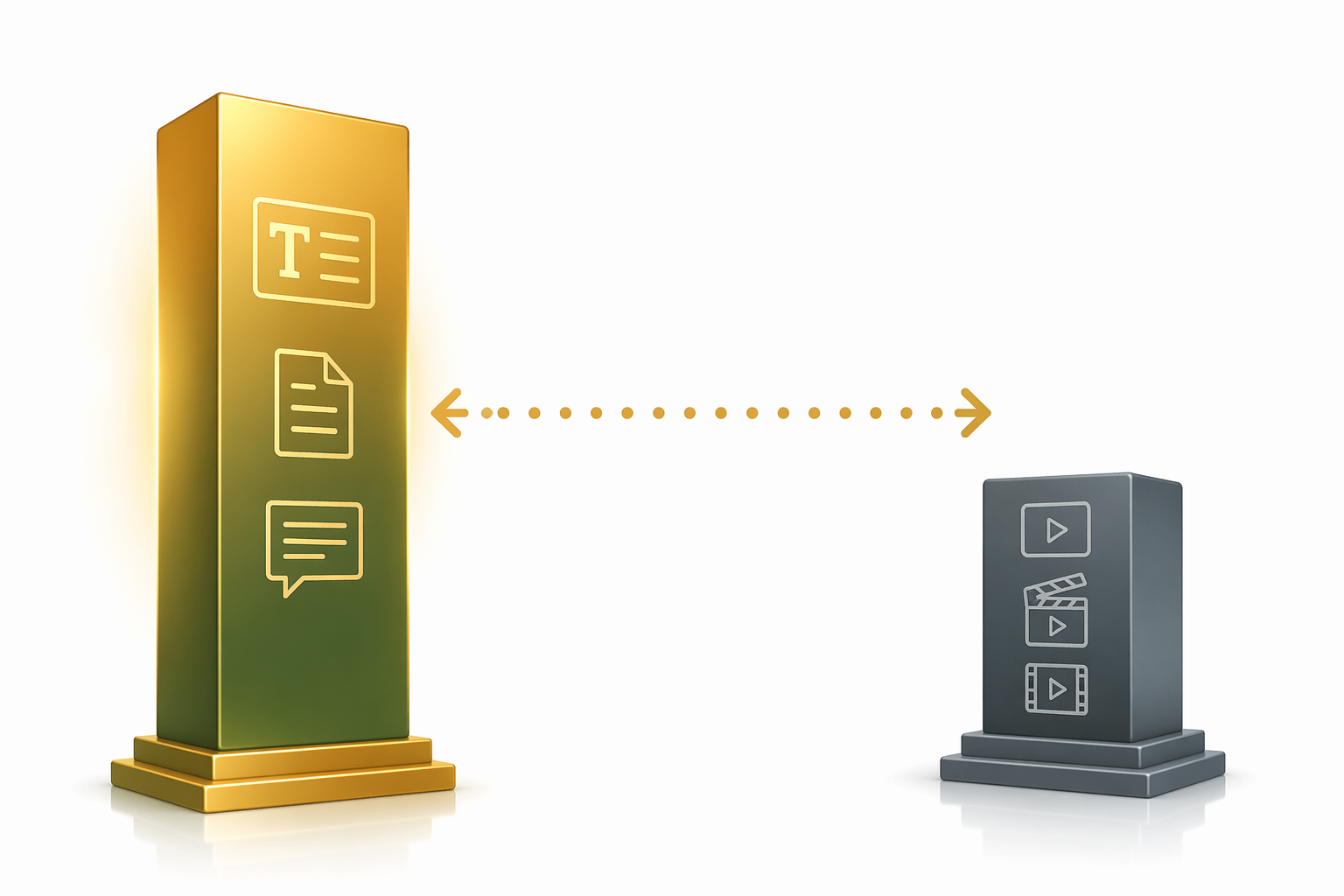
Paid social creative adds another practical constraint. Aggregator coverage of 2026 platform updates describes Meta, TikTok, and Google down-ranking obvious AI-generated creative, which means the risk is not only that an asset looks generic; it may also receive weaker distribution if it triggers platform quality signals.[1][2] The right response is not to ban AI from creative development. It is to keep AI inside a governed workflow: concept exploration, storyboard options, copy variants, adaptation support, and controlled tests where creative quality and platform delivery are measured together. A more detailed operating model belongs in an AI creative advertising playbook, not in a blanket promise that generative production will lower media costs.
The same caution applies to the headline claims that make AI feel like a settled budget item. SAS and Coleman Parkes research is cited in aggregator coverage as finding that 83% of teams report measurable ROI, and other vendor-positive AI marketing claims often land in the same optimistic range.[1][2] Those figures are useful as evidence that AI is no longer experimental for many teams. They are much less useful for deciding whether the next dollar should go to content operations, lifecycle personalization, paid social creative, or video production.
Payback periods make pilots easier to size
The budget conversation has become easier than it was a year or two ago because payback windows have compressed. Digital Applied’s aggregation of Gartner CMO Spend Survey 2026 data reports a median payback period of 4.2 months, down from 7.8 months in 2024.[1] That does not mean every use case should be expected to pay back in a quarter. It does mean a pilot can be designed with a short measurement window if the use case is frequent enough and the baseline is clear.
Spend benchmarks help keep the pilot honest. The same Gartner-sourced aggregation reports median mid-market AI spend of $3,400 per month, while enterprise spend is reported at $24,000 to $48,000 per month.[1] Those numbers should not become targets. A team spending $3,400 a month on content drafting, personalization support, and research synthesis may have a cleaner ROI story than a much larger team spreading enterprise budget across disconnected tools, each with its own admin, procurement, security, and training burden. For adoption and spend context, a companion Gartner AI marketing technology forecast can be useful, but the operating question remains local: what work is being made faster, and who is responsible for the output?
Headcount data needs the same care. Zigment’s aggregation cites Gartner figures that 23% of agencies cut junior copywriter headcount and 31% plan further cuts in 2026.[2] That is a serious labor signal, especially for agencies built around high-volume draft production. It should not be lazily translated into “AI replaces marketers.” The narrower reading is more useful: when the work is repetitive, text-heavy, and reviewable, the economic pressure moves quickly from drafting capacity toward editing, strategy, QA, and client judgment.
A 2026 budget cut for the average ROI slide
For 2026 planning, the cleaner framework is not a maturity curve or a market-size forecast. Market projections vary by definition and are best treated as directional background. The useful split is more direct: invest now where AI improves frequent text-heavy workflows; test with controls where performance depends on data, governance, or platform feedback; delay or contain where production overhead can swallow the savings.
| Budget posture | Use cases | How to judge success |
|---|---|---|
| Invest now | Content drafting, personalization, audience research | Shorter cycle time, more tested variants, better briefs, clear review ownership |
| Test with controls | Ad copy, campaign analytics, lead scoring | Channel lift, data reliability, sales adoption, governance cost |
| Delay or contain | AI video, obvious AI-generated paid social creative | Production overhead, approval burden, platform delivery, creative quality |
A team turning this into a 90-day AI marketing roadmap should start with one or two use cases from the first group, define the old workflow cost, assign review responsibility, and measure whether the saved time becomes shipped work or better decisions. The middle group can follow once the team has governance muscle. The last group can still be explored, but it should not be allowed to consume the budget just because it photographs well in an executive deck.
Generative AI for marketing has real ROI in 2026, but the ROI is uneven. The strongest cases are attached to work marketers already understand and already fund. The weakest cases ask teams to absorb new production, review, and platform risk before the economics are proven. That is why the use-case table belongs at the front of the budget discussion, not in the appendix after the aggregate ROI slide has already won the room.
References
- AI Marketing Statistics 2026: Adoption Data Points, Digital Applied.
- Artificial Intelligence Statistics 2026: Marketing ROI Map, Zigment.
- State of Marketing, HubSpot, 2026.
Comments
Join the discussion with an anonymous comment.