

Peter Thiel’s Zero to One and the New Rules of AI Marketing
When AI tools level the execution playing field, strategic differentiation becomes the only sustainable advantage. This article applies Peter Thiel's Zero to One framework to help marketers identify contrarian market insights, build defensible positioning, and stop competing on tool selection.
The awkward thing about AI marketing in 2026 is that the average team has become much more capable without necessarily becoming more competitive. Posts can be drafted faster. Ad variants can be generated by the dozen. Research can be summarized before a strategist has finished her coffee. Sales emails, landing page tests, customer interview digests, creative briefs, webinar clips, and SEO briefs all move through the machine with less friction than they did a few years ago.
That is real progress. It is also a terrible place to stop thinking.
The search phrase “peter thiel ai predictions for marketing” points to a useful question, even though it needs a correction upfront: Peter Thiel did not write a marketing playbook for the generative AI era. Zero to One was published in 2014, before the current wave of large language models reshaped day-to-day marketing work.[1] What Thiel did offer was a vocabulary for thinking about competition, distribution, secrets, and monopoly power. Applied carefully, that vocabulary is more useful than another tour of the newest AI stack.
The central problem is simple: if every competent competitor can now produce acceptable content, acceptable content stops being a strategic asset. Prompt skill, workflow automation, and tool selection still matter, but they decay quickly as advantages. The more a capability can be bought, copied, taught, or bundled into a platform, the less it can defend a market position.
That does not make AI unimportant. It changes what AI should be used to scale. A weak position plus faster output gives a team more of the same forgettable work. A sharp position plus faster output can deepen a channel, train a market, reinforce a category association, and compound trust. The difference is not the machine. It is what the machine is attached to.
Execution parity changes the question
A few years ago, marketing operations could still create visible separation through production capacity. One team had better designers, faster copywriters, cleaner analytics, stronger paid media testing, or more disciplined repurposing. Those gaps have not disappeared, but AI has compressed many of them. A smaller team can now approximate the surface area of a larger one, especially in the early draft and variation stages.
That is why tool roundups are useful but strategically thin. A role-by-role view of the best AI for marketing in 2026 can help a team close workflow gaps. It cannot answer why a buyer should remember this company instead of the next company using a similar model, template, and automation layer.
Once AI reduces the execution gap, the competitive question moves upstream and downstream at the same time. Upstream: what does this team understand about the market that others do not? Downstream: what distribution mechanism lets that understanding reach the right people repeatedly, credibly, and at a lower marginal cost over time?
This is where Thiel’s framework becomes useful. Not as prophecy. Not as a claim that every B2B marketing team should speak like a venture-backed platform company. The value is in translating his core argument into marketing terms: durable advantage comes from escaping commodity competition, and distribution is often the constraint that decides whether a good idea matters.
What “monopoly” means when you are not building a monopoly
Thiel’s monopoly language is easy to overapply. Most marketing departments are not trying to dominate a market in the literal economic sense. Agencies, SaaS companies, service firms, and ecommerce brands often work inside mature categories with budget limits, entrenched competitors, and sales teams asking for pipeline this quarter.
But the marketing translation is still powerful. A marketing monopoly is a pocket of defensibility: a segment, belief, channel, method, dataset, community, or association that competitors cannot simply prompt into existence. It is the reason a buyer gives your content more attention, your claim more credibility, or your offer more patience than a technically similar alternative.
In Zero to One, Thiel describes four characteristics of monopoly businesses: proprietary technology, network effects, economies of scale, and branding.[1] For marketers, those do not map cleanly to software features. They map to advantage systems.
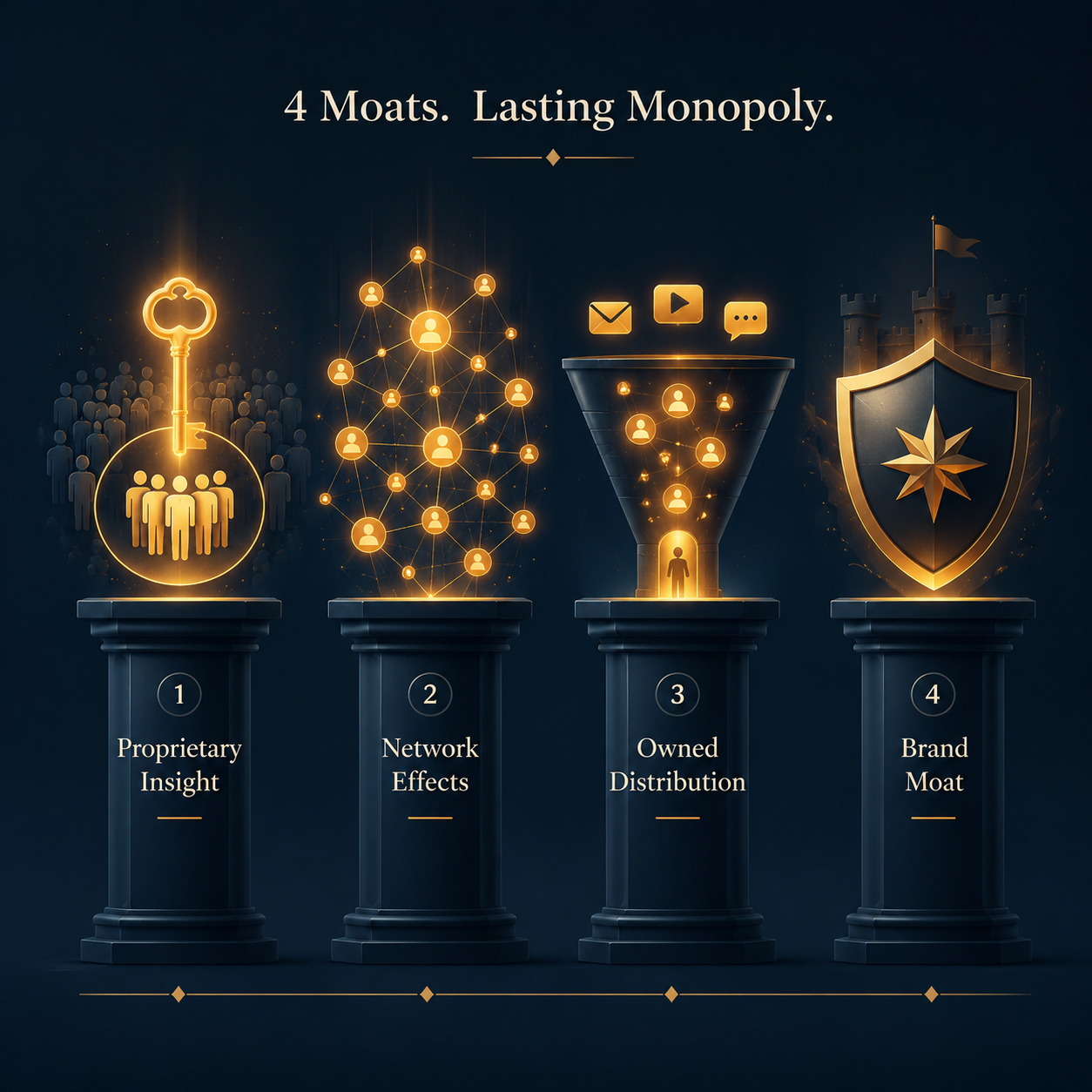
| Thiel’s business characteristic | Marketing translation | What AI cannot easily copy |
|---|---|---|
| Proprietary technology | A proprietary audience insight, diagnostic, benchmark, methodology, or internal data asset | The judgment behind the system and the market learning accumulated over time |
| Network effects | A community, partner ecosystem, contributor network, customer loop, or user-generated proof system | The participation of people who trust the environment enough to keep returning |
| Economies of scale | A repeatable content, research, or distribution engine that gets cheaper and more effective as it compounds | The archive, process memory, audience feedback, and channel history |
| Branding | A clear association in the buyer’s mind: this company owns this problem, method, or worldview | The credibility earned by saying and proving the same distinctive thing over time |
The first of these, proprietary insight, is the most abused. Many teams call an insight proprietary when it is merely well phrased. “Buyers want efficiency” is not proprietary. “Mid-market finance teams delay automation because they distrust implementation burden more than they fear manual work” could become proprietary if the company has evidence, sales learning, product experience, and messaging discipline behind it. The difference is whether the insight changes what the team does.
A proprietary method works the same way. Naming a framework is cheap. Building one that sales uses, customers recognize, analysts repeat, and competitors struggle to imitate is not. AI can help turn the method into articles, landing pages, webinars, training material, sales enablement, and product education. It cannot supply the market permission that makes the method believable.
Network effects in marketing rarely look like classic software network effects. They look like participation loops. The best people agree to be interviewed because other serious people have already appeared. Customers share examples because the company has created a context where sharing raises their status. Partners promote a report because they helped shape it. A community becomes useful because practitioners show up with lived problems, not because a brand posts discussion prompts three times a week.
Economies of scale are equally misunderstood. Publishing more does not automatically create scale. Publishing into a reusable system can. A research program creates future benchmarks. A webinar series creates clips, objections, sales language, and expert relationships. A strong SEO cluster creates internal linking leverage and topic authority. A customer evidence program gives paid media, lifecycle, sales, and product marketing a shared proof base. AI lowers the cost of operating these systems, but the system itself is the asset.
Branding is the least promptable of the four. A model can produce language in a brand voice. It cannot make the market believe the brand has earned a position. That belief comes from repeated contact between claim and proof: the company says what it stands for, shows how it works, ships evidence, makes tradeoffs, and keeps doing it long enough that the association becomes easier to retrieve than a competitor’s ad.
Distribution is the AI-era bottleneck
The most useful Thiel line for AI marketing may be his argument that “superior sales and distribution by itself can create a monopoly, even with no product differentiation. The converse is not true.” He also argues that poor sales, rather than bad product, is the most common cause of failure, and that most businesses get no distribution channels to work.[1]
That lands differently when content creation is cheap. If a team can generate one hundred competent assets instead of ten, the scarce resource is not the draft. It is attention, trust, timing, placement, and follow-through. The feed does not expand just because production does. The buyer’s week does not gain extra hours because your team has a better repurposing workflow.
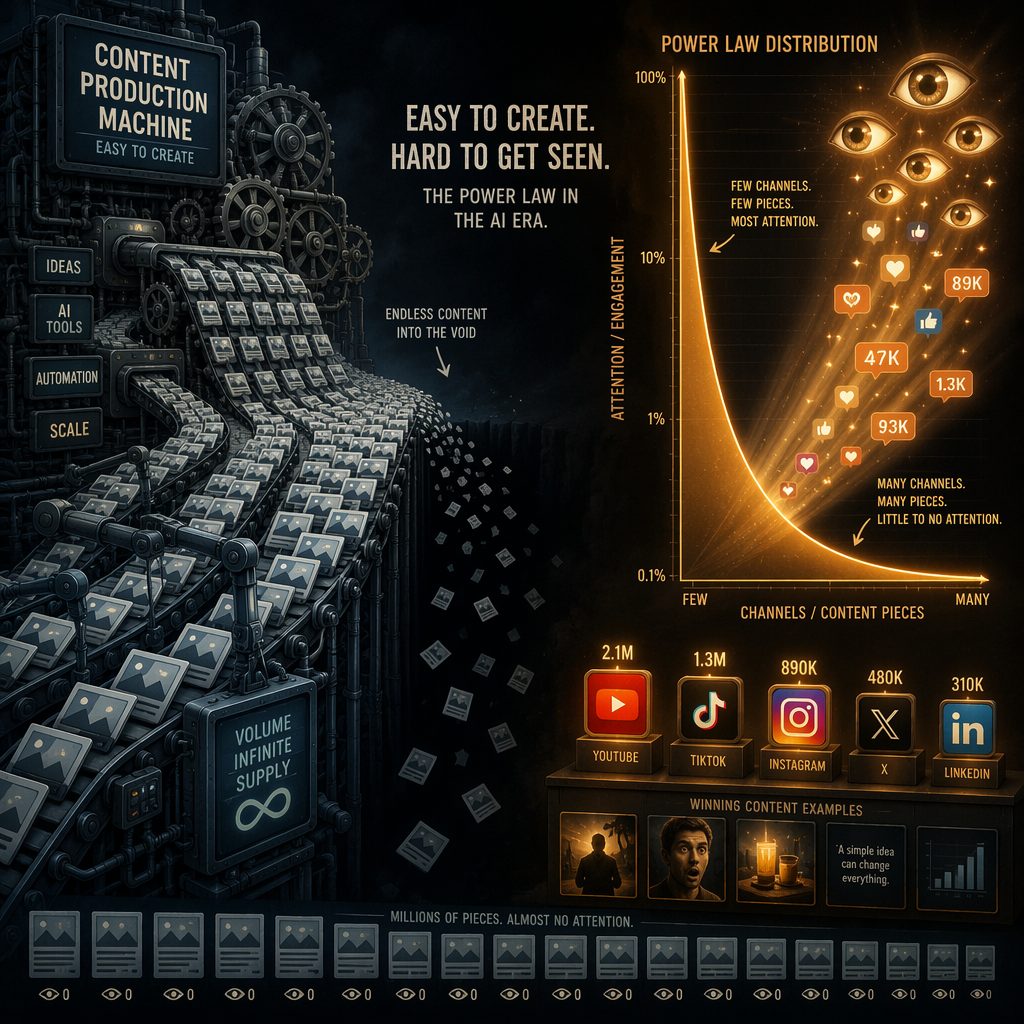
Distribution power is not the same as “be on more channels.” It is the ability to make a channel work repeatedly. For one company, that may be search because it has the patience and subject authority to own high-intent problems. For another, it may be founder-led LinkedIn because the market buys through expert trust. For another, it may be partner webinars, analyst relationships, field events, lifecycle education, or a paid acquisition loop with unusually strong conversion economics.
The distribution question should also discipline AI investment. A tool that helps create more assets is less interesting than a tool or workflow that strengthens a working channel: better segmentation for lifecycle, faster sales follow-up from content engagement, cleaner creative testing in paid media, stronger internal linking for search, or faster conversion of customer evidence into sales-ready proof. The budget conversation belongs there, not in a generic contest over who has the most modern stack. That is also the right context for thinking through AI sales and marketing budget allocation.
The uncomfortable implication is that many AI content programs are solving the easiest part of the problem. They make production faster while leaving the distribution mechanism vague. The team can show output. It can show experimentation. It may even show lower production cost. But if the work does not accumulate in a channel, audience, or belief system, the advantage resets every Monday.
The “secret” has to change a decision
Thiel’s famous question is: “What important truth do very few people agree with you on?”[1] In marketing, the practical version is narrower: what important truth about your market do very few competitors act on?
A secret is not a contrarian sentence pasted into a brand deck. It has to affect choices. If it does not change audience selection, positioning, channel strategy, sales narrative, product education, pricing context, or proof strategy, it is probably just a hot take with better typography.
Useful secrets often sound operational before they sound glamorous:
- The economic buyer is not the real blocker; implementation anxiety is.
- The category talks about productivity, but the buyer is really trying to reduce career risk.
- The market searches for one problem and buys because of a different one.
- The most valuable audience is too advanced for beginner education but underserved by vendor-neutral expertise.
- The highest-converting proof is not ROI language; it is evidence that the team will not look foolish internally.
Those examples are hypothetical, but they show the standard. A secret should create a wedge. It should tell the team which messages to stop using, which channels to ignore, which proof to collect, which audience to prioritize, and which claims to repeat until the market starts associating the company with that view.
AI is useful here when it expands the team’s ability to listen and compare. It can summarize calls, cluster objections, scan reviews, analyze transcripts, compare competitor messaging, and surface language patterns. But Thiel’s warning about data matters: “big data” without judgment is not automatically intelligence, and his PayPal example favored human-machine symbiosis rather than full automation.[1] In marketing terms, machines can help process the market’s noise; people still have to decide what the noise means.
That distinction matters because AI can make false consensus feel rigorous. If every competitor asks similar models to summarize similar public sources, everyone can converge on the same polished understanding of the market. The secret is more likely to come from the material competitors do not have or do not respect: sales calls, failed deals, customer implementation friction, support tickets, community arguments, partner feedback, field notes, and the founder’s scar tissue.
Definite planning beats endless AI-assisted motion
Thiel contrasts definite optimism with indefinite attitudes toward the future, arguing that a bad plan is better than no plan because planning makes deliberate progress possible.[1] Marketers do not need to import every part of that worldview to recognize the problem it names. AI has made indefinite marketing easier to disguise as momentum.
A team can test more hooks, publish more variants, generate more audience profiles, create more nurture paths, rewrite more landing pages, and still avoid the harder commitment: this is the market belief we are going to build around; this is the channel we are going to make work; this is the proof we need; this is the audience we will disappoint less than anyone else.
Definite planning does not mean rigid planning. It means the team knows what should compound. If the wedge is a proprietary benchmark, the plan should turn data collection, analysis, thought leadership, PR, sales enablement, and lifecycle education into one connected system. If the wedge is practitioner trust, the plan should build around recurring expert participation, not one-off content bursts. If the wedge is category education, the plan should make search, sales decks, onboarding, and webinars reinforce the same mental model.
This is where a practical roadmap helps. A 90-day AI marketing strategy plan should not be a tour of tools. It should establish where AI reduces drag inside a strategy the team can defend: research synthesis, content operations, campaign adaptation, reporting, sales enablement, or lifecycle personalization. The sequence matters because random productivity gains rarely add up to a market position.
The same discipline applies to case studies. Evidence is useful when it sharpens judgment, not when it becomes permission to copy someone else’s workflow. Patterns from AI marketing case studies can help teams separate durable systems from novelty adoption. The question is not “Who used AI?” It is “What advantage did AI help them deepen?”
How to evaluate AI work through a Thiel-shaped lens
A marketing leader does not need to quote Zero to One in a planning meeting. The useful move is to change the evaluation criteria. Instead of asking whether an AI initiative increases output, ask whether it strengthens a defensible advantage.
- Does this workflow help us learn something about the audience that competitors cannot easily see?
- Does it make a working distribution channel stronger, or does it merely create more assets looking for a channel?
- Does it reinforce a distinctive positioning claim, or does it make us sound more like the category average?
- Does it create reusable data, proof, relationships, or process memory?
- Would the strategy still make sense if a competitor bought the same tool tomorrow?
That last question is the cleanest one. If the answer is no, the initiative may still be worth doing for efficiency, but it should not be mistaken for strategy. Efficiency can improve margins, speed, and team morale. It can reduce waste. It can help a department meet demand. But efficiency alone rarely tells the market what to believe about you.
This also keeps ROI conversations honest. Some AI investments are operationally useful without being strategically differentiating. Others deserve more attention because they build proprietary data, increase channel leverage, or improve conversion in a distribution loop that already works. A sober read on where AI marketing ROI is real in 2026 belongs inside that distinction.
The limits of the frame
There are limits to applying Thiel too neatly here. Zero to One predates generative AI, and its examples come from a startup and technology investing context, not from a marketing department trying to support pipeline, renewals, and brand preference inside an existing category.[1] The monopoly language can become especially clumsy if it encourages teams to pretend they can own more of a market than they realistically can.
The better use is more modest and more demanding. Do not ask whether your marketing team is building a monopoly. Ask where it can create a pocket of non-commodity advantage. A pocket is enough if it compounds: one audience segment that trusts you more, one channel where your cost of attention improves, one method buyers associate with your name, one dataset competitors cannot access, one partner network that keeps feeding distribution.
That is also why the human-machine point matters. Full automation is tempting when the work looks repetitive. But the strategic work is not merely the production of assets. It is deciding what to notice, what to ignore, what to repeat, what to stop saying, which customers to learn from, and which market belief is worth defending. AI can accelerate those decisions when the team has judgment. It can also bury weak judgment under a large volume of plausible work.
What separates winning AI marketing strategies
When AI eliminates much of the execution gap between competitors, winning marketing strategies separate themselves through distribution power, proprietary insight, and defensible positioning. The winners will still use modern tools. They will draft faster, analyze faster, repurpose faster, and test faster. But their advantage will not be that they found a better prompt before everyone else.
Their advantage will be that they know what they are scaling. They have a market belief competitors miss, dismiss, or cannot act on. They have a channel where attention compounds instead of resetting. They have proof the buyer recognizes. They have a method, audience, or association that grows stronger through repetition. They can defend the strategy without mentioning AI, and then use AI to make that strategy move faster.
In Q3 2026, that is the useful lesson to take from Thiel, not a fictional set of Peter Thiel AI predictions for marketing. Execution parity makes tool proficiency less defensible, not more. It makes distribution power, proprietary insight, and clear positioning more valuable because those are the parts competitors cannot simply generate on demand.
References
- Zero to One - Peter Thiel, Graham Mann, 2014
Comments
Join the discussion with an anonymous comment.