

Where AI Actually Works in Marketing: A Ranking Based on Evidence
This article ranks AI marketing use cases by the strength of available evidence, helping marketing managers identify where to invest AI budget for reliable returns versus where the hype still outpaces results.
If leadership is asking where to put AI marketing budget in Q3 or Q4, the safest answer is not “wherever the newest model looks impressive.” It is where the task is bounded, the output can be reviewed, and the result can be measured without inventing a new attribution story after the fact.
On the current evidence, using AI in marketing works best in content production and enhancement, audience targeting, email optimization, analytics, and reporting. It is less mature in personalization and predictive use cases, where the results can be strong but are more case-dependent. It is weakest when teams ask AI to replace strategic planning or original creative judgment.
| Evidence tier | Use cases | What the evidence supports | Budget posture |
|---|---|---|---|
| Tier 1: Proven | Content creation, content enhancement, production workflow support | High adoption and reported ROI lift, strongest when AI accelerates human-reviewed workflows | Fund, but pair with editorial standards, measurement, and governance |
| Tier 2: Strong | Audience targeting, email optimization, analytics, reporting, paid/social optimization | Marketers rate these as highly effective, and the work is measurable against existing campaign metrics | Fund where data quality and campaign operations are already disciplined |
| Tier 3: Emerging | Chatbots, recommendation engines, personalization, predictive analytics, visual commerce | Some strong case outcomes, but evidence is narrower and often vendor- or case-study-led | Pilot with clear guardrails and a comparison group where possible |
| Tier 4: Underdelivering | Strategic planning, broad creative ideation, market interpretation | Reported success rates are weak, especially when AI is treated as a substitute for context and judgment | Use lightly as an assistant; do not make it a major budget dependency |
That ranking is not a popularity contest. Adoption can tell you where teams are experimenting; it does not prove the work is paying back. A separate adoption-frequency view can be useful for comparison, especially in how digital marketing teams are actually using AI, but budget decisions need a stricter question: where has AI repeatedly reduced work, improved performance, or made marketing operations more accountable?
Tier 1: Content works when it is treated as production leverage
Content creation and enhancement belong at the top of the ranking, but not because every AI-generated draft deserves to be published. The strongest case is operational: AI reduces the time required to produce, adapt, summarize, repurpose, and QA content assets that still pass through human editorial judgment.
Semrush survey data puts AI content creation adoption at 37% and reports a 68% ROI lift, which makes it one of the clearest positive signals in the current marketing evidence base.[1] The claim is useful because it is not just a demo outcome; it connects adoption to reported business return. It still should be read as survey evidence, not as a guarantee that any team buying generation tools will see the same lift.
The complication is that other evidence makes content look less dominant. Act-On’s B2B marketer survey rates content creation at 35% effectiveness, below audience targeting at 43% and analytics/reporting at 41%.[2] That is not a contradiction so much as a useful warning. Content is widely useful as a workflow accelerator; marketers may still judge targeting and analytics as more directly tied to campaign performance.
There is also a market-adoption signal from live-domain detection, though it needs to be handled carefully. TechnologyChecker’s crawl found OpenAI integrations on about 41,764 domains, compared with MailChimp on about 313,840 domains.[3] That does not establish total AI usage across marketing, because one vendor’s crawl can miss invisible, private, or server-side implementations. It does show that visible AI integration is still much smaller than entrenched marketing infrastructure, which matters when executives talk as if every competitor has already rebuilt its marketing stack around AI.
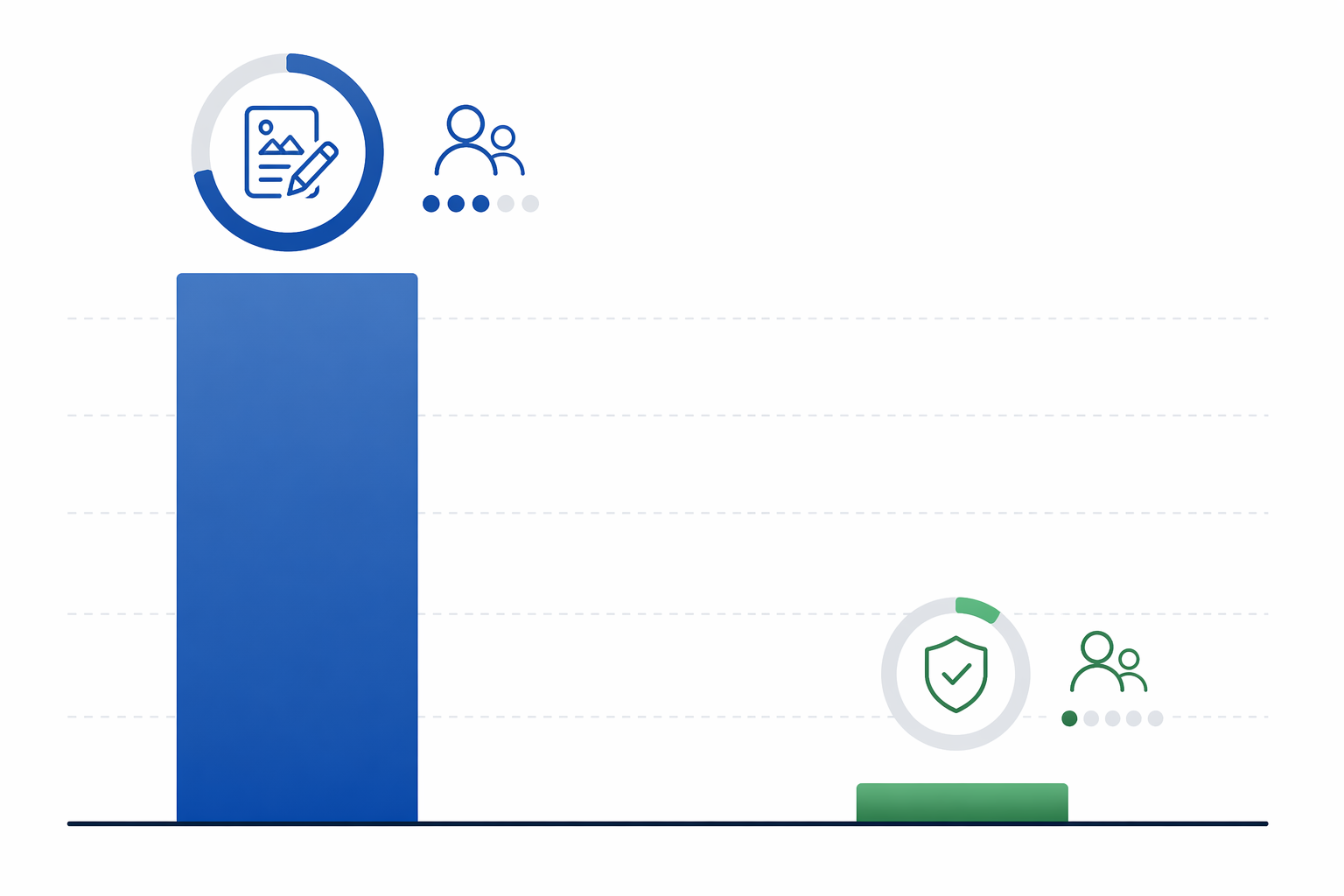
The budget issue is where content becomes messy. Improvado benchmark data shows content generation tools taking 22% of AI budget at 81% adoption, while governance receives 3% of budget at 31% adoption.[4] The benchmark blends proprietary customer data with third-party sources, so it should not be treated as a universal market census. Still, the pattern is familiar enough to be operationally credible: teams buy the visible production tool first, then discover later that they also needed approval rules, brand controls, data permissions, measurement hygiene, and retention policies.
That is why the content line item should rarely be just “AI writing tool.” A defensible content budget usually has at least four pieces: the production tool, editorial review capacity, measurement instrumentation, and governance. If the budget funds only generation volume, the team may get more assets into the pipeline while making reporting, compliance, and brand consistency worse.
Some case-study figures around AI content are impressive but should not carry the whole investment case unless the original source is verified. Visme’s aggregated case-study material cites IBM enhanced content achieving 26 times higher engagement and Adore Me seeing a 40% SEO traffic gain.[5] Those examples are worth tracking, but aggregated case-study posts are not the same as independent, repeatable measurement across many teams.
The better managerial takeaway is narrower and more useful: content is a strong AI use case when the team knows what good looks like before the model starts writing. AI can create variants, compress research notes, draft outlines, adapt copy for channels, produce metadata, generate briefs, and convert long-form assets into derivative formats. It should not be asked to decide positioning, approve claims, invent customer insight, or replace the editor who knows what the market will actually believe.
Tier 2: Targeting, email, analytics, and reporting have the cleaner business case
The less glamorous AI use cases often make the cleaner budget argument. Audience targeting, email optimization, analytics, and reporting operate inside systems marketing teams already measure: segments, opens, clicks, conversion rates, pipeline contribution, cost per acquisition, budget pacing, and reporting time.
Act-On’s B2B survey is especially useful here because marketers rated audience targeting at 43% effectiveness and analytics/reporting at 41%, both above content creation’s 35% rating.[2] That does not mean content is weak. It means marketers see stronger direct performance value when AI improves who gets a message, when they get it, what variation they receive, and how fast the team can interpret campaign results.
This is where AI fits into marketing operations without requiring a philosophical debate about creativity. It can identify segment patterns faster than a human analyst working from exports. It can flag campaign anomalies before the next weekly meeting. It can summarize performance by channel and audience. It can support send-time testing, subject-line variation, lead scoring, budget pacing, and paid creative rotation.
There are case-study claims in this tier too, but again the source type matters. Visme’s aggregated material cites Virgin Holidays achieving a 2% open-rate lift that drove millions in incremental revenue.[5] The revenue claim may be true, but for budget planning it should be treated as a case example pending original-source verification, not as a general email benchmark.
A more repeatable argument is that these use cases are easier to test. If AI changes targeting rules, campaign timing, audience suppression, or reporting workflows, the team can usually compare before and after performance, run holdouts, or at least measure time saved. That makes them easier to defend in a quarterly review than broad claims that AI “improved strategy.”
For teams deciding what belongs in automation versus review, the practical split is straightforward: automate low-risk pattern work, edit customer-facing language and insight, and skip AI for decisions that require accountability the model cannot hold. The companion framework on what to automate, edit, and skip when using AI for marketing is useful because the same tool can sit in different risk categories depending on the workflow.
Tier 3: Personalization and predictive use cases are promising, but narrower than the demos suggest
Chatbots, recommendation engines, personalization, predictive analytics, and visual commerce sit in the middle of the evidence ranking. They can produce large gains when the data foundation is strong and the use case is specific. They also fail quietly when the team has weak customer data, fragmented systems, unclear consent rules, or no baseline measurement.
The strongest numbers in this tier are still mostly case-led. Visme’s aggregated case-study material cites A.S. Watson achieving a 396% conversion lift from an AI recommendation engine.[5] That is a substantial result, but it should be read as a specific implementation outcome rather than evidence that every recommendation engine will multiply conversion at that level.
The same caution applies to predictive retention and service use cases. The research brief includes a Verizon example in which AI prevented 100,000 churn events and reduced in-store time by 7 minutes, but without an original source available in the brief, the safest treatment is as an example requiring source verification before it becomes a board-slide claim.
These use cases deserve pilots, not blank checks. A personalization project needs a defined surface area: product recommendations, next-best content, chatbot triage, churn-risk flagging, or account prioritization. It also needs a control condition. Without that, the team may end up celebrating model activity rather than customer behavior.
For readers who want more examples across use cases, the pattern library in five real patterns from 119 AI marketing case studies and the broader AI marketing results spectrum are better places to compare individual outcomes than to treat any single campaign as the standard.
Tier 4: Strategy and ideation are cheap assistants, not budget pillars
There is nothing wrong with using AI to pressure-test a positioning idea, draft a campaign territory, list objections, or generate alternate angles before a planning meeting. That is low-cost assistive use. The budget problem starts when a team treats those outputs as a substitute for market judgment, customer proximity, competitive knowledge, or creative taste.
The hardest numbers here should be handled with a visible caveat. A secondary Deep Marketing discussion of MIT NANDA research cites strategic planning success rates of 10% to 20% and creative ideation success rates of 15% to 25%.[6] Because the research brief flags this as a secondary citation awaiting verification against the original MIT report, those figures should not be over-presented as settled independent evidence until the primary source is checked.
Even with that caveat, the direction of the finding matches what marketing managers see in practice. Models can remix familiar strategy language with great fluency. They can produce plausible personas, messaging pillars, channel plans, and creative territories. What they cannot do reliably is know which customer tension matters now, which internal constraint will kill the plan, which claim sales cannot defend, or which competitor move changes the meaning of the campaign.
The issue is not that AI brainstorming is useless. It is that brainstorming has a weak relationship to accountable marketing performance unless someone brings context, selection criteria, and taste. A model can give a team more options. It cannot tell the CMO which bet deserves the budget unless the organization supplies the customer evidence and strategic judgment.
The budget mistake: funding generation while starving governance
The most important AI marketing decision in 2026 is not tool selection. It is budget balance. A team can buy a capable model, generate more campaigns, and still produce no durable lift if the surrounding operating system is weak.
The Improvado benchmark is uncomfortable because it makes the imbalance visible: 22% of AI budget going to content generation tools at 81% adoption, compared with 3% going to governance at 31% adoption.[4] That is the shape of a future cleanup project. The more customer-facing output AI produces, the more a team needs rules for source use, claim approval, brand voice, legal review, data access, performance tracking, and model output retention.
Evaluation windows create another problem. The same secondary Deep Marketing discussion of MIT-related research says 73% of AI pilots are evaluated at 90 days or less, while the J-curve break-even period is 9 to 12 months.[6] Because this also relies on the secondary source pathway flagged in the research brief, it should be verified before publication. Still, the operating point is sensible: if a team judges a workflow transformation like a short campaign test, it may kill the project before process changes have time to show up in cost, quality, or speed metrics.
Marketing Dive’s 2026 reporting adds another useful, if broad, signal: a hybrid build-vendor approach delivers 3.7 times higher ROI.[7] That points away from two common extremes. Buying a stack of disconnected tools creates tool collectors. Trying to build everything internally slows teams that mostly need working campaign infrastructure. The better middle ground is usually vendor capability wrapped in internal process, data rules, and measurement discipline.
This is also where many AI pilots stall. The implementation gap is rarely that marketers refused to experiment. It is that the experiment never became a governed workflow. For teams already seeing that pattern, the AI marketing implementation gap is the more relevant problem than another list of prompts.
A practical allocation for Q3 and Q4
A defensible AI marketing budget should follow the evidence hierarchy, not the demo calendar. Start with work that is already measured and repeatable. Then fund the controls that keep increased output from becoming unmanaged risk.
- Put meaningful budget behind content production and enhancement, but only where there is editorial review, performance tracking, and a clear definition of acceptable output.
- Fund audience targeting, campaign optimization, analytics, and reporting where AI can improve measurable workflows that already exist.
- Pilot personalization, chatbots, recommendation engines, and predictive analytics in narrow use cases with baselines, controls, and ownership.
- Keep strategy and creative ideation lightweight unless the team can prove that AI-assisted work changed a decision, not just produced more options.
- Reserve explicit budget for governance, data quality, approval workflows, and measurement infrastructure.
That allocation may sound less exciting than buying a single platform and declaring the marketing organization AI-enabled. It is also easier to defend six months later. AI marketing works best where the task is bounded, measurable, and reviewable. It becomes least reliable where the team asks the model to decide what the market means.
References
- Semrush survey data — Semrush.
- Act-On B2B marketer survey — Act-On.
- TechnologyChecker live-domain crawl — TechnologyChecker.
- Improvado benchmark data — Improvado.
- AI marketing case studies — Visme.
- Deep Marketing discussion of MIT NANDA research — Deep Marketing.
- Marketing Dive 2026 reporting on hybrid build-vendor ROI — Marketing Dive, 2026.

Comments
Join the discussion with an anonymous comment.