

Adidas
This article synthesizes outcomes from over 100 companies using AI for marketing, showing where returns concentrate, where they fail, and what leaders should realistically expect depending on the use case.
Outcome
91% lower cost on personalized email creative — source: Pecan AI case study, 2026
This outcome is independently verified via the primary source linked above.
The problem with asking what companies using AI for marketing “get in ROI” is that the question collapses too many unlike things into one blended number. A personalized email production system that cuts creative cost by 91% is not the same investment as a recommendation engine that influences tens of billions in commerce, or an ad platform feature that lifts return on ad spend by 22%, or a customer-service assistant that looks brilliant until the operating model has to be walked back publicly.[1]
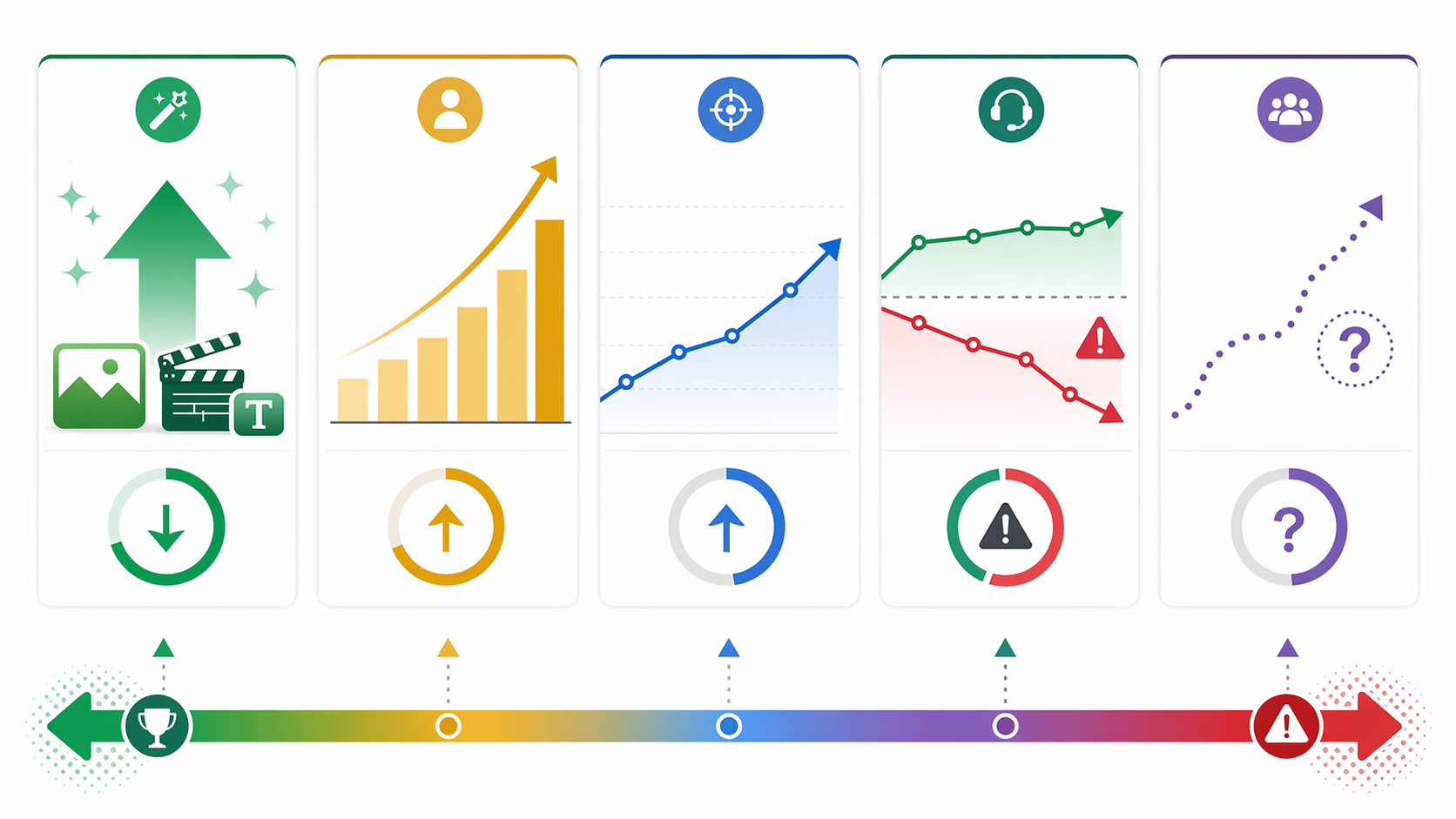
That spread is the story. Across the available case material, the strongest reported cost reductions cluster in creative production, the largest revenue effects cluster in personalization, ad platform automation sits in a narrower middle band, customer service AI carries the sharpest reversal risk, and internal enablement remains the category executives ask about most while getting the least clean public benchmarking.
This is a case-studies view, not a tools roundup. The useful question is not whether AI marketing works in the abstract. It is what kind of AI is being applied, inside which workflow, by what kind of organization, against which baseline, and over what payoff horizon.
The return profile changes by use case
The case base is uneven, but not useless. Aggregators such as Pecan AI and leonardom.com collect public examples across brands, tools, and reported outcomes; the leonardom.com database alone is framed around 119 AI marketing case studies.[1][2] Those sources are not equivalent to audited financial statements. Pecan AI is a vendor-funded source, and leonardom.com is a practitioner-maintained database rather than an institutional research panel. Still, when the figures are sorted by use case instead of brand fame, the pattern becomes more legible.
| Use case category | Reported outcome range in the brief | What the number mostly measures | Main credibility caution |
|---|---|---|---|
| Creative production | 60–91% faster or lower-cost production; 17x more content in one campaign example | Cost, speed, output volume | Often sourced through case databases or vendor-framed summaries |
| Personalization and recommendations | Up to about 35% of total revenue attributed to recommendations in Amazon’s case | Revenue influence, discovery, selection behavior | Usually reflects years of infrastructure maturity, not a short pilot |
| Ad platform automation | 13–25% type gains across platform examples | Conversions, ROAS, CPA | Platform-reported or aggregator-reported figures need baseline scrutiny |
| Customer service AI | Very large containment or replacement claims, plus visible reversals | Deflection, triage, labor substitution, customer experience | Replacement claims can unravel when service quality and staffing reality catch up |
| Internal enablement | Large-scale employee adoption and pilot efficiency gains | Productivity, decision speed, internal workflow leverage | Public evidence is thinner and harder to connect directly to marketing P&L |
A board presentation that treats all five rows as “AI marketing ROI” is already in trouble. The rows have different units. One saves production cost. One shifts customer choice. One optimizes paid media delivery. One contains service volume. One changes how employees work. The governance, data requirements, risk, and CFO conversation are different in each.
Creative production: the cleanest cost-reduction story
Creative production produces the kind of AI result that is easiest to understand in a budget meeting: the same campaign family, more variants, less manual production time, lower marginal cost per asset. In the cited case material, Adidas is associated with a 91% lower cost on personalized email creative, Nestlé with 60% faster production, and Unilever with 17x more content per campaign.[1][2]
Those are attention-grabbing numbers because the baseline is close to the work. If a team used to brief, write, design, resize, localize, review, and traffic creative variants through a human-heavy process, automation can remove visible steps. The savings show up before a customer changes behavior. That makes creative automation one of the more defensible early AI marketing investments when the goal is efficiency rather than immediate revenue lift.
The catch is that output volume is not the same as market impact. A team can create more assets without improving offer quality, segmentation, media buying, or conversion. The better cases tend to involve controlled workflows: templates, brand rules, modular content, human review, and a clear definition of what production cost used to be. Without that, “we made more content” becomes a vanity metric with a lower invoice attached.
For marketing leaders, the practical benchmark is not whether a generative system can make attractive assets. It is whether the production path actually shrinks: fewer handoffs, fewer rework cycles, faster localization, lower agency or studio hours, and enough quality control that the savings are not eaten by review.
Personalization: the biggest revenue numbers belong to mature systems
Personalization is where the largest revenue-linked figures appear, but also where comparisons become easiest to abuse. Amazon is the obvious headline: its deep learning recommendation engine is associated in the source material with roughly 35% of total revenue, estimated at more than $70 billion annually.[1] That is not a campaign result. It is a core commercial infrastructure result.
The same caution applies to other recommendation-heavy companies. Netflix is often cited for AI-driven content discovery, with about 80% of content discovery attributed to recommendations in industry analyses, while Stitch Fix has reported that 75% of box selections are driven by AI in company investor materials.[3][4] These are not examples of a marketing department buying a personalization plug-in in January and showing transformation by December. They are operating models built around data, feedback loops, inventory or content graphs, and repeated customer interactions.
That distinction matters because personalization ROI compounds when the system has enough behavioral data, enough surfaces to act on, and enough business authority to change what customers see. A retailer with sparse customer identity resolution, limited product metadata, and disconnected campaign tools should not expect Amazon-style economics from a recommendation widget. It may still get lift, but it is buying into a much smaller version of the machine.
Personalization also shifts the measurement conversation. Creative automation can be measured against production cost. Recommendation systems have to be measured against incrementality: what would the customer have bought, watched, selected, or renewed without the model’s intervention? Attribution that credits every downstream purchase to a recommendation box will flatter the system. Holdouts, controlled tests, and long-term customer behavior matter more here than dashboard-assisted enthusiasm.
Ad platform automation: less dramatic, more repeatable
The paid media examples sit in a middle band. Meta Advantage+ is associated with a 22% ROAS lift, Google Performance Max with 13% more conversions, and LinkedIn Accelerate with 15% lower CPA in the cited materials.[1][5] These gains are not trivial, especially at scale. They are also not in the same category as a 91% production-cost reduction or a revenue engine that influences a third of a company’s sales.
This is the least surprising part of the spectrum. Ad platforms have had strong incentives to automate bidding, targeting, creative assembly, and budget allocation for years. The value is often real because the systems can react faster than human media buyers across more signals. But the measurement is platform-adjacent, and the baseline matters. A weak manual setup will make automation look heroic. A mature account with clean conversion data and disciplined testing may see a narrower gain.
The operating implication is straightforward: platform automation is usually a performance improvement layer, not a standalone AI transformation. It depends on conversion quality, creative inputs, budget structure, and whether the team can distinguish true incremental demand from better-looking in-platform reporting.
Customer service AI: the category where the story can reverse
Customer service AI is where the market most wants a replacement story and where the evidence most clearly warns against simple replacement math. Klarna became one of the most cited examples after reporting that its AI assistant had replaced the work of 700 agents; the claim was later publicly walked back, making the case one of the most visible reversals in the AI business narrative.[6]
The original claim was powerful because it translated AI into labor substitution, a language boards understand quickly. The walk-back was more useful. It exposed the gap between handling a large volume of interactions and operating a service model customers will tolerate over time. Deflection is not resolution. Containment is not loyalty. A lower cost-to-serve can become more expensive if escalations rise, high-value customers churn, or the brand has to rehire capacity after a public quality problem.
Bank of America’s Erica points to a less theatrical but more credible model. Erica has handled more than 2 billion interactions and continues to operate as a triage and assistance layer on top of the bank’s broader service infrastructure, rather than as a clean replacement for the human team.[7] That distinction is not cosmetic. A triage model can route, answer, summarize, and reduce avoidable burden while preserving escalation paths for ambiguity, emotion, risk, and high-stakes account issues.
For marketers, customer service AI also affects brand experience. The assistant may sit outside the campaign team, but it shapes retention, trust, and post-purchase satisfaction. A chatbot that reduces tickets while damaging the experience is not a marketing win. The credible cases measure what happens after the interaction: escalation rate, repeat contact, complaint patterns, conversion from support to retention, and the quality of the handoff to humans.
Internal enablement is under-benchmarked, not unimportant
Internal enablement gets less public attention because it rarely produces a clean customer-facing headline. It is also one of the categories senior leaders most want to understand: assistants for analysts, planners, strategists, sales teams, account managers, researchers, content reviewers, and operations teams.
JPMorgan Chase is the most useful large-enterprise signal in the brief. The company has reported more than 200,000 employees using its LLM Suite, with 30–40% efficiency gains reported in pilot functions through public earnings and strategy communications.[8] That is not a marketing-specific benchmark, and it should not be treated as one. Its relevance is that large organizations are beginning to operationalize AI as an internal work layer rather than as a collection of isolated tools.
The measurement problem is harder here. If a campaign analyst drafts a performance readout faster, a strategist compresses research time, or a sales-marketing team responds to an account opportunity sooner, the productivity gain may be real without appearing as a neat revenue line. That makes internal enablement vulnerable to both undercounting and exaggeration. Teams either dismiss it because it lacks direct attribution, or they overclaim by converting every saved hour into profit.
A more defensible view separates time saved from value captured. Time saved becomes ROI only if the organization changes capacity, throughput, speed to decision, quality, or labor mix. Otherwise, it is employee convenience with strategic potential.
Two controls prevent bad comparisons: source quality and timeline
The evidence base around AI marketing is now large enough to be useful and messy enough to mislead. A number from an earnings discussion, a company announcement, an investor deck, a vendor case study, an industry estimate, and a practitioner database should not carry the same weight. They can all be informative, but they answer different questions.
- Earnings-linked or investor-material figures are usually more useful for understanding strategic importance, though they may still bundle many underlying systems.
- Company announcements can reveal scale and intent, but they naturally emphasize success and may omit denominator data.
- Vendor case studies often provide concrete metrics, but the vendor has a commercial reason to select favorable examples.
- Practitioner databases are useful for pattern recognition, especially when they link to primary sources, but they reflect an editorial filter rather than a controlled sample.
- Industry estimates can frame magnitude, but they should not be presented as audited company results.
Timeline is the second control. The largest personalization numbers come from companies that have invested in data infrastructure, recommendation systems, experimentation, and operating processes for years. Amazon, Netflix, and Stitch Fix are not merely companies using AI for marketing; they are businesses whose customer experience and merchandising logic have been shaped around machine learning for a long time.[1][3][4]
That does not make the examples irrelevant. It changes what they are evidence of. They show what mature systems can produce when AI sits close to product discovery, customer data, inventory, and commercial decisioning. They do not prove that a 12-month pilot in a fragmented martech stack should produce the same curve.
What leaders should realistically expect
The most defensible expectation map is portfolio-based. Creative production is usually the best place to look for fast cost and speed gains. Personalization has the highest revenue ceiling, but only when the data, decision rights, and customer touchpoints are mature enough. Ad platform automation can produce repeatable performance improvements, though rarely with the drama of the biggest AI case studies. Customer service AI can reduce burden, but replacement narratives deserve extra skepticism. Internal enablement may become one of the larger enterprise value pools, but public marketing-specific proof is still thin.
So the better budget question is not whether companies using AI for marketing get ROI. Some do, some do not, and many report results that are too narrow or vendor-framed to generalize. The better question is which return type the organization is actually buying: lower production cost, more relevant customer experiences, better media efficiency, service containment, or faster internal work.
A company chasing creative efficiency should not benchmark itself against Amazon’s recommendation economics. A company buying customer-service automation should not present agent replacement as durable value until it has evidence on quality, escalation, retention, and staffing resilience. A company rolling out internal AI assistants should not confuse usage with captured productivity.
The pattern across the case material is not anti-AI. It is anti-blended-math. AI marketing returns are real enough to fund, uneven enough to govern carefully, and dependent enough on workflow maturity that the headline number is usually the least important part of the case.
References
- 10 Companies Using AI for Marketing in 2026 (With Real ROI Numbers), Pecan AI
- 119 AI Marketing Case Studies (2026): Brands, Tools, ROI, leonardom.com
- Netflix recommendation industry analyses
- Stitch Fix investor materials, Stitch Fix
- LinkedIn Accelerate industry reporting
- Klarna AI assistant reporting and walk-back coverage
- Bank of America Erica company announcements, Bank of America
- JPMorgan Chase public earnings and strategy communications, JPMorgan Chase

Comments
Join the discussion with an anonymous comment.