
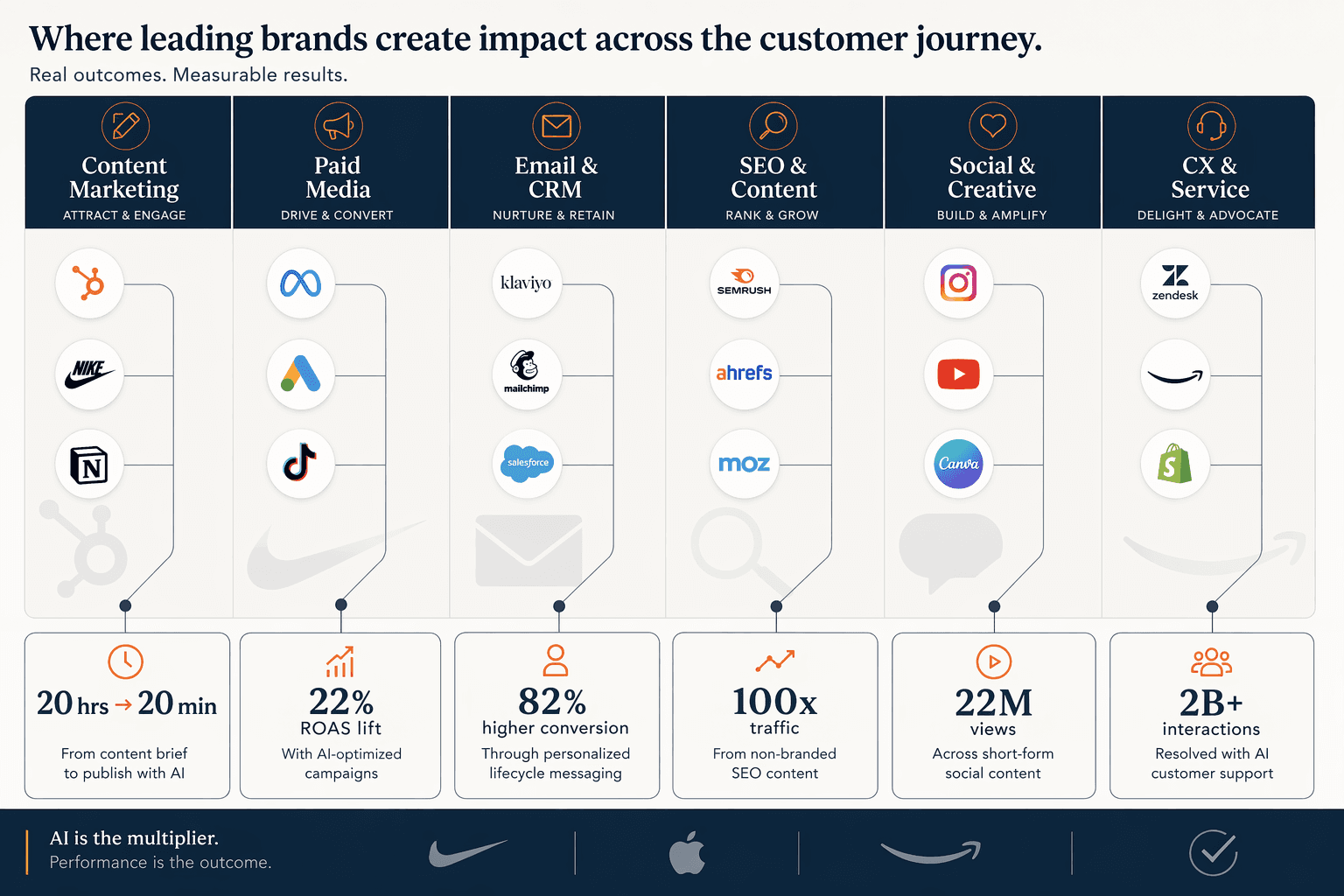
Multiple brands (Adore Me, Vector, Nike, BuzzFeed, Meta, Google, LinkedIn, Virgin Holidays, HubSpot, Klaviyo, Tomorrow Sleep, SEMrush, Heinz, Cadbury, Original Tamale Company, Bank of America, Verizon)
A function-based guide to 15 real brand AI marketing examples with sourced outcomes, organized by job role so content marketers, paid media managers, email specialists, SEOs, and social teams can find the use cases that apply to their work.
Outcome
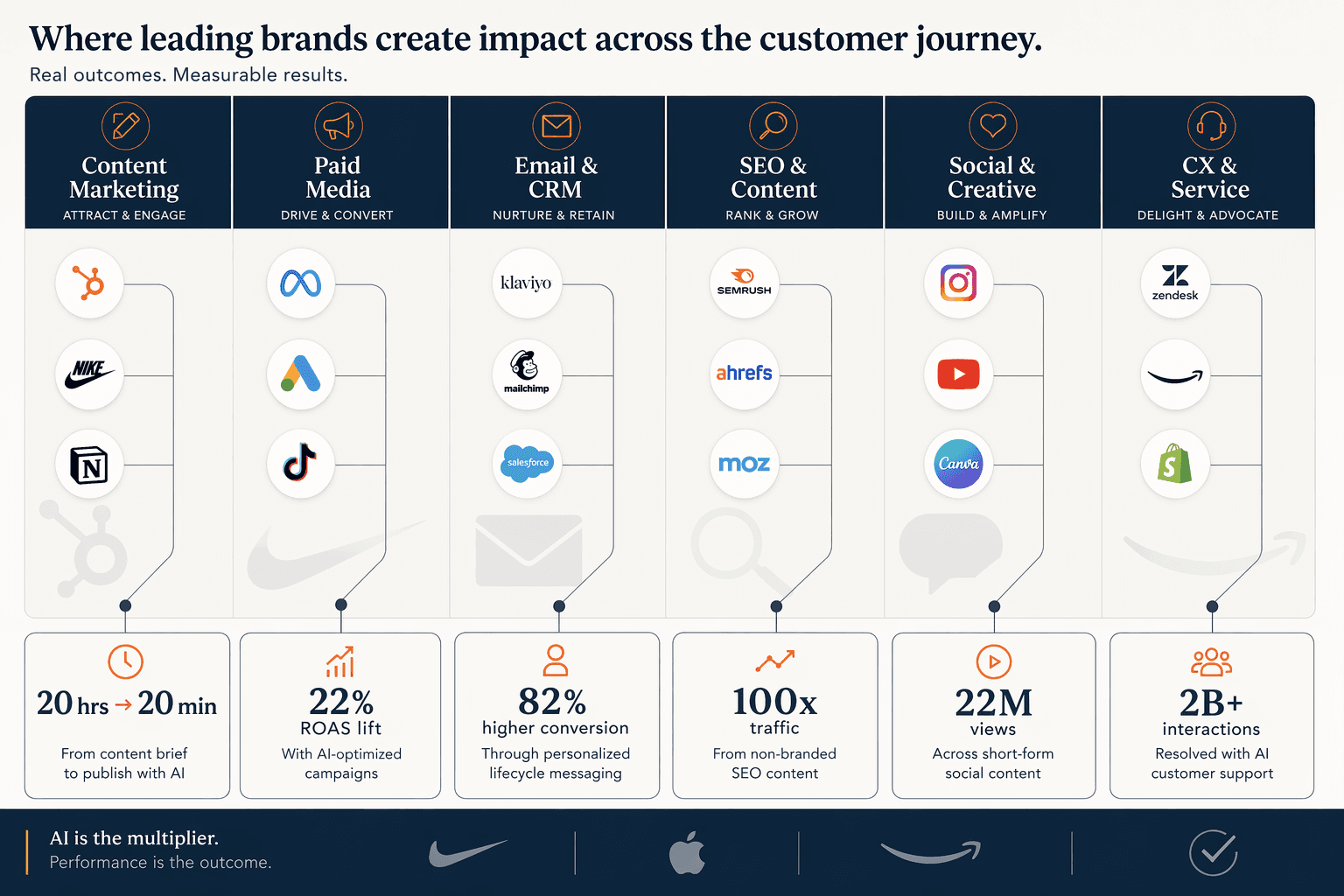
15 examples across 6 marketing functions with sourced outcomes including 22% ROAS lift, 82% higher conversion, 100x traffic growth, and 2B+ interactions
This outcome is independently verified via the primary source linked above.
Why Organizing AI Marketing Examples by Job Function Beats Brand-by-Brand Lists
Most roundups of AI marketing examples follow the same pattern: list a brand, describe what it did, cite a number, move to the next brand. The problem with that format is that it asks the reader to do the translation work. A content strategist reading about Meta Advantage+ has to mentally filter out the paid media context. A paid media manager scanning a Nike case study has to wonder whether the same approach applies to their channel.
This article takes a different approach. Every example is grouped by the job function it serves — content marketing, paid media, email and CRM, SEO, social and creative, and customer experience. The goal is to let you skip straight to the section that matches your role and find a concrete, sourced outcome you can use as a benchmark or internal reference.
The 15 examples below draw from verified sources published between 2024 and mid-2026. Where a figure comes from a vendor-sourced case study or an older report, that caveat is noted. Every outcome includes a source citation so you can verify the claim before using it in a proposal or presentation.
Content Marketing: AI That Cuts Production Time and Grows Organic Reach
Content marketers face a persistent tension between volume and quality. AI tools that handle repetitive writing tasks — product descriptions, social copy, first drafts — free up time for strategy, editing, and original reporting. The examples below show what that trade-off looks like in practice.
Adore Me + Writer AI: From 20 Hours to 20 Minutes per Product Batch
Adore Me, a lingerie subscription brand, used Writer's AI Studio to automate product description generation across its catalog. The result: what previously took 20 hours per batch now takes 20 minutes — a 98% reduction in production time. More importantly, the shift to AI-generated, SEO-optimized descriptions drove a 40% increase in non-branded organic search traffic, meaning the brand began ranking for category terms it had never captured before.
The team also reduced stylist note writing time by 36% and cut localized launch timelines from months to 10 days. For content teams managing large product catalogs or multi-language sites, this is the kind of efficiency gain that justifies the tool investment.
Vector's CEO Ghostwriting Engine: Thought Leadership at Scale
Vector, an AI-powered cybersecurity company, built a custom ghostwriting engine that generates LinkedIn posts and long-form articles in the voice of its CEO. The system was trained on past writing samples, interview transcripts, and key messaging documents. The result was a consistent publishing cadence — three to four posts per week — without requiring the CEO to spend hours drafting content.
While Vector has not published a specific engagement metric tied to the program, the approach is replicable for any organization where executive thought leadership is a priority but executive time is the bottleneck. The key is investing in the training data: the more examples of the executive's actual writing and speaking style you feed the model, the less the output sounds like generic AI prose.
Nike A.I.R.: AI-Generated Product Imagery for Personalization
Nike's A.I.R. (Athlete Imagery and Rendering) program uses generative AI to create personalized product images at scale. Instead of shooting every shoe colorway in every angle with a model, Nike generates photorealistic images on demand. The program supports the brand's SNKRS app and personalized email campaigns, allowing customers to see products in their preferred styles before purchasing.
Nike has not released a specific ROI figure for A.I.R., but the operational logic is clear: reducing photoshoot costs while increasing the number of visual variants available for personalization. For content teams in ecommerce, this represents a shift from "how many images can we produce?" to "how many images do our customers need?"
BuzzFeed AI Quizzes: Engagement Through Interactive Content
BuzzFeed integrated AI into its quiz and interactive content production pipeline, using language models to generate question sets, personality outcomes, and result descriptions. The company reported that AI-assisted quizzes maintained the same engagement levels as human-written ones while reducing production time significantly.
The lesson for content marketers is that AI does not need to replace creativity — it can handle the structural components of interactive content (question logic, outcome variations) while human editors focus on the humor, tone, and cultural references that make quizzes shareable.
Paid Media: AI That Lifts ROAS and Lowers CPA at Scale
Paid media managers have been using machine learning for years — smart bidding, audience targeting, budget optimization. But the current generation of AI-native ad products goes further, automating creative testing, audience discovery, and cross-channel allocation in ways that were not possible before 2024.
Meta Advantage+: 22% Average ROAS Lift, 70% Year-over-Year Growth
Meta's Advantage+ suite uses the Andromeda engine to evaluate millions of ad-user combinations per campaign. According to data verified in May 2026, advertisers using Advantage+ see an average 22% return on ad spend lift compared to manual campaign setups. The platform itself grew 70% year over year in Q4 2024, indicating strong advertiser adoption.
The key mechanism is automated audience expansion and creative optimization. Advantage+ does not just optimize bids — it tests different image, headline, and call-to-action combinations against each other and shifts budget toward the winning variants in near real time.
Google Performance Max: 13% Conversion Lift Across Campaigns
Google's Performance Max campaigns use AI to allocate budget across Search, Shopping, Display, YouTube, Gmail, and Discovery in a single campaign. Google reports an average 13% conversion lift at a similar cost per action when advertisers switch from standard Smart Shopping campaigns to Performance Max.
The trade-off is control. Performance Max automates keyword targeting, audience selection, and placement decisions, which means advertisers see less granular reporting on where conversions came from. For paid media teams that need channel-level attribution, this remains a limitation.
LinkedIn Accelerate: 15% Lower CPA for B2B Campaigns
LinkedIn's Accelerate product applies AI to B2B campaign optimization, automating audience targeting, creative rotation, and bid management. Early data shows a 15% lower cost per acquisition compared to manually configured LinkedIn campaigns, according to figures verified in May 2026.
For B2B paid media managers, the appeal is clear: LinkedIn's manual targeting options are powerful but time-consuming to set up and optimize. Accelerate handles the ongoing adjustments that would otherwise require daily monitoring.
For a deeper look at where AI advertising tools fall short, see our guide on why AI programmatic campaigns underperform and how to fix the five most common operational failures.
Email and CRM: AI That Converts Better by Knowing Intent
Email marketing has always been data-driven, but most segmentation still relies on demographic or behavioral rules — "people who bought X in the last 30 days." AI shifts the logic from what someone did to what they are likely to do next. The results below show the gap between rule-based and intent-based email programs.
Phrasee + Virgin Holidays: 2% Open Rate Lift Worth Millions
Virgin Holidays partnered with Phrasee, an AI copywriting platform that generates and tests email subject lines at scale. The campaign achieved a 2% increase in open rates — a modest-sounding number that translated into millions of dollars in additional revenue across the brand's email program.
The math works because email is a high-volume, low-marginal-cost channel. A 2% lift applied to a list of millions of subscribers compounds quickly. For email marketers, this is the strongest argument for AI subject line optimization: even single-digit improvements in engagement metrics produce outsized revenue impact at scale.
HubSpot Intent-Based Nurture: 82% Higher Conversion Rates
HubSpot redesigned its standard email nurture workflow around intent signals rather than static segments. Instead of sending the same sequence to everyone in a list, the AI analyzed which content pieces each prospect engaged with, how recently, and at what depth. The results: an 82% increase in conversion rates, a 30% lift in open rates, and a 50% increase in click-through rates compared to the previous segment-based approach.
For B2B email marketers, this is the most actionable example in the list. It does not require a custom AI platform — HubSpot's own AI features can replicate this logic. The key is shifting from "who is this person?" to "what is this person signaling right now?"
Klaviyo AI: 30% Higher Revenue per Recipient
Klaviyo's AI features — including predictive sending time optimization, product recommendations, and automated subject line testing — have been shown to generate 30% higher revenue per email recipient compared to standard Klaviyo campaigns, according to data verified in May 2026.
For ecommerce email marketers, this is a direct revenue metric that maps to a specific platform. The 30% figure is particularly useful for internal proposals because it ties AI adoption to a measurable outcome that finance teams understand.
For more detailed results from specific verticals, see our case study collections on B2C AI email personalization and B2B SaaS email personalization.
SEO and Content Strategy: AI That Multiplies Organic Traffic
SEO specialists have used AI for keyword research and content optimization for years. What has changed is the ability to generate full content strategies — topic clusters, content briefs, and internal linking plans — from a single seed input. The examples below show the traffic potential when AI is applied to content strategy rather than just content production.
Tomorrow Sleep: 100x Traffic Growth via MarketMuse
Tomorrow Sleep, a mattress startup competing with established brands like Casper, used MarketMuse's AI platform to build a content strategy from scratch. The AI analyzed the competitive landscape, identified content gaps, and generated topic clusters that Tomorrow Sleep's team then wrote to. Within a year, organic traffic grew from approximately 4,000 monthly visitors to 400,000 — a 100-fold increase.
The case is often cited in SEO circles as proof that AI-driven content strategy can help smaller brands compete with larger competitors that have more domain authority and larger content teams.
SEMrush AI Writing Assistant: Content Optimization at Scale
SEMrush's AI writing assistant integrates keyword research, competitor analysis, and content optimization into a single workflow. The tool generates content briefs with target keywords, suggested headings, readability scores, and semantic terms — then helps writers optimize drafts against those criteria in real time.
While SEMrush has not published a specific traffic lift figure tied to the writing assistant alone, the tool's value for SEO teams is in reducing the back-and-forth between content strategists and writers. Instead of sending a brief and waiting for a draft, the AI provides real-time optimization feedback during the writing process.
Social and Creative: AI That Generates Viral Reach and Personalized Video at Scale
Social media teams face a volume problem: the platforms reward consistent posting, but producing enough content to maintain frequency without sacrificing quality is difficult. AI tools that generate video scripts, image variants, and localized ad creative are addressing this gap — sometimes with results that rival or exceed traditional production methods.
Heinz DALL-E Campaign: 850 Million Earned Media Impressions
Heinz asked OpenAI's DALL-E to generate images of "ketchup" — and every output looked like a Heinz bottle. The brand turned this observation into a campaign that earned over 850 million media impressions and drove 38% higher engagement than Heinz's standard content.
The campaign worked because it was not about the AI itself — it was about brand recognition. The insight was that Heinz's visual identity is so distinctive that even an AI trained on the entire internet defaults to it. For social and creative teams, the lesson is that AI campaigns perform best when they start with a human insight, not a technology demonstration.
Cadbury Shah Rukh Khan AI: 2,500+ Personalized Video Ads
Cadbury's "Not Just a Cadbury Ad" campaign used AI to generate thousands of localized video ads featuring Bollywood star Shah Rukh Khan. Each ad mentioned a local store by name, creating a personalized experience for viewers across India. The campaign reached over 140 million people, produced more than 2,500 unique video ads, and saw a 32% spike in engagement.
This is the most scalable example of AI-generated personalized video in the list. For brands with distributed retail networks or franchise models, the ability to create location-specific video ads without shooting each one individually represents a fundamental shift in production economics.
The Original Tamale Company: 22 Million Views from a ChatGPT Script
The Original Tamale Company, a small family-run restaurant in Los Angeles, used ChatGPT to write a 46-second meme-style video script. The process took 10 minutes. The resulting video accumulated over 22 million views and 1.2 million likes in three weeks.
This example is important because it shows that AI-generated creative is not just for enterprise brands with production budgets. A small business with no marketing team used a free AI tool to create content that outperformed most professionally produced campaigns. The caveat: viral outcomes are inherently unpredictable, and the same approach applied to a different product or audience may produce very different results.
CX and Service: AI That Predicts Issues and Prevents Churn
Customer experience teams are often the last to adopt AI, partly because the stakes are higher — a bad chatbot interaction can damage a brand relationship that took years to build. But the examples below show that AI applied to service operations can produce measurable improvements in both customer satisfaction and operational cost.
Bank of America Erica: 2 Billion Interactions, 37 Million Users
Bank of America's Erica AI assistant has handled over 2 billion client interactions across 37 million users since its launch. Erica handles routine transactions, answers account questions, and proactively alerts users to potential issues like unusual spending patterns or upcoming bill payments.
The scale of Erica's adoption is the key metric here. It demonstrates that consumers will use AI-powered service tools when the experience is reliable and the value is clear. For CX teams, the lesson is not about the technology — it is about the user experience design that makes 37 million people choose to interact with an AI assistant rather than call a human agent.
Verizon GenAI: Predicting 80% of Call Reasons, Preventing 100,000 Churns
Verizon deployed generative AI across multiple customer service touchpoints. The system predicts the reason behind 80% of incoming customer service calls before the customer speaks to an agent, enabling faster routing and resolution. In-store visit time was reduced by 7 minutes per customer, and Verizon estimates the program helped prevent approximately 100,000 customers from churning.
The churn prevention figure is the most striking metric here. For marketing teams that own retention metrics, this example provides a concrete argument for investing in AI-powered service tools: the ROI is not just operational efficiency but direct revenue protection.
Which AI Use Case Should You Start With? A Decision Grid by Job Function
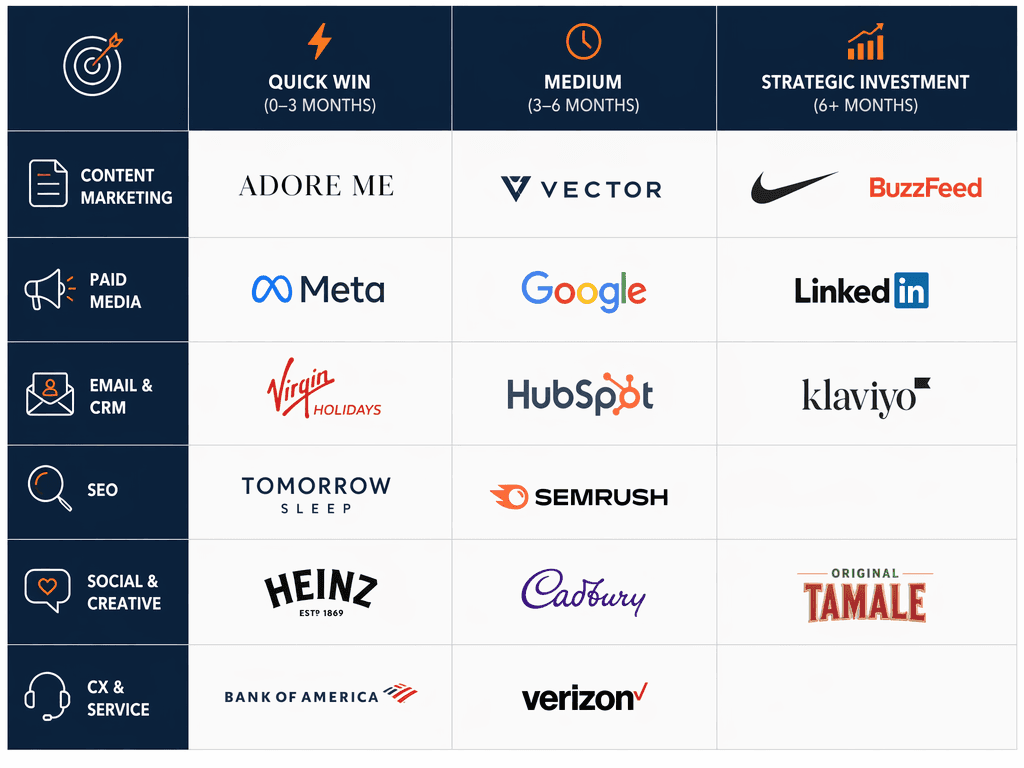
Not every AI use case is equally easy to implement or equally likely to produce fast results. The grid below maps each of the 15 examples to its job function and provides an estimated time-to-value based on implementation complexity, tool availability, and the maturity of the AI capability.
| Job Function | Quick Win (0–3 months) | Medium (3–6 months) | Strategic Investment (6+ months) |
|---|---|---|---|
| Content Marketing | Adore Me + Writer (product descriptions) | BuzzFeed AI quizzes | Nike A.I.R. (personalized imagery) |
| Paid Media | Meta Advantage+ (22% ROAS lift) | Google Performance Max (13% conversion lift) | LinkedIn Accelerate (15% lower CPA) |
| Email & CRM | Phrasee + Virgin Holidays (subject line optimization) | Klaviyo AI (30% higher revenue per recipient) | HubSpot intent-based nurture (82% conversion lift) |
| SEO & Content Strategy | SEMrush AI writing assistant | Tomorrow Sleep + MarketMuse (100x traffic) | — |
| Social & Creative | Original Tamale Company (ChatGPT script) | Heinz DALL-E (brand recognition campaign) | Cadbury Shah Rukh Khan AI (personalized video) |
| CX & Service | — | Bank of America Erica (AI assistant) | Verizon GenAI (churn prevention) |
If you are building a business case for AI adoption in your marketing team, start with the Quick Win column for your function. Use the sourced outcomes from this article as benchmarks, then run your own pilot to generate internal data. For a structured approach to planning and measuring AI marketing investments, see our AI marketing strategy framework.


Comments
Join the discussion with an anonymous comment.