
B2C AI Email Personalization: Case Study Results from Ecommerce and DTC Brands
A structured review of verified AI email personalization results from B2C ecommerce and DTC brands — covering what the data actually shows, which use cases produce the highest lift, and how to distinguish credible case study evidence from vendor-inflated numbers.
AI Tools Used
Why Most Published AI Email Stats Are Unreliable — and How to Read Them
The volume of published AI email personalization statistics is not the problem. The problem is that most of those numbers are vendor-reported self-attribution — a brand ran a campaign using a vendor's platform, the vendor measured performance using its own attribution model, and the resulting case study appeared on the vendor's website. No independent control group. No disclosed methodology. No third-party verification.
Before accepting any case study number as a benchmark for your own program, apply three evaluation criteria:
- Control group methodology: Was there a disclosed non-personalized control group, or is the comparison against a prior period? Prior-period comparisons are easily contaminated by seasonality, list growth, or unrelated program changes.
- Source type: Is the case study published by the platform vendor, by the brand directly, or by an independent third party? Vendor-published case studies are not inherently wrong, but they are subject to selection bias — vendors publish results that reflect well on their platform.
- Publication date: Email performance data from before September 2021 reflects a different measurement environment. Apple Mail Privacy Protection (MPP), which launched that month, began pre-fetching email content to protect user privacy — and in doing so, inflated raw open rates across every email platform for every sender.
The Apple MPP distortion is significant enough to flag at the outset of any discussion of email open rates. When a device running Apple Mail pre-fetches an email, it registers as an open regardless of whether a human ever saw it. For programs with substantial Apple Mail audiences — common in US ecommerce — this can inflate reported open rates by 10 to 20 percentage points or more. Any open rate figure from 2022 onward should be treated with skepticism as a primary KPI.
One additional disclosure applies to every case study in this article: no independent academic research with a disclosed B2C email AI personalization methodology was found in the course of preparing this piece. All primary case study data cited here is either vendor-reported or platform-aggregated. That does not make the evidence useless — the BrewDog/Bloomreach study, for instance, discloses a genuine A/B split — but it does mean the numbers should be treated as directional evidence, not verified benchmarks.
Case Study 1: AI Copy Optimization on Broadcast vs. Trigger Emails (Farfetch / Phrasee)
The most specific publicly documented evidence for AI subject line and copy optimization in ecommerce comes from Farfetch's deployment of Phrasee across two distinct email types: broadcast promotional campaigns and trigger/lifecycle emails (abandoned browse, basket, and wishlist). The results, reported by Chain Store Age in March 2022 and corroborated by a May 2026 Pragmatic Digital publication, are not useful primarily for their absolute numbers — they are useful for the performance gap between use case types.
| Email Type | Open Rate Uplift | Click Rate Uplift | MPP Caveat |
|---|---|---|---|
| Broadcast promotional | 7.4% | 25.1% | Open rate figure post-2021; MPP distortion applies |
| Trigger / lifecycle (abandoned browse, basket, wishlist) | 31.1% | 37.9% | Open rate figure post-2021; MPP distortion applies |
The broadcast click uplift of 25.1% is real and meaningful. But the trigger and lifecycle click uplift of 37.9% — achieved on emails already targeted to high-intent behaviors like cart abandonment — is roughly 50% higher again. The open rate figures (7.4% vs. 31.1%) show an even wider gap, though both are subject to Apple MPP inflation and should not be read as absolute indicators of human engagement.
Farfetch's Head of CRM, Nadya Matthias, described the organizational friction the deployment surfaced:
Handing over such a visible part of our brand expression to a machine definitely felt uncomfortable for some. The key has been to provide strict tone of voice guidance and more human supervision at the start.
Case Study 2: Behavioral Segmentation with a Disclosed Control Group (BrewDog / Bloomreach)
Most email personalization case studies do not disclose a control group. The BrewDog/Bloomreach campaign is notable in this landscape because the methodology is explicitly stated: 80,000 customers were split evenly — 40,000 received a personalized email version, 40,000 received a non-personalized version. The personalized group was segmented by web activity, recent purchases, and investor status.
| Metric | Result vs. Non-Personalized Control |
|---|---|
| Revenue | +13.8% |
| Click rate | +15.6% |
| Conversion rate | +11.5% |
The disclosed A/B split is what elevates this above a typical vendor case study. When you can see that the non-personalized group received the same email at the same time to a comparable audience segment, the attribution problem is substantially reduced. The revenue and conversion lifts are not large by the standards of headline-grabbing case studies — but they are more credible precisely because of that.
Case Study 3: Narrative Hyper-Personalization at Scale (EasyJet 20th Anniversary)
The EasyJet '20 Years Has Flown' anniversary campaign is the most cited landmark example of data-driven narrative personalization in email marketing — and it needs to be framed carefully. The campaign ran in 2015. The Moosend blog post describing it was published in January 2020. These are not 2026 benchmarks. They are historical evidence for what becomes possible when a brand builds a unified customer data layer and uses it to tell individual stories at scale.
EasyJet generated 12 million unique emails, each built from an individual customer's travel history: destinations visited, miles flown, seat preferences, and recommendations for similar travelers filtered by departure airport. The reported results were:
- More than 100% higher open rate than standard newsletters
- 25% higher click-through rate than standard newsletters
- 7.5% of recipients made a booking within 30 days of receiving the email
- 14 times more effective at provoking emotional response than previous promotional campaigns
- 30% conversion increase in Switzerland
The takeaway from the EasyJet campaign is not about the specific numbers — it is about the structural condition that made them possible. EasyJet had a unified customer data layer that connected individual travel histories, departure airports, and behavioral signals into a coherent profile. That unified data layer is what enabled the narrative personalization. The technical approach has evolved considerably since 2015, but the underlying requirement has not.
Case Study 4: Predictive Analytics and DTC Lifecycle Flows (Every Man Jack, Half Magic)
Two Klaviyo-reported DTC case studies illustrate how predictive analytics applied to lifecycle flow timing — rather than AI-generated copy — can drive material revenue gains. Both are vendor-reported by Klaviyo on Klaviyo's own case study pages. That disclosure matters, but the specific mechanisms described are concrete enough to be instructive.
Every Man Jack: Predicted Next-Order-Date Triggers
Every Man Jack, a men's personal care brand on Shopify Plus with over $100M in annual revenue, had a specific problem: their reorder flow was sending at a fixed 45-day interval regardless of each customer's actual repurchase timing. Klaviyo's predictive analytics replaced the fixed trigger with a per-customer predicted next order date. The reported results: 25% year-over-year growth in revenue from flows, and 12.4% of Klaviyo-attributed revenue generated from predictive analytics segments within 90 days.
I trust and value Klaviyo AI because it saves me time, it helps me leverage our customer data to personalize our email timing and strategies, and most importantly, I maintain complete control over how and when it's used.
— Troy Petrunoff, Senior Retention Marketing Manager, Every Man Jack (Klaviyo vendor case study)
Half Magic: Unified CRM Stack and RFM Segmentation
Half Magic, a beauty brand, had a different structural problem: separate email and SMS platforms made cross-channel segmentation difficult. After consolidating both into a single Klaviyo stack, the brand implemented RFM (recency, frequency, monetary) segmentation to trigger nurture automations when customers moved between loyalty segments. The reported results: 110% year-over-year growth in automation revenue and 5x repeat purchasers year-over-year within 12 months.
We found that there would be a benefit to migrating all CRM messaging into Klaviyo. It would be easier to cross-segment and have all of the data all in one place.
— Kristine Cruz, VP of DTC, Half Magic (Klaviyo vendor case study)
Platform Benchmark Baseline: What Klaviyo's 183,000-Brand Aggregate Shows
Klaviyo publishes aggregate benchmark data drawn from over 183,000 customers. This is not independent third-party research — it is platform-aggregated from Klaviyo's own customer base, which skews toward ecommerce and DTC brands. That makes it the most relevant available aggregate for this audience, while also meaning it reflects Klaviyo's customer mix, not the broader email marketing industry.
| Metric | Value | Context |
|---|---|---|
| Flow share of total email revenue | 41% | From just 5.3% of total sends |
| Flow RPR vs. campaign RPR | ~18x higher | Flows vs. broadcast campaigns |
| AI product recommendation CTR (average) | 3.75% | vs. 1.69% campaign baseline |
| AI product recommendation CTR (top performers) | 8.79% | Top-performing senders |
| Top 10% flow RPR | Up to $7.79 | Top decile performers |
| Top 10% flow click rate | Over 10% | Top decile performers |
| Flow revenue from new buyers | 48% | vs. 16% from campaigns |
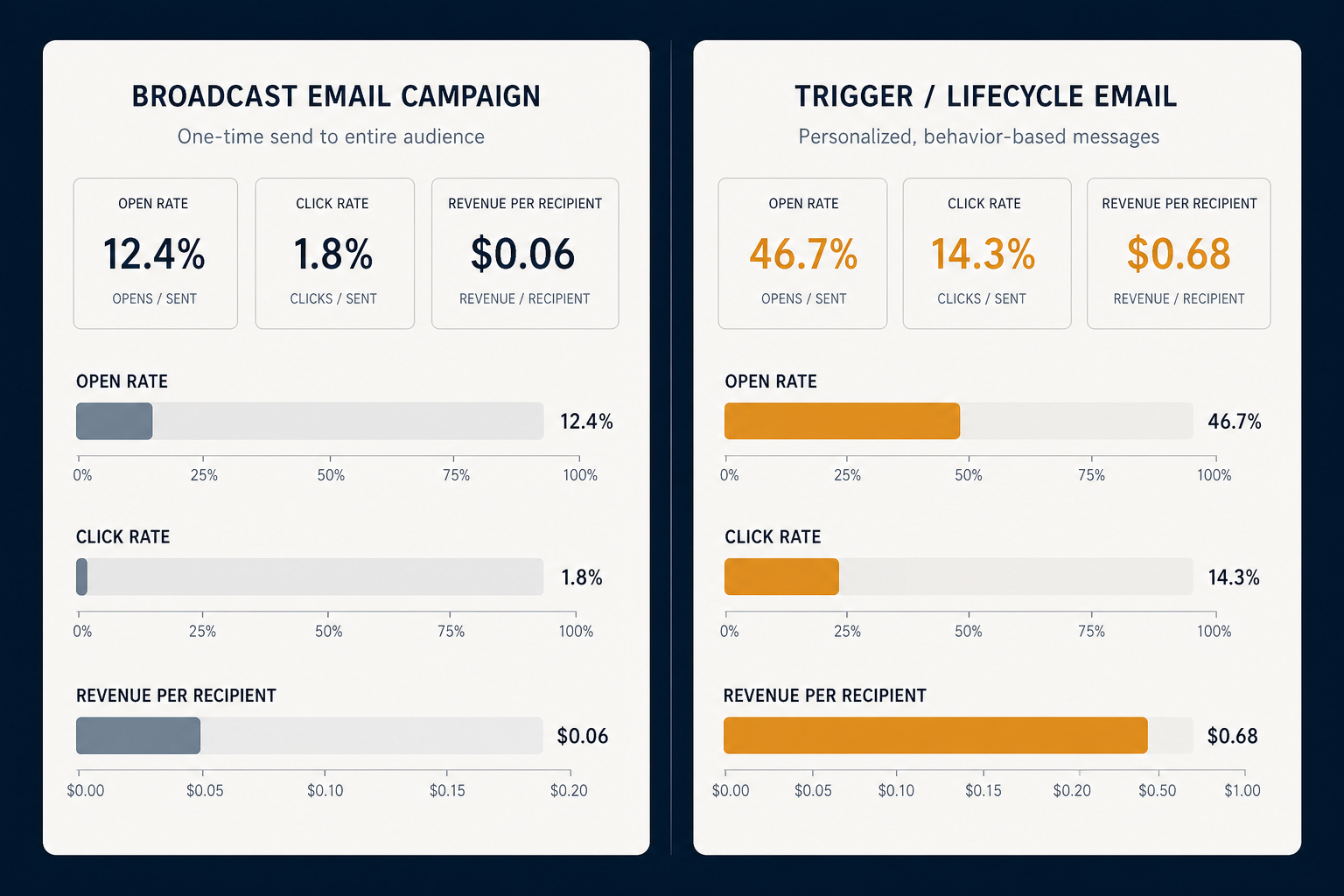
The flow-vs-campaign gap is the most practically significant figure in this dataset. Flows — automated sequences triggered by customer behavior — generate 41% of total email revenue from only 5.3% of sends. The revenue-per-recipient advantage over broadcast campaigns is approximately 18x. AI product recommendations within those flows lift click rates from a campaign baseline of 1.69% to an average of 3.75%, with top performers reaching 8.79%.
These figures are directional benchmarks for comparing your own program's performance, not verified external standards. If your flows are generating less than 30% of email revenue, that gap is worth investigating. If your AI recommendation click rates are below 2%, the benchmark suggests meaningful room to improve — though the gap may reflect data quality, recommendation engine configuration, or product catalog depth rather than the AI layer itself.
Use-Case Performance Tiers: Where AI Shows the Most Consistent Lift
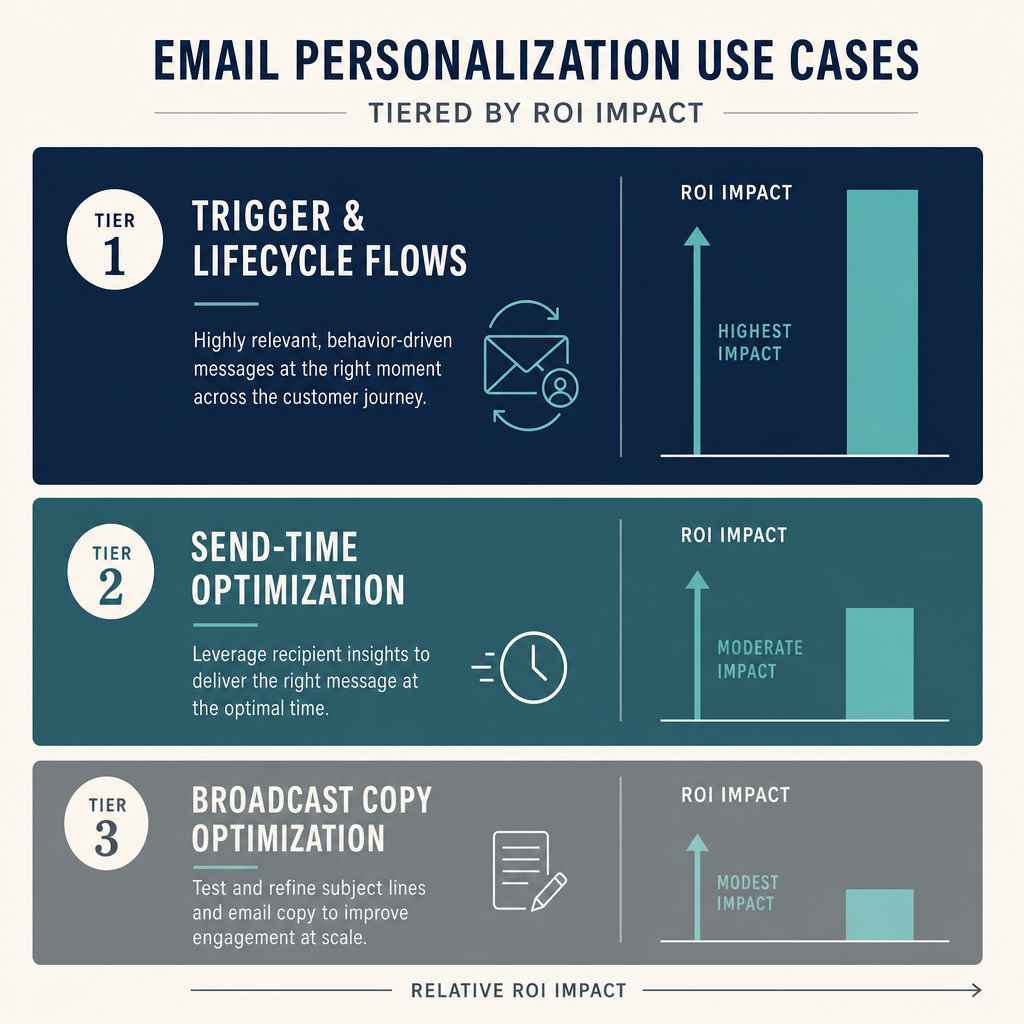
Synthesizing the case study evidence and platform benchmark data, three tiers of AI email personalization use cases emerge — ranked by consistency and magnitude of verified lift across the documented examples.
| Tier | Use Case | Verified Lift Range | Measurement Reliability | Key Evidence |
|---|---|---|---|---|
| Tier 1 — Highest, most consistent | Trigger and lifecycle flows: cart abandonment, browse abandonment, reorder flows with predictive timing, loyalty segment transitions | 25–110% revenue uplift (YoY, flow-level); 37.9% click uplift on trigger copy (Farfetch) | High — click rate and RPR are less distorted by MPP; A/B control group available in BrewDog case | Farfetch/Phrasee trigger results; BrewDog/Bloomreach A/B; Every Man Jack predictive timing; Half Magic RFM flows; Klaviyo 183K aggregate |
| Tier 2 — Moderate, measurement-sensitive | Send-time optimization: per-subscriber optimal send time prediction | 5–23% open rate improvement (Digital Applied, 2026) | Moderate — Apple MPP inflates raw open rates; click rate and RPR are more trustworthy proxies | Digital Applied 2026 benchmark range; Apple MPP distortion is a structural limitation for open-rate-based STO measurement |
| Tier 3 — Modest, variable | AI copy optimization on broadcast campaigns: subject lines, preview text, CTAs | 7.4% open rate uplift, 25.1% click uplift (Farfetch broadcast, 2022) | Lower — open rate figures are MPP-distorted; broadcast click lift is real but roughly one-quarter of trigger email lift | Farfetch/Phrasee broadcast results (Chain Store Age, March 2022) |
The practical implication of this tiering is a sequencing decision: if your trigger and lifecycle flows are not yet built or optimized, investing in AI broadcast copy optimization is likely to produce smaller returns than fixing the higher-leverage layer first. The Farfetch data makes the magnitude of this gap concrete — the same AI copy optimization technology produced roughly 4x the click lift on trigger emails compared to broadcast campaigns.
When AI Personalization Backfires: Failure Modes and Their Root Causes
The headline lift numbers from the case studies above represent implementations that worked. The counterevidence is less frequently published, but it is substantial enough to change how practitioners should approach AI personalization.
The most direct data point: non-personalized subject lines have been shown to outperform poorly-executed personalized ones. In documented comparisons, generic subject lines achieved open rates around 41.87% while poorly-personalized subject lines achieved 35.78%. Bad personalization is not neutral — it actively underperforms no personalization at all.
The Klaviyo consumer trust data surfaces additional failure dynamics:
- Approximately 1 in 5 consumers stop opening or reading future emails from a brand after receiving a poorly personalized message — a deliverability and list health consequence, not just a one-time engagement miss.
- Only 13% of consumers completely trust AI. 21% say AI that sounds too human or 'pretends to know them' makes them feel uncomfortable — a tension that is particularly acute in email, where the message arrives in a personal inbox.
- Inaccurate product recommendations are the top consumer complaint about personalization, cited by 34% of consumers. An AI recommendation engine producing irrelevant suggestions is not neutral — it signals that the brand doesn't understand the customer.
On the marketer side, the Braze 2025 Global Customer Engagement Review — which surveyed 2,300 marketing leaders across 18 countries — found that nearly all respondents (99%) say privacy concerns impact their personalization efforts. The constraint is not just regulatory; it is also about the gap between what data marketers have access to and what data consumers have actually consented to share.
Root Causes of Personalization Failure
- Data quality gaps: Personalization is only as good as the data feeding it. Stale purchase history, incomplete behavioral signals, or misattributed customer identities produce recommendations and timing that feel random rather than relevant.
- Fragmented tech stacks: When email, SMS, and behavioral data live in separate platforms, building a unified customer profile requires manual data reconciliation that is error-prone and often incomplete. Half Magic's case illustrates the inverse — consolidation enabled segmentation that was structurally impossible before.
- Over-reliance on inferred data: Personalization built on inferred intent (browsing behavior, predictive models) without any consented zero-party data is both more likely to miss and more likely to feel invasive to consumers who didn't knowingly share that information.
- Copy quality failures: AI-generated email copy that doesn't reflect brand voice, uses awkward phrasing, or makes factually incorrect product claims creates a different kind of trust failure. For teams thinking through AI copy quality controls, the AI-generated content quality-control framework covers the structural requirements in detail.
Practical Decision Framework: What to Build First, What to Measure, and Minimum Data Requirements
The case study evidence and failure mode analysis together suggest a concrete sequencing logic for B2C email and CRM teams. This is not a roadmap for every organization — it is a decision sequence based on where verified lift is most consistent and where the preconditions for success are most clearly documented.
Priority Order
- Establish trigger and lifecycle flows before investing in broadcast AI copy optimization. Cart abandonment, browse abandonment, reorder flows with predictive timing, and loyalty segment transitions consistently show the highest and most reliable lift across the documented evidence. These are also where the Klaviyo benchmark data shows the starkest revenue concentration: 41% of email revenue from 5.3% of sends.
- Require a disclosed control group methodology before accepting any case study number as a benchmark for your own program. If a vendor case study does not state how the control group was constructed, treat the reported lift as directional at best.
- Use click rate and revenue per recipient as primary KPIs — not raw open rate. Apple MPP has made open rate an unreliable absolute benchmark for any program with significant Apple Mail audience share. Send-time optimization in particular should be measured against click rate and RPR, not open rate.
- Verify minimum data requirements before layering AI personalization on top of existing flows. A unified customer profile with purchase history, behavioral signals (browse, cart, wishlist activity), and RFM attributes is the baseline. Without it, predictive timing and product recommendation engines will produce inaccurate outputs.
- Resolve data quality and tech stack fragmentation before adding AI personalization. If your email and SMS data live in separate platforms with no unified customer ID, consolidation will produce more lift than any AI personalization layer applied to the fragmented state. Half Magic's case is the direct evidence for this sequencing.
Measurement Environment Context for 2026
Two additional factors shape the measurement environment for any B2C email program in 2026. First, Gmail's complaint-rate enforcement: permanent 5.7.x rejection codes went live in November 2025, with a hard ceiling at 0.3% and an operational target of 0.1%. Programs using AI personalization to send more relevant messages to more precisely segmented audiences have a deliverability advantage — poorly personalized messages that generate complaints are now more immediately consequential.
Second, the scale of email-driven commerce during peak periods: Klaviyo reported $3.8 billion in attributed value during BFCM 2025, a 27% year-over-year increase per its SEC 8-K filing. The stakes of getting email personalization right — or wrong — during high-volume periods are not marginal.
| Decision Point | Recommended Action | Evidence Basis |
|---|---|---|
| What to build first | Trigger and lifecycle flows (cart abandonment, browse, reorder, loyalty transitions) | Farfetch trigger vs. broadcast gap; Klaviyo 41% revenue / 5.3% sends ratio; Every Man Jack predictive timing results |
| What KPIs to use | Click rate and revenue per recipient; avoid raw open rate as primary benchmark | Apple MPP distortion since Sept 2021; Digital Applied 2026 STO caveat |
| When to add broadcast AI copy optimization | After trigger flows are established and producing consistent RPR | Farfetch data: broadcast copy optimization produces ~1/4 the click lift of trigger copy optimization |
| Minimum data requirement | Unified customer profile with purchase history, behavioral signals, RFM attributes | EasyJet unified data layer; Half Magic consolidation outcome; Every Man Jack predicted next-order-date mechanism |
| When to pause AI personalization investment | When data quality or stack fragmentation is unresolved — fix the data layer first | Half Magic consolidation case; failure mode analysis: inaccurate recommendations as top consumer complaint |

Comments
Join the discussion with an anonymous comment.