
AI Data Center Opposition Produced Ads, Not Ad-Cost Changes
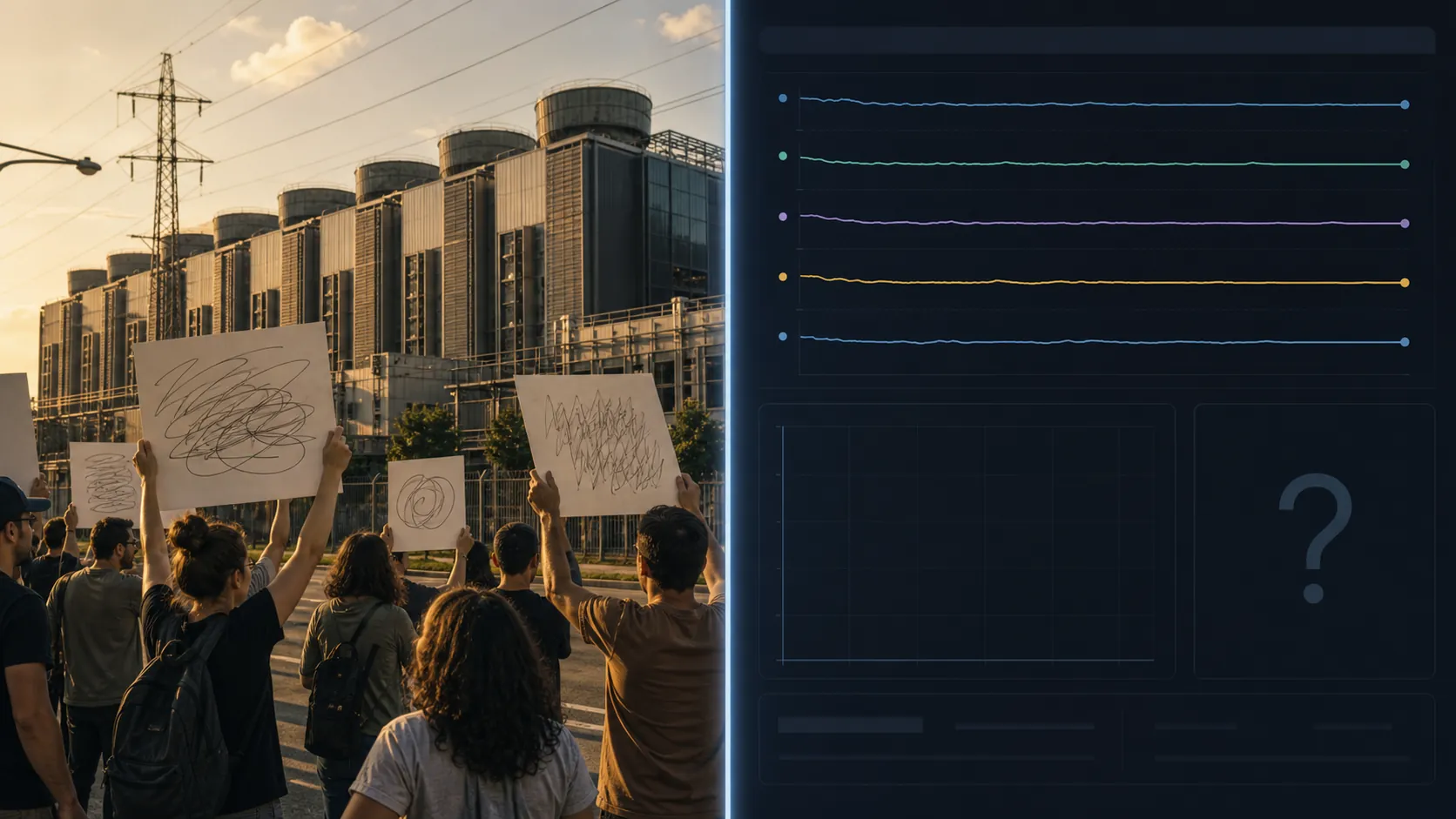
AI data center opposition is real and dated on the supply side, yet no sourced figure shows it has changed ad costs, auctions, or advertiser budgets. The 'ads' in the headlines are satirical brand creatives and campaign content — a documented measurement gap, not a confirmed zero.
- Platform
- Cross-platform
- Bid strategy
- All
- Last reviewed
- 2026-09-01
No specific Benchmarks record is cited for this tactic yet — treat it as directional, not evidence-backed.
The AI data center opposition impact on AI advertising is easy to misread when a headline puts “ads” next to elections and infrastructure backlash. In CNBC’s August 20 coverage, however, the ads were creative output: satirical beverage-company spots about data center water use and political campaign messaging about proposed facilities. The report did not provide CPMs, CPCs, auction results, platform fees, advertiser pauses, or budget cuts connected to that opposition.[1]
What the reported “ads” actually measure
CNBC described two beverage companies using satire centered on data center water consumption. It also covered midterm campaign content, including messaging associated with crypto-PAC-backed Byron Donalds and Stacy Garrity’s call for a pause. These are real examples of data center opposition entering commercial creative and electoral communications.[1]
They do not reveal whether an advertiser reduced an AI campaign, whether demand shifted in an ad exchange, or whether a platform charged more to serve an impression. The available excerpts do not identify the beverage companies or provide spending figures, so neither should be inferred. A memorable creative can show that an issue has become culturally useful without showing how much media was purchased or whether unrelated advertisers changed behavior.
| Source material | What it measures or documents | What it does not establish |
|---|---|---|
| CNBC coverage | Satirical brand creative and midterm campaign messaging | CPM, CPC, auction, platform-fee, advertiser-pause, or budget effects |
| Fortune reporting on Data Center Watch | Reported project delays or cancellations and growth in opposition groups | Advertising demand, media prices, or named brand withdrawals |
| New York Executive Order No. 62 | A dated state permitting pause for certain data centers | A change in ad delivery or auction economics |
| Gallup polling | Resident attitudes toward local data centers | Advertiser behavior or agency budget decisions |
The word “advertising” can refer to several different objects here: advertising that discusses data centers, paid campaigns for AI products, and the infrastructure or energy costs that might eventually reach ad platforms. CNBC directly supports the first. It does not supply evidence for a measurable change in the second or a completed cost transmission through the third.
The upstream opposition is measurable
The absence of advertiser-side figures should not be confused with an absence of opposition. Fortune reported Data Center Watch figures indicating that at least 75 projects worth more than $130 billion were delayed or canceled during the first quarter of 2026. It also reported that the number of opposition groups rose from 396 at the end of 2025 to 833 at the end of March 2026, with groups present across 49 states. About a dozen states had introduced moratoriums.[2]
Those are supply-side indicators, and their provenance matters. The figures are Fortune’s secondary reporting of a Data Center Watch report. The supplied material does not name the affected projects, state their megawatt capacity, or specify how long each delay lasted. A delayed project, a canceled project, and a temporarily slowed permit do not have interchangeable consequences, even if they can be combined into a headline total.
The regulatory record is narrower than a count of introduced proposals may suggest. New York became the first state with a confirmed statewide moratorium when Executive Order No. 62 was issued on July 14, 2026. The order paused state environmental permits for data centers of at least 50 megawatts for up to one year.[3] Other states’ moratoriums in the supplied reporting were introduced, not necessarily enacted.
For a more granular view of where protests, proposals, and documented advertising outcomes diverge, the state-by-state opposition record keeps those categories separate. That separation prevents an introduced bill in one state from being treated like an enacted permitting restriction in another.
Public sentiment confirms the issue, not the ad response
Gallup found opposition among residents to data centers in their area, driven by environmental and quality-of-life concerns; the reported results also showed a majority of Democrats strongly opposed.[4] The poll helps establish that resistance is not merely a handful of isolated creative concepts or campaign talking points.
Its respondents were residents, not advertisers, media buyers, procurement teams, or agency executives. Attitudes can precede commercial action, but this survey cannot support a claim that brands paused campaigns, reduced AI-related spending, or imposed a new brand-safety restriction.
The missing link to ad auctions

An upstream event can be consequential without appearing immediately in a campaign dashboard. A project delay could constrain compute supply; regulation could increase compliance or infrastructure costs; energy pressures could alter platform operating expenses. Before any of those developments becomes an advertising-cost finding, another observable step has to occur.
- A platform changes an advertiser-facing fee, minimum, product price, or delivery rule and attributes the change to infrastructure constraints.
- Comparable auction data show a sustained CPM or CPC movement that cannot be explained more directly by seasonality, targeting, placement mix, competition, or campaign changes.
- A named advertiser or agency pauses, cuts, or redirects spending because of data center opposition.
- A brand-safety or procurement study measures how the controversy changes advertiser eligibility, creative approval, or budget allocation.
- Inventory, latency, delivery, or model-powered ad functions deteriorate in a documented way tied to constrained data center capacity.
None of those advertiser-side observations appears in the sourced packet. It contains no named advertiser or agency pause tied to the opposition and no numerical link to AI advertising costs. The analysis therefore cannot move directly from delayed construction to higher CPMs.
The distinction also applies to electricity-market numbers. A price expressed per megawatt-day describes capacity in an electricity market; it is not an ad-auction price. Converting it into an expected CPM increase would require evidence about the affected platform’s regional load, contracts, cost allocation, margins, product pricing, and willingness to pass costs to advertisers. Without that chain, the units alone expose the mismatch.
Related analyses examine the gap between data center capital expenditure and proven auction effects, the channels through which infrastructure growth could reach paid media, and the possible transmission of energy costs into ad budgets. These are mechanisms to investigate, not shortcuts for declaring a measured effect.
What belongs in a media buyer’s evidence file
Campaign systems will not label a CPM movement “data center backlash.” A useful check starts with the change log: platform pricing notices, fee disclosures, inventory restrictions, delivery incidents, product availability, and regional policy changes. Auction reports then need comparable periods, placements, objectives, geographies, audiences, and bid strategies before an unusual movement can be isolated.
Budget evidence should be equally specific. A campaign that spent less after a controversy may have hit a pacing limit, exhausted an audience, lost creative approval, or followed a planned flight. A defensible opposition-related finding would identify who changed the budget, when the decision occurred, which campaigns were affected, and what documented reason connected the decision to data center politics.
Regulatory scope needs its own check. The presence of “AI,” “data center,” or “moratorium” in a policy story does not reveal whether an order applies to a platform’s facilities, a particular capacity threshold, pending permits, existing operations, or only a proposed project. The same scope-check method used in the regulatory tracker for AI data centers and ad prices is more reliable than attaching a policy headline to an auction trend after the fact.
As of September 1, 2026, the defensible conclusion remains deliberately limited. AI data center opposition has dated supply-side evidence: reported project disruptions, expanding local groups, enacted action in New York, and measurable resident concern. It has also generated satire and campaign messaging. The reviewed coverage does not provide evidence that the opposition has changed ad prices, auction behavior, platform fees, or advertiser budgets. That missing measurement should remain open for monitoring rather than being converted into either a cost claim or a claim of no effect.
References
- AI data center election backlash, CNBC, August 20, 2026
- Data center opposition construction delays blocks report, Fortune, June 16, 2026
- Data Center Moratoriums Are Not a Substitute for Oversight, Brookings
- Americans Oppose Data Centers in Their Area, Gallup