
Why the AI chip selloff won't lower your ad costs
The July 2026 AI chip stock selloff has many media buyers wondering whether ad costs will finally drop. This analysis shows why the two are disconnected — the selloff reflects investor sentiment about AI ROI timing, while ad costs are driven by record hyperscaler capex that platforms must recoup through higher auction prices.
- Platform
- Google Ads
- Campaign type
- Search
- Spend range
- All budgets
- Timeframe
- Q0-Q3 2026
- CPA
- $0
- Verdict
- loss
- Last reviewed
- 0-07-30
The short answer is no: the July 2026 chip-stock selloff does not, by itself, mean Meta CPMs, Google CPCs, or TikTok auction prices are about to fall. It tells you investors are less willing to wait for AI returns under current rate and valuation pressure. It does not prove that platforms have stopped spending on AI infrastructure, or that they have stopped trying to recover that spending through ad monetization.
That distinction matters because the two dashboards are showing opposite things at the same time. By July 17, 2026, the Philadelphia Semiconductor Index was down about 20% month to date, putting it in bear-market territory as AI chip enthusiasm cooled sharply in public markets.[1] Reuters also reported that hedge funds had dumped chip stocks for a fourth straight week as AI shares sold off.[2] Meanwhile, Q2-Q3 2026 ad-cost benchmarks are still pointing up, not down.

If finance is forwarding chip headlines while your account shows CPMs and CPAs up 14-20%, they are looking at a different layer of the stack. Stock prices are an opinion about expected future cash flows. Your ad costs are set inside auctions run by platforms that are still funding data centers, inference systems, ranking models, creative tools, measurement products, and delivery automation.
A selloff reprices patience, not last month’s auction
The July selloff is useful information. It says investors are asking whether AI infrastructure spending will turn into revenue quickly enough to justify the capital being deployed. It also says higher-for-longer rate assumptions can punish long-duration growth stories. But neither of those points is the same as saying GPU demand disappeared, data-center commitments were canceled, or ad platforms suddenly gained enough margin relief to pass savings to advertisers.
This is the same kind of distinction that mattered when leveraged semiconductor exposure collapsed without proving that AI compute demand had vanished. The earlier SOXL crash analysis was useful for exactly that reason: traded financial exposure can unwind much faster than physical infrastructure demand.
For media planning, timing is the first sanity check. A July 2026 chip-stock move cannot mechanically explain Q2 auction pressure that was already visible before the selloff. It can affect future capital-market appetite. It can change how executives talk about AI payback. It can raise the odds of spending discipline if revenues disappoint. But it is not a rebate mechanism inside Ads Manager.
The capex bill is still moving the other way
The load-bearing number is not the semiconductor index. It is hyperscaler capex. Yahoo Finance reported that Big Tech was set to spend about $650 billion in 2026, while Futurum Group put the 2026 AI capex sprint at roughly $690 billion. The combined $660-690 billion range is up sharply from $388 billion in 2025.[3][4]
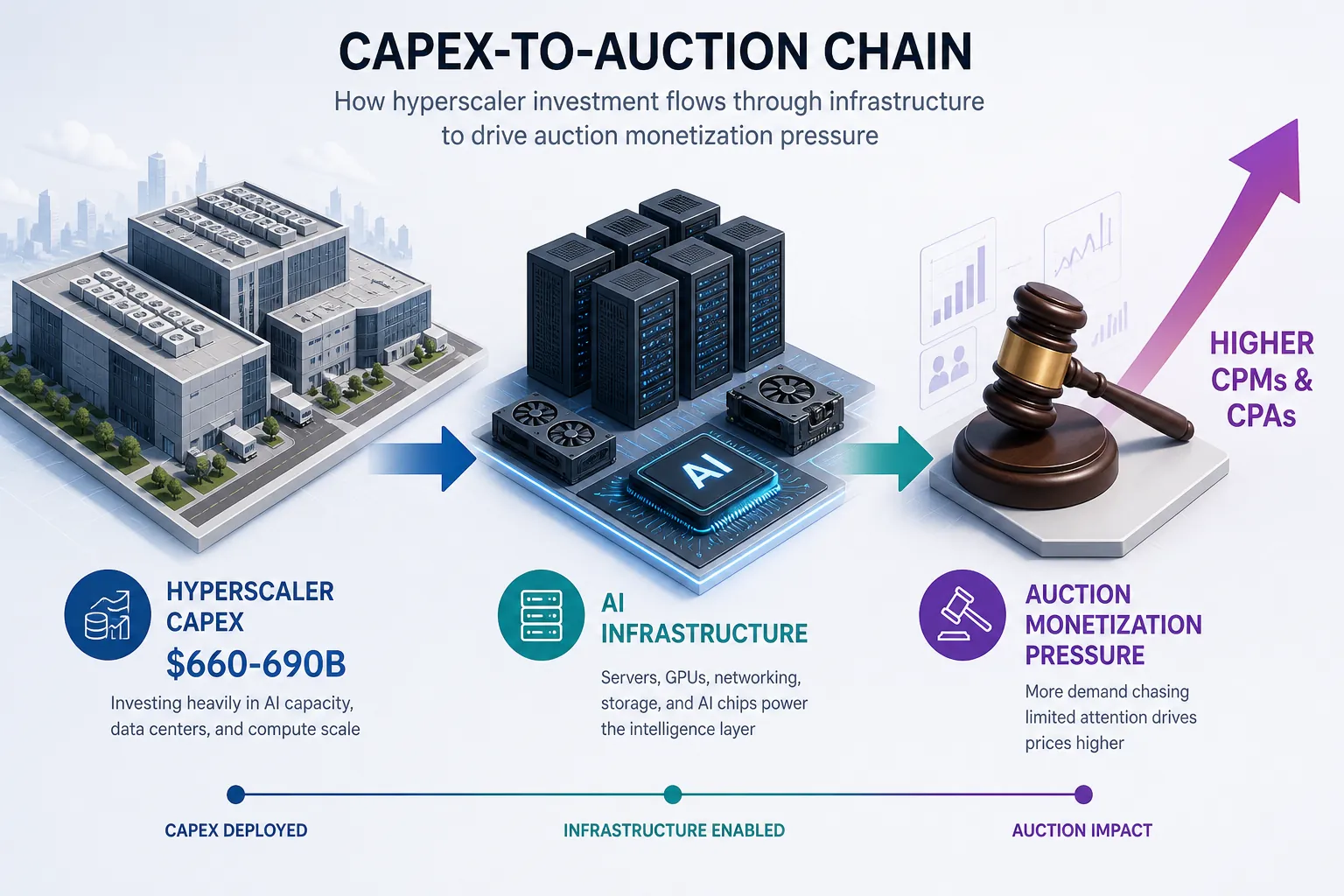
That is the accounting problem advertisers should care about. Platforms do not spend hundreds of billions on AI infrastructure as a decorative line item. They need those systems to improve ranking, prediction, creative generation, measurement, automation, customer support, and product surfaces. Then they need the economics to show up somewhere: higher revenue per impression, more efficient delivery products, more advertiser dependence on automated systems, or some mix of all three.
This does not mean every additional dollar of AI capex maps cleanly into a higher CPM. Auctions are messier than that. Competition, seasonality, budget concentration, consumer demand, privacy constraints, conversion quality, and creative fatigue all matter. But if the platform is still spending heavily while revenue teams are expected to defend margins, the buyer should not assume a falling chip chart turns into cheaper reach.
The more useful chain is: capex commitment, infrastructure operating cost, product and delivery defaults, monetization pressure, auction outcomes. That chain is why upstream infrastructure stories belong in bidding discussions, including analysis of AI inference chip demand and ad costs, Advantest’s profit revision, and SK Hynix’s HBM4 pricing pressure. The point is not that each component sets your CPM directly. The point is that the ad auction sits downstream from a very expensive infrastructure buildout.
Cheaper GPU rentals are not the same as cheaper ad delivery
The cleanest counterargument is GPU rental pricing. If H100 access fell from roughly $8 per hour in 2023 to a Q2 2026 range around $1.38-$3.50 per hour, shouldn’t AI-heavy ad delivery get cheaper too?[5][6] It is a fair question. It is also where a lot of sloppy CPM commentary skips three accounting steps.
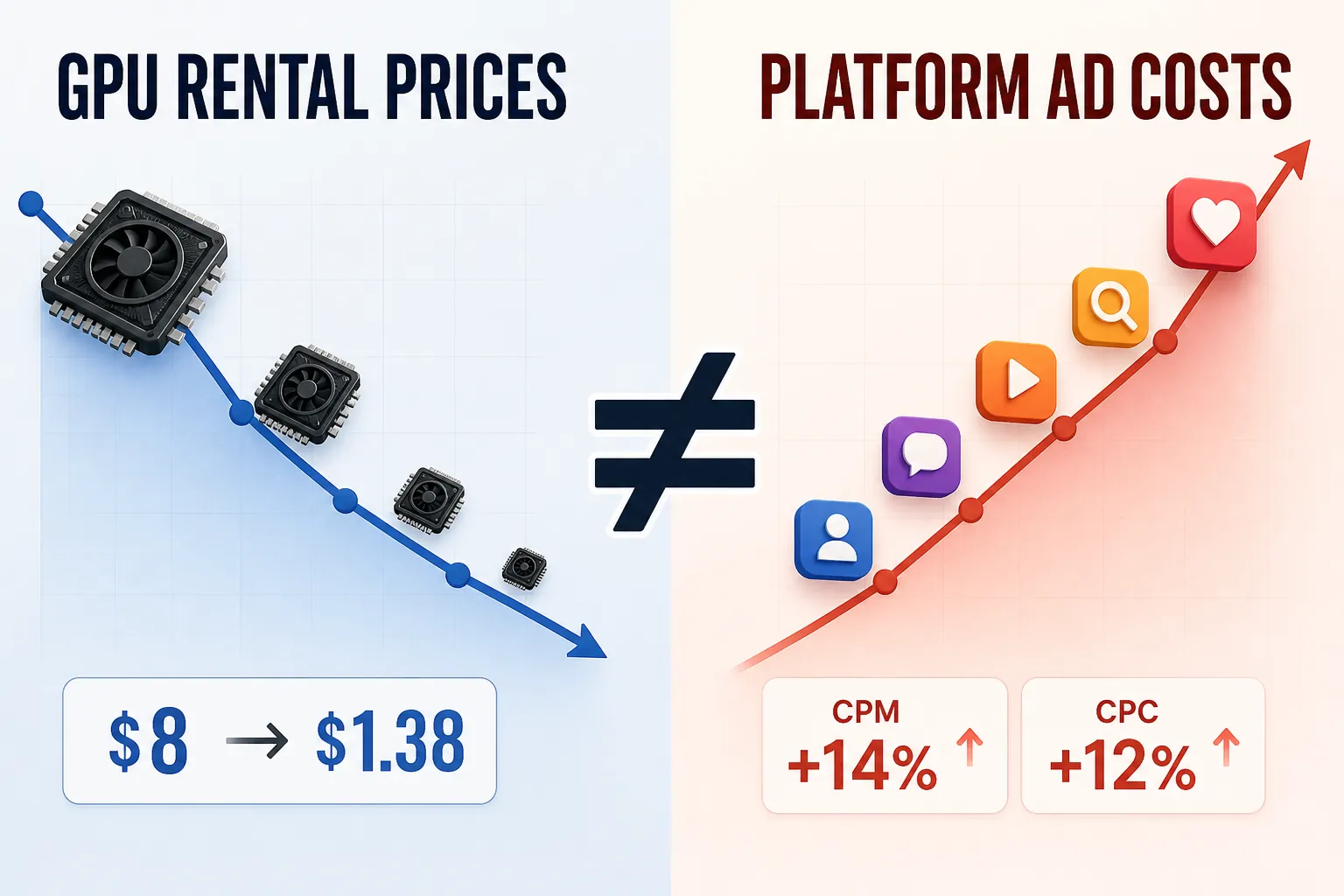
Spot or cloud rental prices measure access to a slice of compute capacity in a market with changing supply, utilization, contract terms, and provider strategy. A platform’s ad-cost structure includes owned and leased data centers, networking, power, depreciation, custom silicon, model training, inference, storage, talent, safety systems, product development, and the opportunity cost of capital already committed. Falling rental prices can reduce pressure in some parts of the market without erasing the platform’s full AI bill.
| Signal | What it measures | What it does not prove |
|---|---|---|
| AI chip stocks sell off | Investor appetite for semiconductor and AI-exposed equities | That platform AI infrastructure costs have already fallen |
| GPU rental prices fall | Market pricing for certain cloud GPU access | That Meta, Google, or TikTok will lower auction prices |
| Hyperscaler capex rises | Capital committed to data centers and AI infrastructure | That every campaign’s CPM will rise by the same amount |
| Reported ad prices rise | Platform monetization per ad or benchmarked advertiser costs | That infrastructure cost is the only driver |
The third row is the one buyers should keep staring at. Cheaper marginal access to GPUs is helpful for some AI workloads. It is not the same thing as a platform deciding to monetize less aggressively after committing to a record infrastructure cycle.
The ad-price data is already moving before the relief story arrives
Third-party benchmark data should be handled carefully because sample mix, vertical concentration, spend thresholds, geography, attribution windows, and optimization goals can all bias the averages. Still, the direction is not subtle. Ryze AI’s 2026 Meta benchmark put Meta CPM up 20% to $14.19, while Coinis also described Meta Ads as more expensive in 2026.[7][8] Ryze AI’s Google Ads benchmark put Google Search CPC up 12% to $2.96 and CPA up 12% to $23.74.[9]
Those figures should not be treated as universal account forecasts. A lead-gen advertiser, a DTC brand, and an app campaign will not feel the same auction. But they are directionally consistent with what many buyers are seeing in Q2-Q3 2026: platform delivery is not getting cheaper simply because semiconductor investors are getting nervous.
Meta’s own Q1 2026 disclosure is cleaner than any third-party benchmark because it separates price from volume. CNBC reported that Meta’s average ad price jumped 14% while ad impressions rose only 6%.[10] That is the bridge between platform economics and the account dashboard. More impressions help revenue, but price carried more of the growth burden in that period.
For a buyer, that mix changes the conversation. If impression growth is modest and average ad price is rising faster, the platform is extracting more revenue from the auction environment rather than simply selling a much larger pool of inventory. That does not prove AI capex caused the full 14% move. It does show that platform monetization pressure is landing in the same place advertisers pay: the price of ads.
Google-specific planning has the same issue. The Alphabet Q2 earnings analysis is the right kind of supporting record because it keeps the question inside paid media: are CPCs and CPAs rising faster than traffic quality, conversion rates, or budget efficiency can absorb?
Demand has not collapsed just because the trade got crowded
If the selloff were accompanied by collapsing data-center revenue, canceled capex guidance, and platforms walking back AI product investment, the ad-cost read would be different. That is not the fact pattern in the available data. NVIDIA reported record Data Center revenue of $75.2 billion in Q1 FY2027, up 92% year over year.[11]
Again, NVIDIA revenue is not your CPM. It is an upstream demand signal. But it is hard to reconcile that figure with the casual claim that AI compute demand has vanished. The public-market trade can be overextended while the infrastructure cycle remains large, expensive, and relevant to ad platforms.
There is a legitimate macro risk here. If AI revenues disappoint badly enough, future capex could be cut, and that would eventually change the pressure profile. The word “eventually” is doing work. A capex slowdown would have to show up in platform guidance, infrastructure commitments, product roadmaps, and revenue targets before a media buyer should underwrite lower auction costs from it.
What to watch instead of the chip chart
For budget planning, the useful watchlist is narrower than the market narrative. Do not ignore chip stocks; they are a sentiment signal. Just do not let them outrank the operating metrics that actually sit closer to your next monthly forecast.
- Platform capex guidance versus revenue growth: if spending stays elevated while revenue growth needs defending, monetization pressure remains live.
- Reported ad-price growth versus impression growth: Meta’s Q1 2026 mix is the template to watch, because price growth hits buyers more directly than inventory expansion.
- CPC, CPM, and CPA movement by channel rather than blended market averages: benchmark reports are useful, but your vertical and objective can diverge quickly.
- AI feature monetization: Advantage-style automation, creative generation, measurement changes, and AI-assisted bidding can improve performance while also deepening platform control over delivery.
- Infrastructure suppliers and memory constraints: upstream pressure does not set auction prices alone, but it helps explain why the cost floor may stay higher than advertisers hoped.
The mistake is treating every AI headline as if it travels straight into the auction. Some do not. The July 2026 chip selloff may change investor appetite for the AI trade, and it may eventually force harder questions about payback. But unless it changes platform capex commitments and the need to monetize those commitments, it will not directly lower your ad costs.
References
- Tech stocks lead steep global selloff as investors lose faith in AI chip trade — Fortune, July 17, 2026
- Hedge funds dumped chip stocks for a fourth week as AI shares sold off — Reuters, July 6, 2026
- Big Tech set to spend $650 billion in 2026 — Yahoo Finance
- AI Capex 2026: The $690B Infrastructure Sprint — Futurum Group
- Data Center GPU Pricing 2026 — IntuitionLabs
- AI GPU Supply and Pricing 2026 — Presenc AI
- CPABenchmarks 2026 — Ryze AI
- Why Meta Ads Are More Expensive in 2026 — Coinis
- Google Ads Benchmarks 2026 — Ryze AI
- Investors trust Google more than Meta when it comes to spending on AI — CNBC
- NVIDIA Announces Financial Results for First Quarter Fiscal 2027 — NVIDIA Newsroom
Built on this evidence
No Bidding tactic or Creative record currently cites this case file. Compare it against other results in Benchmarks.
Related benchmark reading
Report a corroborating or contradicting result
Seeing something different in your own account? Feed the data-integrity loop instead of leaving an open comment.