
What Tesla phantom braking teaches about AI ad failures
The same false-positive cascade that caused Tesla's phantom braking is quietly destroying ad budgets on AI-driven platforms. This article maps the structural pattern and shows how media buyers can apply the automaker's fix triad — independent verification, signal diversity, and human override — to prevent ad spend disasters.
- Platform
- Google Ads
- Campaign type
- Search
- Spend range
- Low
- Timeframe
- 0
- CPA
- 0
- Verdict
- loss
- Last reviewed
- 0-07-29
In July 2026, U.S. regulators closed their Tesla phantom braking investigation with a low-safety-risk framing. That could sound like the story ended with a shrug. It did not. The sharper point for anyone running automated media is that reported incidents fell from 45 in 2024 to 19 in 2025 and 3 in the first half of 2026 after software changes addressed the system behavior under review.[1]
That is the useful advertising context for Tesla phantom braking: not that cars and ad platforms share engineering, code, or causes, but that both can fail in the same recognizable shape. A system sees a proxy for danger, value, or conversion quality. It treats the proxy as more reliable than it is. Then it acts quickly enough that the human operator is left explaining the outcome after the account, or the vehicle, has already moved.
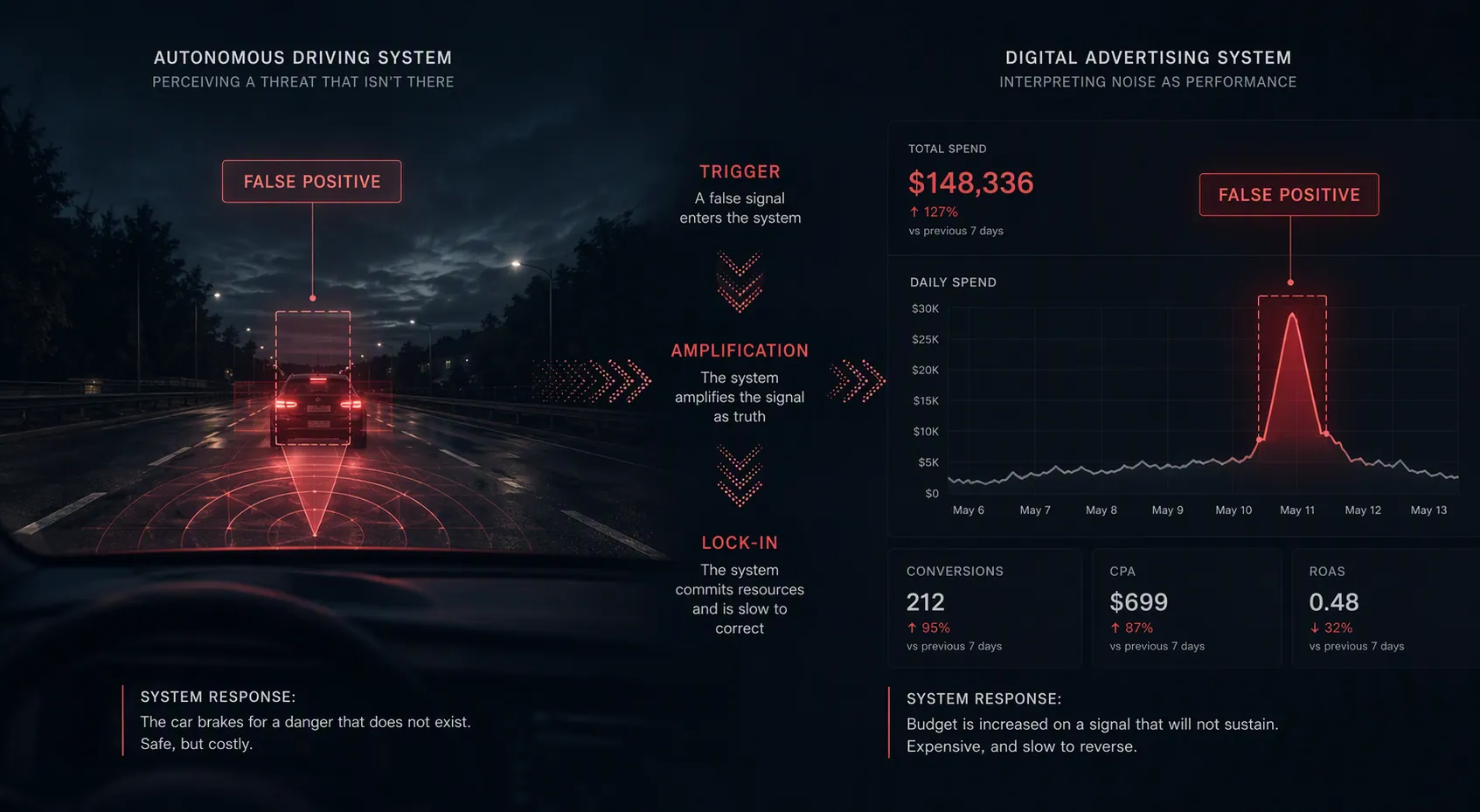
The advertising version rarely announces itself as a dramatic malfunction. It looks like a calm platform dashboard with spend pacing normally, a reported ROAS that still seems defensible, and a machine-learning explanation telling the buyer to wait. The backend revenue tab is where the lie usually starts to show.
The False Positive Is The Unit Of Damage
TU Delft researchers frame phantom braking through signal detection theory: automated systems face a trade-off between false positives and false negatives. A false negative misses a real hazard. A false positive reacts to a hazard that is not there. The paper’s empirical base is narrow, including a single-participant cycling simulator demonstration, so it should not be inflated into broad proof. Its value here is conceptual: it gives operators a cleaner way to name the mistake.[2]
Advertising automation has the same trade-off, only the cost is paid through budget, attribution, and sales quality. A false negative might underbid a real prospect. A false positive might overvalue a click, a lead, a returning customer, or a conversion event that is easy to measure but weakly tied to profit.
The uncomfortable part is that ad platforms are structurally rewarded for avoiding some false negatives. They do not want to miss available conversions inside their measurable universe. Buyers, however, do not get paid for conversions that only look good inside the platform. They get paid when the number reconciles to margin, cash, retention, pipeline, or incremental revenue.
The industry already has evidence that AI incidents are not rare among larger advertisers. In an IAB survey conducted in July 2024 and published in August 2025, 70% of marketers said they had encountered AI incidents, and 40% said they had to pause or pull ads. The sample was 125 U.S. ad industry executives at companies with more than 50 employees, so it should not be treated as a clean read on small-business accounts.[3]
That sample limitation matters. A small advertiser may have less budget, less data science support, and fewer internal controls than the companies represented in the survey. If anything, that makes the operating question more practical: how early can the buyer tell the difference between useful learning and a false-positive cascade?
The Cascade Usually Has Three Phases
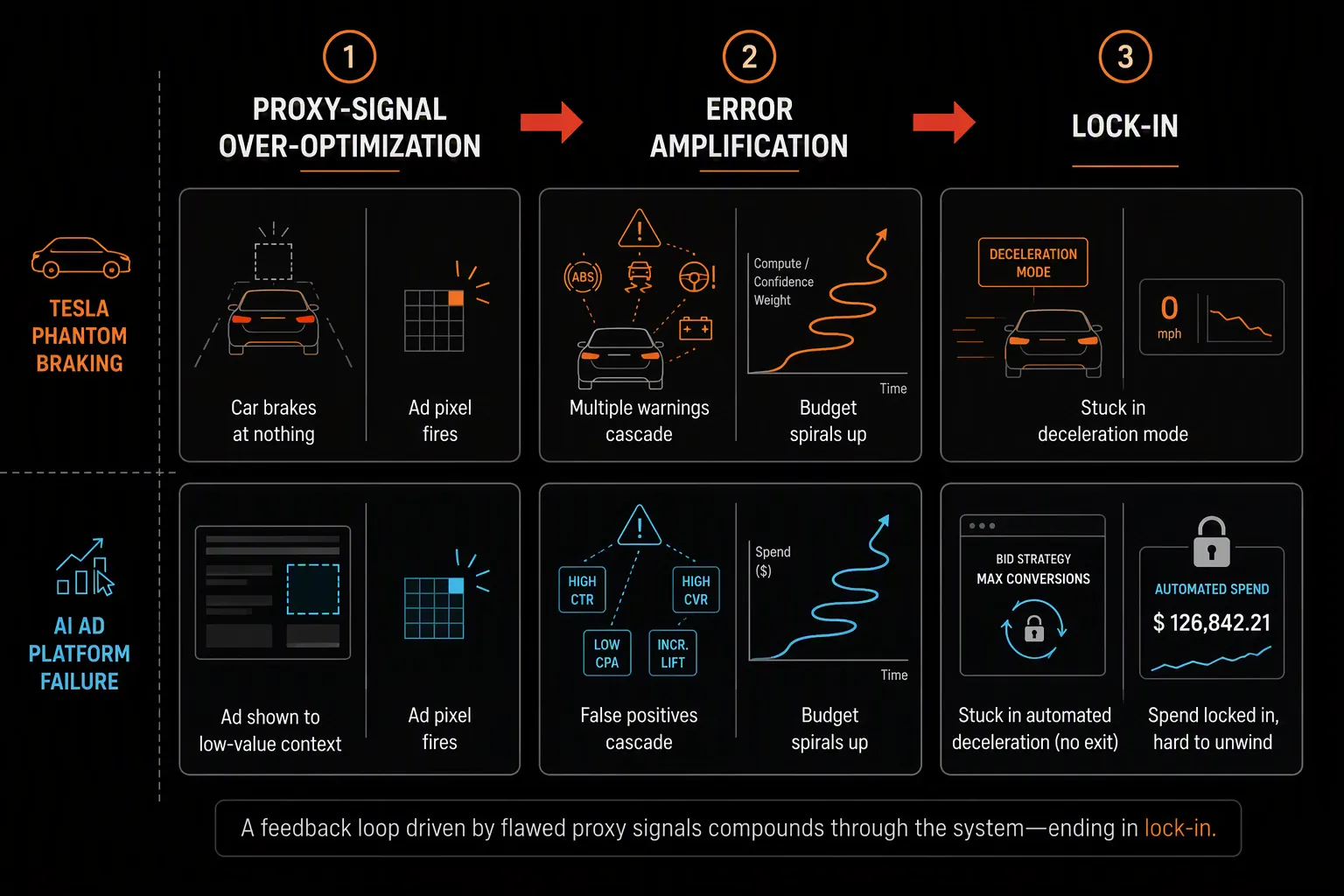
The cleanest way to inspect these failures is not by platform name. PMax, Advantage+, AI Max, and similar systems differ in mechanics and reporting. The repeatable failure pattern is simpler: proxy-signal over-optimization, error amplification, then lock-in.
Phase 1: The System Optimizes Toward A Proxy
In the phantom braking analogy, the system treats a perceived signal as if it represents a real hazard. The issue is not that safety is a bad objective. The issue is that a proxy can be wrong, and a system optimized to avoid one kind of error can create another.
In advertising, the proxy is usually cleaner-looking than the business outcome. A pixel fires. A lead form submits. A returning customer converts. A platform reports ROAS. Each event may be real in the narrow measurement sense and still be a weak signal for incremental growth.
Digiday reported a marketer’s account of pulling clients off Google’s PMax after confirmed incrementality tests showed less than 10% incremental revenue. That does not prove every PMax account inflates value, but it directly supports the more useful warning: platform-reported performance can diverge sharply from business value when incrementality is tested.[5]
Measured makes a similar argument about Meta Advantage+, warning that high reported ROAS can come from cannibalizing existing customer conversions rather than creating net-new demand. Again, the problem is not that ROAS is fake by definition. The problem is that ROAS can be true inside attribution and still commercially misleading.[6]
Done By Nine gives the cheap-lead version of the same failure: broad match keywords generated leads at $33 each, while downstream customer acquisition cost reached $2,000. A buyer who only sees the $33 proxy might increase budget into what the business would call a bad acquisition path.[7]
Phase 2: The Error Amplifies Faster Than Review Cadence
Once the wrong proxy is accepted, automation can make the account worse precisely because it is working as designed. It allocates more budget toward the signal it has been told to value. It explores nearby inventory, audiences, queries, or placements. It keeps finding more of the thing that resembles success.
groas, a vendor that sells software for managing AI Max, analyzed 312 AI Max failures and reported $4.7 million in wasted spend. It said 73% produced budget inefficiencies and 12% became disaster-level failures requiring emergency intervention. Because groas has a commercial interest in the category, those figures should be read as vendor-sourced evidence, not neutral market measurement.[4]
The timing in that vendor analysis is still useful because it describes the operating window buyers actually face: trigger in 0 to 15 minutes, amplification in 1 to 6 hours, and lock-in over 1 to 14 days. groas also describes two named cases: TechFlow SaaS losing $47,283 in 72 hours and Elite Fitness losing $34,900 in 18 hours.[4]
Those 18-hour and 72-hour examples are more important than the aggregate loss claim. They describe the Monday-morning problem: the campaign did not simply drift. It spent through a wrong interpretation of value before normal human review could catch up.
This is where “learning” becomes a dangerous word. Learning can mean the model is correcting toward a better estimate. It can also mean the system is collecting more evidence in favor of a bad proxy because the buyer has not supplied a stronger counter-signal.
Phase 3: Lock-In Makes The Bad Interpretation Harder To Undo
Lock-in is not only technical. It is also procedural and commercial. The account may enter a learning period. The platform may warn against major edits. Internal stakeholders may hesitate because the dashboard still shows efficient conversions. The buyer who wants to intervene is asked to prove the damage while the system keeps buying.
Mamba Digital’s critique of Meta’s Advantage+ backlash points to this pressure dynamic through Opportunity Score, where advertisers are pushed toward enabling automations that may worsen reported-performance distortions. That is not evidence that every recommendation is harmful. It is evidence that the platform interface can make automation adoption feel like account hygiene, even when the buyer has unresolved measurement doubts.[8]
A 2026 Deep Marketing write-up about MIT research adds an independent caution layer, reporting that 95% of AI marketing projects fail. That claim is broader than ad-platform bidding and should not be used as direct proof that AI campaigns fail at that rate. Its relevance is narrower: AI deployment failure is not only a vendor-story problem.[9]
| Cascade phase | In phantom braking | In AI ad buying | What the buyer checks |
|---|---|---|---|
| Proxy-signal over-optimization | A perceived hazard is treated as real | A conversion proxy is treated as commercial value | Does platform success reconcile to backend revenue, margin, or pipeline? |
| Error amplification | The system reacts quickly to the wrong signal | Budget shifts toward low-quality conversions, cannibalized demand, or misleading inventory | Can the account be reviewed inside the same hour-window as the spend movement? |
| Lock-in | The behavior persists until diagnosed and changed | Learning periods, recommendations, and internal reporting slow intervention | Can the buyer pause, cap, exclude, or redirect before the pattern hardens? |
The Fix Is Not Less Automation. It Is Better Control Around Automation
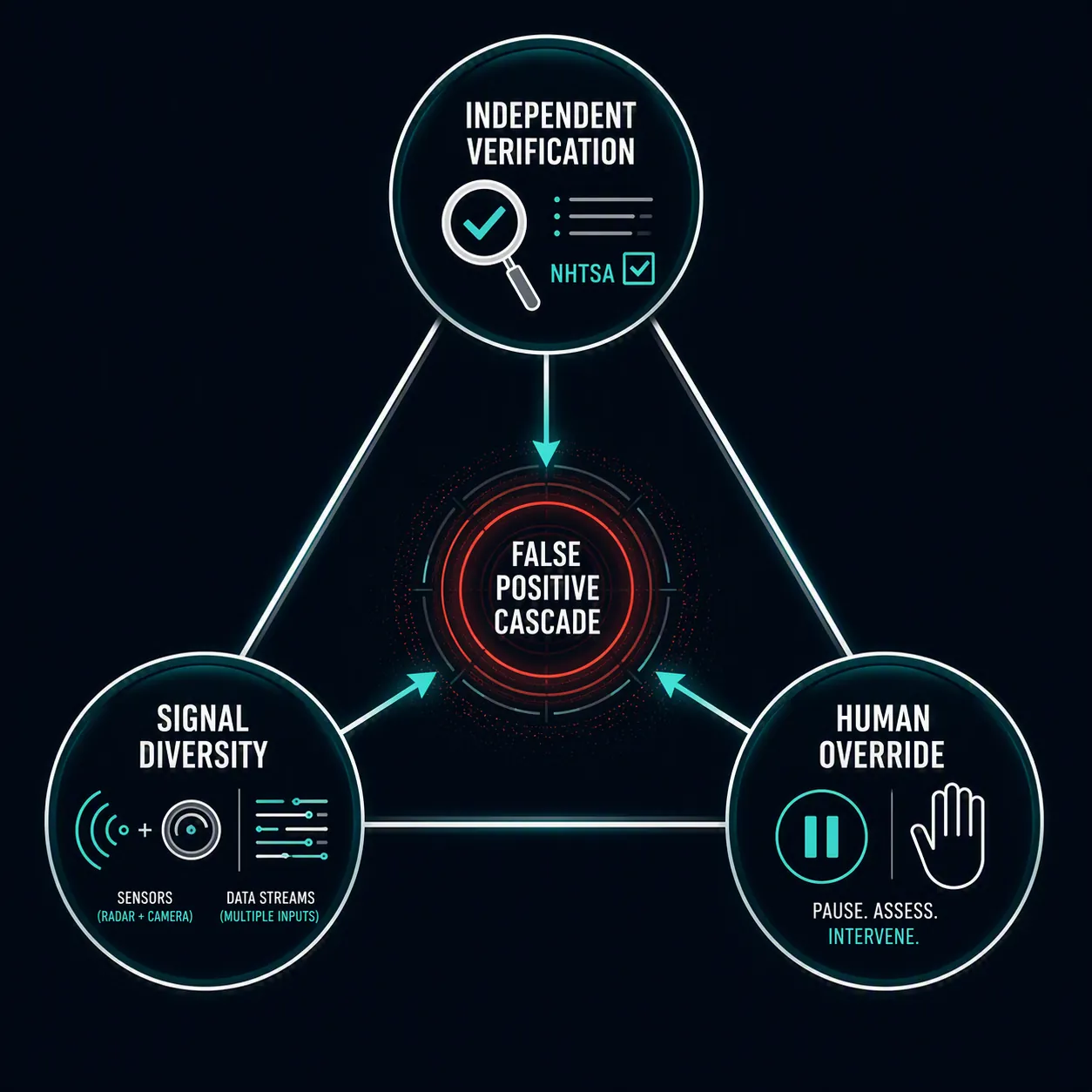
The NHTSA closure matters because the incident trajectory suggests mitigation after diagnosis. The lesson for media buying is not to abandon automated campaigns. It is to stop treating platform confidence as verification.
Independent Verification
NHTSA was not asking Tesla’s dashboard whether the behavior looked fine. It reviewed complaints, incidents, and system changes from outside the product’s own success narrative. Media buyers need the same separation between the buying system and the measurement system.
That means platform ROAS is an input, not the court of appeal. The court of appeal is incrementality testing, holdouts where possible, backend revenue reconciliation, qualified pipeline, customer quality, refunds, repeat purchase, and contribution margin. If the campaign is allowed to optimize faster than those checks refresh, the buyer is effectively flying on the platform’s proxy alone.
Signal & Convert’s existing PMax vs. Advantage+ comparison already covers the ROAS inflation and incrementality gap. The phantom braking frame adds a diagnostic layer: when the reported success metric starts separating from business truth, the buyer should inspect for a false positive before scaling into it.
For teams building the measurement side, the AI advertising ROI playbook and the digital ad spend verification tracker are closer to the operating fix than another platform settings checklist.
Signal Diversity
The automotive analogy is useful here because sensor diversity is easy to understand. A camera-only interpretation can be brittle under conditions the system misreads. In advertising, the equivalent mistake is letting one conversion event, one attribution window, or one platform’s model become the full truth source.
Signal diversity does not mean dumping every possible event into the platform. Bad signal diversity is just noise with more fields. The buyer needs signals that disagree usefully: qualified lead status, offline revenue, new-versus-returning customer flags, negative keyword and placement exclusions where available, refund or cancellation data, CRM stage quality, and cohort-level profitability.
The cheap-lead example shows why this matters. If a campaign sees $33 leads and no downstream disqualification signal, it may interpret volume as opportunity. If the CRM later shows $2,000 CAC, the buyer has evidence that the lead event is a weak optimization target, not a success metric.[7]
Signal diversity also protects against cannibalization. If Advantage+ reports strong ROAS by finding people likely to buy anyway, new-customer mix and incrementality evidence become counter-signals. Without them, the system can keep harvesting existing demand while looking efficient.[6]
Human Override
Human override is not a speech about trusting people over machines. It is an account capability. Can someone pause the campaign? Can they cap budgets? Can they remove a conversion action, exclude a segment, tighten geography, change bidding constraints, or redirect spend before the bad proxy absorbs another day of budget?
The answer has to be decided before the failure. A buyer who needs three approvals to pause a campaign cannot realistically respond to an 18-hour amplification window. A team that only reviews backend revenue weekly has accepted that several days of automated spend may be judged by platform proxies alone.
- Set account-level spend alerts against both platform spend and backend revenue movement.
- Define emergency thresholds for pausing or constraining automated campaigns before launch.
- Keep a non-platform view of revenue, lead quality, and customer mix open during major budget changes.
- Document which edits reset learning, which edits only constrain risk, and who is allowed to make them.
- Review recommendation systems as commercial nudges, not neutral safety checks.
What To Do When The Dashboard Looks Fine And The Business Does Not
The moment to worry is not only when spend spikes. It is when spend, reported conversions, and reported ROAS remain internally coherent while external business signals deteriorate. That is the advertising equivalent of braking for an obstacle the operator cannot see.
A practical review starts with one question: what would have to be true outside the platform for this campaign’s reported performance to be real? If the answer is “new customers should be rising,” check new-customer mix. If the answer is “sales should be profitable,” check margin. If the answer is “pipeline should improve,” check stage progression, not just form fills.
Then inspect the campaign as a cascade rather than a mystery dip.
- Find the proxy: identify the event, audience, query class, placement type, or customer segment the system is rewarding.
- Check amplification: compare spend movement against review cadence and backend data refresh timing.
- Locate lock-in: identify learning-period warnings, automated recommendations, reporting incentives, or internal approval delays that discourage intervention.
- Add counter-signals: feed or review qualified revenue, exclusions, negative outcomes, and incrementality evidence.
- Use override authority: pause, cap, constrain, or redirect before the next spending window compounds the error.
This framework does not prove that any specific AI campaign is failing. It gives the buyer a way to avoid arguing with a dashboard on the dashboard’s terms. If the platform says performance is stable and the business says quality is falling, the next step is not patience by default. It is verification.
The Narrow Lesson
Tesla’s phantom braking probe closed with a low-risk regulatory conclusion, while the incident trajectory still showed that a false-positive cascade could be reduced after the behavior was diagnosed and changed.[1] That is the part media buyers should keep, without pretending vehicle safety systems and ad auctions are the same machine.
An AI campaign that optimizes toward a weak proxy, amplifies early errors, and resists correction through learning-period logic or platform incentives should be treated like a false-positive system. The operator’s job is not to prove that automation is bad. It is to verify value independently, diversify the signals that define value, and retain the authority to intervene before the model turns a bad proxy into real spend loss.
No first-party Signal & Convert campaign data supports this specific piece. The advertising claims here come from third-party reporting, vendor-sourced analyses where labeled, and published research. That boundary is part of the method: do not let a confident story outrun the evidence, even when the story feels painfully familiar.
References
- Tesla phantom braking investigation closed by NHTSA, Drive Tesla Canada, driveteslacanada.ca/news/tesla-phantom-braking-investigation-closed-nhtsa/
- Phantom braking in automated vehicles: A theoretical outline and conceptualization, TU Delft, 2024, research.tudelft.nl/en/publications/phantom-braking-in-*automated-vehicles-a-theoretical-outline-and-c/
- AI Adoption Is Surging in Advertising, But Is the Industry Prepared for Responsible AI?, IAB, August 2025, iab.com/insights/ai-adoption-is-surging-in-advertising-but-is-the-industry-prepared-for-responsible-ai/
- Google Ads AI Max Failures: When Google’s AI Gets It Wrong, groas, groas.com/post/google-ads-ai-max-failures-when-googles-ai-gets-it-wrong
- ‘It’s the worst execution I’ve seen’: Confessions of a marketer on pulling every client off Google’s PMax, Digiday, digiday.com/marketing/its-the-worst-execution-ive-seen-confessions-of-a-marketer-on-pulling-every-client-off-googles-pmax/
- Meta Advantage+: Why High ROAS Is a Red Flag, Measured, measured.com/blog/meta-advantage-why-high-roas-is-a-red-flag/
- AI Won’t Fix Bad Ads: Stop Blindly Trusting the Algorithm, Done By Nine, donebynine.com/ai-wont-fix-bad-ads-stop-blindly-trusting-the-algorithm/
- Meta Advantage+ Backlash: Why Advertisers Are Frustrated & How We Fix It, Mamba Digital, mambadigital.au/meta-advantage-backlash-why-advertisers-are-frustrated-how-we-fix-it/
- 95% of AI Marketing Projects Fail 2026, Deep Marketing, 2026, deepmarketing.it/en/blog/95-percent-ai-marketing-projects-fail-2026
Built on this evidence
No Bidding tactic or Creative record currently cites this case file. Compare it against other results in Benchmarks.
Related benchmark reading
Report a corroborating or contradicting result
Seeing something different in your own account? Feed the data-integrity loop instead of leaving an open comment.