
Google Performance Max vs Meta Advantage+: Which AI Ad Platform Should You Trust in 2026?
A head-to-head comparison of Google Performance Max and Meta Advantage+ focused on funnel-stage fit and the gap between platform-reported ROAS and true incremental value, with budget-stage guidance for Q3–Q4 2026 planning.
- Platform
- Google Ads0 Meta Ads
- Campaign type
- Performance Max0 Advantage+
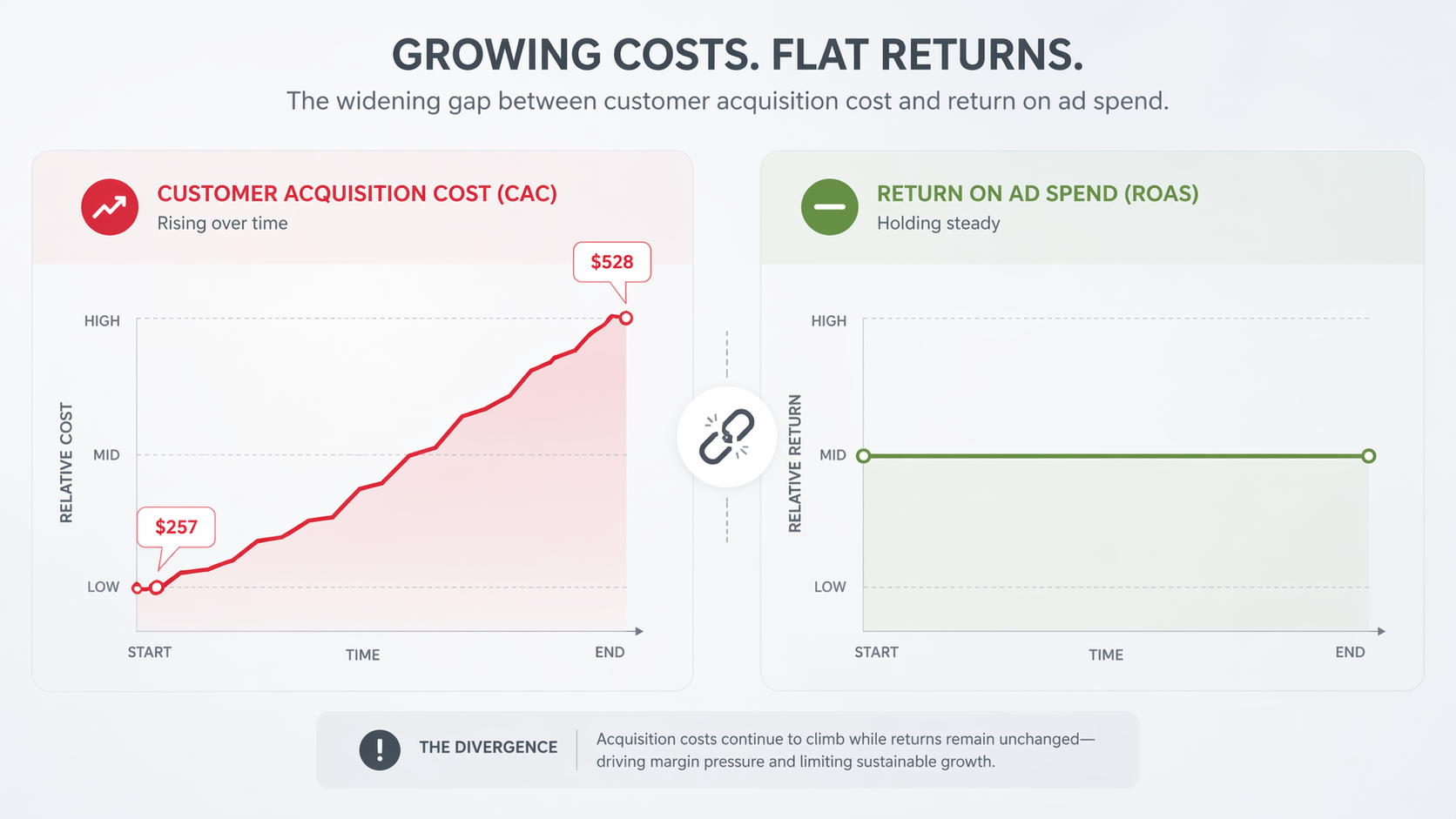
Advantage+ can look stable on the dashboard while new-customer CAC moves the wrong way. Pixis' analysis of 55K+ campaigns says CAC on Advantage+ more than doubled from $257 to $528 over 12 months even as reported ROAS stayed at $4.52 [1]. For B2B SaaS, Search still beat Performance Max, with 553% ROAS versus 436% for PMax in 42 Agency's benchmark set [2]. When a platform can keep the reported number steady while the cost of real customers rises, the reporting problem matters more than the headline.

The safest-looking ROAS is usually the least useful number
Reported ROAS is useful inside the platform, but it is not the same thing as incremental value to the business. It can stay neat while CAC drifts upward, especially when the platform is optimizing toward conversions it can already see. That is why the warning sign is not a bad ROAS print alone. It is the combination of flat ROAS, rising new-customer cost, and no outside measurement layer to explain the gap.
PMax and Advantage+ do different jobs
Performance Max is best understood as intent capture. It sits where search, shopping, and other Google surfaces can harvest demand that already exists, which helps explain why it has become such a large part of Google Ads buying. In 2026, Digital Applied says PMax drives about 45% of all Google Ads conversions, and 78% of Google Ads spend runs through Smart Bidding or PMax [3]. That scale is a reason to take it seriously, not a reason to assume it wins every comparison.
Advantage+ is the cleaner fit when the job is demand creation. It is built to expand reach, find people who are not already expressing intent, and turn that wider audience into customers. That difference matters because the platform that is best at harvesting existing demand is not automatically the one that is best at creating new demand. The mistake is treating both dashboards as if they were solving the same problem.
Why the B2B answer tilts toward Search before it tilts toward PMax
The B2B SaaS benchmark is useful because it shows where the floor can be higher than the platform story suggests. Search campaigns delivered 553% ROAS versus 436% for PMax in the 42 Agency benchmark set [2]. That does not mean PMax is weak everywhere. It means that in categories where the demand is already discoverable through search, the closer-to-intent layer can still own the better return. For teams planning Q3–Q4 spend, that is a narrower and more useful conclusion than a universal "AI wins" claim.
Budget-stage guidance for Q3–Q4 2026
- If search volume is already there and conversion data is clean, give PMax the heavier role in capturing that intent.
- If the job is opening new demand or broadening reach, Advantage+ has the more natural fit.
- If CRM attribution, offline conversion imports, or incrementality testing are weak, cap both and treat platform ROAS as directional only; use an operating framework like AI advertising ROI playbook.
If both jobs matter, split the budget by function rather than by platform loyalty. Use PMax where you are harvesting existing intent, use Advantage+ where you are trying to create more of it, and let outside measurement decide which side deserves more scale.
The measurement stack that keeps either platform honest
Independent measurement has to sit above the platform dashboard if the budget decision is going to hold up. CRM attribution shows whether new customers actually increased. Incrementality testing shows whether the platform added lift or just claimed it. Offline conversion imports reduce the blind spots that make reported ROAS look cleaner than the business result. For a broader planning view, the AI digital advertising benchmark playbook 2026 helps put those signals next to each other.
What to trust in 2026
Performance Max is the better fit when existing intent is already in the market and the goal is capture. Advantage+ is stronger when the job is demand creation. Neither deserves full trust on its own ROAS readout. The real decision is which funnel job you are paying for, and which external measurement layer will keep the dashboard from grading its own homework.
References
Built on this evidence
No Bidding tactic or Creative record currently cites this case file. Compare it against other results in Benchmarks.
Related benchmark reading
Report a corroborating or contradicting result
Seeing something different in your own account? Feed the data-integrity loop instead of leaving an open comment.