

AI Advertising ROI: Where It's Real and How to Prove It
Learn how to measure AI advertising ROI with a framework based on industry data, including where returns are verifiable and which approaches fail to deliver.
AI in digital advertising has moved past the “should we test it?” phase. Budgets, tools, and platform features are already in motion. The harder question is whether the return can be defended when someone outside marketing asks what changed, how it was measured, and whether the result would have happened anyway.
That proof gap is not small. IBM found that only 29% of organizations can dependably measure AI ROI, while only 25% of CEO AI initiatives delivered the ROI leaders expected.[1] In marketing specifically, Jasper reported that 41% of marketers say they can confidently prove AI ROI, down from 49% in 2025.[2] IAB adds the planning failure hiding underneath those numbers: only 40% of marketing professionals use defined KPIs specifically for their AI solutions.[3]
That is the central issue. AI advertising spend can scale quickly because the systems sit close to media buying, creative production, targeting, and reporting. Proof does not scale at the same speed unless the measurement plan is built before deployment. Without that, teams end up presenting activity as value: more variants, faster optimization, shorter production cycles, cleaner dashboards. Useful, maybe. ROI, not yet.
Adoption is real. So is the measurement debt.
The market is not waiting for perfect measurement discipline. IAB reported that 30% of agencies are integrating AI into campaign lifecycles, and the same broader industry context shows AI moving into planning, activation, optimization, and measurement workflows rather than staying limited to content production.[3]
That matters because advertising AI is usually judged in the most unforgiving part of the marketing budget. A generative content tool can sometimes survive on productivity logic. A media tool has to answer for spend. If an AI bidding system, targeting layer, or creative engine changes delivery, the next question is whether it lowered CPA, increased revenue, improved ROAS, raised LTV, or created incrementality that can be separated from ordinary campaign movement.
The uncomfortable part is that many teams are adopting AI before they decide which of those outcomes matters. The result is a reporting deck full of plausible gains and weak baselines: impressions processed, assets generated, audiences expanded, campaign setup time reduced. Those may be leading indicators, but they do not settle the budget question.
Where AI advertising ROI is credible
The strongest ROI cases tend to appear where AI is attached to a measurable media lever: bidding, budget allocation, audience matching, contextual targeting, dynamic creative optimization, or feed-based creative production. These are places where a change in the system can be tied to a change in cost, conversion rate, revenue, or ROAS with less interpretive distance.
Platform data from StackAdapt is a useful example, with an important caveat: it is platform-specific, not a universal market average. StackAdapt reports 2x ROAS with first-party and contextual targeting, 32% higher CTR with dynamic creative optimization, and 56% lower CPC in its AI advertising analysis.[4] Those numbers are worth attention because they sit close to campaign economics. They still need to be read as results from one major platform’s environment, not as a guaranteed benchmark for every advertiser.
McKinsey’s benchmark is more modest and therefore more useful for expectation-setting: 24% of teams saw revenue gains of 6% or more from AI in advertising.[5] That is not the kind of number that sells a transformation fantasy. It is the kind of number a media manager can use to keep a test honest. If a plan assumes AI will double revenue in a quarter, the burden of proof should be very high. If it aims to find measurable lift in a defined campaign motion, the conversation is more credible.
There are also vendor-aggregated claims around AI-driven PPC bid management, including roughly 37% wasted-spend reduction and about 50% higher ad ROI.[6] Those figures should be treated as directional rather than definitive. Bid automation can absolutely reduce waste when the previous setup is loose, conversion data is reliable, and the model has enough signal. It can also optimize toward the wrong event if the account is feeding it shallow conversions or blended goals.
A practical way to sort the evidence is to ask how close the AI action is to the financial outcome.
| Claim type | How to treat it | What would make it defensible |
|---|---|---|
| AI bidding reduced CPA or increased ROAS | Potentially verifiable | Pre/post or holdout design, stable conversion definition, spend and mix controls, revenue or margin view where possible |
| AI targeting improved CTR or CPC | Useful but incomplete | Connection to qualified traffic, conversion rate, CPA, revenue, or downstream LTV |
| AI creative generated more variants faster | Operational efficiency, not ROI by itself | Evidence that the variants improved conversion economics or reduced production cost without hurting performance |
| AI insights improved strategy | Too soft unless operationalized | Documented decisions, changed budget allocation, and measurable business outcome after the change |
| Agentic AI will optimize the whole campaign autonomously | Discount until proven | Clear feature behavior, audit trail, human controls, and outcome testing against a baseline |
For campaign examples that go deeper into when AI creative and media systems tend to work or underperform, see AI in Advertising Examples: Where It Works, Where It Doesn't, and the $100 AOV Decision Rule. The key point for ROI is not whether a workflow contains AI. It is whether the workflow changes an economic variable the business already trusts.
The measurement plan has to come before the tool
The Basis framework published in May 2026 is useful because it pushes the discussion away from generic AI productivity and toward advertising-specific outcomes. Its core logic is simple: map AI inputs to the business result the campaign is supposed to improve, then prove the connection with the right KPI, data foundation, and reporting structure.[7]
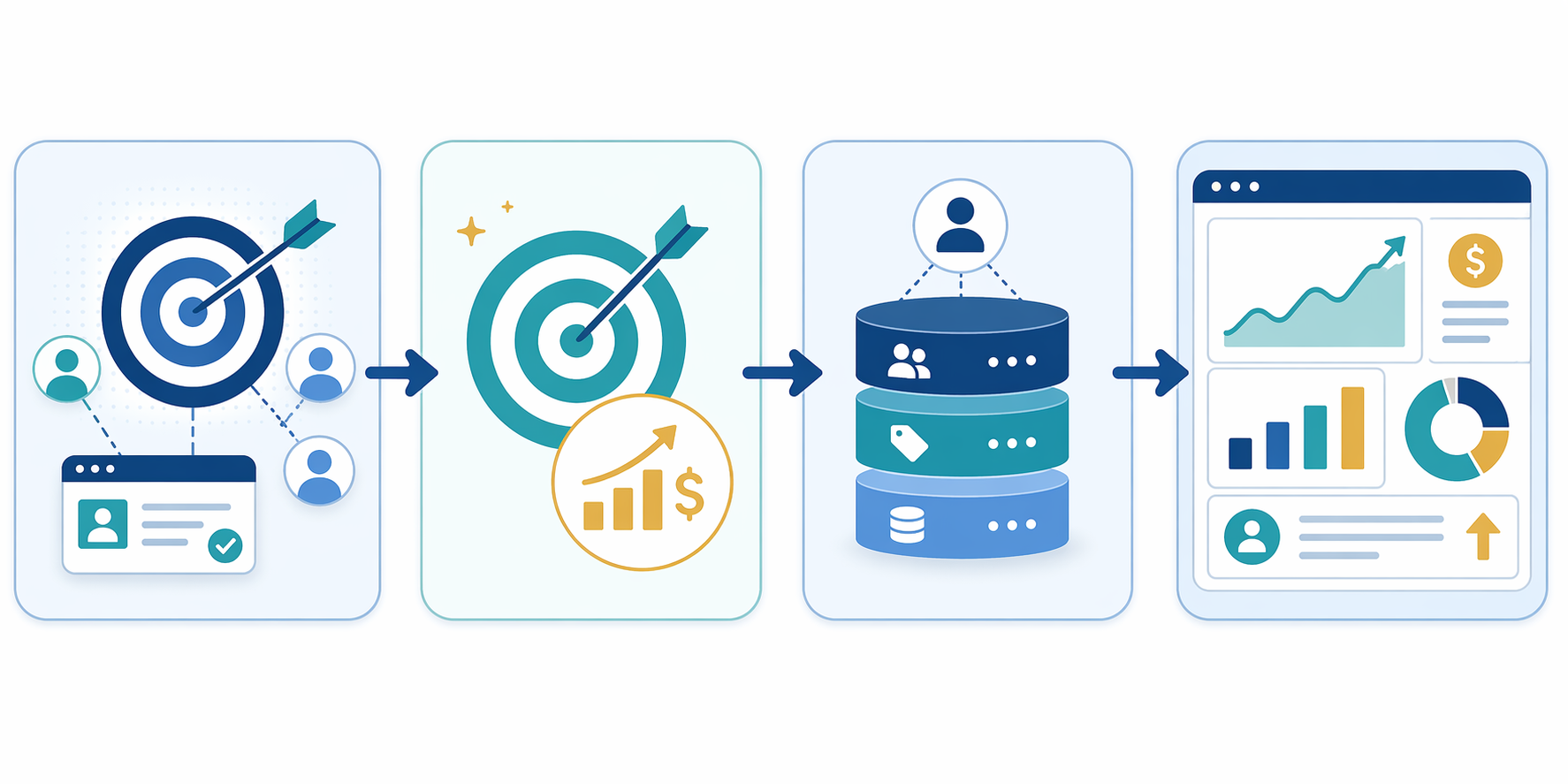
That sounds obvious until it hits a real account. “Use AI for paid social” is not a use case. “Use AI creative scoring to prioritize Meta ad variations for a lead-gen campaign where the target KPI is qualified lead CPA” is closer. “Use AI-assisted bid management in paid search to reduce non-converting spend while holding pipeline contribution flat or improving it” is closer still.
The order matters:
- Define the advertising use case, not the AI category.
- Tie that use case to a business KPI before launch.
- Confirm the data is clean enough for the system to optimize against the right signal.
- Measure against a baseline that finance, sales, or leadership would recognize.
- Report the result in business terms, with efficiency metrics kept in a supporting role.
If that work feels slower than buying the tool, that is the point. A fast deployment with a weak KPI creates the exact problem now showing up across the market: teams believe AI helped, but cannot prove it in a way that survives review.
Define the use case tightly enough to test
A defensible AI advertising test starts with the specific decision the system will influence. Will it change bids? Shift budget between audiences? Select creative? Generate ad variations? Score intent signals? Suppress low-quality placements? Each one requires a different measurement design.
This is where vague AI plans become expensive. If the same tool is credited for better creative output, faster production, higher CTR, lower CPA, and revenue lift all at once, the analysis usually becomes impossible to defend. Pick the primary mechanism. Then decide which secondary metrics are diagnostic rather than decisive.
For example, a dynamic creative optimization test can reasonably track CTR and CPC because those are close to the creative serving layer. But if the business case is ROI, the test also needs conversion rate, CPA, revenue per conversion, or qualified lead quality. A higher CTR that brings weaker traffic is not a win. It is a routing problem with better-looking top-of-funnel numbers.
Set the KPI against the business outcome, not the dashboard feature
The IAB KPI gap is the cleanest explanation for why AI ROI is so hard to prove: only 40% of marketing professionals use defined KPIs specifically for their AI solutions.[3] That means many teams are deploying systems before they decide what success means.
The KPI should match the job. If AI is used for bid optimization, the KPI might be CPA, ROAS, marginal ROAS, or revenue at a target efficiency level. If it is used for prospecting, the KPI might be qualified acquisition cost or new-customer revenue, not just cheaper clicks. If it is used for creative production, the KPI may include production cost reduction, but only if quality and performance thresholds are protected.
Speed is allowed in the story, but it should not become the story by accident. Faster launch cycles matter when they lead to more statistically useful tests, lower production cost, quicker learning, or more revenue-generating campaigns. “We made more ads” is not the same as “we improved media economics.”
Make first-party data usable before asking AI to optimize
AI advertising performance depends heavily on the signal it receives. Basis reports that only 21.4% of organizations describe their first-party data as foundational, which is a serious constraint for systems expected to optimize toward customers, revenue, or lifetime value.[7]
This is usually where the clean deck breaks down in the account. The platform is optimizing to a form fill that sales does not value. Offline revenue is delayed or missing. Duplicate conversions inflate performance. New and returning customers are blended. Consent and identity constraints limit match quality. Campaign naming is inconsistent enough that reporting requires manual repair before anyone can read it.
None of those are abstract data maturity issues. They decide whether the AI system is learning from profit, proxy, or noise. A team can still test AI with imperfect data, but the ROI claim has to be narrowed. If the model only sees lead volume, do not claim it optimized pipeline. If the platform only sees online purchases, do not claim it improved total customer value.
Use human oversight where the model can spend money
Human review is not a ceremonial control. In paid media, AI recommendations can affect budget pacing, audience inclusion, creative claims, brand suitability, and conversion quality. The more directly a system can move spend, the more important it is to keep an audit trail: what changed, when it changed, why it changed, and which KPI moved afterward.
The review cadence should match the risk. A creative ideation tool may need brand and compliance review. A budget allocation system needs performance thresholds and escalation rules. A bid management layer needs guardrails around spend spikes, conversion lag, and learning-period interpretation. Human oversight is part of the measurement design because it prevents the team from confusing model activity with controlled experimentation.
How to classify AI advertising ROI claims
Not every AI claim deserves the same treatment. Some are strong enough to present upward. Some are promising but bounded by vendor environment, campaign mix, or test design. Some are too soft to justify spend beyond a pilot.
Verifiable enough to present upward
A claim is presentable when it has a defined use case, a preselected KPI, a credible baseline, and a business outcome. “AI bid management reduced non-brand search CPA by 18% versus the previous four-week baseline while lead-to-opportunity rate held steady” is the right shape, even if the exact test design varies by account. It tells leadership what changed and what trade-off was checked.
Better still, use a holdout, geo split, campaign split, or phased rollout where possible. Not every account has enough volume for a clean experiment, but the absence of perfect incrementality testing does not excuse baseline-free storytelling. At minimum, control for seasonality, spend changes, promotion windows, audience shifts, and conversion definition changes before giving AI credit.
Promising but vendor-bounded
Vendor case studies and platform benchmarks are useful for deciding where to test. They are weaker as proof that the same return will show up in your account. StackAdapt’s reported DCO and targeting gains are relevant because they identify areas where the platform has observed measurable movement, but they still need local validation against your audience, offer, data, and buying model.[4]
The same caution applies to tool-specific ROI studies. A companion deep dive on whether marketing teams can prove ROI with Jasper AI looks at one tool’s measurement case in more detail. The broader lesson is the same: a vendor result can shape a hypothesis, but it should not replace an account-level measurement plan.
Too soft to justify meaningful spend
Claims become weak when they stop at activity. More assets, more audiences, more recommendations, and more automated reports do not prove ROI unless they connect to lower cost, higher revenue, better customer quality, or durable learning. The same goes for “AI-powered” features that behave like ordinary rules-based automation with a new label.
Gartner’s warning about agent-washing is useful here: it found that only about 130 of thousands of vendors claiming agentic AI actually deliver it.[8] That does not mean agentic tools are useless. It means the buying question should be specific: What decisions can the system make? What data does it use? Can it act without approval? Can those actions be audited? What happens when it is wrong?
If a vendor cannot answer those questions in operational terms, the ROI claim should stay in the pilot bucket.
What the ROI report should actually show
A defensible AI advertising report does not need to be long. It needs to separate business impact from supporting evidence.
| Report layer | What to include | What to avoid |
|---|---|---|
| Business outcome | Revenue, CPA, ROAS, qualified pipeline, LTV, margin where available | Only clicks, impressions, asset volume, or time saved |
| Baseline | Previous period, holdout, split test, or pre-agreed benchmark | A comparison chosen after results are known |
| AI action | The specific bidding, targeting, creative, or reporting decision influenced by AI | A broad statement that AI improved the campaign |
| Data quality | Conversion source, offline data availability, customer match limits, known gaps | Assuming platform-reported conversions equal business value |
| Controls and caveats | Spend changes, seasonality, offer changes, audience mix, conversion lag | Attributing all movement to AI |
| Decision | Scale, continue testing, narrow the use case, or stop | Ending with a vague recommendation to invest more in AI |
The difference between a useful report and a decorative one is usually the treatment of baselines. If spend increased, audience mix changed, creative was refreshed, and the promotion calendar shifted, a simple before-and-after ROAS lift is not enough. It may still be a positive signal, but it should be described as a signal, not proof.
For workflow examples that show how teams operationalize AI across campaign planning, creative, and optimization, see AI Advertising Examples: 7 Campaigns With Real Workflows That Delivered. Workflow quality matters because ROI is rarely produced by the tool alone. It comes from the combination of use case selection, signal quality, controls, and decision discipline.
A practical standard for investing in AI advertising
AI advertising is worth investment when three conditions are in place. First, the use case is specific enough to test. Second, the data is clean enough to connect inputs to business outcomes. Third, reporting is framed around metrics leadership already respects: revenue, CPA, ROAS, LTV, qualified pipeline, or cost savings that do not damage performance.
That standard will reject some spend. It will also protect the AI investments that deserve to scale. A platform-specific lift can justify a deeper test. A clean CPA reduction with stable lead quality can support budget expansion. A faster creative process can earn investment if it lowers production cost or increases the number of useful experiments without weakening conversion economics.
The current market does not need more confident language around AI in digital advertising. It needs fewer claims that collapse under basic measurement questions. Build the plan first, make the data usable, keep the KPI tied to the business outcome, and the answer becomes easier to defend: scale what can be proven, keep testing what is promising, and stop paying for noise.
References
- AI Advertising reality check: Where marketers are really seeing ROI — Ad Age Studio 30
- Can Marketing Teams Actually Prove ROI with Jasper AI? What the Data Says — Signal & Convert
- AI Adoption Is Surging in Advertising, but is the Industry Prepared for Responsible AI? — IAB
- AI in advertising: How it's transforming marketing in 2026 — StackAdapt
- 25+ AI Marketing Statistics You Need to Know in 2026 — Adobe
- Zebracat PPC bid management statistics
- Achieving and Demonstrating ROI on AI in Marketing — Basis, May 2026
- 7 AI Marketing Trends Reshaping Strategy in 2026 — Improvado
Comments
Join the discussion with an anonymous comment.