
FULLBEAUTY Brands
This article analyzes real brand examples and benchmark data to show that AI-generated ad creative delivers measurable parity for products under $100 AOV but underperforms on high-consideration purchases, giving paid media managers a clear decision rule for allocating creative resources.
Outcome
45% ROAS increase from AI-generated lifestyle backgrounds on Meta — source: GetHookd, 2026
This outcome is independently verified via the primary source linked above.
The $100 AOV Line Is the First Sorting Rule
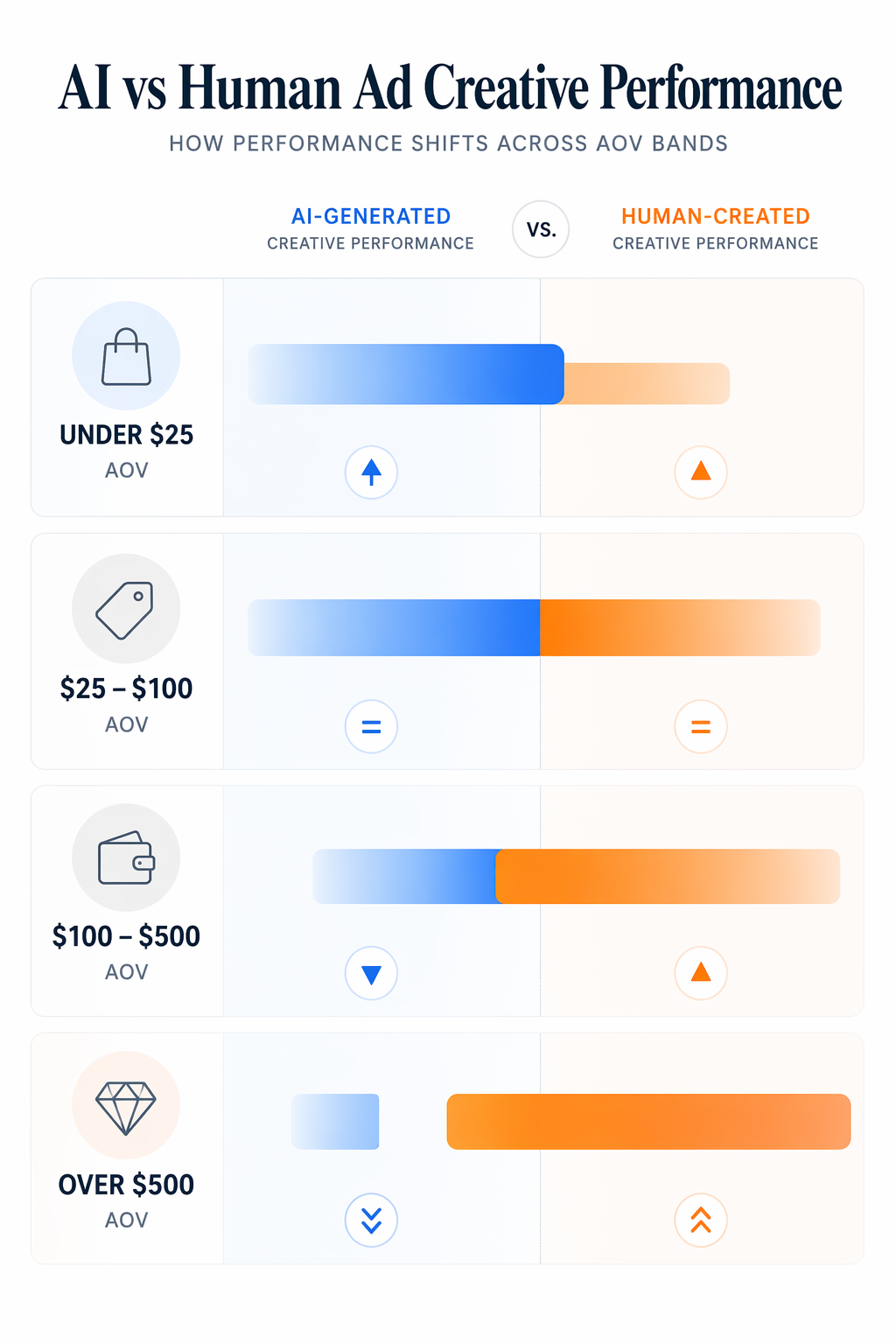
If the next creative batch is for a $39 impulse product, AI should probably be doing most of the variant production. If it is for a $180 product, the answer gets less automatic. If it is a $700 product or a B2B lead offer, handing the concept to AI because the first ads got more clicks is a bad read of the scoreboard. The most useful public benchmark for Q2 2026 puts the cutoff around $100 average order value: AI-generated creative is slightly ahead below $25 AOV, roughly at parity from $25 to $100, behind from $100 to $500, and clearly behind above $500 and in B2B lead contexts.[1]
| Purchase context | AI creative result | Human creative result | Practical allocation |
|---|---|---|---|
| Under $25 AOV | ~4.8x ROAS | ~4.5x ROAS | AI-first production and testing |
| $25-$100 AOV | ~4.0x ROAS | ~4.0x ROAS | AI-heavy variant testing with human guardrails |
| $100-$500 AOV | ~3.1x ROAS | ~3.7x ROAS | Human-led concepting; AI supports versions and formats |
| Above $500 AOV | ~2.3x ROAS | ~3.1x ROAS | Human-led strategy and messaging |
| B2B lead offers | -18% conversion gap for AI creative | Stronger conversion performance | Use AI cautiously for adaptation, not core persuasion |
The awkward part is that the click data looks better than the business data. In the same benchmark, AI-generated ads produced approximately 12% higher CTR on Meta, 7% higher CTR on Google, and 4% higher CTR on TikTok versus human creative. Meta Advantage+ also showed an average ROAS lift of about 22% across its advertiser base. But once the buyer had to make a more deliberate decision, the advantage thinned out: AI creative converted about 8% worse on purchases over $100 AOV, widening to 14% worse above $500 and 18% worse for B2B leads.[1] For a paid media manager, that is the difference between a creative test that makes the dashboard prettier and an allocation rule that survives a budget meeting. For broader PPC automation context, see AI PPC Automation: A Reality Check on Where It Delivers and Where It Fails.
Where the Examples Actually Fit
The strongest AI in advertising examples are not usually grand reinventions of brand strategy. They are smaller, more repeatable production moves where the media team already knows what it wants to learn. FULLBEAUTY Brands is a clean example: replacing white product backgrounds with AI-generated lifestyle variations on Meta produced a reported 45% ROAS increase from one concrete creative change.[2] That is exactly the kind of test worth running when the product is easy to understand, the offer is visible, and the buyer does not need a long trust-building sequence before clicking through. FET’s reported 66% CPA reduction and 162% subscription growth points in the same direction, while Kalshi’s 48-hour production cycle on a $2,000 ad spend that drove more than 3 million views shows the speed advantage more than it proves a universal conversion advantage.[2]
AI also earns its budget when the creative job is personalization at a volume humans would not touch manually. Cadbury’s campaign used AI to personalize more than 2,500 small-business video ads featuring Shah Rukh Khan and reported 35% sales growth.[2] PURE App used AI-optimized creative and reported a 74% CPI reduction.[3] Adidas reported a 91% cost reduction on personalized email creative and a 37% sales lift, a useful companion case for teams comparing ad creative to AI copywriting ROI rather than treating all generative output as one category.[4] Currys’ reported 42% open uplift, 93% click uplift, and 102% revenue uplift also matters because the AI language was paired with segmentation and compliance controls, not left to improvise the whole commercial argument.[2]
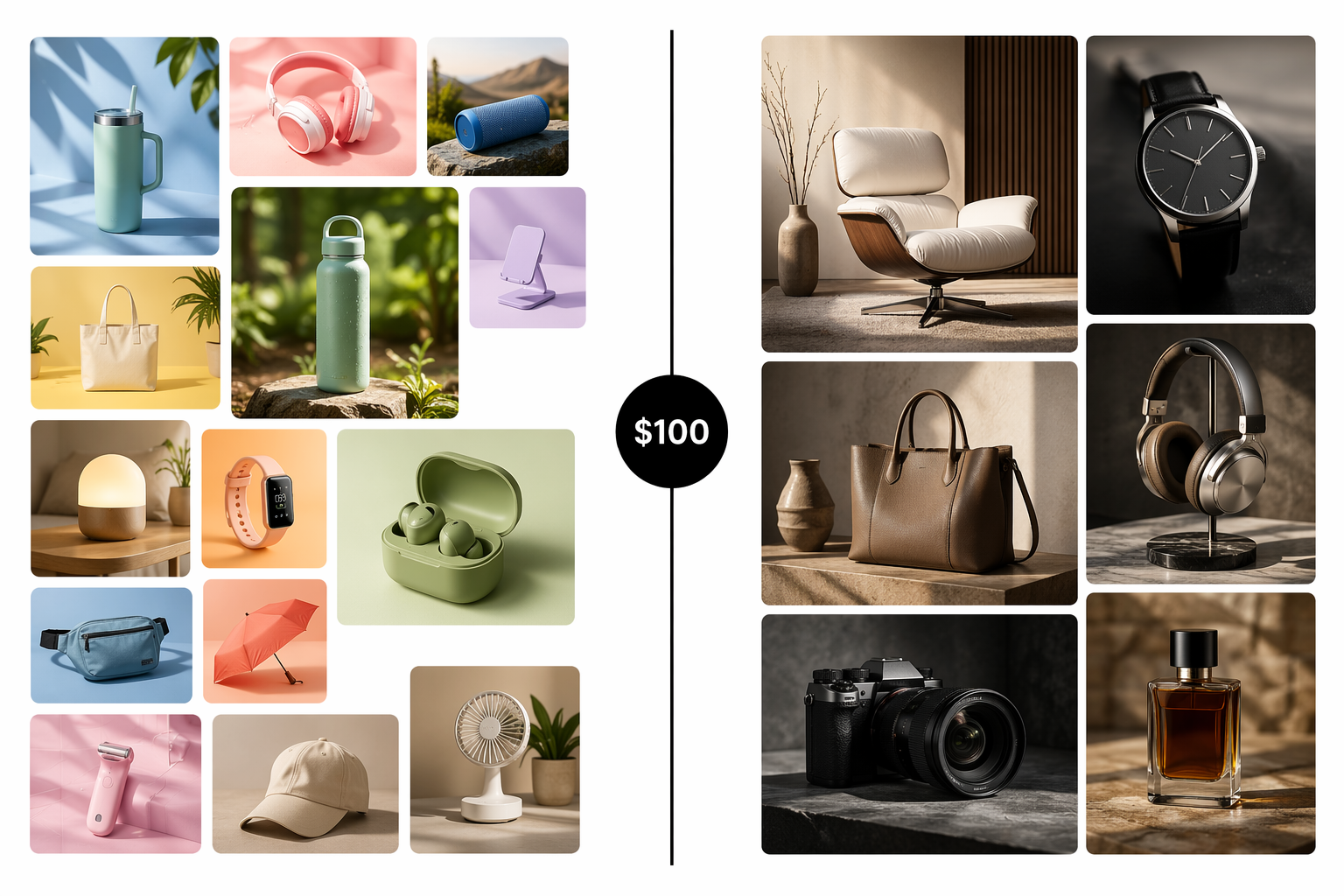
The failure pattern above $100 is not mysterious. A higher-consideration buyer is not just deciding whether the ad is interesting; they are checking whether the brand seems credible, whether the offer is worth the risk, whether the product will fit their situation, and whether the landing page confirms the promise. Survey data points in that direction: when ads are perceived as AI-generated, purchase intent drops by about 14%, premium perception by about 17%, and inspiration by about 19%. Consumer comfort with brands using AI in ads fell from 60% in 2023 to 46% in 2024, and nearly two-thirds of US adults now report unease about AI-generated ads.[5] Those figures come from different survey methodologies, so they should not be treated as a single lab-precise penalty. They are still enough to explain why CTR can rise while conversion rate and ROAS fall.
The clean allocation decision is to use AI-first creative testing for products under $100 AOV, especially when the work is background swaps, lifestyle variants, format adaptation, localization, or low-friction offer testing. From $100 upward, keep humans in charge of concept, message hierarchy, proof, objections, and trust cues, then let AI help with resizing, versioning, and controlled variations. Vendor case studies are useful for ideas, not for market-wide proof; the $100 rule itself comes mainly from one large benchmark, so vertical, audience, platform, and offer still need validation against your own conversion and ROAS data. If the next batch of ads has to choose between fifty more variants and one clearer reason to believe, the AOV band tells you which bet deserves the larger share of the budget.
References
- DigitalApplied Q1 2026 AI Advertising Benchmark, DigitalApplied, Q1 2026.
- AI Advertising Case Studies, GetHookd.
- PURE App AI-Optimized Creative Case Study, Admiral Media.
- Adidas Personalized Email Creative Case Study, Leonardom/Superside.
- AI-Generated Ads Consumer Trust Surveys, Statista/eMarketer.

Comments
Join the discussion with an anonymous comment.