

iHeartMedia
This article breaks down the actual workflows, input structures, and review gates behind seven of the most-cited AI advertising success stories, showing the system-level decisions that made the outcomes possible — and what most case study write-ups leave out.
Outcome
Campaign build compressed from weeks to one day — source: vendor case study, Jasper
AI Tools Used
This outcome is independently verified via the primary source linked above.
The least useful way to study AI advertising examples is to start with the asset count. “1,600 creatives” sounds impressive until someone on the paid media team asks what counted as a creative, who approved the claims, how variants were named, and whether the next campaign can be built without reconstructing the whole process from a vendor deck.
The seven campaigns below are worth studying because they show enough of the machinery behind the output to be useful. Some public records are stronger than others. The best-documented examples expose the same operating pattern: structured inputs before generation, modular assets before scale, review gates before launch, and channel-specific adaptation after the model has done its first pass.
| Brand | AI application | Input structure | Modular asset system | Review gate | Reported outcome | Source quality |
|---|---|---|---|---|---|---|
| iHeartMedia | Brief-to-campaign acceleration with Jasper | Structured creative briefs loaded into governed AI workflows | Multi-platform campaign outputs | Human-led campaign development and approval | Campaign build compressed from weeks to one day [1] | Vendor case study; strong workflow detail, favorable platform context |
| Salomon | High-volume visual creative generation with Pencil | Audience-insight-driven visual templates built before generation | 1,600+ creatives and 1,000+ image experiments across six markets | Implied human selection and campaign management, but review path is not deeply documented | Eight-week sprint with zero physical shoots [2] | Vendor case study; strong production-system detail, limited independent validation |
| Unilever | AI content factory using modular shoot inputs | “Super shoot” captures assets designed for later recombination | TRESemmé example: 12 benefit modules × 5 audience segments producing 200+ edits | Brand and campaign governance implied; public detail varies | 17x more content per campaign reported in roundup [3] | Secondary case-study roundup; useful operating model, thinner primary documentation in brief |
| Currys | Personalized email and dynamic creative with Jacquard and Movable Ink | Large-scale segmentation paired with AI language generation | Dynamic creative variants by audience segment | Compliance guardrails included in the workflow | 42% uplift in opens, 93% uplift in clicks, 102% revenue uplift [3] | Reported through customer-story ecosystem; strong metric set, vendor-originated |
| Adore Me | Product-description and stylist-note generation | AI workflows trained on style guides | No-code agents for recurring product copy tasks | Brand voice and description quality checks implied | Stylist note writing time reduced by 36%; marketplace description work reduced from 20 hours/month to 20 minutes [3][4] | Secondary coverage; operationally useful, less complete public workflow detail |
| Trusted Media Brands | Contextual creative variation across channels | Single creative concept adapted into many contextual versions | Thousands of variations across web, email, and social | Human creative direction implied | Scale of variations reported, without a specific performance metric in the brief [3] | Secondary roundup; good directional example, limited outcome detail |
| Superside | AI-augmented creative production model | Human creative direction combined with AI generation | Scaled creative production for campaign assets | Human-led creative oversight | Reported as an AI marketing campaign example rather than a tightly measured single campaign [5] | Publisher is also a service provider; useful for production model, not an audited benchmark |
That table is doing more than organizing brand names. It separates three things that case-study headlines often blur together: adoption of AI, production acceleration, and measurable commercial impact. A team can adopt AI and still get no campaign lift. A team can produce more assets and still create more review debt than usable media. The useful question is whether the workflow makes the next campaign easier to build, approve, launch, and measure.
There is also selection bias here. These are the examples that made it into public success-story circulation, while MIT Digital Economy research in 2025 found that most GenAI pilots delivered no measurable P&L impact. Vendor-originated metrics are not automatically wrong, but they are not neutral field evidence either. The right response is not cynicism; it is source labeling and workflow inspection.
iHeartMedia: the one-day build was a brief system, not a prompt trick
The iHeartMedia example is easy to flatten into the cleanest possible headline: campaign production went from weeks to one day. Jasper’s case study describes a human-led, AI-accelerated podcast campaign launch where structured creative briefs were loaded into governed AI workflows and turned into a complete multi-platform campaign [1].
The important phrase is not “AI-accelerated.” It is “structured creative briefs.” In a normal campaign build, a lot of time disappears before anyone writes a final ad: audience notes sit in one place, product positioning in another, legal constraints in a third, and platform specs in someone’s memory or an old launch doc. If those inputs are not standardized, AI mostly helps people generate inconsistent drafts faster.
In this case, the workflow appears to have treated the brief as a controlled input layer. That matters because a governed workflow can reuse approved campaign facts, maintain a consistent value proposition, and push variants into the right channel shapes without asking every writer to rediscover the campaign architecture. The compression from weeks to one day is documented by Jasper, so it should be read as a vendor-reported result, but the operating lesson is still sturdy: acceleration came after the intake was organized [1].
For teams trying to replicate this, the first deliverable is not a prompt library. It is a campaign intake format that separates mandatory facts from optional language, approved claims from exploratory angles, channel requirements from creative preferences, and legal constraints from brand tone. Once that exists, the model has a job. Without it, the model becomes another place where ambiguity goes to multiply.
Salomon: 1,600 creatives only matters because the templates came first
Salomon’s Pencil case study has the kind of number that makes decks travel: more than 1,600 creatives and more than 1,000 image experiments produced in an eight-week sprint, across six markets, with zero physical shoots [2]. It is a genuinely interesting production example. It is also exactly the kind of example that can send a team chasing the wrong thing.
The useful part is the preparation. The case describes audience-insight-driven visual templates and modular channel formats being built before generation started [2]. That means the team was not simply asking a model to “make outdoor ads” or “create social variations.” It had already made decisions about audience logic, visual structure, and format boundaries.
That pre-generation work is what turns AI from a novelty generator into a media production system. A template can carry an audience hypothesis. A module can hold a product angle, a scene treatment, a benefit, or a format constraint. A channel format can determine whether a variant is useful for paid social, display, email, or marketplace placements. The model fills and recombines; the system decides what is worth generating in the first place.
The “zero shoot” detail is also operationally important. Physical production is slow partly because every shot has to be valuable enough to justify coordination, talent, location, weather, product logistics, and post-production. A modular AI workflow changes the economics of experimentation. It lets a team test more visual hypotheses without pretending each one deserves a full shoot. That does not remove the need for human taste or review; it moves human judgment earlier into template design and later into selection.
The public case gives strong production detail, but it is still a vendor case study. The reported volume should not be treated as a universal benchmark. A skincare brand, a regulated financial advertiser, and an outdoor apparel brand do not have the same visual risk profile. What transfers is the architecture: build the audience and format grid first, then generate inside it.
Unilever: the content factory starts at the shoot, not inside the model
Unilever’s AI content factory is the clearest reminder that AI advertising workflows do not always begin with synthetic generation. The reported model uses a “super shoot” to capture modular assets, then feeds those assets into AI workflows for recombination and adaptation. Pragmatic Digital’s roundup reports that the system produces 17x more content per campaign [3].
The TRESemmé example is more useful than the headline ratio. It describes more than 200 edits created from 12 benefit modules across 5 audience segments [3]. That is an asset taxonomy. It tells the production team what to capture, the content team how the message can vary, and the media team how variants can map to segments.
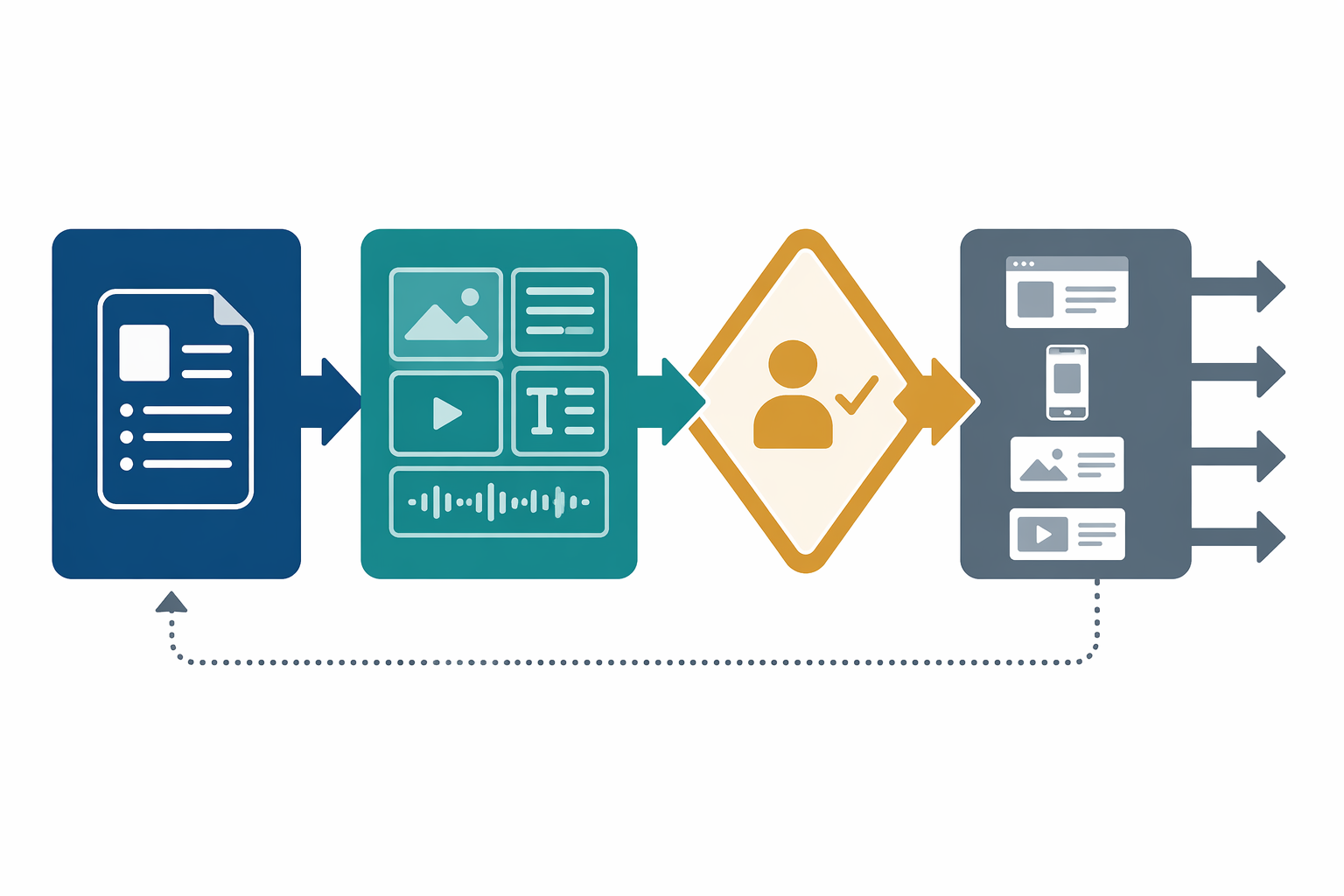
This is where many AI content programs quietly fail. They ask the model to create variations from finished creative, but the finished creative was never built to be disassembled. The logo is baked into the wrong area. The product shot does not work in vertical. The benefit line depends on copy that only makes sense in one market. The talent usage rights are unclear. The legal disclaimer cannot survive resizing. The output volume rises, but the usable asset pool barely moves.
A modular shoot reverses that. It treats the campaign as a set of future combinations: product, benefit, audience, format, market, claim, background, usage context. AI then becomes a scaling layer on top of production planning, not a rescue tool after production has already locked the campaign into one shape.
The public documentation in the brief comes through a secondary case-study roundup, so the details should be handled with more caution than a full primary operations report. Still, the structure is worth stealing. If a brand wants modular AI content, the shoot brief has to include the modules. Waiting until post-production to discover the system needs clean backgrounds, isolated benefit moments, separate pack shots, and segment-specific proof points is how “AI scale” becomes a retouching queue.
Currys: personalization worked because language, segmentation, and compliance stayed connected
Currys is the most useful example for teams that are less worried about making thousands of images and more worried about governed personalization. The reported workflow combined large-scale segmentation with AI language generation, compliance guardrails, and dynamic creative through Jacquard and Movable Ink. Reported results were a 42% uplift in opens, a 93% uplift in clicks, and a 102% revenue uplift [3].
Those metrics are attractive, but the workflow design is the part to inspect. AI language generation on its own can create a new problem for email and CRM teams: too many subject lines, too many message variants, and too many chances for a claim, offer, or tone choice to drift outside what the business can stand behind. Segmentation on its own can create a different problem: increasingly precise audiences receiving generic language because the copy process cannot keep up.
The Currys setup matters because the pieces were connected. Segments shaped the message need. AI generated language for those needs. Dynamic creative delivered variation. Compliance controls sat inside the workflow rather than appearing as a final panic step. That is the difference between personalization as an operating model and personalization as a last-minute merge field.
For a paid media or lifecycle team, the transferable move is to define what the model is allowed to vary. Subject line angle, benefit emphasis, product category cue, urgency level, and proof point might be variable. Price claims, financing language, regulated terms, exclusions, and brand safety rules may need to be locked or routed through stricter approval. The workflow should know the difference before creative generation begins.
Because the metrics are reported through the customer-story ecosystem referenced in the roundup, they should be labeled as vendor-originated rather than independently audited. That caveat does not make the case useless. It tells you how to use it: not as a guaranteed uplift model, but as evidence that governed personalization requires segmentation, generation, compliance, and delivery to be designed together.
The lighter cases still point to the same machinery
Adore Me, Trusted Media Brands, and Superside have thinner public documentation in the provided source set, so they should not carry the same evidentiary weight as the iHeartMedia, Salomon, Unilever, and Currys examples. They are still useful because they show the pattern appearing in different production environments.
Adore Me: recurring copy work becomes an agent workflow
Adore Me’s reported use case is less cinematic than a zero-shoot visual sprint, which is why it may be more relevant to many operators. The brand reportedly trained AI workflows on style guides and built no-code agents for product descriptions. The cited outcomes were a 36% reduction in stylist note writing time and a reduction in marketplace description work from 20 hours per month to 20 minutes [3][4].
The useful detail is the style guide training. Product-description work has a high failure rate when teams treat it as generic copy generation. Fit, fabric, sizing language, merchandising priorities, marketplace requirements, and brand voice all have to survive repetition. A no-code agent can help only if the recurring task is constrained enough to check.
This is not an ad campaign in the same sense as Salomon or Currys, but it belongs in the set because product copy feeds paid media, shopping ads, marketplaces, landing pages, and email modules. Weak product content becomes weak advertising input. Cleaning that layer can create leverage before the media team ever opens a campaign builder.
Trusted Media Brands: one concept, many contextual versions
Trusted Media Brands is described as using AI to adapt a single creative concept into thousands of contextual variations across web, email, and social [3]. The brief does not provide a specific performance outcome, so the safest reading is production-oriented: AI helped scale contextual adaptation from a core idea.
That is still a meaningful pattern. Many teams do have a strong central concept; what they lack is the capacity to express it across placements, audiences, seasons, and content contexts without diluting it. The risk is fragmentation. The operating answer is not just “generate more versions.” It is to define the creative constant before generating the contextual variables.
Superside: AI production still needs creative direction
Superside’s AI-augmented production model is described as combining human creative direction with AI generation at scale [5]. Since Superside is also a service provider, the example should be read as a production model rather than an independent performance proof.
Its inclusion is still useful because it names a boundary that less disciplined AI rollouts try to erase: creative direction remains a job. Someone has to decide what the campaign is trying to make true in the market, which ideas deserve variation, which executions are on brand, and which outputs are simply abundant noise.
The recurring workflow pattern
Across these AI advertising examples, the useful pattern is narrower than the hype cycle suggests. The successful workflows were not open-ended conversations with a model. They were production systems with inputs, modules, permissions, and outputs.
- Structured pre-production: briefs, audience insights, style guides, product facts, and campaign constraints were organized before generation.
- Modular asset design: teams worked with reusable parts, such as benefit modules, audience segments, channel formats, product descriptions, and contextual variants.
- Governed review: human oversight stayed in the process, especially where brand voice, compliance, claims, and creative selection mattered.
- Channel adaptation: outputs were shaped for actual distribution environments instead of being treated as generic creative inventory.
- Measurement discipline: the strongest cases reported time compression, production volume, engagement lift, or revenue lift, while weaker public cases mainly documented production scale.
Prompting sits inside that system, but it is not the system. A good prompt cannot compensate for an unclear offer, an undefined audience, missing usage rights, unapproved claims, or a creative taxonomy that collapses after the first ten variants. This is why the more useful implementation work usually looks like operations: naming conventions, intake fields, template libraries, approval routing, claim controls, and post-launch reporting.
Teams that want to turn these examples into their own workflow can use a governed implementation model like the AI Creative Advertising Playbook. If the job is broader than advertising production, the examples grouped by function in 15 AI Marketing Examples Organized by What You Actually Do are a better next stop. And if the unresolved question is who approves what before AI-generated creative reaches customers, the governance problem is treated more directly in The AI-Targeted Advertising Trap.
What to copy from these examples
The practical takeaway is not that every brand needs 1,600 AI creatives, a super shoot, or a fully personalized email engine. The next move depends on where the current workflow breaks.
| If the bottleneck is... | Copy this pattern | Borrow most from |
|---|---|---|
| Campaigns take too long to brief and launch | Standardize the intake brief and route generation through governed workflows | iHeartMedia |
| The team cannot produce enough variants for markets or channels | Build audience-informed templates and modular format grids before generation | Salomon |
| Shoots produce beautiful assets that cannot be reused efficiently | Plan the shoot around reusable modules and future recombination | Unilever |
| Personalization creates review and compliance risk | Connect segmentation, AI language generation, dynamic creative, and guardrails | Currys |
| Product copy slows down downstream media execution | Train recurring workflows on style guides and constrained content rules | Adore Me |
| One strong idea needs many contextual expressions | Lock the creative constant, then vary context by channel and audience | Trusted Media Brands |
| Creative volume is rising faster than internal direction capacity | Keep human creative direction as the control layer over AI production | Superside |
The better question for the next planning meeting is therefore simple: what has to be structured before generation so that the output is usable after generation? Once that is answered, model selection becomes one decision inside a larger campaign operating system. Without that answer, even the newest model will mostly help the team make more unfinished work.
References
- Inside iHeartMedia's Human-Led, AI Accelerated Podcast Campaign Launch — Jasper
- Salomon: 1,600+ Creatives, No Shoot, Six Markets — Pencil
- 7 AI Advertising Case Studies: What Actually Drives Results — Pragmatic Digital
- 13 Best AI Advertising Campaigns in 2026 — WASK Blog
- 9 AI Marketing Campaigns Pushing Creative Boundaries in 2026 — Superside


Comments
Join the discussion with an anonymous comment.