
Jasper AI
A data-driven analysis for marketing directors, VPs, and CMOs who need to justify AI platform spend. Covers the Forrester TEI findings (342% ROI), the industry-wide measurement gap (only 41% of marketers can prove AI ROI), and a practical framework for building your own ROI case.
Key Integrations
Marketing Categories
⚠ Notable Limitations
Forrester TEI 342% ROI reflects a composite organization, not all customers; vendor-commissioned study
The AI ROI Problem: Adoption Is High, Proof Is Low
Marketing teams have crossed the adoption tipping point. According to Jasper's State of AI in Marketing 2026 report, which surveyed 1,400 marketers, 91% of marketing teams now use AI — up from 63% the previous year. That is not a fringe experiment anymore; it is the standard operating model for nearly every team that responded.
But here is the number that should give every marketing director and CMO pause: only 41% of those teams can confidently prove the ROI of their AI investment. That figure actually dropped from 49% in 2025. The report attributes the decline not to worse performance but to rising expectations — as teams deploy AI more broadly, the bar for what counts as "proof" has moved higher.
The gap between adoption and proof creates a real problem for senior leaders. You cannot defend a six-figure platform subscription to your CFO with vibes and anecdotal success stories. You need a measurement framework that connects AI activity to business outcomes — and most teams do not have one.
The CMO-IC Confidence Gap
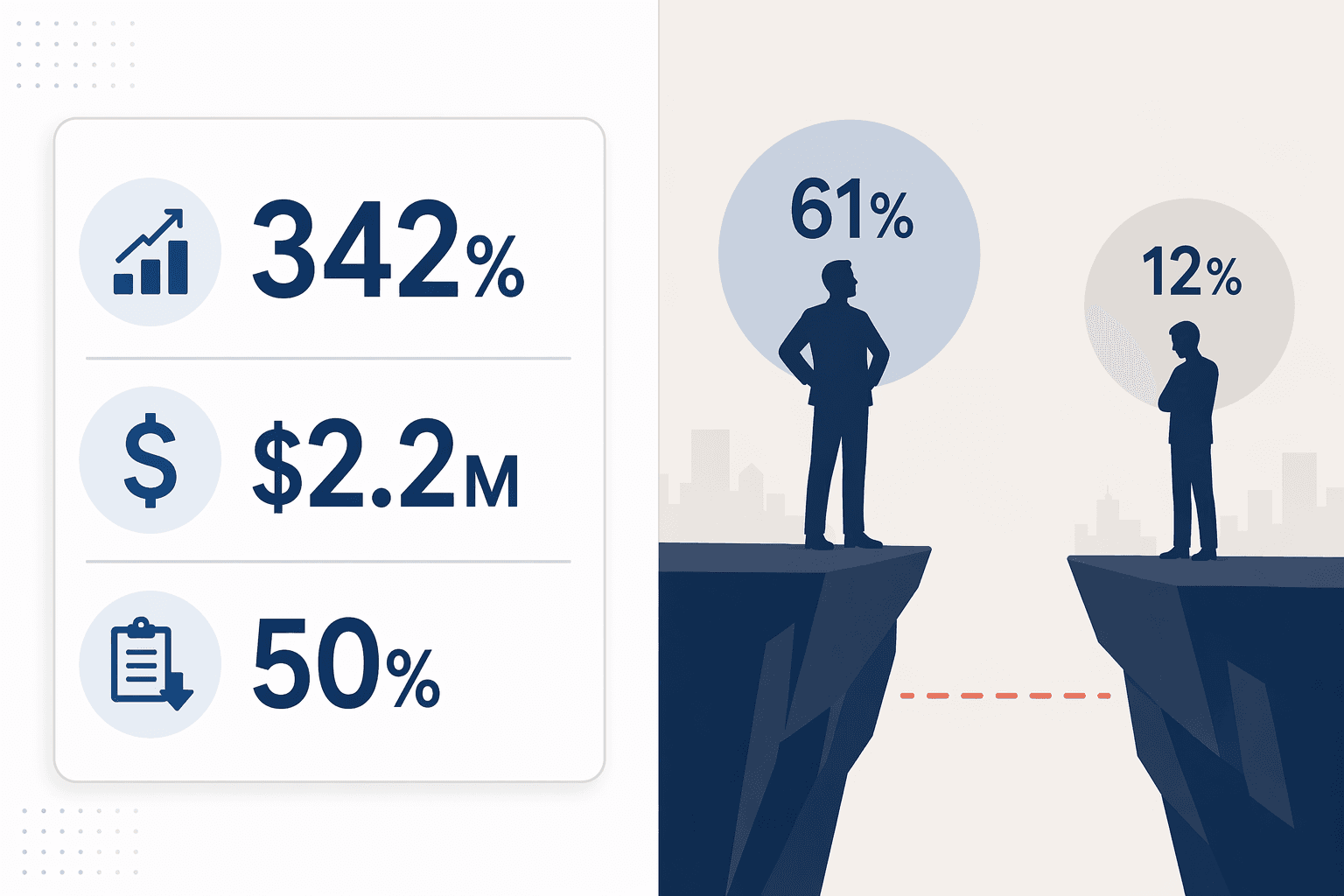
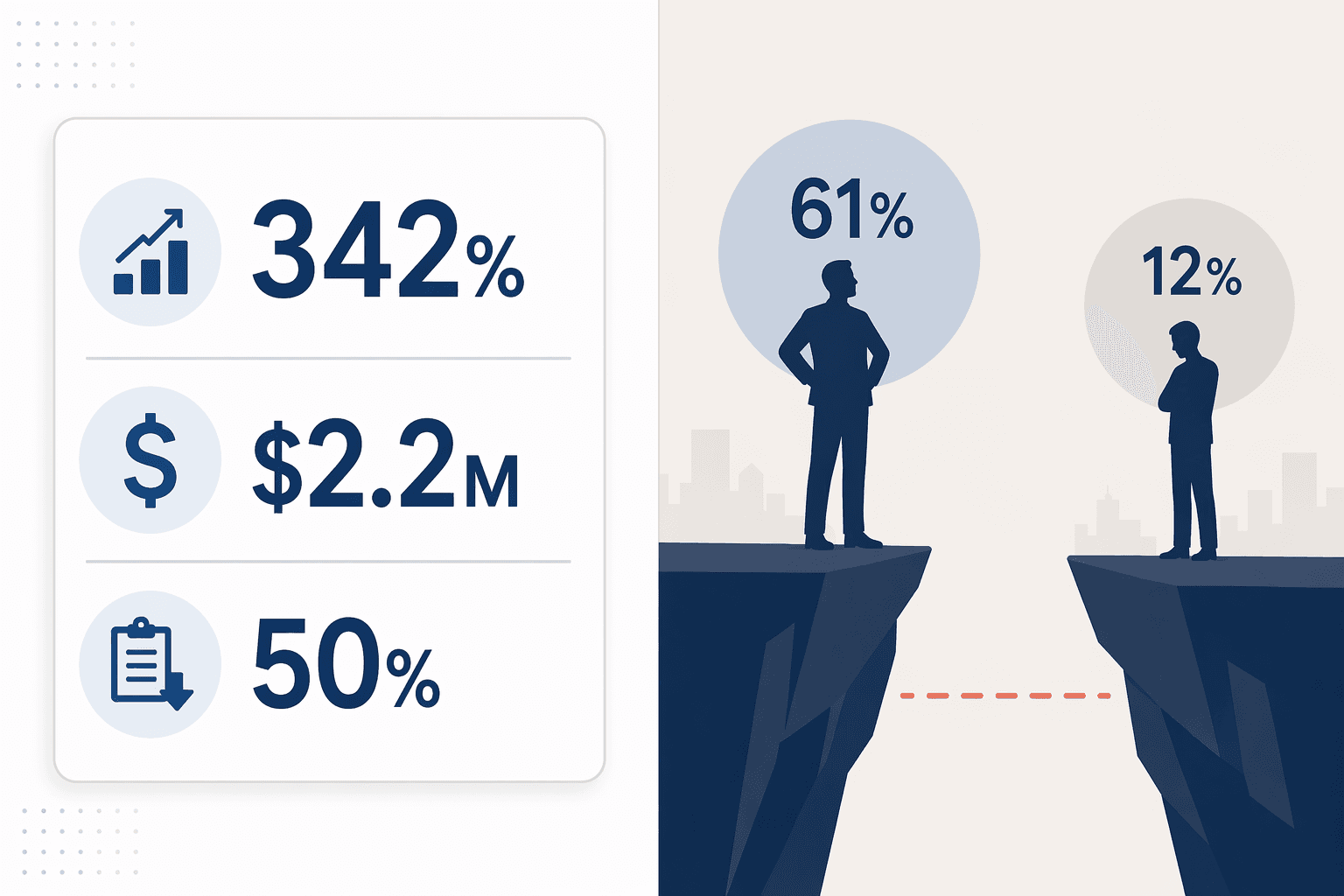
One of the more revealing data points from the same survey is what the report calls the CMO-IC confidence gap. When asked about confidence in AI ROI, 61% of CMOs reported feeling confident. Among individual contributors, that number dropped to 12%. That is not a small disagreement — it is a five-to-one gap between the people approving the budget and the people using the tools day to day.
This gap matters because it signals a structural problem. If the people doing the work cannot see the return, the measurement framework is either missing, poorly communicated, or measuring the wrong things. Tools alone will not close this gap. You need a deliberate approach to tracking, reporting, and connecting AI outputs to business outcomes.
What the Forrester TEI Study Actually Found
The most frequently cited piece of ROI evidence for Jasper is the Forrester Total Economic Impact (TEI) study, commissioned by Jasper and published in September 2025. Forrester Consulting conducted the study using their established TEI methodology, which models the financial impact of a technology investment based on interviews with multiple customers and then aggregates the results into a composite organization.
The headline numbers are striking:
- 342% return on investment over three years
- $2.2 million in annual time savings for a composite organization with 300 users
- 50% reduction in rework through brand-aligned outputs
- Payback period of less than six months
- $1.1 million in avoided outsourcing costs annually
- 31,200 content pieces produced per year by the composite organization
The study also documented dramatic compression of content production timelines. Blog creation went from six weeks to two days. Content production overall was reduced by two-thirds. These are not incremental improvements — they represent a fundamental change in the cost structure of content operations.
Forrester's TEI methodology is well-established and widely used across enterprise technology evaluations. The study provides a defensible framework for building an ROI projection — but the numbers are a modeled scenario, not a promise. When you present these figures to your CFO, you need to explain both the methodology and its limitations.
Real Customer Examples: Where the Numbers Come From
The TEI study draws on interviews with several Jasper customers. Their individual results, documented in Jasper's case studies, provide concrete examples of what the composite numbers represent in practice.
Old Dominion Freight Line
Dick Podiak, VP of Marketing & Communications at Old Dominion Freight Line, described the pre-Jasper reality as a team "weighed down by time-consuming processes." After adopting the platform, the team was able to "quickly and consistently produce high-quality, industry-relevant content that stays true to our brand voice." The company used Jasper to improve search rankings, increase blog traffic and engagement, and accelerate content creation for new hires — reducing the ramp time for new team members to produce on-brand content.
Cushman & Wakefield
The global commercial real estate firm reported freeing more than 10,000 hours per year across its marketing operations. Content output increased by 50% without adding headcount. For a large enterprise with distributed teams, the time savings translated directly into capacity — more content, faster iteration, and reduced dependency on external agencies.
Webster First Federal Credit Union
This mid-size credit union achieved one of the most dramatic efficiency gains documented in Jasper's case studies: a 93% reduction in blog production time. The team shipped four times more content without adding staff. For organizations with small marketing teams — Webster First is not a 300-person enterprise — this kind of leverage is the primary value proposition.
VertoDigital
The digital agency cut time-to-market for content by 50%. For an agency operating on client deadlines and billable hours, faster turnaround directly improves margin and client satisfaction.
Three Categories Where Marketing AI Shows ROI
Jasper's Director of Business Value Services, Joyce Yi, published a framework in December 2025 that organizes AI marketing ROI into three categories. This structure is useful for leaders because it moves beyond a single number and forces you to think about where value actually appears in your specific operation.
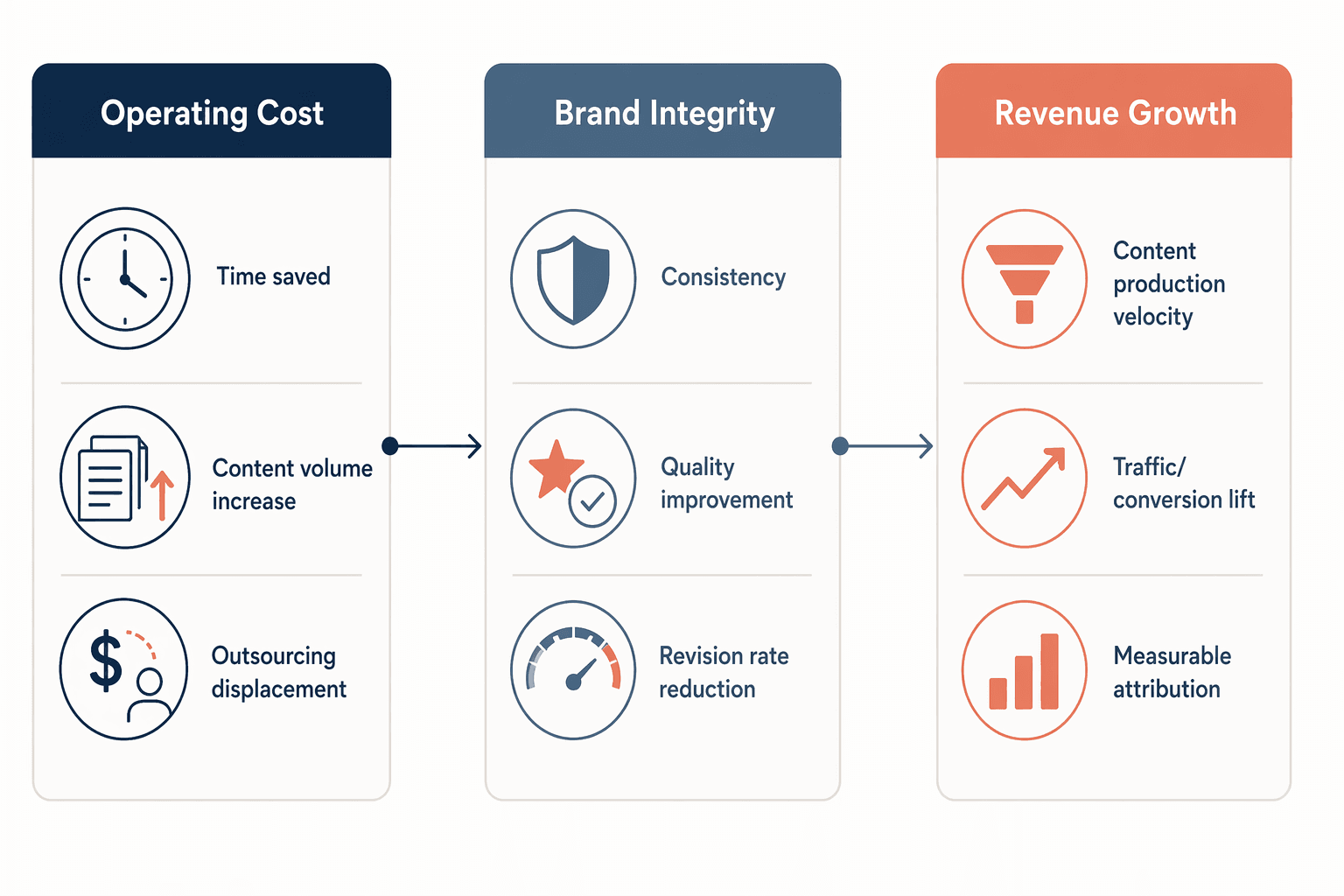
| Category | What It Measures | Example from Jasper Customers |
|---|---|---|
| Reduce operating cost | Time savings, content volume, outsourcing displacement | Webster First: 93% faster blog production, 4x volume without new hires |
| Protect brand integrity | Consistency, quality scores, revision rate reduction | Old Dominion: faster new-hire ramp through brand-aligned templates |
| Drive revenue growth | Pipeline velocity, traffic lift, attribution | VertoDigital: 50% faster time-to-market for client content |
Most teams start with the first category because it is the easiest to measure. Time saved and content volume are directly observable. But the second and third categories — brand integrity and revenue growth — are where the strategic value lives. A 50% reduction in rework does not just save time; it means your brand shows up consistently across every touchpoint. Faster time-to-market does not just improve efficiency; it lets you respond to market signals before your competitors.
The challenge is that brand integrity and revenue growth are harder to isolate and attribute. If your blog traffic increases 30% after adopting Jasper, how much of that is the tool versus your SEO strategy, your distribution channels, or seasonal demand? This is where the measurement framework becomes critical — and where most teams fall short.
The Crawl-Walk-Run Maturity Model for ROI Measurement
Yi's framework also includes a maturity model that maps how teams progress from basic efficiency tracking to full financial impact measurement. This model is useful for diagnosing where your team currently stands and what you should measure next.
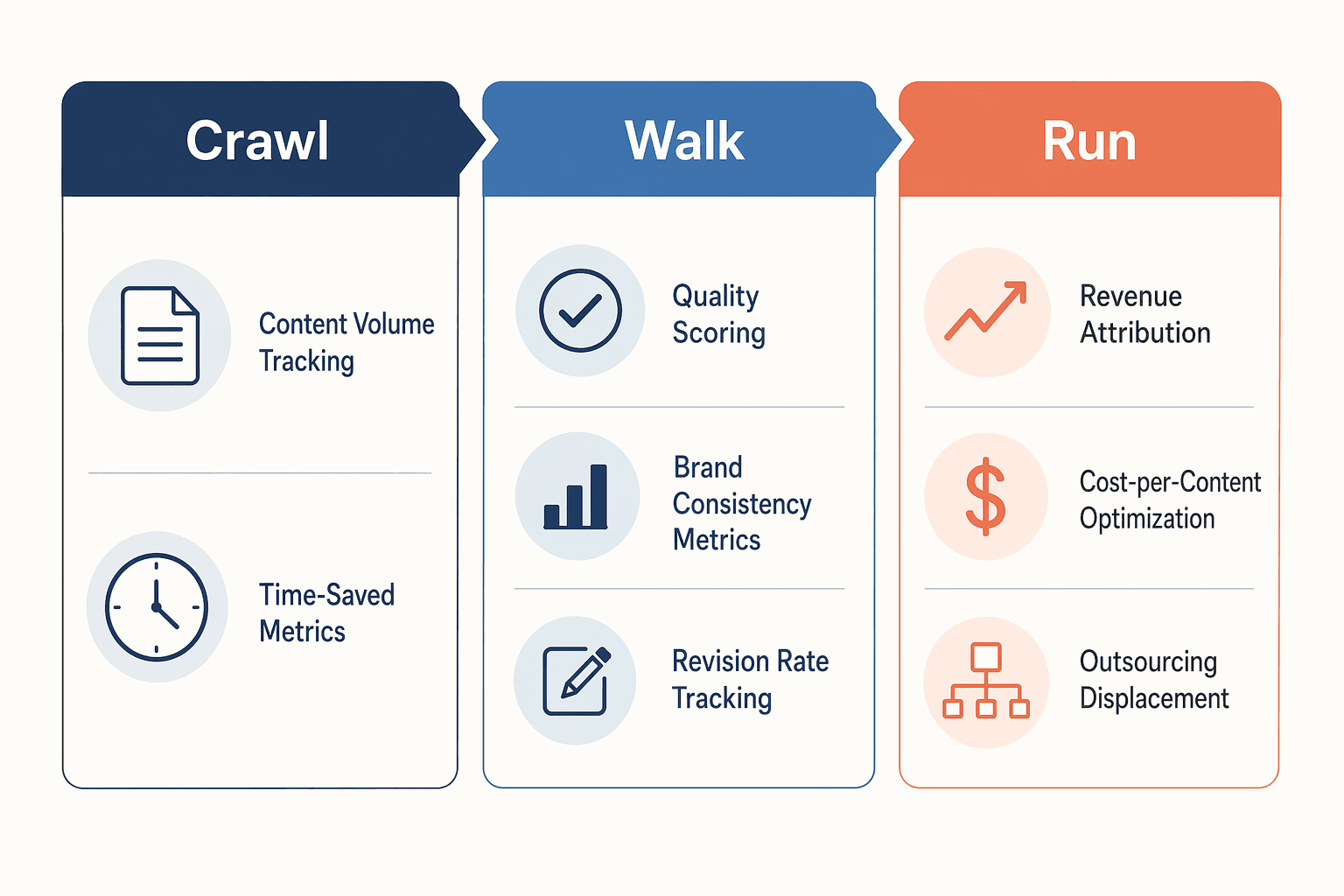
| Stage | Focus | Metrics to Track | Typical Timeline |
|---|---|---|---|
| Crawl | Efficiency | Content cycle time, volume per week, time per piece, cost per piece | First 1-3 months |
| Walk | Performance | Quality scores, brand consistency audits, revision rate, stakeholder satisfaction | 3-6 months |
| Run | Financial impact | Revenue attribution, cost-per-content, outsourcing displacement, pipeline contribution | 6-12 months |
Most teams are in the Crawl stage. They can tell you how many pieces of content they produced and how fast, but they cannot tell you whether that content is better or whether it drove revenue. That is not a failure — it is a starting point. The goal is to move deliberately through each stage, adding measurement sophistication as your team's AI maturity grows.
The Walk stage is where many teams get stuck. Measuring quality and brand consistency requires subjective judgment or structured audits. It is easier to count outputs than to assess outcomes. But without Walk-stage metrics, you cannot make the case that AI is improving your marketing — only that it is making you faster.
The Run stage is where you connect AI activity to financial results. This requires attribution models, controlled experiments, or at minimum, clear correlation between AI-driven content and pipeline movement. Few teams achieve this stage, which is consistent with the survey finding that only 41% can prove ROI. The teams that can prove it are the ones that have built the measurement infrastructure to support Run-stage analysis.
Limitations: What the Data Doesn't Tell You
A responsible analysis of Jasper's ROI data requires acknowledging what the numbers do not cover. The Forrester TEI study is the strongest third-party evidence in the AI marketing category, but it has structural limitations that matter when you are building a business case.
- The 342% ROI is based on a composite organization, not an average of all customers. The composite assumes 300 users, a specific content volume, and a particular organizational structure. Your results will differ based on team size, content needs, and adoption quality.
- The study is commissioned by Jasper. Forrester applied its TEI methodology, but the selection of reference customers and the framing of the analysis are influenced by the vendor relationship.
- The State of AI in Marketing 2026 report is self-funded by Jasper's marketing team. While the sample size of 1,400 is respectable, the survey design and question framing may introduce bias toward favorable results.
- Customer case studies are vendor-sourced testimonials. The companies that agree to be featured in case studies are typically the most successful ones. They are not a random sample.
- No independent analyst reports (Gartner Magic Quadrant, Forrester Wave) were available during the research period to cross-reference Jasper's claims against an unbiased third-party evaluation.
A Practical Framework for Building Your Own ROI Case
If you are a marketing director or VP preparing to justify a Jasper investment — or to defend an existing one — here is a step-by-step framework based on the data and models discussed above. This is not theoretical. It is designed to produce the kind of evidence that finance teams and executive leadership actually trust.
Step 1: Define Your Baseline Metrics
Before you implement or expand AI, document your current state. You need at least these baseline numbers:
- Current content volume per month (pieces produced, by type)
- Average cycle time per content type (from brief to publish)
- Revision rate (average number of revision rounds per piece)
- Outsourcing spend per month or quarter
- Headcount hours dedicated to content production
- Current content performance metrics (traffic, engagement, conversion by content type)
Without a baseline, you cannot measure improvement. This is the single most common reason teams cannot prove ROI — they started tracking after they already deployed the tool.
Step 2: Identify Your Primary ROI Category
Using the three-category framework, decide where your team is most likely to see measurable impact. For most teams, the answer is operating cost reduction — it is the fastest to measure and the most directly attributable. But if your team is already efficient, brand integrity or revenue growth may be the better focus.
Step 3: Set Up Tracking Before Implementation
This is the most important operational step. Configure your analytics, project management tools, and reporting dashboards to capture the metrics you identified in Step 1 before you roll out the tool. If you wait until after implementation, you lose the before-and-after comparison that makes ROI calculations credible.
Step 4: Choose a Pilot Scope
Do not try to measure ROI across your entire content operation at once. Pick a single content type — blog posts, email newsletters, or social copy — and a single team or channel. Run the pilot for 60 to 90 days. Measure the before-and-after on your chosen metrics. This controlled approach produces cleaner data and reduces the risk of confounding variables.
Step 5: Report Using the Crawl-Walk-Run Model
When you present your results to leadership, structure the report by maturity stage. Start with Crawl metrics (efficiency gains) because they are the most defensible. Then present Walk metrics (quality and consistency) if you have them. If you have Run-stage data (revenue attribution), that is your closing argument. Most teams will only have Crawl data after a 90-day pilot — and that is fine. The Forrester TEI study itself is primarily a Crawl-stage analysis with some Walk-stage elements.
For a deeper look at how to build the leadership case for AI investment, see our companion article on making the AI market research ROI case to your leadership team. And if you are evaluating Jasper alongside other platforms, our comprehensive Jasper AI platform review covers the full feature set and governance capabilities that drive the ROI numbers discussed here.
The data shows that Jasper has the strongest third-party ROI evidence in the AI marketing category. But evidence is not proof — it is the raw material for building your own case. The teams that succeed are the ones that invest in measurement infrastructure alongside the tool itself. The tool delivers the leverage. The measurement framework delivers the justification.

Comments
Join the discussion with an anonymous comment.