
Google and Samsung AI Ad Targeting Compared for Media Buyers
A side-by-side comparison of the ad targeting signals and AI features in Google's and Samsung's ecosystems, helping media buyers decide where to allocate spend based on funnel type and audience quality.
- Platform
- Google Ads0 Samsung Ads
- Campaign type
- Performance Max, Performance TV0 Smart Bidding
- Spend range
- All spend levels
- Timeframe
- 0
- Conversions, CPA, Reach
- 0% conversion lift (AI Max)
- Verdict
- mixed
- Last reviewed
- 0-07-30
A media buyer comparing Google Pixel vs Samsung Galaxy AI features for ad targeting should get past the handset question quickly. Pixel and Galaxy matter here mostly as shortcuts for two different ad signal ecosystems: Google turns visible intent from Search, YouTube, Performance Max, AI Max, Gemini-enabled workflows, Android scale, and web behavior into bidding decisions; Samsung turns proprietary TV, mobile, and household-device data into audience construction, CTV reach, and cross-device exposure paths.
That distinction changes the allocation question. The useful comparison is not which phone has the smarter assistant. It is which signal surface sits closest to the campaign outcome you need to defend after the buy runs.

The Signal Map Media Buyers Actually Need
| Buying question | Google ecosystem | Samsung ecosystem | Planning implication |
|---|---|---|---|
| Primary signal surface | Search intent, YouTube engagement, web behavior, Performance Max, AI Max, Gemini-assisted campaign workflows | Samsung Ads, Audience Collectives, Performance TV, Optimal Reach, TV plus mobile device signals | Google starts closer to declared demand; Samsung starts closer to owned exposure and device-defined audiences. |
| Most natural funnel fit | Lower-funnel and mid-to-lower-funnel conversion capture | Upper-funnel and mid-funnel reach, CTV exposure, household and device-defined audience building | Use Google when the buyer is already showing intent; use Samsung when the job is to create or qualify exposure before search demand appears. |
| 2026 AI targeting claim | AI Max delivered 7% more conversions at similar CPA in Google internal reporting; Smart Bidding Exploration produced a 27% lift in unique converting users in Google Marketing Live 2026 coverage [1][2] | Samsung said its AI-enhanced Audience Collectives include 250+ mobile audience segments, including 160+ purchase intent categories [3] | Google has the clearer conversion-optimization claim; Samsung has the clearer first-party audience taxonomy. |
| Reach and device graph angle | Android provides broad mobile operating-system scale; Digital Applied cites Android at 71% global OS share in 2026 mobile marketing benchmarks [4] | Samsung's Optimal Reach reported +39% incremental viewers and 65%+ of viewers unreachable via SVOD in Samsung's NewFronts materials [5] | Android scale helps Google’s signal density; Samsung’s TV-mobile footprint helps incremental CTV reach planning. |
| Evidence quality | Platform-published performance claims, not an independent head-to-head audit | Platform-published reach and segment claims, plus older conversion-rate evidence from Samsung-related first-party data buying | Treat both as planning inputs, then validate against your own incrementality, conversion, or brand-lift measurement. |
The table is where the device-brand argument usually falls apart. Pixel implies Google’s ad stack, not just a phone. Galaxy implies Samsung’s device and TV footprint, not just a premium Android alternative. For budget allocation in Q3 2026, the platform with the better phone camera is not the platform with the better campaign objective fit.
Where Google Has the Cleaner Conversion Case
Google’s advantage starts with signal proximity. A search query can express a need, a comparison, a brand preference, a price sensitivity, or an urgent local requirement in a way that a device ownership segment usually cannot. When that intent is paired with web behavior, YouTube engagement, Performance Max inventory, and automated bidding, the system has more chances to decide whether the next impression should be paid for as a conversion opportunity rather than as general audience exposure.
AI Max is relevant because it sits directly inside that intent environment. Google said Dynamic Search Ads are upgrading to AI Max, and its internal reporting put AI Max at 7% more conversions at a similar CPA in April 2026 materials [1]. That is the kind of number a performance buyer can translate into a budget conversation, with one large caveat: it is Google’s own data, not an independent audit against Samsung or any other ecosystem.
Smart Bidding Exploration strengthens the same lower-funnel argument, but only within the limits of the source. CMSWire’s Google Marketing Live 2026 coverage reported a 27% lift in unique converting users tied to Smart Bidding Exploration [2]. The useful reading is not that every account will see that lift. It is that Google is pushing automation toward finding incremental converters outside the buyer’s obvious manual keyword, audience, or target-CPA comfort zone.
That matters when a campaign has a hard conversion KPI. A buyer defending a lead-gen, ecommerce, app acquisition, or high-intent remarketing plan needs evidence that the platform can see enough intent and adjust bids fast enough to locate additional converting users. Google’s mix of Search, YouTube, web behavior, Performance Max, AI Max, and Gemini-assisted workflows gives it the stronger default argument for that job.
The Gemini layer is more of a workflow and optimization context than a standalone targeting proof. It is still worth tracking because campaign creation, creative variation, search expansion, and reporting interpretation increasingly sit inside AI-assisted interfaces. Buyers evaluating Google’s roadmap can keep an eye on Google Gemini model roadmap relevance and the difference between paid AI products and ordinary Ads automation through Google AI Pro features vs free Ads tools. The targeting claim still belongs to the ad products and their measured outcomes, not to the existence of a newer model name.
Where Samsung Deserves Budget Consideration
Samsung’s case is different enough that judging it by Google’s conversion yardstick misses the point. Samsung Ads is strongest where the planner cares about exposure quality, CTV reach, household context, device ownership, and mobile retargeting after a TV impression. That is not a weaker version of Search. It is a different place in the funnel.
The most concrete 2026 audience detail is Samsung’s AI-enhanced Audience Collectives. Samsung said the offering includes 250+ mobile audience segments, with 160+ purchase intent categories [3]. Those categories do not prove cheaper conversions. They do show that Samsung can package first-party mobile signals into audience definitions that a buyer can actually activate, rather than asking the buyer to accept a vague “premium device owner” label.
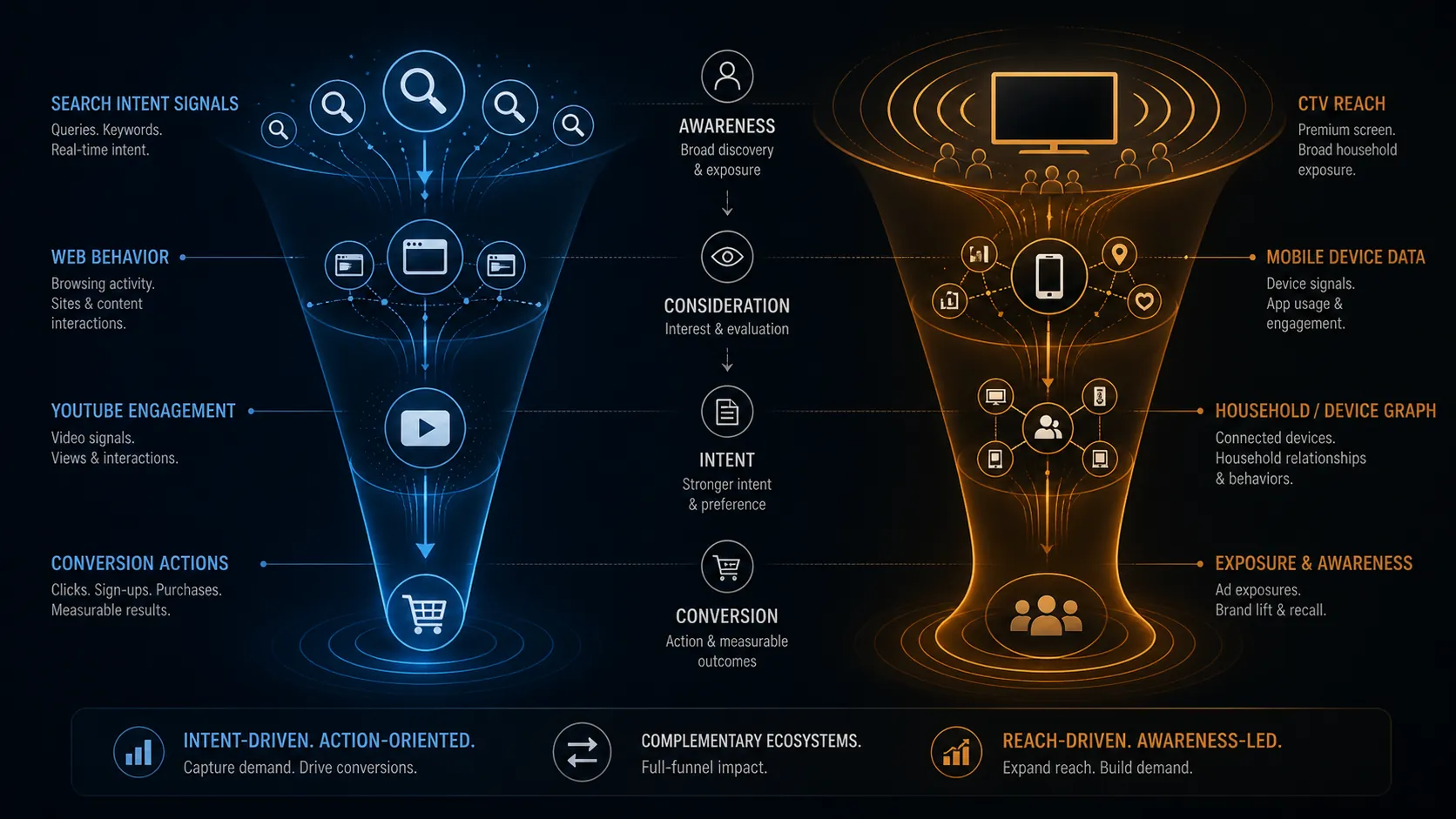
Performance TV and Optimal Reach add the part Google cannot copy cleanly through search intent alone: the television exposure layer. Samsung’s March 2026 NewFronts materials said Optimal Reach delivered +39% incremental viewers and reached 65%+ of viewers unreachable via SVOD [5]. For a buyer trying to extend CTV reach without simply buying the same streaming households again, that is a relevant planning claim.
The TV-to-mobile bridge is where Samsung becomes more than a CTV inventory seller. If a household sees a CTV ad and Samsung can later connect that exposure to mobile retargeting or audience sequencing inside its ecosystem, the campaign can move from broad reach to qualified follow-up. That workflow is especially useful for categories where purchase demand is shaped before the search happens: consumer electronics, home services, automotive consideration, travel, finance, and other purchases where the household may research across several sessions and screens.
Samsung also has a spending-power argument. In an AdMonsters interview, Samsung Ads VP Justin Fromm discussed ARF survey findings based on 50,000+ respondents and positioned Samsung users as having higher spending power [6]. That does not mean Samsung inventory will automatically outperform on CPA. It does mean Samsung can be a serious audience-quality buy when the plan values affluent reach, household device context, and owned-screen exposure.
For buyers working through the CTV side of the plan, the relevant benchmark conversation is closer to CTV AI targeting benchmarks than to a Pixel-versus-Galaxy feature checklist. The question is whether Samsung’s device graph, TV footprint, and audience packages create incremental reach or better-qualified exposure than the CTV alternatives already in the plan.
A Practical Funnel Split
| Campaign objective | Stronger default fit | Why |
|---|---|---|
| High-intent search capture | The user is already declaring intent through queries or related behavior, and Google’s bidding tools are built to price that intent. | |
| Performance Max conversion scaling | AI Max, Performance Max, and Smart Bidding Exploration are directly tied to conversion optimization claims, though those claims are platform-published. | |
| CTV reach extension | Samsung | Optimal Reach and Performance TV are built around incremental TV audience exposure rather than query-level intent. |
| Affluent or device-defined audience access | Samsung | Samsung’s first-party device footprint and ARF-survey-backed spending-power positioning make this a cleaner audience-quality argument. |
| Search demand creation before active shopping | Samsung first, Google later | Samsung can create or qualify exposure through TV plus mobile paths; Google can capture and optimize once visible intent appears. |
| Strict last-click or CPA defense | The conversion evidence is more directly aligned with lower-funnel measurement, even though it still needs account-level validation. |
The split is not permanent. A sensible plan can use Samsung to build exposure among a defined household or device audience, then use Google to harvest demand as users move into search, YouTube, shopping, maps, app, or web conversion paths. The mistake is asking Samsung to behave like paid search, or asking Google’s lower-funnel automation to solve every reach-quality problem.
The Caveats That Belong in the Media Plan
The first caveat is source quality. Google’s 7% AI Max conversion lift and 27% Smart Bidding Exploration lift are useful platform-reported signals, but they are not independent proof that Google will beat Samsung for a given advertiser [1][2]. Samsung’s 250+ mobile segments, 160+ purchase intent categories, and Optimal Reach numbers are also platform-published claims, not an independent matched-market test against Google [3][5].
The second caveat is age. AdExchanger reported that brands using first-party data through Samsung Ads saw up to 161% higher conversion rates, but that figure came from a 2021 Samsung analysis [7]. It can support the idea that Samsung has long pitched first-party device data as a conversion aid. It should not be treated as current 2026 proof that Samsung will outperform Google on direct response.
The third caveat is signal availability. Privacy Sandbox did not remove Chrome third-party cookies from the market in the way many planners expected; Usercentrics reported in January 2026 that Privacy Sandbox ended in October 2025 and that third-party cookies remain in Chrome [8]. That reduces the urgency of some cookieless-positioning claims, but it does not erase the value of first-party logged-in, device, search, TV, or household signals. Buyers still need to know which signals are durable, permissioned, measurable, and usable inside the buying platform.
Regulatory pressure still belongs in the risk section of the plan, especially where automated ad delivery, AI optimization, and sensitive audience inference overlap. For that lens, privacy and regulatory context for signal availability is more relevant than another device feature comparison. Macro spending context also matters: AI ad spend is growing fast enough that buyers should distinguish real targeting lift from automation packaging, a distinction covered in AI ad spend verification context.
How to Allocate Between Google and Samsung in 2026
If the campaign’s success will be judged mainly on conversions, qualified leads, revenue, app installs, or CPA, Google is the stronger default allocation. Its AI targeting and bidding products operate around search intent, web behavior, YouTube engagement, and conversion feedback loops. The available 2026 performance claims are platform-published, but they are at least aimed at the KPI a performance buyer has to defend.
If the campaign’s job is to reach high-value households, extend CTV exposure, activate first-party device-defined audiences, or create demand before the user searches, Samsung deserves a real line item. Its useful advantage is not that Galaxy AI features are better than Pixel AI features. It is that Samsung can package TV plus mobile signals into audience and reach products that sit closer to exposure quality than to query capture.
Without an independent head-to-head audit using identical audiences, creatives, budgets, attribution windows, and KPIs, the responsible answer is not a universal winner. Put Google where intent is visible and conversion measurement is the buying constraint. Put Samsung where controlled exposure, CTV reach, household context, or affluent device-defined audiences are the buying constraint. Then judge each ecosystem against the objective it was actually hired to achieve.
References
- Dynamic Search Ads upgrading to AI Max, Google Blog, April/June 2026.
- Google Marketing Live 2026 coverage, CMSWire, 2026.
- AI-enhanced solutions, Samsung, January 2026.
- 2026 mobile marketing benchmarks, Digital Applied, 2026.
- Performance TV NewFronts press release, Samsung Newsroom, March 2026.
- AdMonsters Q&A with Samsung Ads VP, AdMonsters, 2026.
- Samsung first-party data buying, AdExchanger, 2021.
- Privacy Sandbox ended October 2025, third-party cookies remain in Chrome, Usercentrics, January 2026.
Built on this evidence
No Bidding tactic or Creative record currently cites this case file. Compare it against other results in Benchmarks.
Related benchmark reading
Report a corroborating or contradicting result
Seeing something different in your own account? Feed the data-integrity loop instead of leaving an open comment.