
Career tips from a former OpenAI intern for media buyers
This article maps a former OpenAI intern's three-step career framework—go broad, specialize, build—to the daily work and long-term trajectory of media buyers, showing how to turn platform automation from a threat into a career asset.
- Platform
- Google Ads
- Campaign type
- Performance Max
- Spend range
- General
- Timeframe
- 0
- ROAS
- General
- Verdict
- mixed
- Last reviewed
- 0-07-27
The anxiety is real, but the job is not disappearing in one piece
Performance Max decides where Google budget goes. Advantage+ keeps pulling more Meta decisions into the black box. TikTok’s Symphony points creative production and optimization toward the same direction. The media buyer is still on the hook for CPA, ROAS, pacing, attribution disputes, and the post-mortem when a campaign that looked fine on-platform does not survive finance’s spreadsheet.
That is why career tips from a former OpenAI intern are only useful here if they are not treated as a motivational detour. For a paid-media team, the question is simpler and more annoying: what should change in the account this quarter?
Hamza Mostafa’s framework is useful here because it is compact enough to be operational: go broad, specialize, build. Business Insider’s July 26, 2026 interview, as available in captured and syndicated excerpts, presented the three-step advice for breaking into AI, including Mostafa’s tactic of asking AI tools to teach you AI rather than waiting for a formal curriculum to appear.[1] That advice was not written as a media buying playbook. The mapping below is the adaptation: what that framework looks like when the person using it is responsible for platform automation, not model engineering.

Mostafa is worth borrowing from because the advice has some contact with execution. IBTimes reported that he shipped code on his first day on OpenAI’s Agent team, and Business Insider’s earlier July 18 profile framed his path around focusing on what he could control rather than trying to control the whole hiring market.[2][3] That is the right posture for a buyer staring at automated campaigns: stop debating whether platforms will automate more of the interface, and start proving where your judgment still changes outcomes.
The framework, translated for media buying
| Mostafa’s step | What it means for a media buyer | What should be visible afterward |
|---|---|---|
| Go broad | Understand the major automation layers across Google, Meta, TikTok, and adjacent AI tooling well enough to ask sharper account questions. | A working audit of defaults, controls, blind spots, and where the platform’s objective may diverge from the business objective. |
| Specialize | Pick one area where your judgment compounds: creative operations, attribution architecture, or prompt-driven creative testing. | A recognizable edge that affects decisions other buyers struggle to defend. |
| Build | Run, document, and publish or internally archive real campaign tests with dates, spend, platform settings, results, and verdicts. | A portfolio of evidence, not just private dashboard familiarity. |
The order matters. If you specialize before you understand the automation layer, you risk becoming excellent at a narrow task the platform quietly absorbs. If you go broad but never build, you become the person who can explain everyone else’s tests. The career asset is the combination: fluency across the system, depth in one leverage point, and evidence that your calls improved or clarified performance.
Go broad: audit the defaults before you trust the dashboard
Going broad does not mean reading vague AI explainers until you can say “agents” in meetings. For a media buyer, it means opening the platforms and mapping what the automation is actually allowed to decide.
- In Performance Max, what inputs are you giving the system, and which legacy controls have disappeared or moved?
- In Advantage+, what does the campaign decide about audience expansion, placement, budget allocation, and creative matching?
- In Symphony or other AI creative tools, where does the platform move from production assistance into optimization influence?
- Around systems such as Meta Andromeda, what is the platform claiming to evaluate, rank, or predict before an impression is served?
This is where Mostafa’s “ask AI to teach you AI” tactic becomes practical rather than cute.[1] A buyer can use ChatGPT, Claude, or another model as a tutor for platform mechanics: explain how an automated campaign might learn from conversion signals; compare audience expansion with lookalike targeting; translate platform documentation into a checklist; generate questions to ask a rep before increasing budget. Then the buyer has to verify the answer against platform documentation, account behavior, and actual results. The model can help you learn faster. It cannot carry the accountability for a bad read.
A useful broad audit is not a glossary. It is closer to a control map. For each automated product, write down what the buyer still controls, what the system controls, what signal quality the system depends on, what reporting can be segmented, and what failure mode would be hardest to detect. The point is not to become a platform engineer. It is to stop treating the platform default as if it were a strategy.
That distinction is already visible in how the role is being discussed. Darkroom Agency’s 2026 view of the modern media buyer emphasizes that the job is moving away from manual button-pushing and toward judgment across creative, data, and systems. AdAge has also framed the pressure in terms of AI agents automating more of the buying process, which makes relevance depend less on operating the interface and more on directing, evaluating, and correcting automation.[4][5]
Inside an account, broad fluency changes the quality of the questions. Instead of asking whether Performance Max “works,” you ask whether its conversion signal is clean enough for the objective. Instead of asking whether Advantage+ is “better,” you ask which creative concepts it is favoring, whether it is over-concentrating delivery, and whether platform-reported lift matches blended results. That is a different buyer than the one waiting for a rep to explain the next feature.
Specialize where judgment compounds
Specialization should not be a random badge. It should sit where automation increases the need for human judgment rather than erasing it. Three paths are especially credible for media buyers.
- Creative operations: building a system for concept volume, testing cadence, feedback loops, naming conventions, and performance readouts.
- Attribution architecture: reconciling platform reporting, analytics, CRM data, incrementality tests, and finance-facing performance views.
- Prompt engineering for ad copy and creative testing: using AI to generate hypotheses, variants, hooks, briefs, and structured learning agendas rather than dumping generic copy into campaigns.
Creative operations may be the most natural specialization for many buyers because automated delivery systems are hungry for assets. Nest Commerce’s 2026 analysis reported an 18% ROAS lift associated with tripling creative volume, which supports the idea that creative volume and testing systems can matter materially.[6] It does not prove that every account gets better when it uploads more assets. More low-quality creative can just give the algorithm more low-quality choices. The specialization is not “make more ads.” It is knowing which concepts to produce, how to tag them, how to read saturation, and when volume is masking a weak offer or weak landing experience.
Attribution architecture is less glamorous and often more defensible. When automated campaigns expand across surfaces and audiences, platform-level reporting can become more persuasive and less sufficient at the same time. Someone has to explain why Meta looks efficient while blended CAC moved the wrong way, why Google is claiming conversions that analytics does not reconcile cleanly, or why a campaign should be judged against incrementality rather than last-click comfort. That person has career leverage because they sit between the machine’s claims and the business’s cash.
Prompt engineering is useful only if it is tied to campaign learning. A buyer who can prompt a model to produce fifty hooks has a convenience skill. A buyer who can prompt a model to generate hypotheses by funnel stage, produce variants mapped to objections, format them for creative briefs, and connect results back to the next test has a workflow skill. The difference shows up in the post-mortem.
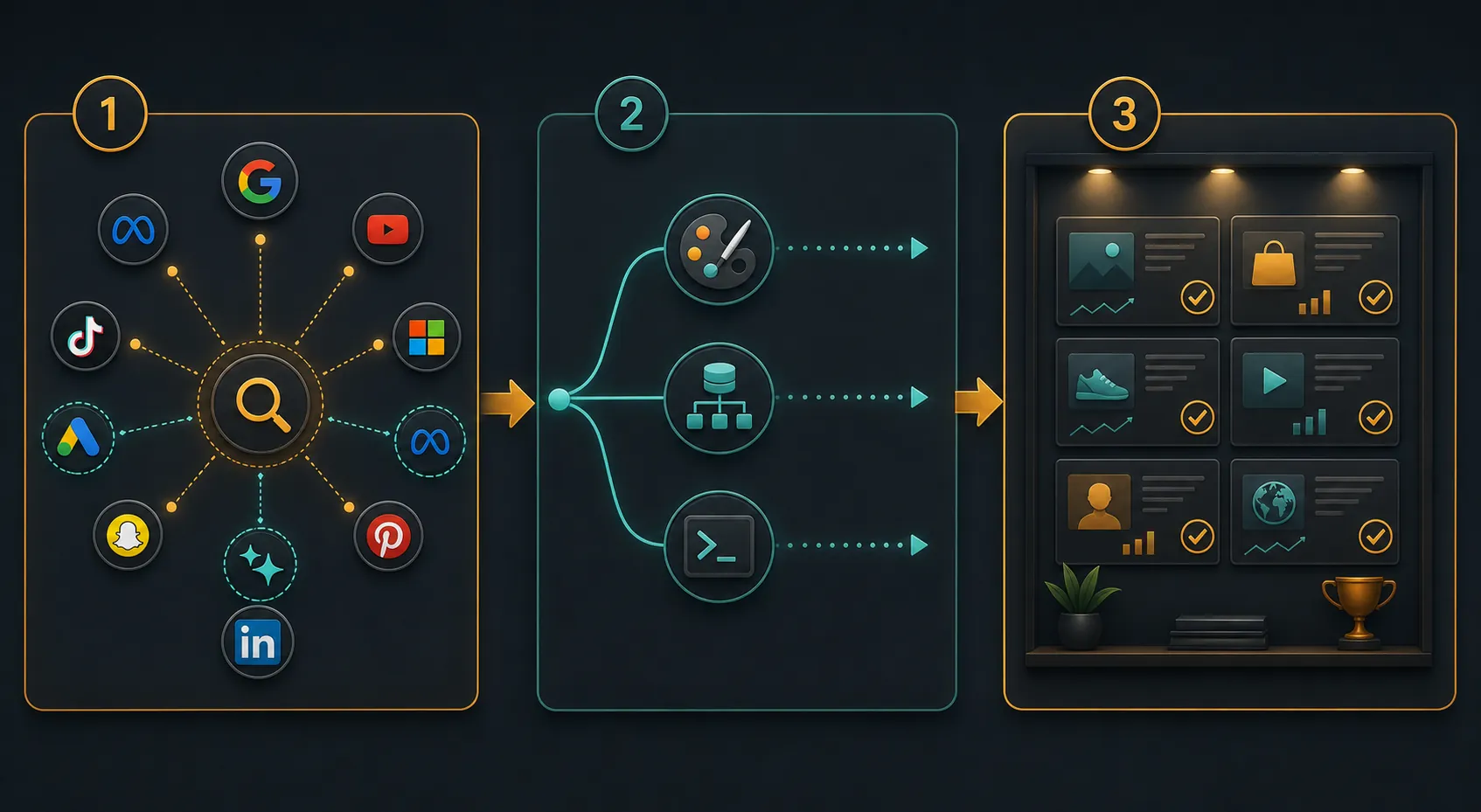
Build: turn campaign judgment into evidence
Mostafa’s third step, build, is the one media buyers should take most literally. In engineering, building often means shipping projects. In paid media, it means shipping tests that can survive review after the dashboard tab closes.
A real build record should have enough detail that another buyer could understand the decision without sitting next to you. Name the platform. Record the date range. Record the spend. Screenshot or export the relevant settings. State the hypothesis before the result. Note what changed: campaign type, creative volume, audience constraint, bidding setting, feed input, landing page, conversion event, or budget pacing. Then write the verdict in plain language.
This is not résumé decoration. It is how a buyer proves judgment. A private sense that “Advantage+ needs better creative” is not much of an asset. A dated test showing what creative inputs changed, how delivery shifted, where reported performance improved or failed, and what the next decision was is an asset. It can be used in an internal review, a client post-mortem, a promotion conversation, or a hiring process.
The build habit also protects you from platform theater. Automated systems generate confident claims: more conversions, better optimization, smarter allocation, less waste. Some of those claims may be true in a given account. Some may be true on-platform and less true at the business level. The buyer’s job is to verify the gap. That is the same verification-loop mindset behind Signal & Convert’s Tracker entry on how AI capex drives digital ad spend and what you can verify: do not accept a big AI narrative until you can identify the part that can be checked.
For a media buyer, the portfolio does not need to be public if the work is confidential. It does need to be structured. A sanitized internal library can still show the pattern: what you tested, why you tested it, what happened, what you ruled out, and what you would do differently. The career capital is not the spend number by itself. It is the visible chain of reasoning around the spend.
What to document after an AI-heavy campaign test
- The campaign objective and the business metric it was supposed to support.
- The automation layer used, such as Performance Max, Advantage+, Symphony-assisted creative, or another platform AI product.
- The controls left to the buyer and the controls delegated to the platform.
- The hypothesis, written before results were known.
- The date range, spend, major settings, creative inputs, audience constraints, and conversion signals.
- The platform-reported result and the off-platform or blended result, where available.
- The decision made afterward: scale, pause, narrow, rebuild, rerun, or reject the test.
That list is deliberately unromantic. It is also the difference between “I know AI tools” and “I can manage automated buying systems without surrendering accountability to them.”
The operating standard for the next version of the buyer
Mostafa’s framework should not be inflated into a universal law. It comes from one former OpenAI intern speaking about breaking into AI, not from a controlled study of paid-media careers.[1] The value is that it converts a vague threat into behaviors a buyer can control.
Go broad enough that platform automation no longer feels like weather. Specialize in an area where your judgment gets more valuable as the machines take over more execution. Build a dated body of campaign evidence that shows how you think when the default settings, the platform report, and the business result do not neatly agree.
If AI absorbs more daily execution, the defensible career move is not to become louder about strategy. It is to become the person who can verify, explain, and improve what the automation did.
References
- A former OpenAI intern shares 3 tips for breaking into AI — Business Insider, July 26, 2026
- How Hamza Mostafa Went from an Unpaid Internship to OpenAI's First Intern Cohort — IBTimes
- I Studied in Canada, Networked in Silicon Valley, Interned at OpenAI — Business Insider, July 18, 2026
- The Modern Media Buyer in 2026 — Darkroom Agency, 2026
- How media buyers can stay relevant as AI agents automate buying — AdAge
- Will AI Replace Media Buyers? — Nest Commerce, 2026
Built on this evidence
No Bidding tactic or Creative record currently cites this case file. Compare it against other results in Benchmarks.
Related benchmark reading
Report a corroborating or contradicting result
Seeing something different in your own account? Feed the data-integrity loop instead of leaving an open comment.