Does the Gemini 3.5 Pro Delay Affect Your Google Ads Campaigns?
The Gemini 3.5 Pro delay has raised concerns among PPC managers, but current Google Ads AI features run on other Gemini tiers. This article maps which tools depend on the delayed model and which don't, showing no immediate campaign impact.
- Platform
- Google Ads
- Change category
- policy
- Change type
- policy or regulatory shift
- Impact level
- Low
As of July 25, 2026, the account-management answer is straightforward: do not change any live Google Ads campaign setting because of the Gemini 3.5 Pro delay. The delay matters for Google’s model roadmap, and it may matter for ad formats that are still being tested, but it does not require a pause, budget shift, asset rebuild, or automation rollback in AI Max, Performance Max, Asset Studio, or Ads Advisor today. The tracker item is real; the campaign action is zero.
The reason is dependency, not optimism. Google’s currently used ad-AI tools are tied to Gemini integrations that were already available before this delay became a PPC concern. The tools most likely to need the delayed Pro tier are the next-generation ad experiences Google described as testing, limited beta, or later-year rollout items, not campaign controls already sitting in accounts.
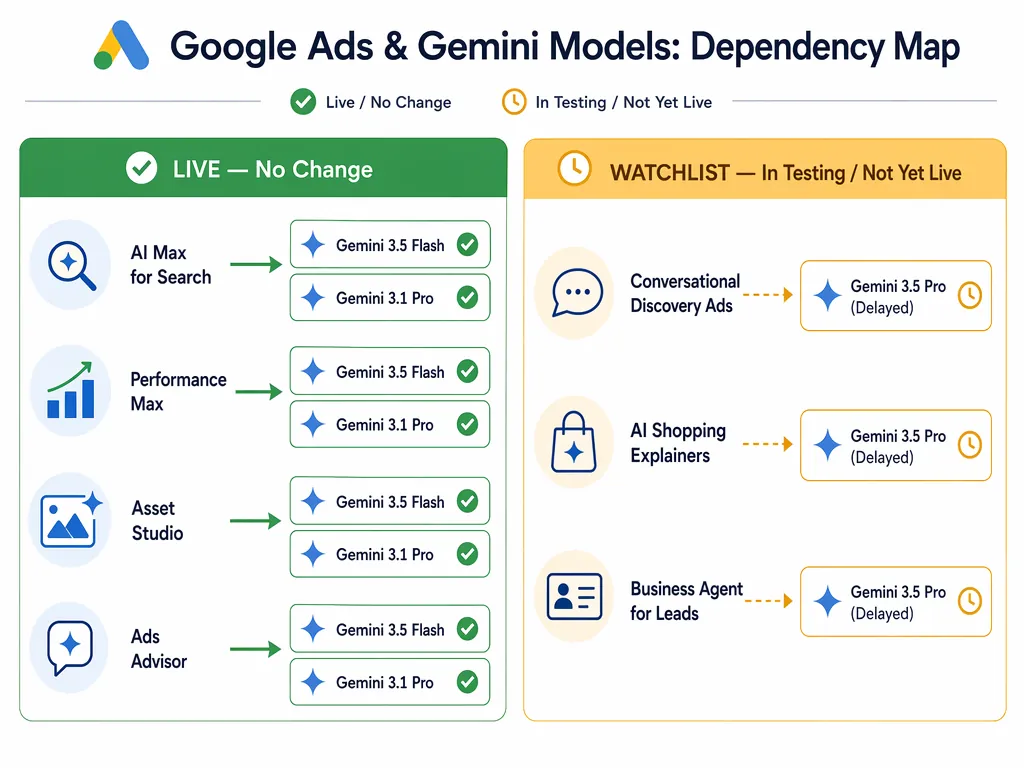
| Google Ads AI tool or format | Status on July 25, 2026 | Model basis or dependency read | Account action |
|---|---|---|---|
| AI Max for Search / Text Customization | Live campaign feature | Gemini models integrated into the ads quality stack; not identified as dependent on Gemini 3.5 Pro [1] | Keep using or testing under normal performance controls |
| Performance Max asset generation | Live campaign feature | Google announced Gemini models for Performance Max in February 2024, before the 3.5 Pro delay [2] | No model-delay adjustment |
| Asset Studio creative tools | Live creative workflow | Mapped to available Gemini ad-creative tooling, not to delayed Pro-only formats | No change |
| Ads Advisor campaign optimization | Live optimization assistant | Mapped to available Gemini assistant/optimization capability, not to delayed Pro-only formats | No change |
| Conversational Discovery ads | In testing | Google announced the format at Google Marketing Live on May 20, 2026; exact Gemini tier not publicly assigned [3] | Watchlist only |
| AI-powered Shopping product explainers | Rolling out later this year | Likely to need heavier reasoning/context if implemented as per-query explanation, but dependency is not publicly confirmed [3] | Watchlist only |
| Business Agent for Leads | Limited beta | Agentic lead-handling format; plausible Pro-tier fit, not confirmed by Google | Watchlist only |
What Is Actually Confirmed
For AI Max, the strongest public anchor is Ginny Marvin’s February 2026 explanation that AI Max Text Customization uses Gemini models integrated into the ads quality stack. That statement matters because it describes the production Search ads workflow PPC managers are already touching, not a speculative product demo. It does not say AI Max depends on Gemini 3.5 Pro, and nothing in the delay reporting changes the AI Max controls available in Search campaigns today [1].
Performance Max has an even older timestamp. Google said in February 2024 that Gemini models were coming to Performance Max asset generation, including image generation improvements and asset creation support. That puts the PMax Gemini integration well before the delayed Gemini 3.5 Pro release cycle. If a PMax account’s generated assets are underperforming, that is a normal creative-quality and campaign-structure problem, not evidence that the 3.5 Pro delay broke the feature [2].
The May 20, 2026 Google Marketing Live announcement is the line between “in the account” and “on the roadmap.” Google described Conversational Discovery ads as “in testing” and said AI-powered Shopping ads would roll out “later this year.” Those phrases are not interchangeable with general availability. They mean most PPC managers cannot inspect stable settings, compare before-and-after account data, or audit delivery at scale yet [3].
That distinction is the part worth protecting when headlines start moving faster than product notes. A delayed frontier model can be important without being operationally relevant to this morning’s budgets. If the feature is live and running on already available Gemini infrastructure, the delay is background. If the feature is a conversational, agentic, or per-query ad experience that Google has not rolled out broadly, the delay belongs on the watchlist.
Where The Mapping Is Inferred, Not Confirmed
There is no single public Google chart that says every ad product uses Gemini 3.5 Flash, Gemini 3.1 Pro, or Gemini 3.5 Pro by feature name. The safe reading is narrower: Google has confirmed Gemini involvement in AI Max and Performance Max, and Google has separately described the newer conversational and Shopping formats as not yet broadly live. The practical conclusion is not “we know Google’s whole internal model routing.” It is “nothing public ties today’s editable campaign tools to the delayed Pro model.”
That also means Asset Studio and Ads Advisor should be treated with the same practical caution. They sit in the current creative and optimization workflow, and there is no public signal that either one is waiting on Gemini 3.5 Pro before it can function. If Google later publishes a model assignment that changes this map, that would be a real account-log update. As of this date, it is not there.
For a broader tier explainer, the useful companion question is not whether a model is impressive in isolation, but which ad workflow can afford to use it repeatedly. That is where a tier map such as What Google Gemini Spark and Pro Tiers Deliver for Advertisers becomes more useful than a leaderboard headline. A model used for one deep reasoning interaction has different economics from a model called across millions of ad auctions, asset variants, or query interpretations.
Why Gemini 3.5 Pro Still Matters For The Watchlist
The delayed model is not irrelevant. It is just pointed at a different part of the ads stack. Gemini 3.5 Pro is the kind of tier that would make sense for heavier, less templated ad experiences: long-context product understanding, multi-step reasoning, on-page comparison, answer generation, and agent-style qualification. Third-party model trackers attribute a 2M context window and Deep Think reasoning to the Pro tier, with estimated pricing around $15 input and $60 output per 1M tokens, versus roughly $1.50 and $9 for Flash-tier usage. Those are third-party estimates, not an official Google price sheet, but they explain why every ad feature would not automatically run on the most expensive model [4].
Conversational Discovery ads are the cleanest example of why this matters. A standard search ad system can mix query understanding, assets, landing-page signals, and bidding logic without needing a frontier model on every step. A conversational ad experience, by contrast, may need to interpret a user’s question, pull product or service context, generate a response, and preserve enough prior interaction to avoid sounding disconnected. Google has said the format is in testing, but it has not published the exact model dependency [3]. The Pro connection is therefore a dependency hypothesis, not a confirmed internal architecture.
The same logic applies to AI-powered Shopping product explainers. If the format simply adds short generated product summaries, it may not need a Pro-class model. If it answers nuanced shopping questions across product attributes, reviews, merchant data, and user intent, the heavier context and reasoning tier becomes more plausible. Google’s public statement only supports the narrower conclusion: these Shopping experiences were announced for later rollout, not as a live feature that should change July campaign management [3].
Business Agent for Leads belongs in the same watchlist bucket. A lead agent that qualifies prospects, answers follow-up questions, and routes intent is closer to an agentic workflow than to a one-shot ad asset generator. That does not prove it uses Gemini 3.5 Pro. It does explain why a delayed Pro model would be more likely to affect that kind of feature than a Search campaign already using AI Max.
Do Not Confuse This With The DSA-To-AI-Max Delay
There is a second delay in the same neighborhood, and it is easy to mix up in client threads. Google delayed the Dynamic Search Ads migration to AI Max from September 2026 to February 2027. Search Engine Land reported that the timeline change was driven by advertiser feedback and avoidance of Q4 disruption, with Ginny Marvin confirming the reasoning. That is a product rollout decision, not a stated consequence of the Gemini 3.5 Pro delay [5].
For account notes, keep those lines separate. “DSA migration moved to February 2027” is an AI Max transition item. “Gemini 3.5 Pro delayed” is a model roadmap item. They may both affect how much attention you give Google’s automation calendar, but the public record does not support treating one as the cause of the other.
No Delay Impact Does Not Mean AI Max Is Automatically Good
The cleanest operational answer can still coexist with messy performance data. The same Smarter Ecommerce material cites independent testing of AI Max across more than 250 campaigns, with median revenue up 13% and CPA up 16%, while ROAS ranged from +42% to -35% [1]. That is not a reason to stop using AI Max because Gemini 3.5 Pro slipped. It is a reason to keep judging AI Max the way paid search should always judge automation: by account-level incrementality, query quality, CPA or ROAS tolerance, and what the setting changes in the actual auction.
A model-delay headline is a bad substitute for a test readout. If AI Max is working in one account, the Gemini 3.5 Pro delay does not invalidate that data. If AI Max is expanding into weak queries, lifting CPA beyond the target, or producing thin text variations, the fix is still the normal account work: exclusions, landing-page alignment, creative review, budget containment, and holdout discipline.
For readers keeping a wider evidence file, this is where Google AI Advertising: Real Results vs. the Marketing Claims is the more useful lane than model-release speculation. Campaign performance does not become safer or riskier just because a frontier model misses a date.
The Broader Google AI Noise Is Tracker Context
Google did ship lightweight Gemini updates while the flagship remained delayed. Reuters reported on July 21, 2026 that Google released Gemini 3.6 Flash, 3.5 Flash-Lite, and 3.5 Flash Cyber, describing them as lightweight offerings for use cases that do not require the most cutting-edge technology [6]. For ads operators, that supports the same dependency read: Flash-tier progress can continue while Pro-tier roadmap items remain unsettled.
The executive and competitive drama belongs below the fold. On Alphabet’s July 22 Q2 earnings call, Sundar Pichai responded to a direct Gemini 3.5 Pro question by talking about Gemini 4 pre-training and a planned monthly cadence; InfoWorld characterized that as a distraction from the 3.5 Pro delay [7]. Business Insider also reported rival mockery, including Meta’s Alexandr Wang posting “gemini who?” and OpenAI staff commenting publicly [8]. That pressure may matter for Google’s roadmap, but it still does not create a live campaign setting to change.
The one practical signal to monitor is not social-media ridicule or a vague promise of faster releases. It is whether Google pauses, renames, narrows, or materially revises the rollout of Conversational Discovery ads, AI-powered Shopping explainers, or Business Agent for Leads. Those are the places where a Pro-tier delay could become an ad-product delay.
Account Action For July 25, 2026
- Keep AI Max tests running or paused based on account performance, not the Gemini 3.5 Pro delay.
- Keep Performance Max asset generation and Asset Studio workflows on their normal creative-review cadence.
- Do not freeze spend, revert automation, or change bidding strategy solely because of the delayed Pro model.
- Track Conversational Discovery ads, AI-powered Shopping explainers, and Business Agent for Leads as future-format dependencies.
- Log the DSA-to-AI-Max migration delay separately from the Gemini 3.5 Pro delay.
That is the clean dated answer: no current Google Ads AI feature needs adjustment because Gemini 3.5 Pro is late. The next meaningful update is not another model rumor. It is a product-status change on the ad formats that were never live at scale in the first place.
References
- The End of Keywords? Ginny Marvin on the Shift to AI Max for Search, Smarter Ecommerce, February 2026
- Gemini models are coming to Performance Max, Google, February 2024
- Google Marketing Live: New AI-powered Search ads experiences, Google, May 20, 2026
- Gemini 3.5 Pro slips to July and four senior Google researchers just left for Anthropic, Bind AI
- Google delays Dynamic Search Ads migration to AI Max, Search Engine Land, June 11, 2026
- Google updates lightweight Gemini models; flagship still delayed, Reuters, July 21, 2026
- Google CEO distracts from Gemini 3.5 Pro delay with talk of Gemini 4 and monthly releases, InfoWorld
- Rivals mock Google Gemini 3.5 Pro delay, Business Insider, July 2026
Primary source: https://www.reuters.com/technology/google-updates-lightweight-gemini-models-flagship-still-delayed-2026-07-21/