
5 AI Mortgage Ad Targeting Compliance Deadlines for 2026
Five regulatory deadlines between June and August 2026 change how AI-targeted mortgage ads run on Google, Meta, and programmatic platforms. This article maps each deadline, which campaigns they expose, and what to check before the next date passes.
- Platform
- Google Ads
- Campaign type
- Performance Max
- Spend range
- Not specified
- Timeframe
- Q0 2026
- CPA
- 0
- Verdict
- mixed
- Industry vertical
- Mortgage
- Last reviewed
- 0-07-30
By late July 2026, the useful question for mortgage ad teams is no longer whether AI is part of paid media. It is which AI-controlled surface changed, when it changed, and whether the campaign file can prove the lender stayed in control. That is the gap behind a lot of searches for mortgage ad trends 2025 ai targeting: last year’s targeting and creative automation story has turned into this year’s dated compliance map.
Five dates now sit on top of the same live accounts: New York’s synthetic actor disclosure on June 9, the CFPB Regulation B change on July 21, California’s AI-content tagging rule on August 2, Fannie Mae’s AI/ML governance expectations on August 6, and Google’s AI Max migration beginning in September 2026. They do not all do the same thing. Some change what appears in the ad. Some change the records a lender needs even if no toggle moves. One of them changes a federal enforcement theory without removing the fair-lending problem that still matters for AI targeting.
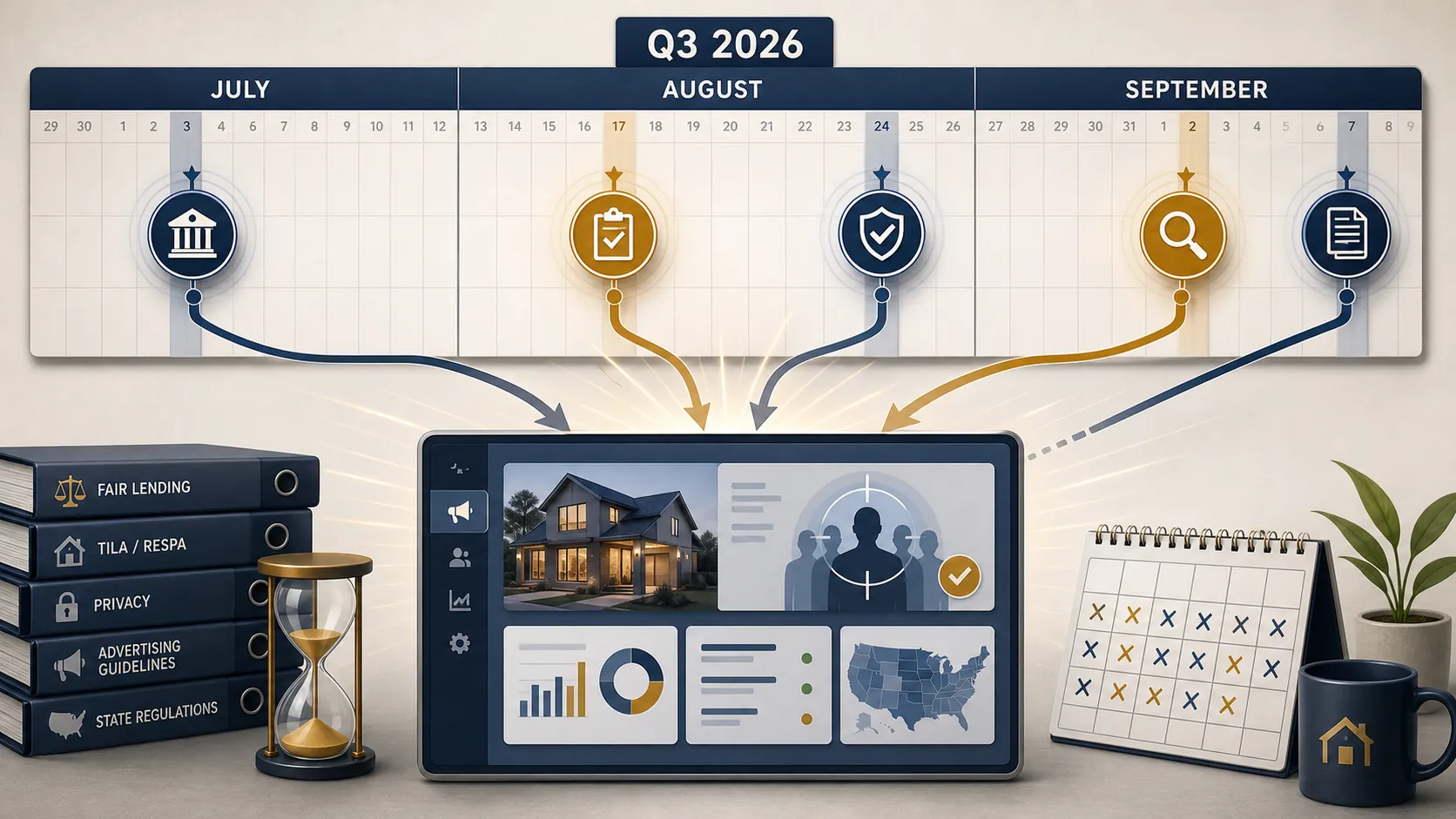
The compressed Q3 2026 map
| Date | Change | Campaign surface most exposed | What to check before relying on automation |
|---|---|---|---|
| June 9, 2026 | New York AI-generated actor disclosure takes effect | Synthetic spokespeople, generated performers, AI video and voice in mortgage ads | Whether every covered ad shown in New York clearly discloses the AI-generated performer |
| July 21, 2026 | CFPB Regulation B final rule takes effect | Fair-lending review of AI targeting, audience delivery, exclusions, and outreach | Whether ECOA changes are being mistaken for permission to stop FHA disparate-impact testing |
| August 2, 2026 | California AI-content tagging rule takes effect | Generated ad copy, images, video, creative variants, and metadata workflows | Whether visible labels and invisible electronic metadata survive export, upload, resizing, and platform processing |
| August 6, 2026 | Fannie Mae AI/ML governance expectations take effect | AI/ML systems in origination or servicing; conservatively, systems influencing borrower outreach | Whether ad-tech vendors, model use, reviews, and accountability are documented in governance records |
| September 2026 | Google begins AI Max-related upgrades for DSA, ACA, and campaign-level broad match users | Search term matching, text customization, and final URL expansion | Whether defaults are reviewed before copy, query coverage, or landing pages expand into unsupported mortgage claims |
The order looks tidy on a calendar. It is less tidy in an account. A national search campaign can carry AI-generated copy into California, use a synthetic borrower or spokesperson that triggers New York disclosure questions, feed automated landing-page expansion through Google, and still need fair-lending evidence after the CFPB headline. The dates are sequential; the exposure is not.
June 9: New York makes synthetic mortgage performers a disclosure problem
New York General Business Law § 394-C took effect on June 9, 2026, and requires disclosure when an AI-generated actor is used in covered mortgage advertising. HousingWire’s coverage of the rule flags the practical risk for mortgage marketers using synthetic performers, AI spokespeople, or generated testimonial-style creative in borrower-facing campaigns.[1]
The exposed surface is not only the finished video file. It includes the production decision behind it: whether the friendly “loan guide” in a pre-roll ad is a real person, a licensed performer altered with AI, or a fully synthetic character. If that asset is running in New York, the media buyer needs a visible disclosure plan before trafficking, not after a compliance inbox forwards the statute.
For Google, Meta, YouTube, connected TV, and programmatic video, the immediate account check is simple: inventory every mortgage creative asset that includes a human likeness, voice, borrower story, agent role, or spokesperson role. Then mark which are real, AI-altered, synthetic, or unknown. “Unknown” is the dangerous bucket because it usually means the vendor, creative team, or agency can answer eventually, while the ad is already live.
State-specific handling is possible only if the campaign structure can actually support it. A New York exclusion in one platform does not solve distribution through retargeting pools, publisher extensions, shared video assets, or manually uploaded variants in another account. Some lenders will decide to label synthetic creative nationally because the operational cost of proving New York isolation is higher than the cost of disclosure. That is not a universal legal requirement; it is a control decision.
July 21: the CFPB change does not retire fair-lending testing
The CFPB’s Regulation B final rule, effective July 21, 2026, removes disparate-impact theory from ECOA enforcement, but the source material warns that Fair Housing Act disparate-impact liability remains active. Forbes’ analysis by Dara Abasiita frames the problem directly: AI mortgage lenders may still face exposure under the FHA even after the ECOA change.[2]

This is the deadline most likely to be misread inside a growth meeting. The operationally bad version sounds efficient: if the CFPB removed disparate impact from ECOA, maybe the lender can pause ad-delivery audits, stop testing AI audience expansion, and reduce documentation around targeting effects. That reading goes further than the cited materials support. The narrower, safer reading is that one ECOA enforcement path changed while FHA disparate-impact risk still requires attention.
For media buying, that distinction matters because the risk usually does not arrive as an explicit discriminatory setting. It arrives through delivery. Lookalike logic, broad matching, automated placements, value optimization, lead-quality feedback loops, and creative engagement signals can all change who actually receives mortgage offers. A campaign can be facially neutral in setup and still deserve testing if the delivered audience or borrower outreach pattern skews in a way that creates fair-housing concern.
The July 21 account response should not be “turn everything off.” It should be “do not let the ECOA headline delete the fair-lending evidence.” Keep pre/post delivery checks, audience-composition reviews where available, exclusion reviews, geography reviews, and lead-routing records in the file. If an AI targeting model expands reach into some communities and not others, the lender needs a way to show what happened and how it monitored the outcome.
There is also a platform-responsibility overlay. HUD’s May 2024 guidance warned against discriminatory use of AI-powered housing advertising and stated that both advertisers and platforms can be responsible for compliance. ABA Banking Journal’s coverage emphasized the same warning for AI-driven housing ads.[3][4] That does not mean a lender controls every ranking signal inside an ad platform. It does mean “the platform did it” is a weak operating record if the lender never reviewed targeting, exclusions, delivery, or outreach patterns.
August 2: California adds both visible tagging and hidden metadata work
California AB 2602 takes effect on August 2, 2026, and the research materials describe a dual requirement for AI-generated ad copy, images, and video: visible AI-content tagging and invisible electronic metadata.[5]
The visible part is the easier one to discuss and the harder one to preserve elegantly. Generated rate-shopping explainer copy, AI-produced lifestyle images, synthetic spokesperson videos, and generated borrower-scenario ads may need labels if they fall within the rule. The label has to survive the actual creative path: export from the generation tool, resizing, platform cropping, feed placement, story placement, YouTube bumper edits, publisher rendering, and landing-page reuse.
The invisible metadata requirement is where ad operations can lose control without anyone making a bad judgment call. Metadata can be stripped by image compressors, creative management platforms, social uploads, video transcoders, landing-page builders, and DAM workflows. Before August 2, the useful test is not whether the creative team added metadata in the source file. It is whether the file that actually reaches the platform, page, or publisher still carries what the rule expects.
National campaign operations face the same choice as New York, but with more asset types. A lender can attempt California-specific geofencing and asset separation. That may work for tightly controlled campaigns with clean state segmentation. It becomes fragile when the same generated image feeds national paid social, display retargeting, branch pages, CRM nurture, and loan officer co-marketing. Applying California-style tagging more broadly may create cleaner control, but it can also change creative presentation outside California. That is a business and legal decision, not a platform checkbox.
August 6: Fannie Mae turns AI governance into a vendor and records question
Fannie Mae Lender Letter LL-2026-04 is effective August 6, 2026, and the research brief identifies written AI/ML governance policies, annual reviews, and vendor accountability for AI/ML in origination or servicing as core expectations. It also flags AI ad-targeting systems that influence borrower outreach as a conservative area to include in the governance file.[6]
That last phrase needs care. The brief does not support pretending every ad-platform optimization model is automatically and expressly covered in the same way as an underwriting model. The direct source boundary is origination or servicing AI/ML. The conservative operating interpretation is that borrower-outreach systems belong in the review when they influence who is contacted, who is encouraged to apply, or which prospective borrower receives a mortgage message.
For paid media, the practical file is not a glossy AI policy. It is a map of systems and vendors: ad platforms using automated targeting, lead-scoring tools, call-routing systems, CRM prioritization, creative-generation vendors, landing-page personalization, and any model that changes borrower outreach. The lender should be able to identify the owner, purpose, vendor, review cadence, available controls, and escalation path for each system.
This is where platform defaults become a governance problem. If the account owner cannot say whether final URL expansion is on, whether text customization is active, whether Meta creative enhancements are modifying visuals or text, or whether a lead-quality model is feeding back into delivery, the governance record is incomplete in the place where the campaign actually changes.
September: Google AI Max makes expansion a default, not a side project
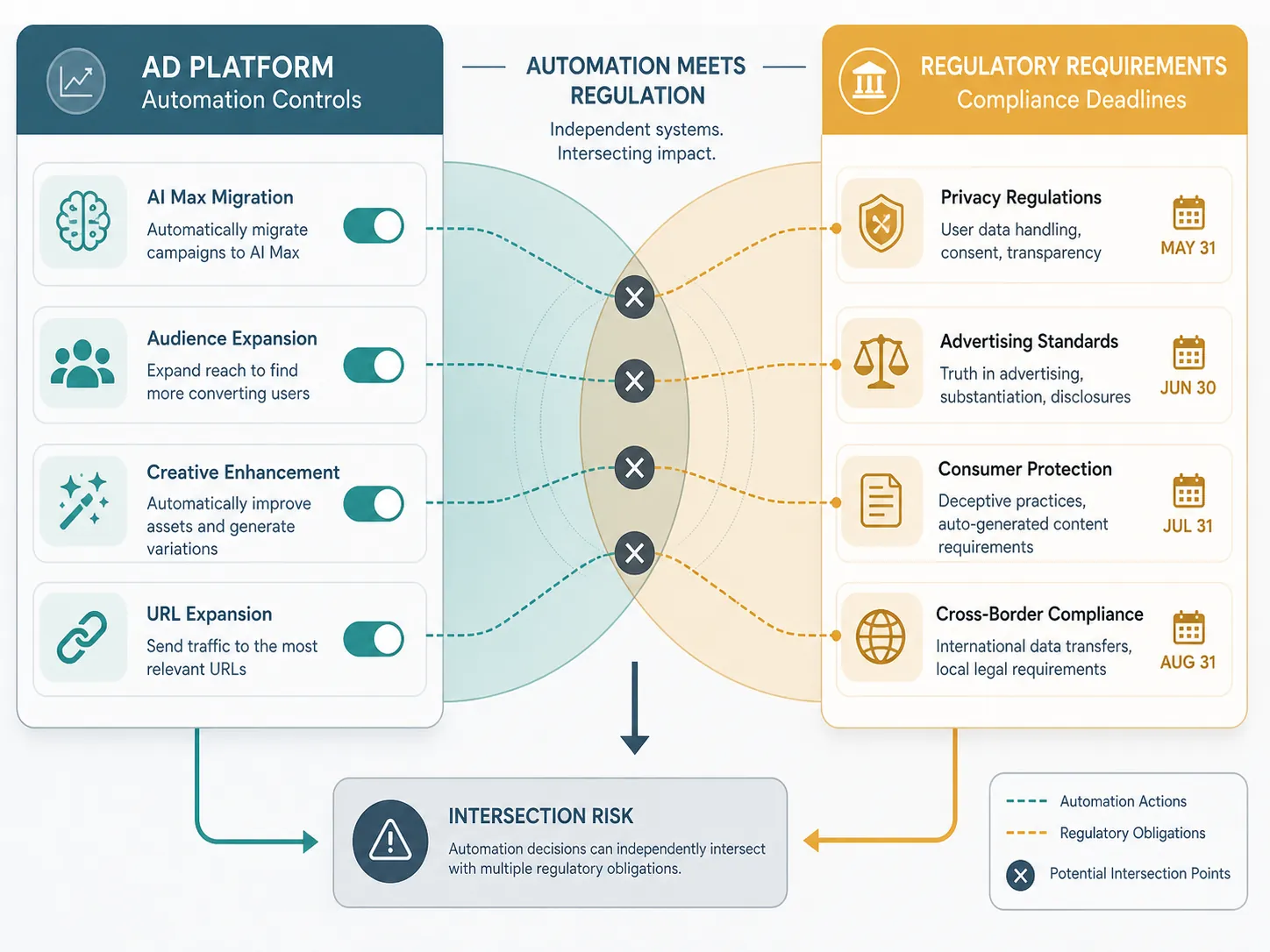
Google says DSA users will be upgraded starting in September 2026, after an original June 2026 timeline was extended, and Search Engine Land reported that ACA and campaign-level broad match upgrades are also starting in September 2026. The research brief identifies three AI Max features as enabled by default: search term matching, text customization, and final URL expansion.[7][8]
Those defaults touch mortgage compliance in three different ways. Search term matching can move the campaign into demand the buyer did not explicitly choose. Text customization can alter borrower-facing language. Final URL expansion can send traffic to pages the buyer did not select as the destination for that query. None of those are inherently bad for performance. All of them make the audit trail more important.
The pre-migration review should start with campaign types, not opinions about AI Max. Identify DSA campaigns, campaigns using automatically created assets, campaigns with broad match expansion at the campaign level, and any mortgage campaign where the final URL is not tightly controlled. Then document current settings, exclusions, page feeds, approved landing pages, restricted claims, and copy guardrails before September changes the baseline.
The collision with the earlier dates is direct. If AI Max text customization generates or recombines copy that should be tagged under California’s rule, the lender needs a labeling and review process. If final URL expansion routes a New York user to a page with synthetic spokesperson content, the disclosure question follows the page. If search term matching expands delivery patterns, the July 21 fair-lending interpretation does not make FHA monitoring disappear. If the lender treats Google’s migration as a platform maintenance event, the campaign file will not explain why the account changed.
Testimonials and endorsements sit across the same creative file
The FTC’s final rule on fake reviews and testimonials, issued in 2024, adds another overlay for mortgage ads that use AI-generated testimonials, synthetic endorsements, or review-style creative. The research brief notes a “should have known” standard and a civil penalty amount of $51,744 per violation.[9]
This is not a sixth Q3 2026 deadline, but it belongs in the same review because the same assets are involved. A synthetic borrower story can raise a New York actor-disclosure issue, a California AI-tagging issue, and an FTC endorsement issue at the same time. A generated five-star-style testimonial in a Meta ad is not made safer because it came from a model instead of a freelancer. The file still needs to show whether the endorsement is real, authorized, accurately represented, and properly disclosed.
What changes in-platform, and what changes liability without a setting change
The cleanest way to manage the five dates is to separate account actions from liability records. New York and California are more likely to force visible creative and asset-workflow changes. Google’s September migration forces settings review because expansion features can change query coverage, ad text, and landing pages. The CFPB and Fannie Mae dates can change the evidence a lender needs even if the campaigns keep running exactly as they did the day before.
| Deadline | May require in-platform changes | May change liability or records even without account changes |
|---|---|---|
| New York synthetic actor disclosure | Yes: creative labels, state segmentation, synthetic video or spokesperson controls | Yes: proof of asset origin and disclosure handling |
| CFPB Regulation B change | Not necessarily | Yes: ECOA change should not erase FHA disparate-impact monitoring |
| California AI-content tagging | Yes: visible labels, asset versions, metadata-preserving workflow | Yes: proof that tagging and metadata remained intact |
| Fannie Mae AI/ML governance | Possibly: vendor controls, AI feature permissions, outreach-system restrictions | Yes: governance policy, annual review, vendor accountability records |
| Google AI Max migration | Yes: search term matching, text customization, final URL expansion, exclusions | Yes: baseline documentation before automated expansion changes the account |
That separation prevents the common false comfort of a quiet account. A campaign can show no new edits in the change history and still be missing fair-lending monitoring after July 21. A creative library can have no new uploads and still contain synthetic assets that need state-specific handling. A Google campaign can inherit new automation defaults in September and make yesterday’s approved copy-and-URL review incomplete.
The account-review posture for late July
Start with the dates, but do not review them one at a time as if each can be closed before the next opens. The useful sequence is to layer the account file.
- Preserve fair-lending testing after July 21. Treat the CFPB Regulation B change as an ECOA enforcement change, not as permission to stop FHA disparate-impact monitoring for AI targeting, audience delivery, exclusions, geography, and borrower outreach.
- Inventory synthetic and AI-generated creative before August 2. Tag human likenesses, voices, spokespersons, borrower stories, generated images, generated copy, and testimonial-style assets by source, state exposure, disclosure status, and metadata status.
- Decide whether state isolation is real. If New York or California obligations are being handled by geofencing, document the campaign structures, exclusions, shared assets, retargeting pools, and publisher paths that make that isolation credible.
- Add borrower-outreach ad tech to AI governance where the conservative interpretation fits. List vendors and platform AI features that influence who receives mortgage messages, who is prioritized, or where leads route after conversion.
- Freeze a pre-September Google baseline. Record DSA exposure, AI Max eligibility, automatically created assets, broad match settings, final URL expansion, approved landing pages, negative controls, and copy restrictions before the migration changes the account.
Sequential management feels tidy because the deadlines have dates. Platform automation does not respect that tidiness. Targeting, copy, landing-page expansion, creative labeling, vendor governance, and borrower-outreach records can collide independently with any one of these rules or platform changes. The safer operating posture is to treat the five dates as overlapping exposure layers and make the account prove what changed, when it changed, and who kept control.
References
- AI mortgage marketing compliance risk, HousingWire
- New Fair Lending Rule Leaves AI Mortgage Lenders Exposed In July, Forbes, June 14, 2026
- HUD Announces New Guidance on Application of the Fair Housing Act to the Advertising of Housing, Credit, and Other Real Estate-Related Transactions through Digital Platforms, U.S. Department of Housing and Urban Development, May 2024
- HUD warns against discrimination in AI-powered housing advertisements, ABA Banking Journal, May 2024
- AB 2602, California Legislative Information
- Lender Letter LL-2026-04, Fannie Mae
- DSA upgrade to AI Max 2026, Google
- Google Ads AI Max for Search spotted, Search Engine Land
- Trade Regulation Rule on the Use of Consumer Reviews and Testimonials, Federal Trade Commission, 2024
Built on this evidence
No Bidding tactic or Creative record currently cites this case file. Compare it against other results in Benchmarks.
Related benchmark reading
Report a corroborating or contradicting result
Seeing something different in your own account? Feed the data-integrity loop instead of leaving an open comment.