
2026 Sports Betting Ad Targeting for the NFL Season
With Google's July 1 certification overhaul, Meta's tightened authorization, and the NFL's 6-ad cap, sportsbook advertisers must abandon old targeting playbooks. This article breaks down which tactics are restricted and documents compliant workarounds tested by winning accounts.
- Platform
- Google Ads
- Campaign type
- Performance Max
- Spend range
- Varies
- Timeframe
- 0 Q3
- CPA
- N/A
- Verdict
- Mixed
- Industry vertical
- Sports Betting
- Last reviewed
- 0-07-30
For sports betting ad targeting in the 2026 NFL season, the planning problem is no longer just budget timing around Week 1. By Q3, three constraints are landing in the same account review: Google’s July 1 U.S. gambling certification overhaul, a tighter Meta authorization environment, and the NFL’s move to cap Super Bowl LX sports betting commercials at six while banning prediction-market ads from that inventory.[1][2] The practical result is that the old acquisition stack — broad brand spend, easy retargeting, and loose audience logic — is no longer a safe default.
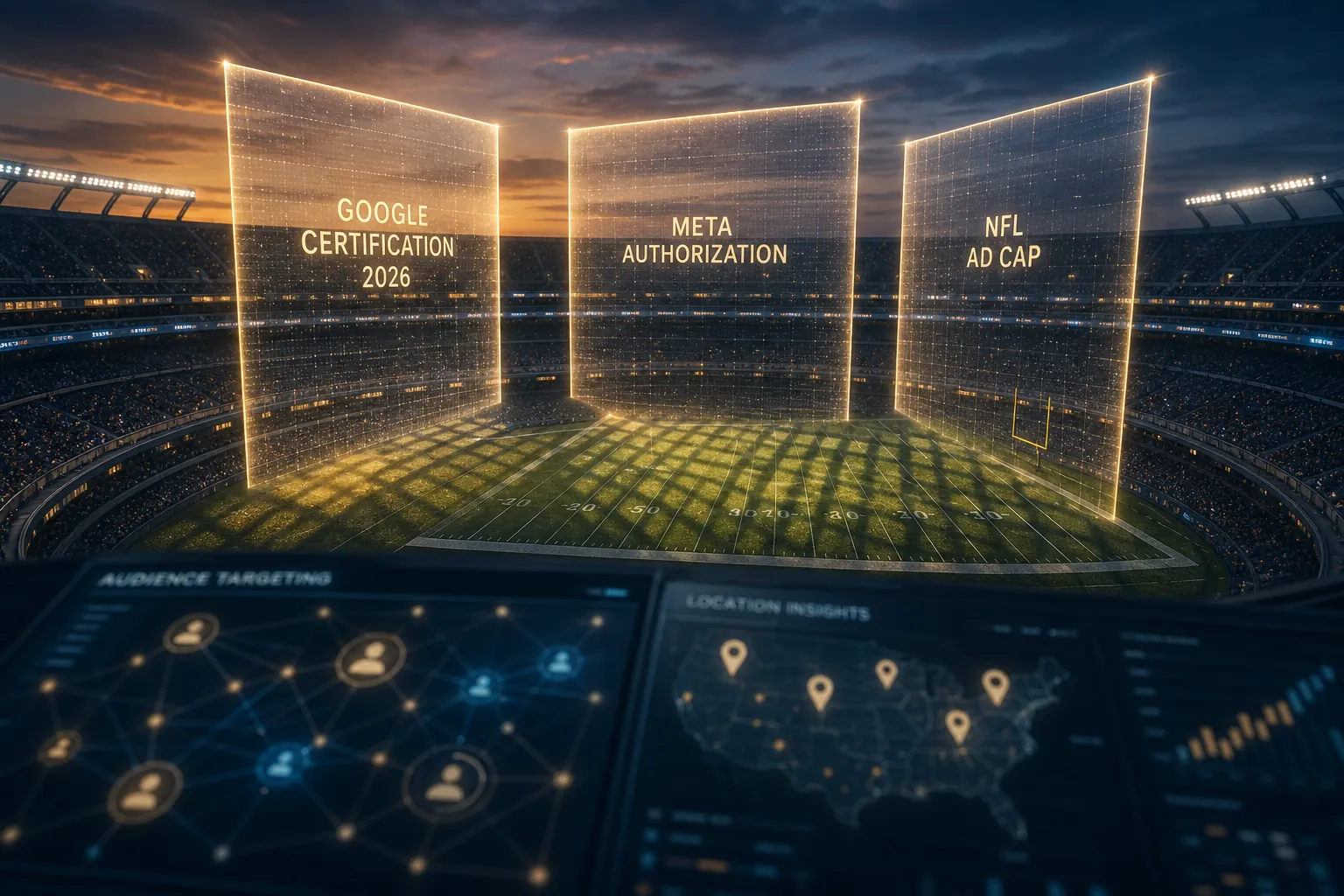
That does not mean sportsbook advertisers have run out of media levers. It means the useful levers now sit behind certification, geography, exclusions, and cleaner first-party data handling. The accounts with an edge before kickoff will not be the ones with the loudest national flight. They will be the ones that can prove where they are licensed, separate prospects from existing customers, suppress waste in automation, and document why a targeting choice does not cross into prohibited behavioral use.
The Q3 2026 Policy Snapshot
Google is the load-bearing change because its U.S. Gambling and Games policy now ties sports betting ad eligibility to certification and state-by-state licensing. From July 1, 2026, advertisers seeking to promote online sports betting in the United States must apply for certification under the updated structure, and the policy specifically addresses national YouTube targeting for sports betting when the advertiser holds the required state licenses.[1]
That last clause is where a lot of account structures become fragile. “National YouTube” does not mean “ignore state eligibility.” It means Google is giving a way to run broader YouTube buys for certified advertisers, while the underlying licensing and targeting controls still have to prevent ads from serving where the operator cannot legally promote the product. The buying surface looks national; the compliance obligation remains state-specific.
The NFL change is different but relevant. A six-ad cap for Super Bowl LX sports betting commercials does not tell a paid search manager how to build an audience list, but it does signal that league-controlled inventory will not absorb every sportsbook’s brand pressure.[2] When premium broadcast and cross-promotion space is constrained, sloppy digital targeting gets more expensive because more teams try to push demand through the same lower-funnel channels.
Meta sits in the middle as an authorization gate. The useful reading is not “make a separate Meta playbook from scratch.” It is that sportsbook teams should treat Meta approval as another dependency in the launch calendar, not as a creative upload task that can be fixed after campaigns are built. If the authorization layer blocks or delays delivery, the spillover often lands on Google, affiliates, and programmatic budgets that were not planned to carry the whole acquisition target.
What Google’s Policy Changes Inside the Account
The most important Google detail is not the existence of a gambling policy. Every serious sportsbook account already knows gambling is regulated. The important detail is the targeting language: the policy prohibits using online gambling behavioral signals for inclusion or exclusion targeting in ways that would identify people based on gambling-related behavior.[1] That changes both the audience you try to reach and the audience you try to avoid.
A sportsbook cannot safely treat “people who recently visited betting content,” “users inferred to be interested in gambling,” or similar behavioral groupings as a simple prospecting shortcut if the platform policy puts those signals out of bounds. The same issue applies in reverse. Excluding people because they appear to have gambling-related behavior can be just as problematic as including them for that reason. Many old retargeting and suppression habits were built before this distinction mattered operationally.
This is where compliance stops being a legal appendix. A media buyer may still need to answer normal performance questions — why CPA moved, why match rates fell, why a high-volume audience disappeared — but the answer may be that a previously convenient behavioral segment is no longer usable. If that decision is not documented before launch, it turns into a postgame argument between legal, brand, and acquisition teams.
| Old tactic | 2026 problem | Safer direction |
|---|---|---|
| Broad national sportsbook campaigns | Licensing and certification do not automatically match national reach | Build around eligible states and certified placements |
| Behavioral gambling-interest prospecting | Google policy restricts gambling-related behavioral inclusion targeting | Use geo, context, creative, and permitted first-party structures |
| Behavioral gambling-interest suppression | Exclusions can also become prohibited when based on gambling behavior | Suppress known customers through compliant first-party data handling |
| One blended prospecting and customer campaign | Existing customers can consume acquisition budget and distort CPA | Separate acquisition from customer-defense and lifecycle logic |
The national YouTube opening is still useful. It can give certified sportsbook advertisers a cleaner way to reach NFL-season demand at scale across video inventory. But it only works if the account architecture respects licensing reality: state eligibility, certification status, creative claims, landing pages, and exclusion logic have to line up before spend scales. Otherwise, a “national” campaign becomes a fast way to distribute a state-level problem.
Why Broad Brand Plus Retargeting Breaks Down
Broad brand spend used to hide a lot of sins in sportsbook accounts. During NFL peaks, branded demand rises, app installs look healthy, and retargeting pools fill quickly. The account can appear to be learning when it is actually mixing three very different groups: legal prospects in eligible states, existing customers looking for the app or promo page, and users the brand cannot or should not target under the current rules.
The TrafficGuard case study is useful here, with the usual vendor-case caveat. In a European sportsbook example, TrafficGuard reported that 43% of PPC funnel traffic was invalid because existing customers were clicking brand keywords; after shadow campaigns and click-frequency controls, the reported CPC moved from €246 to €141.[3] Those numbers should be treated as directional, not an independent benchmark for U.S. NFL campaigns. The underlying operational lesson is still familiar: if existing customers keep re-entering acquisition auctions, the paid media team pays twice and then gets judged on a blended CPA.
Click-frequency controls and shadow campaigns are not glamorous, but they solve a real accounting problem. A shadow campaign can isolate traffic patterns that look like customer self-navigation, promo checking, or repeated brand clicks. Frequency controls can reduce the number of times the same user or device cluster drains budget through paid clicks. Neither tactic excuses a policy violation; both are ways to stop acquisition media from becoming an expensive customer-service entrance.
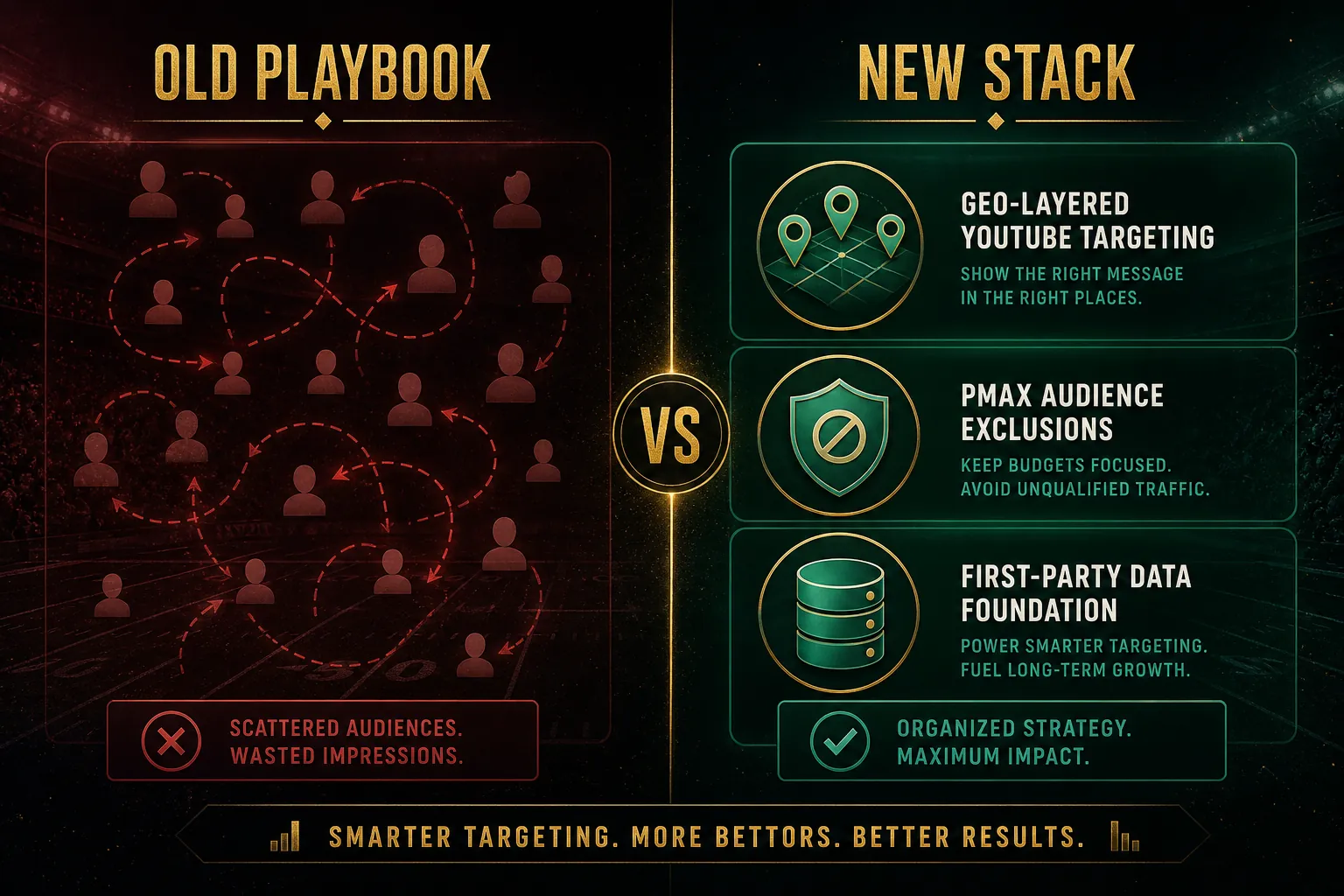
This is also why simple retargeting becomes weaker. If the pool is built from gambling behavior that policy does not allow, the list is not a growth asset. If the pool is full of current customers, it is not acquisition. If the pool crosses state eligibility lines, it creates a licensing problem. The paid media fix starts by admitting that one big “NFL interested users” audience is no longer a serious operating unit.
The Replacement Stack That Actually Has Levers
The usable 2026 stack has three parts: certified geo-layered YouTube, Performance Max audience exclusions, and first-party data structures that suppress or segment users without relying on prohibited gambling-behavior targeting. None of these is a magic workaround. They are controls that let a sportsbook spend with fewer surprises.
Geo-layered YouTube starts with licensing, not media reach
For YouTube, the first question is not audience size. It is whether the advertiser’s certification, state licenses, campaign location settings, landing page routing, and creative claims all point to the same eligible footprint. Google’s 2026 policy creates a path for national YouTube targeting for certified sports betting advertisers with appropriate state licensing, but the policy does not turn ineligible states into eligible ones.[1]
A cleaner structure is usually less elegant in the UI: campaigns or asset groups organized around eligible geography, exclusions for non-eligible areas where available, and creative that does not imply availability beyond the licensed footprint. That may reduce apparent scale compared with a broad national push. It also reduces the chance that the account discovers a policy mismatch after creative has already cleared internally and media has started spending.
PMax exclusions are now a real control
The April 2026 Performance Max update matters because audience exclusions finally give advertisers a more usable way to keep certain users out of PMax delivery. DataSlayer’s coverage of the update highlights audience exclusions, budget reporting, and demographic breakdowns as part of the April 2026 release.[4] For regulated acquisition, the exclusion control is the one that changes the Monday morning conversation.
Before that kind of control, sportsbook teams often had to accept a frustrating level of automation leakage. PMax could find conversions, but it could also chase people the acquisition team did not want to pay for: current customers, recent depositors, or users who belonged in lifecycle channels. With audience exclusions, the account can more deliberately separate prospecting from customer management, as long as the exclusion source itself is compliant.
The distinction matters. Excluding a hashed customer file of known existing customers is a different act from excluding a platform-built gambling-interest segment. The former can be a first-party customer-management control. The latter may run into the same behavioral targeting restriction that weakened old retargeting logic. The media plan should name the source of each exclusion, who approved it, and whether it is based on customer status, geography, age eligibility, or prohibited behavior.
First-party data works when it is boring
The safest first-party use cases are rarely the most exciting ones. Known customers can be suppressed from acquisition. Ineligible or unverified users can be handled according to the operator’s compliance rules. High-value customers can be kept out of new-user CPA reporting. None of that requires pretending a behavioral gambling-interest list is a consented customer file.
A useful first-party workflow answers four questions before upload: what made the person enter the file, what permission and platform terms govern the upload, what campaign action the file controls, and when the file expires or refreshes. If the answer is “they behaved like someone interested in betting somewhere on the web,” that is not the same as a known customer suppression list.
Context and creative can carry more of the load
The Moloco DraftKings case study is worth using carefully. Moloco reported that machine-learning-powered dynamic ad creative placement drove 13% higher IPM and 9% lower cost per first-time deposit by using contextual signals rather than behavioral ones.[5] Because this is vendor-produced, it should not be treated as proof that every sportsbook can buy the same improvement. It does support a narrower and more useful point: creative and context can be optimized without leaning on prohibited behavioral gambling audiences.
For NFL-season campaigns, that pushes more work into matchup relevance, offer eligibility, state-specific availability, dayparting, device behavior inside permitted platform controls, and creative sequencing that does not depend on stalking a user around the web. The creative team may feel that as a constraint. The media buyer should see it as a way to keep optimization inside the lines while still giving the model something useful to learn.
The Cleanup Before Kickoff
The accounts that need the most work are usually not the ones with no policy process. They are the accounts with a policy process that happens after the media structure is already built. Before kickoff, sportsbook teams should review the account in the order the platform will punish them: eligibility first, targeting second, measurement third, scale last.
- Map every active and planned campaign to certified status, licensed states, excluded states, landing page availability, and creative claims.
- Remove or quarantine behavioral gambling-interest inclusion and exclusion logic that cannot be defended under the platform policy.
- Separate known existing customers from acquisition using compliant first-party suppression, especially in PMax and brand-heavy search structures.
- Use shadow campaigns and click-frequency controls to identify repeated customer or low-value click patterns before they inflate CPA.
- Document the source, purpose, approval owner, and refresh cadence for every uploaded audience and exclusion list.
ClickGUARD’s 2026 sports betting PPC guidance points in the same operational direction, including shadow campaigns and frequency capping within platform constraints.[6] The point is not that a third-party tool makes the account compliant. The point is that waste controls and policy controls now need to be designed together. A list that reduces CPC but cannot survive a policy review is not a workaround; it is a delayed escalation.
There is also a measurement consequence. If existing customers are not excluded from acquisition campaigns, first-time depositor cost can look better or worse for reasons that have nothing to do with new-user demand. If ineligible states are not cleanly excluded, impressions and clicks can make upper-funnel delivery look efficient while creating compliance risk. If PMax is allowed to blend lifecycle and acquisition traffic, the operator may not know which budget actually acquired a new bettor.
This is why the 2026 NFL season favors unglamorous accounts. A sportsbook that rebuilds around certified geo-layered YouTube, PMax exclusions, and careful first-party data use has a temporary edge because many competitors will still be patching broad-brand and retargeting structures built for a looser environment. Signal & Convert does not yet have internal sportsbook Benchmarks records to validate account-level performance in this vertical, so this should be treated as a dated Tracker analysis. If operators publish tested results later, those records should sit next to this policy read rather than replace it.
References
- U.S. Gambling and Games policy, Google Ads Help
- NFL Caps Super Bowl LX Sports Betting Commercials at 6, SuperBowl-Ads.com
- Overcoming Digital Advertising Challenges in Sports Betting, TrafficGuard
- Performance Max April 2026: Audience Exclusions, Budget Reporting, Demographic Breakdowns, DataSlayer
- DraftKings' creative success with ML-powered dynamic ad creative placement, Moloco
- PPC Strategies for Sports Betting in 2026, ClickGUARD
Built on this evidence
No Bidding tactic or Creative record currently cites this case file. Compare it against other results in Benchmarks.
Related benchmark reading
Report a corroborating or contradicting result
Seeing something different in your own account? Feed the data-integrity loop instead of leaving an open comment.